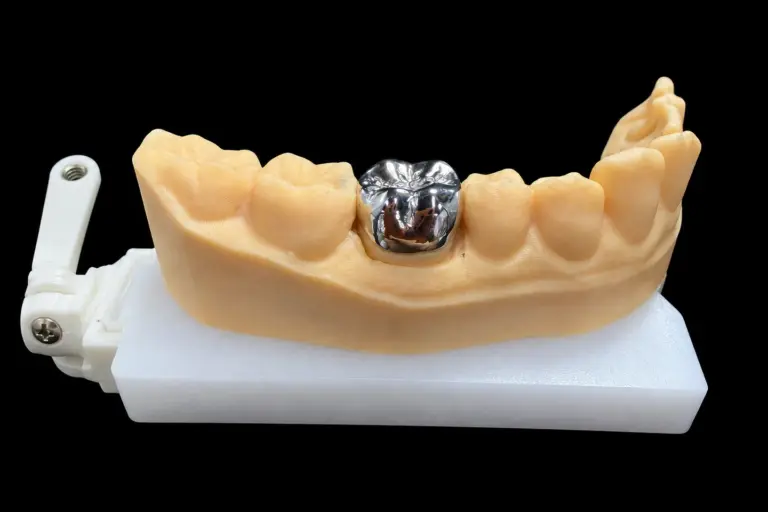
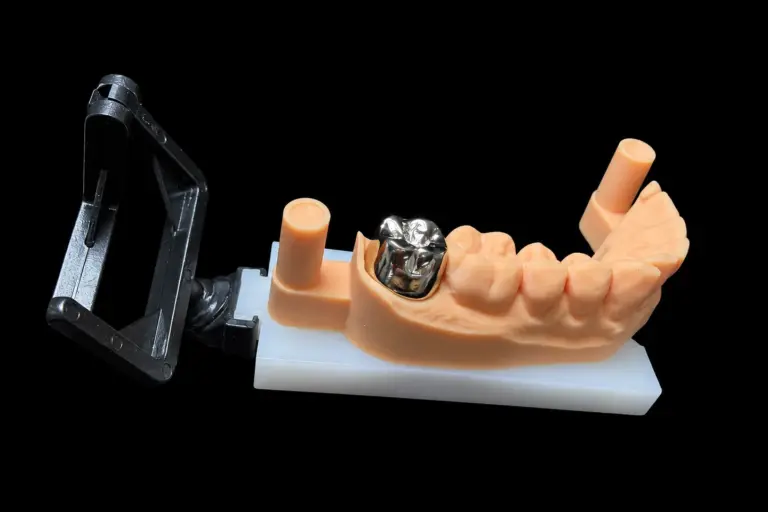
PFM CoCr Crown Manufacturing for Dental Labs and Clinics
A PFM CoCr crown — porcelain fused to a cobalt-chromium (CoCr) metal substructure — remains one of the most practical fixed restorations we build. The reason is unglamorous: on posterior teeth with heavy occlusion, limited vertical clearance, or a mix of margin conditions that would compromise an all-ceramic, a well-made PFM still gives clinicians the predictability they need. We make them in-house from alloy casting through porcelain layering and glazing, with every case tied to a single traceable work order.
- Lab production time
- 2–3 working days
- Substructure
- Cast or milled CoCr
- Recommended margin
- Shoulder
- Posterior occlusal room
- 1.5–2.0 mm
Who makes your PFM CoCr crown
Istar Digital Dental Lab is a full-service manufacturing dental lab founded in 2012, with production in Shenzhen and Huizhou, China. We are not a trading company and we do not outsource cases to third-party labs. For a PFM CoCr case, we handle receiving, CAD design, metal casting or milling, porcelain layering, firing, finishing, QC, and shipment under one roof.
Our regulatory footprint for custom restorations covers FDA facility registration and device listing, EU MDR Annex XIII custom-device notification, UK MHRA registration, and an ISO 13485-certified quality system. These are regulatory registrations and notifications, not product approvals — a distinction that matters because custom crowns are not CE-marked in the usual sense. We issue the custom-device declaration ourselves and complete EUDAMED notification through our EU authorised representative.
Alloy choice for a PFM CoCr crown
PFM is defined by its substructure, so every case decision starts there. We work with four alloy families, and the choice is usually clinical rather than cosmetic.
| Alloy family | Typical use | Nickel-free / beryllium-free | Notes |
|---|---|---|---|
| Cobalt-chromium (CoCr) | Default non-precious choice; posterior single units, bridges, bruxism cases, cost-sensitive quadrants | Yes on request | Mechanical workhorse of the four. Cast or milled per case |
| Palladium-silver | Mid-tier semi-precious; patients with documented base-metal sensitivity | Yes on request | Softer margin handling than CoCr |
| High gold | High-value anterior and posterior work, long-span patients, allergy-sensitive patients | Yes | Highest alloy cost; the trade-off is handling and biologic track record |
| Platinum | Specialty cases where high-gold is specified but platinum content is required | Yes | Rare in our volume; available on request |
Our ceramic metal is sourced from Bego; porcelain layering uses Ivoclar, Shofu, or Noritake depending on case preference. Specific brand or batch requirements are honored when the material is commercially available to us; we document the brand, country of origin, and batch number on request per case.
For Vickers hardness and metal-ceramic bond strength, we rely on the manufacturer’s material certificates and specification sheets rather than publishing composite figures without a load, method, or sample size behind them. Those documents are available with each case on request.
When a PFM CoCr crown is the right answer — and when it isn't
PFM is a well-studied restoration category. A systematic review of tooth-supported single crowns in the clinical literature from 2014 to 2024 reports a five-year survival rate of 97.1% for metal-ceramic crowns across 3,509 units — effectively indistinguishable from veneered zirconia at 97.3% and monolithic zirconia at 96.8% (Pjetursson et al., Int J Prosthodont, 2026, PMID 41489982). A long-term retrospective study of 60 posterior metal-ceramic crowns — frameworks fabricated by laser sintering, with CoCr used on 31 crowns and high-gold (AuPt) on 29 — found an 81% cumulative survival rate at 14.7 years, with no statistically significant difference between the two alloy groups (Chaar, Passia and Kern, J Prosthodont Res, 2020, PMID 32063533). In practice, a non-precious substructure is not a shortcut on longevity — the clinical gap between gold and CoCr PFM is smaller than the price gap, and preparation, cement, and occlusion drive outcomes more than alloy choice.
PFM is not the right answer for every case.
Good fit for PFM CoCr
Where PFM CoCr is usually the wrong choice
If a case could reasonably go either way on material, our teams can comment on the submitted scan before CAD starts. Lab-to-lab clients routinely use us for a second opinion on marginal cases before deciding what to prescribe.
Margin design: what works, what fails
Margin choice is the part of a PFM case most likely to produce a remake. For a CoCr PFM crown we recommend a shoulder margin, cleanly defined, with the finish line visible on the scan. The other options have specific failure modes we see repeatedly:
Subgingival margins need retraction before the scan or impression. Without soft-tissue displacement, no scanner or impression material will give us a usable finish line, and no amount of design-side cleanup will fix that reliably. We would rather see a note that says “retracted, rescanned after bleeding stopped” than guess from a blurred edge.
When vertical clearance is short
Minimum occlusal thickness for layered porcelain is 1.5–2.0 mm on posterior and 1.0–1.5 mm on anterior restorations, measured over the metal coping (which itself needs 0.3–0.5 mm). If the preparation does not leave that room, we offer three options and will go with whichever you prefer:
For bruxers, we also increase the occlusal thickness and flatten the morphology to distribute load — ask us to do this at submission, not after seating.
Long-span bridges and non-parallel abutments
Five units is the practical threshold where “long span” starts to matter for PFM. Beyond that, three constraints apply simultaneously: each abutment carries at most one pontic, the connector cross-section needs to grow with the span, and non-axial lateral forces during excursion become the dominant failure mode. If the arch requires more than that, splitting the restoration into two short-span bridges is almost always safer than one long span, and we will say so.
If the abutments are not parallel enough for a common path of insertion, segmented design is the first option. The second is thickening the cervical collar on the diverging unit to protect the margin without compromising fit. We will not simply “force the path” in CAD and hope the clinician can seat it.
Starting a PFM CoCr crown case
The single biggest cause of avoidable delay is incomplete submission. A PFM CoCr case needs the following on day one.
Working file requirements
Physical impressions and models
VPS and polyether impressions are preferred; stone models and printed resin models are accepted. Alginate is not suitable for international shipping — it dehydrates, distorts, and triggers biosecurity holds in several of our destination markets.
Before you ship, confirm the impression is free of pulls, voids, or distortions in the areas that matter: shoulder, subgingival margin, proximal contacts, and the occlusal of the preparation. Defects on soft-tissue regions well away from the margin are fine. Defects on the margin itself are not — those cases will be flagged for a retake, and the production clock does not start until we receive a usable impression.
Prescription and reference material
The prescription needs the practice name, prescribing dentist, patient identifier, product specification (unit, material, shade), and the required delivery date. The working arch, opposing arch, and bite registration are all required for a crown; we cannot design to a plausible occlusion we invented. Shade photos, sketches, old restorations, and diagnostic wax-ups are all accepted as reference material — if a case has visual complexity, send more rather than less.
A downloadable Rx form and a submission checklist are available on request.
Cases we return before production starts
To keep remakes down, we pre-check every case against the same six conditions. If any of these apply, your case coordinator will contact you before the file goes into CAD:
These are not rejections. They are case holds while we agree on what to do, and the clock pauses until the question is resolved.
How we fabricate a PFM CoCr crown
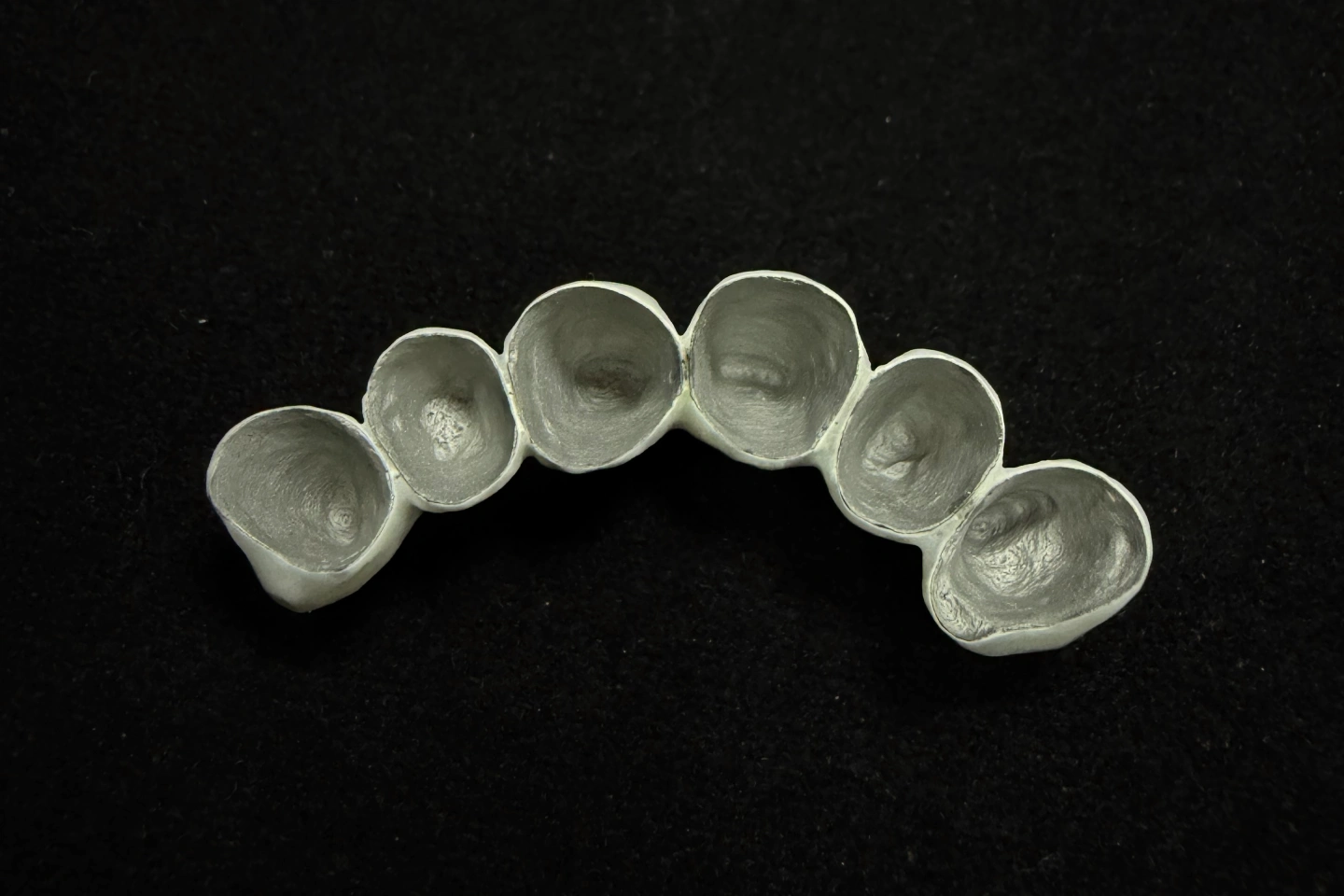
For CoCr PFM, we build the metal substructure by casting or by milling from a solid blank, depending on span, geometry, and the alloy’s suitability for each route. We do not use metal 3D printing as the primary production route for PFM copings. An in vitro comparison testing metal-ceramic bond strength per ISO 9693 three-point bending reported no statistically significant difference between selective laser melted and lost-wax cast CoCr, with both methods exceeding the standard’s minimum requirement (Xiang et al., J Dent, 2012, PMID 22402336). That finding is one reason we treat the choice between casting, milling, and printing as a decision about geometry and throughput rather than a quality differentiator.
Coping thickness is verified at 0.3–0.5 mm with calipers or a thickness gauge, with margins and support geometry checked under magnification and on the model. Before porcelain application, the metal surface is sandblasted with aluminum oxide at controlled pressure, ultrasonically cleaned, and pre-oxidized under vacuum or inert atmosphere.
Porcelain layering follows a standard dentin / enamel / incisal buildup. We match a porcelain whose coefficient of thermal expansion sits just below the alloy’s — the target window is a CTE differential of 0.5–1.0 × 10⁻⁶ /°C, which is the single most important parameter against delamination and cooling-induced tensile stress in the ceramic. Firing is capped at three to four cycles with staged temperature ramps, vacuum sintering, and controlled cooling.
Reclaimed casting material is used only up to 50% of a melt and only alongside fresh alloy at the manufacturer’s specification, with composition verified periodically.
Quality control
Every case passes three inspections before it ships: inbound (data and material completeness), in-process (between departments), and final (independent QC). The final sign-off is performed by a dedicated QC team member who is not the technician who built the case — a separation of roles we consider non-negotiable for consistency.
The checklist for a fixed restoration is 100% inspected, not sampled, and covers:
If a case fails at final QC, it is automatically remade; we do not ask the client to approve a rework at that stage. Our internal rework rate — measured as cases returned by clients, not internal fails — runs around 2% to 3%. We publish that number as context rather than a guarantee; your mix of case types, preparation styles, and shade requirements will shift the actual rate up or down.
Every case is logged under a single work-order ID that binds the technician, the equipment used, the material batch, and each inspection record. If a question comes up months later and the records are still within our retention period, we can trace it.
PFM CoCr crown delivery windows
Delivery windows for PFM work are quoted the way they are actually met, with explicit clock-start and clock-stop rules.
Every quoted window follows the same rules:
Rework and responsibility
A rework policy is useful when it spells out what is covered and what is not.
Free remake, lab absorbs rework cost
Not covered
New preparation = new case. If the preparation geometry changed, the case counts as a new submission, not a remake under the previous order.
Logistics on remakes: physical units need to be returned to us for inspection; digital-only cases can be rebuilt from the original data in most situations. Return shipping on remakes is covered where the fault is ours, excluding import duties and implant parts.
Turnaround on rework: priority queue, typically 3–5 working days from receipt.
If a case is remade twice and the issue is still not resolved, we will discuss credit or refund rather than send a third attempt.
Documents we can provide for your case
Standard, included with any case on request:
For procurement, quality, and compliance teams:
Case records are retained for three months by default. Longer retention can be arranged in advance if your regulatory environment requires it — tell us at the point of order, not after.
Pricing and commercial terms
Pricing is quoted per case. A number depends on four variables we need from you first:
A unit-level quote includes design, model, components, packaging, and outbound shipping on standard routes. Return shipping on client-return remakes is covered when the fault is ours.
Standard commercial terms:
Single-case trial orders are accepted. Sustained single-case volume is not economic at international shipping costs for either side.
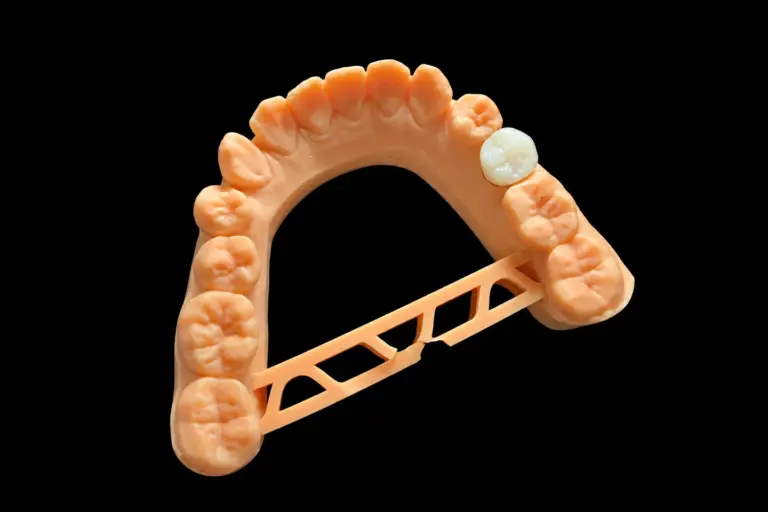
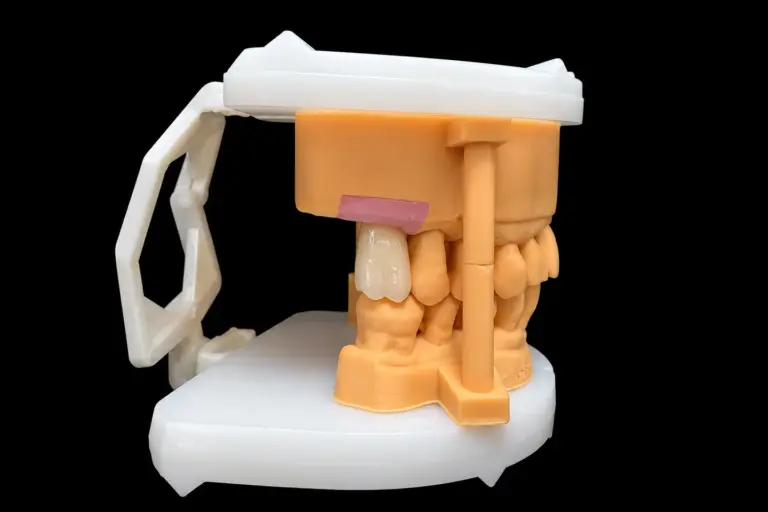
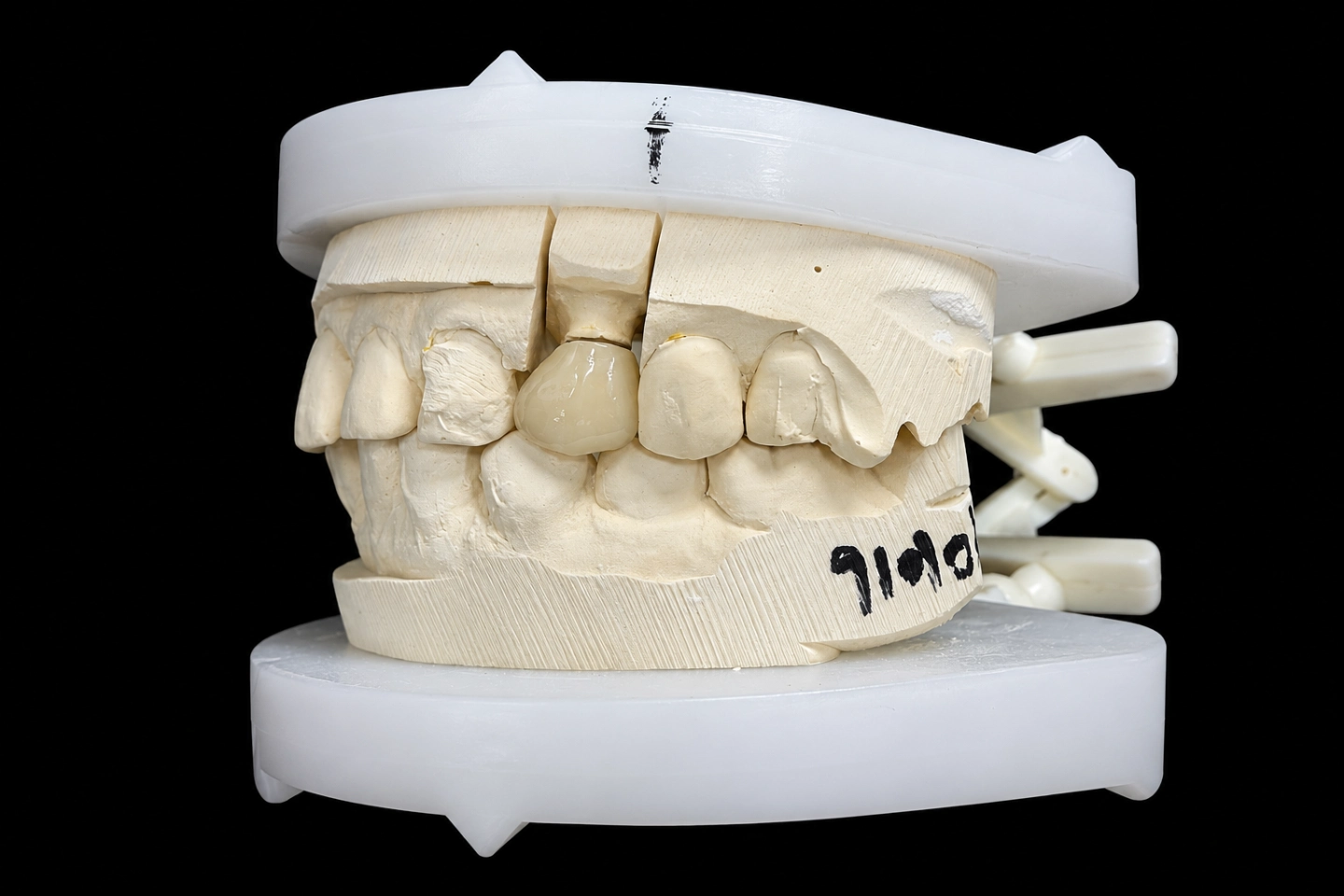
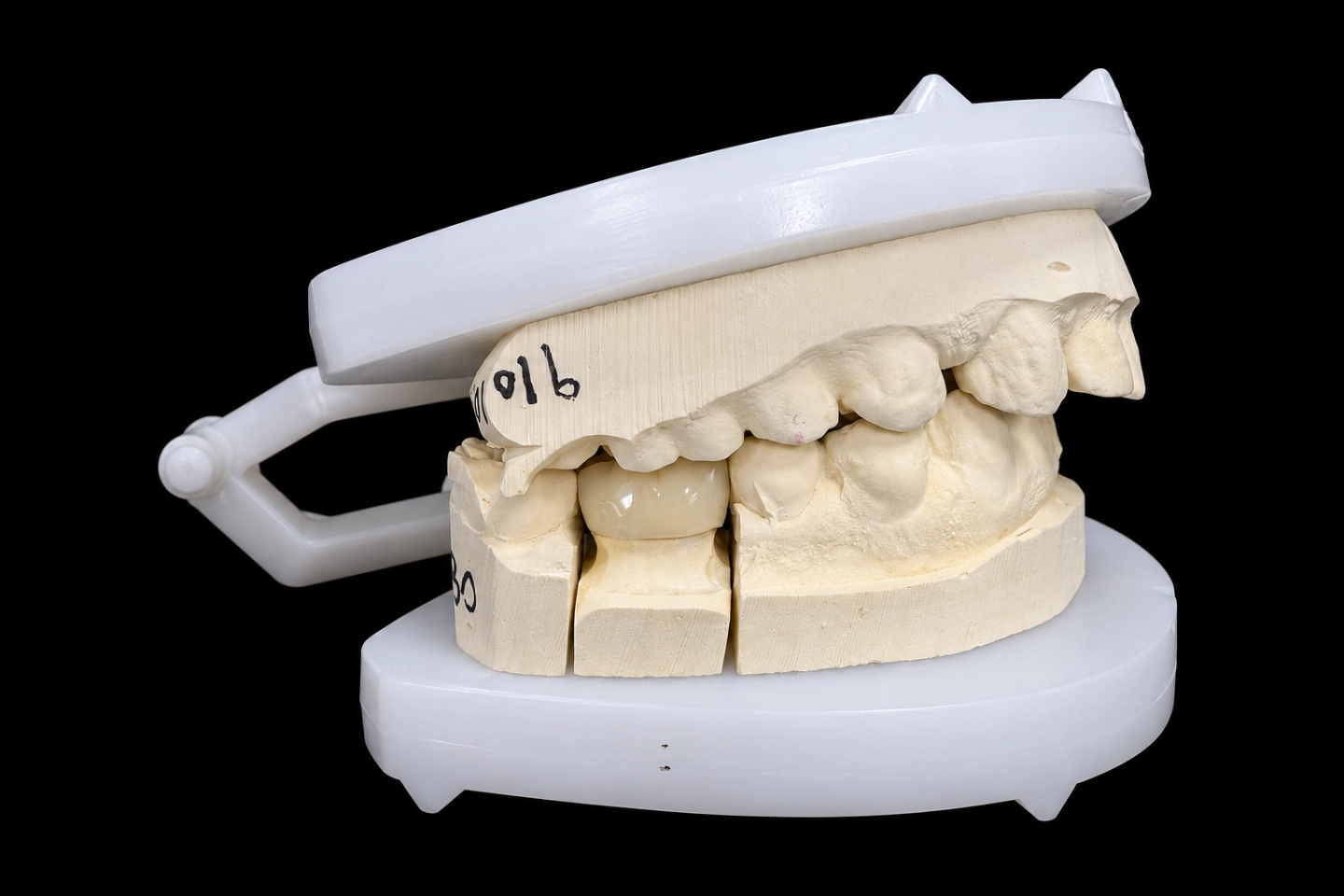
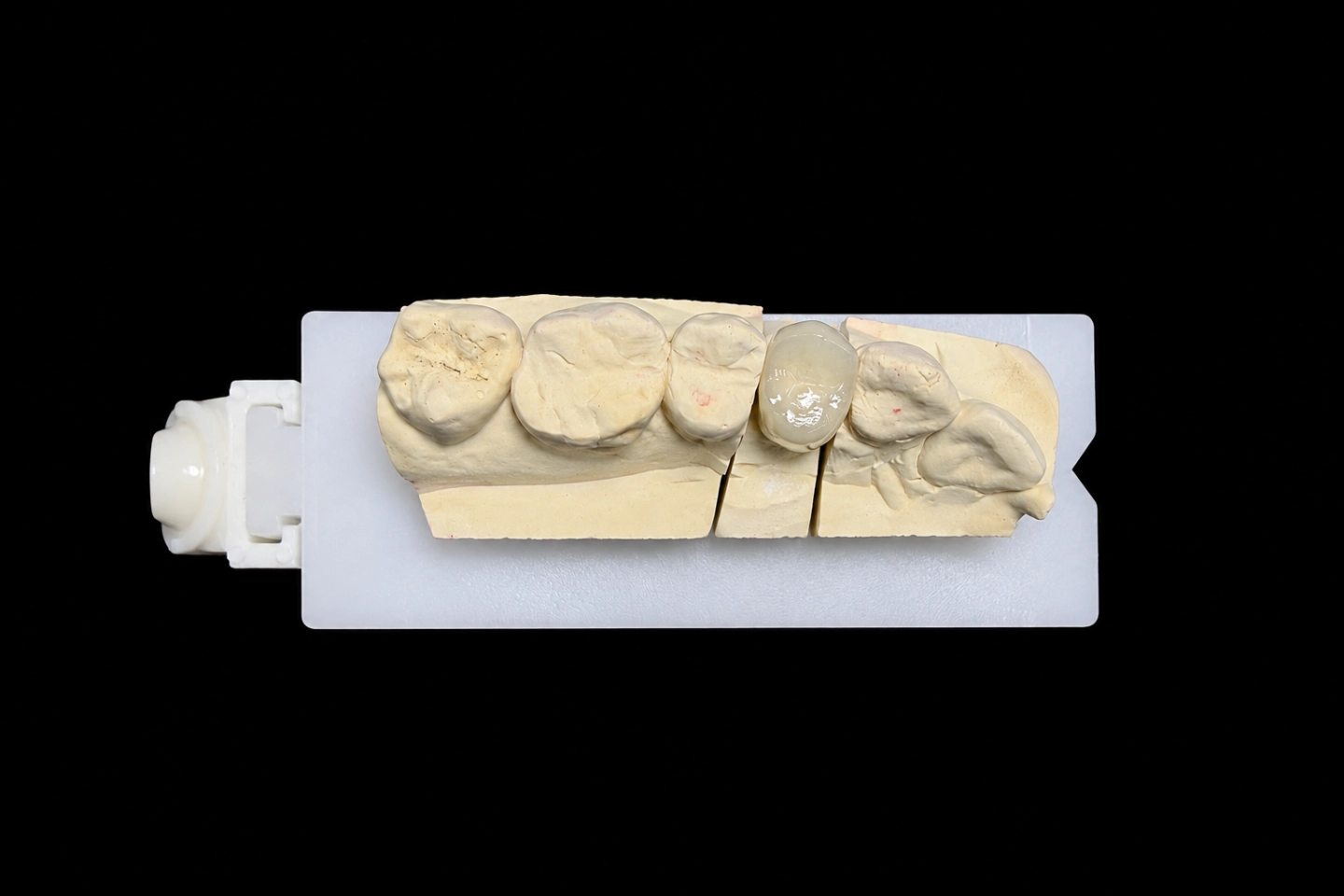
PFM cases from our lab
FAQ
What should I know before ordering a PFM CoCr crown?
The four decisions that matter are alloy family, margin type, occlusal clearance, and who owns the design. For a CoCr PFM crown the margin should be a shoulder, and you need 1.5–2.0 mm of occlusal room posteriorly for the porcelain. If you want a second opinion on whether PFM CoCr is the right restoration for a specific case, send the scan before CAD begins — we will tell you if layered zirconia or a different approach serves the patient better.
Can we specify a particular alloy brand or batch for our PFM CoCr crown order?
Yes, as long as the material is commercially available to us. We will confirm the exact brand, origin, and batch on the case documentation.
What happens if the specified material is out of stock when the case arrives?
We stop and contact you with options: wait for restock, substitute to an equivalent of the same family with your written approval, or hold the case. We do not substitute materials silently.
Do you accept cases where the client has already done the CAD?
Yes. We can run design-only, milling-and-sintering only, or full production. If you supply the design, we mill or build per your file and do not re-check thickness, margin, or connector dimensions before machining. Chip-off and material failures remain our responsibility; seating-related issues on client-supplied designs are not.
How many design revisions are included?
One design pass plus two revisions, included. Beyond that, additional revision rounds may extend the delivery window.
Can you work from a client-specified implant library we provide?
Yes. We use your library to ensure the restoration fits your part inventory; version mismatch between libraries is a known cause of fit issues, so we default to your file rather than ours.
How do you handle a porcelain chip in the first weeks after seating?
Return the case to us with photos of the chip in the mouth, the opposing arch, and the occlusal contact pattern if available. If the fracture is manufacturing-related, we remake free of charge. Lateral forces from a changed opposing restoration or an undiagnosed parafunctional habit are a different conversation, and we will tell you honestly which side we think it falls on.
Do you ship directly to our clinics under our label?
We can honor your packaging and labeling standards; shipping addresses on the air waybill cannot be modified after dispatch. We do not approach your end clients.
Request a quote or send a test case
Three ways to open an account or send your first PFM CoCr crown case:
The question we would rather answer first is not “how much does one unit cost” but “will this case run cleanly through your workflow.” Share a scan or an impression and we can tell you.