PFM Implant Crowns: Metal Strength, Built Around Your Implant
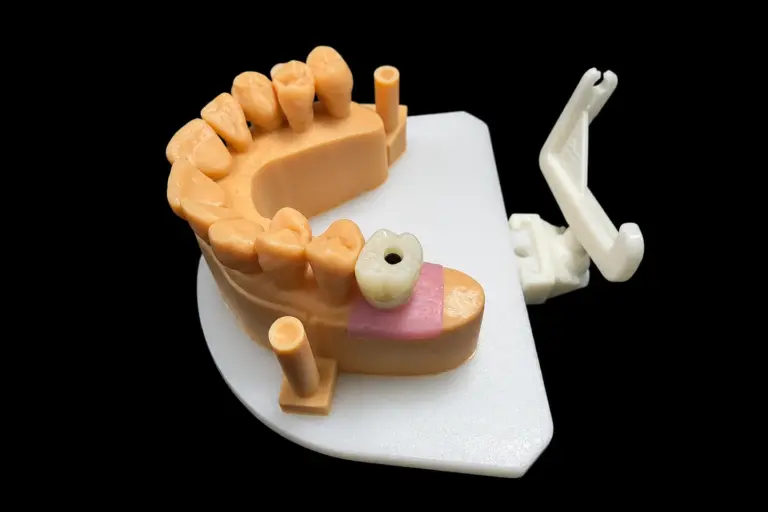
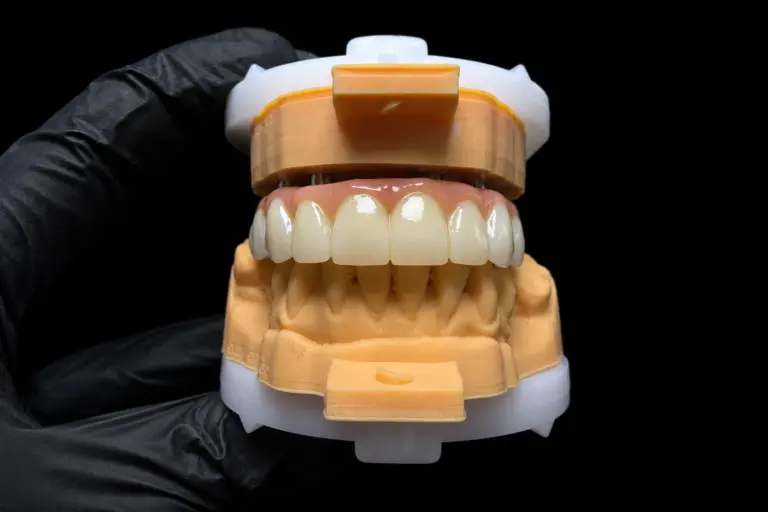
When an implant has to take a heavy bite, the space is tight or the case has to stay on budget, a PFM implant crown is still one of the most dependable restorations you can prescribe. The metal framework carries the load and the porcelain gives a natural finish. What makes it last on an implant is how carefully it’s built around the connection.
That’s the part our implant team at Istar Digital Dental Lab takes personally. We match your implant system before design, give the porcelain the metal support it needs and seat every crown on its analog before it ships. You get a crown that goes in the way you planned, case after case.
Send us one case and judge the fit yourself.
Why Dentists and Labs Send PFM Implant Crowns to Istar Digital
PFM implant crown on an implant analog model
Implant work has its own team. About 80 people work in our implant department, across four labs we own in Shenzhen and Huizhou. Founded in 2012, Istar Digital makes every case in-house, from design to final inspection, with no outsourcing.
People who answer. Our team replies in English, usually within an hour during working hours (9:30 am to 6:00 pm China time, UTC+8), with extended support until midnight for urgent cases.
Pricing you can plan around. Quotes are itemized by unit, material, implant components and design complexity, and you can confirm the full cost before production starts.
A lab you can verify. Istar Digital is an FDA-registered establishment, Registration Number 3039441248, which you can check in the FDA Establishment Registration & Device Listing database. In the EU, our custom-made restorations follow the MDR custom-made device procedure, and the lab holds ISO 13485. You’re welcome to visit in person or by video.
When a PFM Implant Crown Is the Right Choice
PFM shines on molars and premolars, under heavy occlusal loads and bruxism, across long spans and where occlusal space is limited. It’s also a smart choice when cost matters more than maximum esthetics.
For a highly esthetic anterior implant crown, we’ll usually point you to E.max or layered zirconia instead, because metal limits translucency. We’d rather tell you that before production than have you find out at the chair.
PFM also holds its own against zirconia on the evidence. The ITI consensus on single implant crowns found similar 5-year survival and no significant difference in veneer chipping. Zirconia-ceramic crowns had more core fractures, and metal-ceramic crowns had more screw loosening and esthetic failures. The ITI advises choosing by the patient’s esthetic expectations, and we’re glad to talk that through on any case.
Screw-Retained or Cement-Retained Implant PFM Crown?
Where the implant position allows it, we recommend screw retention: the crown stays retrievable, and there’s no cement to chase around the implant. Cement retention makes sense when the access hole would land on the facial surface, or when there’s room and the esthetic demand is high.
Either can serve your patient well. The ITI consensus on retention found high survival with both and noted that cemented metal-ceramic prostheses failed less often than cemented all-ceramic ones. That’s a point in PFM’s favor when cement retention is the plan.
For cemented crowns, a stock abutment suits ideal implant positions, while a custom abutment suits the esthetic zone, demanding soft tissue or difficult angulation. PFM crowns work with conventional cementation, using glass ionomer or resin cement.
If the screw channel falls in the wrong place, there’s usually a way around it: an angled screw channel with a custom abutment, a multi-unit abutment or a reshaped crown that moves the opening lingually. Cement retention stays the last resort, and any angled channel stays within the component maker’s limit, with your approval.
Implant supported porcelain fused to metal crown or abutment-supported?
An implant supported porcelain fused to metal crown attaches directly to the implant, with no separate abutment; an abutment-supported crown sits on one. As Delta Dental’s implant coding guidance shows, the two use different codes, and the alloy changes the code as well. The code is your office’s call. We make it easier with a composition certificate for the metal in your case, which shows its ADA alloy class.
Screw-retained and cement-retained implant PFM crown designs
Built So the Porcelain Lasts
Chipping usually starts where porcelain has no metal behind it. That’s why every implant PFM crown we make follows the same limits:
| What we control | Our standard |
|---|---|
| Metal coping thickness | Usually 0.3–0.5 mm, measured before porcelain |
| Porcelain thickness | An even 1.0–1.5 mm anterior, 1.5–2.0 mm posterior |
| Metal support | Under connectors and load-bearing occlusal areas |
| Thermal expansion | Porcelain matched slightly below the alloy, within 0.5–1.0 × 10⁻⁶/°C |
| Porcelain firings | Usually no more than 3–4, to limit distortion and color shift |
Frameworks are cast or milled in cobalt-chromium, palladium-silver or gold alloys, using Bego metals. Nickel-free and beryllium-free options are available for patients with allergies. Each alloy is processed with its own tools and equipment, so compositions never mix.
Before porcelain goes on, the framework is air-abraded, cleaned and pre-oxidized for a reliable bond. Our technicians record every layering recipe, so a shade you liked can be repeated on the next case.
When space runs short, we keep strength first. A metal occlusal surface, a thinner porcelain layer with an agreed esthetic trade-off or a small adjustment to the opposing tooth all keep the crown sound. Where a metal margin would show, we can finish with a porcelain margin and no metal collar.
Cross-section of a PFM implant crown showing the metal framework and porcelain layers
You Approve the Design Before We Build
We shape the emergence profile from your healing abutment or provisional scan, with a smooth contour your patient can keep clean. You then receive the design with occlusal, buccal and lingual views, the screw-hole position and the contacts marked. If we see a risk, such as limited space or an occlusal interference, we flag it in the preview so you can decide.
Sending Us a PFM Implant Crown Case
You don’t need a special setup. We accept open files from 3Shape TRIOS, Medit, iTero, CEREC/Sirona, Shining3D Aoralscan and Planmeca, in STL, PLY, OBJ, DCM or 3OXZ format. Physical impressions and implant models with analogs are welcome too, and our case submission guide covers shipping.
Most implant delays come from missing implant details, so a few items make all the difference:
- Implant brand, platform, connection and diameter, with a photo of the package label, so the library matches your connection
- Scan body brand, model and CAD library name
- An intraoral scan with the scan body fully seated, plus the opposing arch and bite, or an impression with an implant analog and a VPS bite (wax can deform in transit)
- A tissue cuff or provisional scan for the emergence profile
- Smile, occlusion and shade photos, with the shade tab in frame
- Your prescription: support type, retention, alloy, shade, and OEM or compatible components
We never change a material or component without your consent. Your files are used for your case only, never to train software.
Have a case ready? Send your scan and implant details.
Checked on the Analog Before It Ships
Final release belongs to dedicated inspectors, not the technicians who made the crown. On every PFM implant crown, they confirm that the interface sits cleanly on the analog, the screw turns in smoothly, the crown seats passively without rocking and every component matches your prescription. Margins, contacts, occlusion and shade are checked again after glazing. Inspection photos are available on request.
We check seating directly rather than quoting a single fit number, because a systematic review in The Journal of Prosthetic Dentistry found the evidence can’t yet set an acceptable misfit threshold for implant restorations. In practice, 95% of our cases pass final inspection, and 2–3% come back from clients for a remake.
Technician checking the implant interface of a PFM implant crown
Your Hundredth Case, Like Your First
A great first case only matters if the next ones match it. Your preferences are saved in writing, with separate notes for each dentist in a group. Because Istar Digital runs four labs, we can compare technician teams and assign your cases to the one you like best.
Every case carries a unique number tied to its technician, equipment, material batch and inspection results. If a remake ever happens, we trace the cause and fix the process, not only the crown.
Timing, Warranty and Remakes
Routine crown and bridge cases take 2–3 working days in the lab, and complex implant cases 5–7; in a staged case, the custom abutment takes 3–4. Clients sending 10 or more cases a month get free rush service with a guaranteed ship date.
Implant restorations carry a 3-year warranty. If something isn’t right, tell us within 24 hours. We agree on the cause with you, put the remake at the front of the queue and ship it back at our cost. Implant component costs and shade or material changes requested after the order aren’t covered. If repeated remakes can’t solve a problem, we refund.
PFM Implant Crown FAQ
Which implant systems do you work with?
Most implant systems on the market. If your digital library version differs from ours, we’ll use yours, so the connection matches your components exactly.
Should I choose OEM or compatible components?
We recommend OEM components for fit and long-term stability. Validated compatible parts can make sense on a tight budget or when a part is discontinued, though tolerances, materials and warranty may differ. OEM parts cost more, since they’re charged at purchase price plus a handling fee.
Can you make implant PFM bridges?
Yes, from short spans to full-arch frameworks. For multi-unit work, we confirm a common path of insertion and check that the framework seats passively on the model, without screws pulling it into place. For tooth-supported bridges, see our PFM bridge page.
What torque should I use?
Follow the implant manufacturer’s instructions. We can give you a reference value, but the manufacturer’s figure is final.
Can you match characterization in neighboring teeth?
Yes. We can reproduce custom staining, white spots, craze lines, translucent zones and surface texture. Clear photos of the neighboring teeth are all we need.
Can you supply screws and other components?
Yes, including Ti-bases, multi-unit abutments, screws and tools. Note what you need on the order. Screws and small parts ship in their own labeled bag, so nothing goes missing at the chair.
We're a dental lab. Can you take on part of the work?
Yes. You can send us only porcelain layering, glazing or add-on porcelain, and we can ship directly to the address you name.
Do I need a minimum order to try Istar Digital?
No. Single trial cases are welcome, and many new clients start with one. Ongoing partnerships work best with a regular case flow.
Start With One PFM Implant Crown
The best way to judge a lab is with a real case. Send us one PFM implant crown, compare the fit and finish with what you get today, and decide from there. We’ll review your files and flag anything that could cause trouble before we start. To see more of what we make, explore our implant dental laboratory services or learn about Istar Digital.