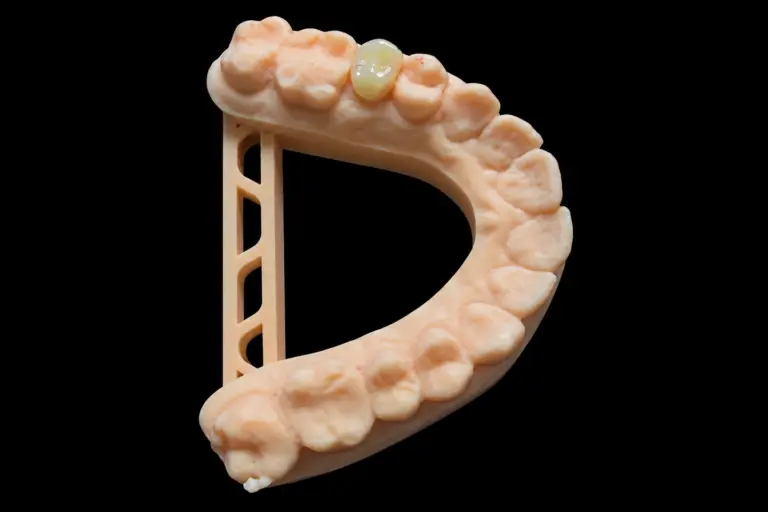
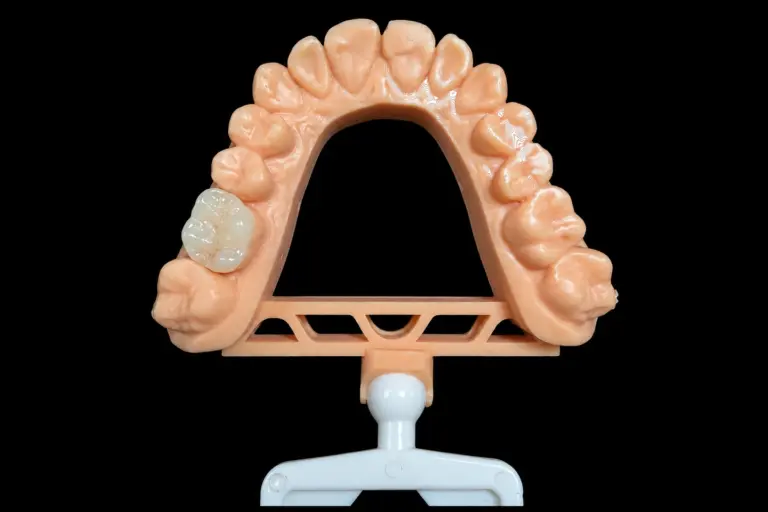
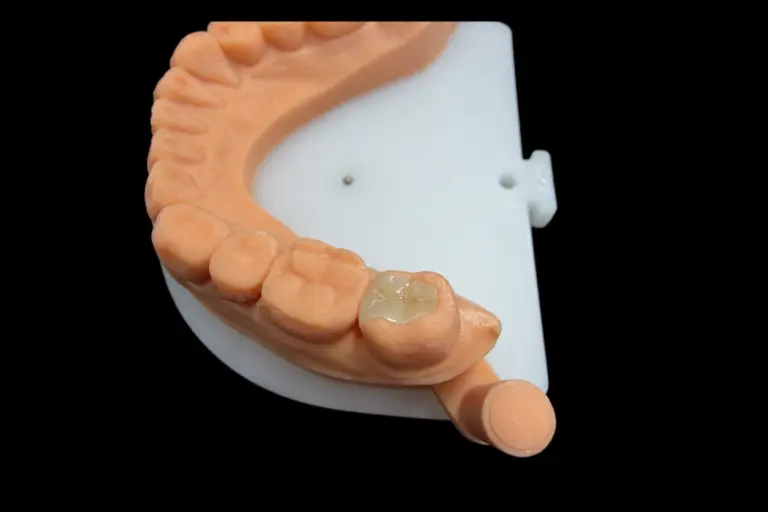
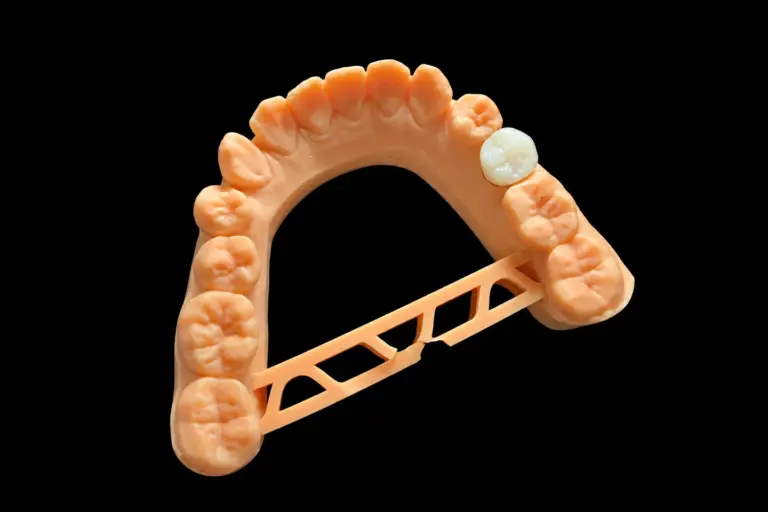
Metal Inlay Dental Lab for Inlays, Onlays, Overlays and Endocrowns
Istar Digital Dental Lab makes metal inlay dental restorations for clinics, DSOs and dental labs: inlays, onlays, overlays and endocrowns in the alloy class you prescribe. You send the prep, the bite and the Rx. We check that the case will work in metal before we start, and we contact you if it won’t.
Cast metal partial coverage is held mainly by the shape of the prep and the fit of the casting, not by a resin bond. That makes the prep, the records and the alloy choice the decisions that matter most on these cases, and they’re what this lab is set up to check.
Metal Inlays, Onlays, Overlays and Endocrowns We Make
| Restoration | Coverage | Typical case |
|---|---|---|
| Inlay | Occlusal and/or proximal surfaces, inside the cusp tips | Small to moderate posterior defect that doesn’t involve the cusps, with sound walls and a healthy pulpal floor |
| Onlay | One or more cusps plus the adjoining occlusal surface | Weakened or lost cusps, including root-canal-treated posterior teeth |
| Overlay | All cusps and the whole occlusal table | Every cusp needs protection, but the axial walls are sound |
| Endocrown | Occlusal table, with retention extending into the pulp chamber | Endodontically treated molar or premolar with a usable pulp chamber |
A wide isthmus or an undermined cusp is a reason to move from an inlay to an onlay, not to widen the inlay. For a root-canal-treated molar that needs cusp coverage, we recommend an onlay over a full crown: it removes less sound tooth structure, and in our experience it performs better. If you’d rather have tooth-colored partial coverage, we press inlays and onlays in IPS e.max on a separate line.
When a Metal Inlay Tooth Restoration Is the Right Call
Metal makes the most sense on posterior teeth outside the esthetic zone, where the patient accepts a metal surface, and in three situations in particular:
- Deep or subgingival margins. Adhesive ceramic needs a dry, isolated field. Metal can be luted with a conventional cement, so it tolerates a margin where bonding is hard to control. In a retrospective study of ceramic inlays and onlays versus cast gold partial crowns (Clinical Oral Investigations, 2024), operators preferred cast gold for teeth with subgingival cavities. With follow-up of up to 24 years, both groups reached about 92% cumulative survival at 23.5 years. Ceramic fracture was the main complication with ceramic, and endodontic complications with gold.
- Limited occlusal clearance. Alloy holds up in thinner sections than ceramic, so less reduction is needed over the cusps.
- Heavy occlusal load. There is no veneering ceramic to chip.
Alloy Options for Metal Inlays and Onlays
Our metal department works with cobalt-chromium, palladium-silver and gold alloys. Prescribe the class you need, or name a specific alloy brand and product, and we confirm the alloy for your case before production starts.
| Class (ADA) | Gold + platinum-group metals | Handling on a partial-coverage casting |
|---|---|---|
| High noble | ≥ 60%, with gold ≥ 40% | Soft and ductile: adjusts, polishes and finishes at the margin most easily |
| Noble (“semi-precious”) | ≥ 25% | Varies widely by alloy; the manufacturer’s data sheet gives the hardness |
| Predominantly base metal | < 25% | Cobalt-chromium: hard and rigid, takes longer to adjust and polish chairside |
The thresholds come from the ADA’s overview of materials for indirect restorations, which also notes that the hardness of base alloys compared with gold complicates adjustments. On a small inlay that difference shows up at the margin: a gold margin can still be finished in the mouth, while a cobalt-chromium margin leaves little room for chairside correction.
- Allergy requirements. We supply nickel-free and beryllium-free alloys, and alloys for other specific allergy requirements.
- No silent substitutions. If a prescribed alloy is unavailable, we tell you first. Nothing changes without your consent, written or verbal.
- Proof of alloy. On request, we provide the brand, origin and batch number of the alloy used on a case, with its certificate and proof of composition.
Preparing the Tooth for Cast Metal
A prep cut for a bonded ceramic onlay is not a cast metal prep. As Inside Dentistry’s review of conservative cast gold inlays describes, traditional cast gold preparation relies on a precise taper of about 6–10°, sharp internal line angles and beveled margins. Bonded ceramic preps moved to rounded internal angles, extra taper and chamfer or butt margins, because the resin bond takes over retention. When metal is luted with a conventional cement, the prep geometry has to do that work.
What we look for on a metal inlay or onlay prep:
- One path of draw, no undercuts. Smooth, evenly tapered walls, with the proximal boxes following the same path as the occlusal outline.
- A defined proximal box with a clear gingival floor that the impression or scan can capture.
- Margins the alloy can finish. Beveled margins suit gold alloys. If you prepare chamfer or butt margins, tell us on the Rx so we design the margin to match.
- Enough metal over the cusps. Shape the occlusal reduction to follow the cusp anatomy instead of a flat cut.
- Bruxism. For bruxers we thicken the occlusal surface and keep contacts flat and even to spread the load.
When We Stop and Call You
Our technicians measure clearance and check the prep on the model before design. We contact you before going ahead when the occlusal space is too tight for the design you ordered, when an undercut is too large to seat without adjusting the prep, when the impression or bite has a problem, or when the tooth number doesn’t match the Rx. The case is paused, not guessed at. Your case coordinator follows up every other day until it’s resolved, and on request we pack a note with the finished work naming the tooth and how many millimeters to reduce.
What to Send: Rx, Records and Scans
Write these on the Rx form:
- Tooth number and design: inlay, onlay, overlay or endocrown, and which cusps are covered.
- Surfaces: the surface count also decides the CDT code you report (D2510–D2530 for metallic inlays, D2542–D2544 for metallic onlays). The coding choice stays with you.
- Alloy: the class, or the brand and product.
- Margins: type and position, supragingival or subgingival and by how much.
- Contacts: light, normal or tight.
- Cementation plan: conventional luting or adhesive resin.
- Bite and space notes: bruxism, or “occlusal space inadequate” with the clearance you measured.
Impressions: send the prepared arch, the opposing arch and a bite record. Use a VPS bite registration rather than wax; wax distorts with heat in international transit.
Scans: we accept 3Shape TRIOS, Medit, iTero, CEREC/Primescan, Shining3D, Planmeca and any scanner that exports open files, in STL, PLY, OBJ, DCM or 3Shape .3oxz, through 3Shape Communicate, Medit Link or WeTransfer. STL is enough for a metal inlay. Trace the margin yourself instead of relying on automatic detection. For a subgingival box, retract, dry and scan slowly along the margin, capturing a little of the area below it so the finish line reads as one continuous line. We check every scan within one working day. File packaging is covered on our digital dental laboratory page.
How We Make and Inspect Each Metal Inlay
- Design approval on request. We send screenshots or files by email or to your case group before the case is cast or milled. Approval adds 1–2 working days.
- Alloys kept apart. Each alloy is processed in its own zone, with dedicated tools, separate sandblasting and polishing equipment and sorted recycling, so the composition on the certificate is the composition in the casting.
- Validated melting equipment. Melting and heat-treatment equipment goes through installation, operational and performance qualification (IQ/OQ/PQ), covering temperature control, vacuum or protective atmosphere and cast quality, with periodic requalification.
- Finishing. Each casting is ground, refined and polished in stages, then ultrasonically cleaned and steam-cleaned.
- One case number throughout. Every restoration is tied to the technicians, equipment, material batches and inspection results behind it.
Final release is done by quality inspectors who don’t make restorations. They check each piece on the model against the Rx and the approved design: an even marginal gap with no lifting, a clean intaglio with no nodules or porosity, complete seating, contact tightness, and centric, protrusive and lateral occlusion. Castings are examined for porosity, cracks and distortion, with microscopes and digital measurement. Lab-wide, 95% of cases pass final inspection; the share clients send back for a remake is a separate figure, at 2–3%.
Turnaround, Warranty and Terms
- Lab time: 5–7 working days for all four designs, counted from the day we have complete records. Waiting for missing records or design approval isn’t counted. Transit time comes on top.
- Rush cases: free for clients who send 10 or more cases a month. We guarantee the ship date; the arrival date depends on customs.
- Quotes: itemized to what you order, and you can confirm the full cost before production. When metal prices move, we discuss it with you and give a week’s notice before prices change.
- Shipping: you pay to send impressions or models to us; we pay to ship finished work back, including remakes.
- Warranty: 3 years. We remake or adjust lab-caused problems free of charge: an open margin or contact, high occlusion, a restoration that doesn’t seat, or visible defects. A remake is charged if you change the material or the case requirements, or if we flagged an unclear impression and you asked us to proceed. For seating, margin or bite problems, send a new scan, model or impression, since the original records may be the cause.
The Lab Behind Your Metal Work
Istar Digital was founded in 2012 and runs four dental labs in Shenzhen and Huizhou, China, with about 460 people, including a ceramic and metal finishing team of about 70 and an independent QC team of about 25. Every step is done in house, with no outsourcing. Each client gets a dedicated manager and a case group, so a question about a draw or a margin reaches the people working on the case. More about Istar Digital.
Istar Digital Dental Lab is an FDA-registered establishment, Registration Number 3039441248, which you can check in the FDA establishment registration database. Our device listing includes inlays and onlays. For EU clinics, custom restorations follow the MDR custom-made device procedure, and the lab works under an ISO 13485 quality management system. For full-coverage work, see our crown and bridge dental laboratory.
Metal Inlay FAQs
Which cement should we use?
Conventional cements such as glass ionomer or zinc polycarboxylate work on a retentive prep, and resin cements are an option. To bond a precious alloy with resin, follow the cement manufacturer’s instructions for treating the alloy surface; some systems call for a metal primer or tin plating.
Can you supply a provisional?
Yes. We can make provisionals for inlay and onlay cases in composite or PMMA, including 3D-printed provisionals. Ask for them on the Rx.
Can you ship finished work straight to my client's office?
Yes. We ship to any address you give us, so a dental lab can have finished work go directly to the prescribing clinic. The sender address on the waybill can’t be changed.
Can you keep each dentist's preferences on file?
Yes. Occlusion, contact, margin and design preferences are recorded in each client’s file and applied to later cases, and you can confirm on the Rx whether to use them. Large clients can have a fixed technician team.
What are your hours, and how quickly do you reply?
Our customer service team works 9:30 a.m. to 6:00 p.m. China time (UTC+8) and stays available until midnight for urgent cases. During working hours, technical questions usually get an answer within an hour. Outside them, the time difference can stretch that to 7–8 hours, but never more than 12.
Send Your First Metal Inlay Dental Case
One inlay or onlay on one of your own patients is the quickest way to judge our fit, contacts and margins. Single trial cases are welcome, and ongoing partnerships work best with a regular flow of cases.
- Digital case: email or upload your scans with a completed Rx form.
- Impression case: follow the how-to-send guide. We can send you a prepared waybill, or you can ship to our address and send us the tracking number.
- Alloys and pricing: tell us which alloy class you prescribe and roughly how many cases you send a month. We’ll reply with the matching alloys and the current price list.
- Vetting us as a supplier: book a factory visit or a video tour of our metal and QC areas.