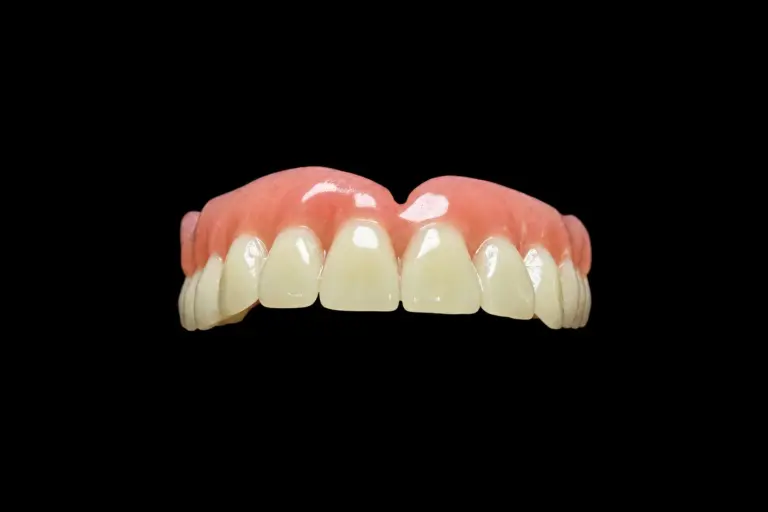
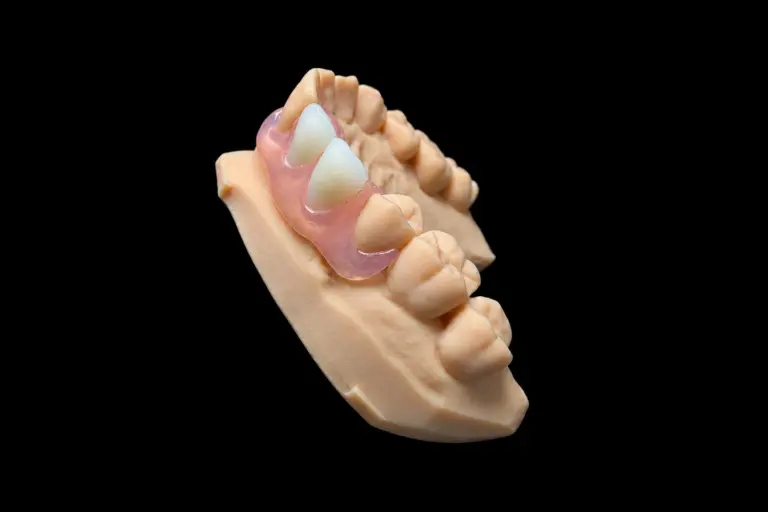
Complete Dentures for Dental Practices Working With an Overseas Lab
If you’re reading this, you’re not shopping for a denture. You’re deciding whether to send a complete denture case to a lab you’ve never visited, in a country whose postal rules you don’t want to think about. That’s a different problem, and most pages about complete dentures don’t address it.
Start with the part that decides everything else: how the denture actually gets made.
Three Routes to the Denture Base
The base is where good complete dentures and merely acceptable ones part company. We work three routes, and the choice depends on soft-tissue condition and the clinician’s preference, not on which route is cheapest for us.
Heat-cured PMMA
Classic water-bath polymerization. Lowest cost, well-understood, and still the honest default when the case is routine and the ridges are stable. The failure modes are known: bubbles, polymerization shrinkage, warpage from rapid cooling. We control them by holding the powder-to-liquid ratio, packing in the dough stage, applying stepped-temperature polymerization, and cooling the flask with the bath, never under a cold tap.
Injection-molded PMMA
Pressure during polymerization reduces shrinkage and improves tissue-surface adaptation. We use this for cases where fit is doing the heavy lifting: flat ridges, combination syndrome risk, or anywhere a borderline retention diagnosis means a few percent of dimensional change will cost you a reline inside the year.
CAD/CAM-milled PMMA
Pre-polymerized pucks milled on a dental CNC. Reproducibility is excellent, and the design is archived against your case number, so a remake two years out repeats a file rather than a records appointment. Milling’s honest limitation is fine soft-tissue detail at the border, which is why we keep a hybrid route: digital design, digital try-in, final base finished in injection or heat-cure when the tissue surface is doing the retention work. A 2021 systematic review and meta-analysis in the Journal of Dentistry set CAD-CAM against conventional complete dentures across fit, biocompatibility, mechanical and surface properties, color stability, time and cost, and clinical and patient-reported outcomes, and concluded that CAD-CAM is not inferior, with better mechanical and surface properties and the advantage of a retained digital record.
A fact we feel we owe you
We do not use 3D-printed resin as the final denture base. Printing is for try-ins and verification models. The reason is evidentiary, not ideological. The 2020 narrative review of printed complete dentures that gathered the clinical and patient-reported literature found short-term performance promising but concluded that more research on materials and printers was needed before wider application. The bond between tooth and base is the other weak point: a 2024 review of tooth-to-base bonding found the best-performing combinations still come from conventional heat-cured dentures after surface treatment, with failures traced to material incompatibility and incomplete copolymerization. When the evidence base changes, we’ll change with it.
Materials We Work With
The complete-denture material question has two parts: what the base is made of, and what the teeth are made of.
Base
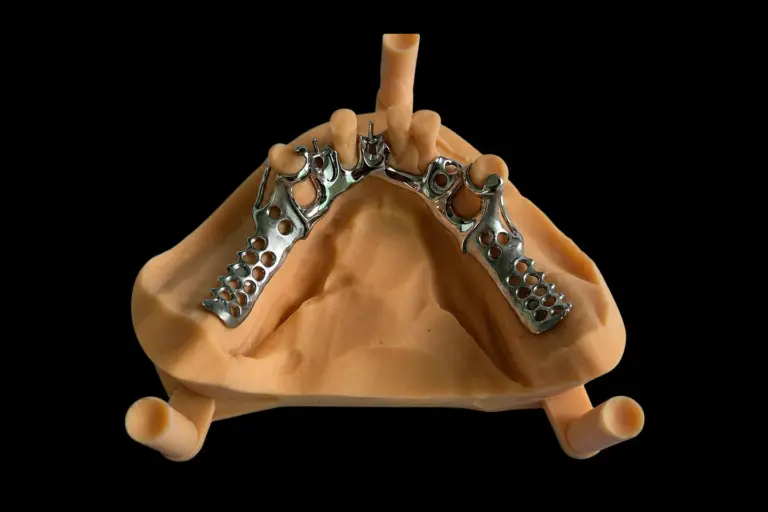
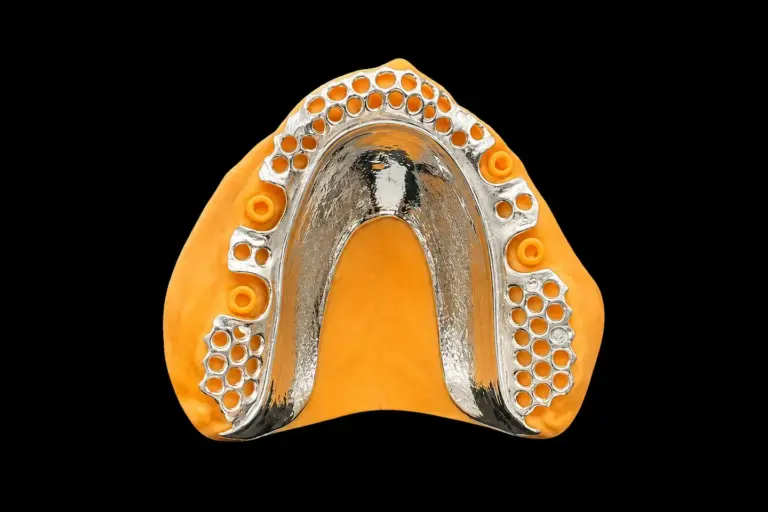
Heat-cured PMMA (including Lucitone 199 and comparable domestic high-impact grades), injection resin, and milled pre-polymerized PMMA pucks. Metal-base complete dentures are quoted case by case. Our standing metal work is partial-denture frameworks (CoCr, Vitallium, titanium, PEEK), so a cast base for a complete denture is a scheduled item rather than a routine one.
Teeth
Composite resin teeth, acrylic resin teeth, and porcelain teeth. VITA, Ivoclar, and Shofu are our standard brands for most anterior work.
If you need a specific brand, grade, or batch, write it on the prescription. We can source and keep records of the exact material used on a case so you can request the brand, country of origin, batch number, and material certificate against a given case number later.
If a specified material is temporarily out of stock, we pause the case and ask you. We don’t substitute silently.
One pre-emptive answer. Patients with disclosed nickel or beryllium sensitivities can be accommodated at both the framework and acrylic stages. Note the allergy on the prescription and we will match a compatible material.
Verification Happens Four Times
A complete denture passes through verification at the end of each production stage, independently of the technician who did the work.
| Stage | What we check | What triggers a rework |
|---|---|---|
| Model | Cast integrity, mounted alignment, articulator relationships against the records | Cracked cast, undocumented mounting, VDO conflict |
| Wax-up | Tooth position vs the approved layout, midline, lip support, occlusal plane | Any drift from the approved try-in |
| Set-up | Occlusal contacts in centric and excursions, posterior palatal seal integrity, border extension | Non-balanced occlusion where balanced was requested, under-extended flange |
| Finished base | Base thickness measured with calipers, internal voids checked with transillumination, surface finish, fit on the model | Bubbles, honeycombing, poor tissue-surface adaptation, polish breaking into the border |
After the four stage checks, an independent QC (not the technician who made the denture) releases the case. If it doesn’t pass, it goes back without any customer touch.
The occlusal scheme follows your prescription rather than a lab default, and the evidence is more specific than “always balance”. The best-evidence consensus statement on complete denture occlusion found strong support that the average patient with good residual ridges and no neuromuscular problems functions adequately whatever the scheme, and no strong support either way for bilateral balance on satisfaction, preference, or chewing ability. It also reported some support for more alveolar bone loss where occlusion is not balanced, and a clear need for balance in patients who have already lost stability and retention. So where you prescribe balance, we verify it in excursions. Where the case is routine and you prescribe a simpler scheme, we don’t add contacts you didn’t ask for.
The check that earns its place is the one you can’t do photographically: transillumination of the finished base. A clean base is clean against a bright light. A base with internal porosity shows it. We do this on every unit.
Edentulous Jaws Are Harder, and Here's Why
Dentate jaws give you teeth to seat against. Edentulous jaws don’t. Mucosa yields under pressure, so centric relation records that look crisp on paper may not reproduce on remount. The lower arch is the hard one, and the published patient-reported numbers are blunt about it: in a 2023 service evaluation of 147 patients receiving new complete dentures, satisfaction with upper denture fit ran at 82 percent while chewing ability and lower denture fit together sat at 39 percent.
Two operational consequences we build into every case:
- Flat or atrophic mandibular ridges earn a conversation before we start, not after the try-in. The honest answer may be that an implant-retained option sits better with this patient’s long-term retention than another conventional lower, and if that’s where the case points, we say so. We don’t do the implants, but we’ll say when they are the better path.
- When the ridge classification is challenging (Prosthodontic Diagnostic Index Class III to IV in the ACP system), we flag it on the case review and either agree a modified acceptance condition or decline the case up front.
Two Workflows, Same Denture
A complete denture is a complete denture whether the file came off a scanner or a stone cast. What changes is the first mile.
Digital case
You export open files (STL, PLY, OBJ, DCM, or a 3Shape .3oxz package) and send them through your scanner’s cloud portal or a plain file-transfer service. We confirm receipt the same day and come back within one business day with either clear-to-design or a specific reason to rescan. Skipping the physical model removes customs and the inbound courier leg from the critical path.
Physical case
You take a VPS or polyether impression, disinfect it, courier it to our Shenzhen facility (you can use our shipping account), and we add the parcel’s transit time on top.
The lab-side time to make the denture is the same in both. The difference is logistics, not craftsmanship.
What we can read
Our CAD team routinely works with 3Shape TRIOS (.3oxz package or exported STL/PLY), Medit, iTero (post-export STL/PLY only; iTero’s native encrypted file isn’t openable outside the Myitero portal), CEREC/Sirona (exported STL/PLY only; DXD/RST aren’t accepted), Shining3D Aoralscan, and Planmeca. For an anterior aesthetic complete denture, send PLY rather than STL. We need the gingival shade and surface texture that STL throws away. Keep single-arch STL under 150 MB and PLY under 300 MB. Zip the case folder, don’t RAR it, and please skip non-ASCII filenames.
What We Need Before the First Appointment
Complete denture cases live or die on the first set of records. Here’s what we ask for, and why.
Jaw relation records
Vertical dimension (VDO) captured on a wax rim or the patient’s existing denture. Centric relation (CR) with a Gothic arch tracing or a thin wax wafer. A frontal smile photograph so we can place the incisal plane and midline against your lip line rather than a technician’s best guess.
Tooth selection
Facial form and arch form, the mould and shade of the existing denture if there is one, VITA or equivalent shade with notes on translucency, length and width targets for the central incisors, and a reference photograph of anterior arrangement. With no existing denture to inherit from, the smile photo does more of the work.
The rule when records disagree
Prescription first. Clinical photographs second. Existing denture third. When the three conflict, we stop and write to you before any wax goes down. Edentulous jaw relation records are inherently less repeatable than records against a dentate arch, so nothing is approved off the paper alone.
A note that saves everyone time
If the resin cast comes in broken, if the opposing scan ends short of the second molar, or if the vertical dimension on the wax rim differs from what’s written on the prescription, the case pauses and your project manager writes you. We don’t guess, and we don’t produce a denture against unresolved data.
The Try-In Is Where the Case Is Really Decided
A wax try-in, or a digital try-in milled or printed as a mock-up, is included on every complete denture. Skip it and the next thing you’ll look at is a finished denture that doesn’t fit the face in front of you.
Eight things we ask you to check at the chair:
- Aesthetics in the lip and face, with the lips at rest and smiling
- Tooth position and midline alignment
- Tooth form (shape, length, incisal character)
- Occlusion in centric and in excursions
- Vertical dimension at rest and in function
- Speech, especially “s” and “f” sounds
- Base stability under finger pressure
- Overall patient satisfaction
Approve the try-in and the arrangement locks. Shade and surface characterization can still be refined during finishing, because neither one moves a tooth. Tooth position and the occlusal scheme cannot be changed after approval without a new try-in, which we will build if the case needs it.
Credentials, Custom-Device Pathway, and Private Labeling
Istar Digital operates under ISO 13485 (certificate number available on request). We hold FDA registration in the United States and MHRA registration in the United Kingdom. For the European market, complete dentures made to a dentist’s written prescription are custom-made Class IIa devices and travel under the EU MDR’s Annex XIII custom-device pathway, with an EU authorized representative handling the EUDAMED-side notification and the custom-made declaration stored against each case.
The practical consequence for you: a complete denture made for one of your patients is a patient-specific device, not a stock item. The documentation chain supports it, and when a regulatory question comes back from a national authority, we have the records to respond.
Private labeling. Packaging, prescription forms, and product-level labels can ship without any Istar Digital marking. If you work under a parent lab or a DSO brand, we don’t appear in the box.
Turnaround, Payment, Rework
Turnaround
We quote turnaround in working days against complete records. A digital case saves one to two working days against a physical case, because the inbound courier leg disappears. The design-approval cycle isn’t counted. If the case sits in your inbox waiting for the try-in sign-off, that pause pauses our clock. National holidays in mainland China (the Spring Festival stretch in late January or February, and the National Day stretch in early October) don’t count as production days.
International shipping
We can ship on our courier accounts at negotiated rates. The commercial invoice declares the product as a dental restoration or denture, with a true-value declaration at the lab fee rather than a nominal number, because destination customs check. Import duty, clearance, broker fees, and remote-area surcharges sit on your side; we handle the export side cleanly so your broker doesn’t have to call us.
Payment
Bank transfer and PayPal, in USD. Standard terms are net-30, invoiced per batch or as a monthly statement. For lab customers we usually look for around USD 500 a month in average lab fees, below which the admin and shipping overhead works against both sides.
Rework
We rework for free when the problem is on our side: a base that doesn’t seat, a border that lifts, poorly set clasps on an overdenture framework, occlusion that misses, a shade that doesn’t match the approved try-in, or any aesthetic defect the approval photos didn’t anticipate. We don’t rework for free in three situations: the patient changed their mind on tooth mould or material after approval, the material spec changed after production started, or the impression came in with known defects and you asked us to work with it anyway. Reworks are prioritized in production and typically ship inside three to five additional working days.
Shipping damage
If the parcel arrives damaged, we need a video of the unopened package with the courier label visible, within 24 hours, and the broken items and original packaging kept until the claim closes. On that evidence we remake for free and we help you file the courier claim.
Cases from our lab
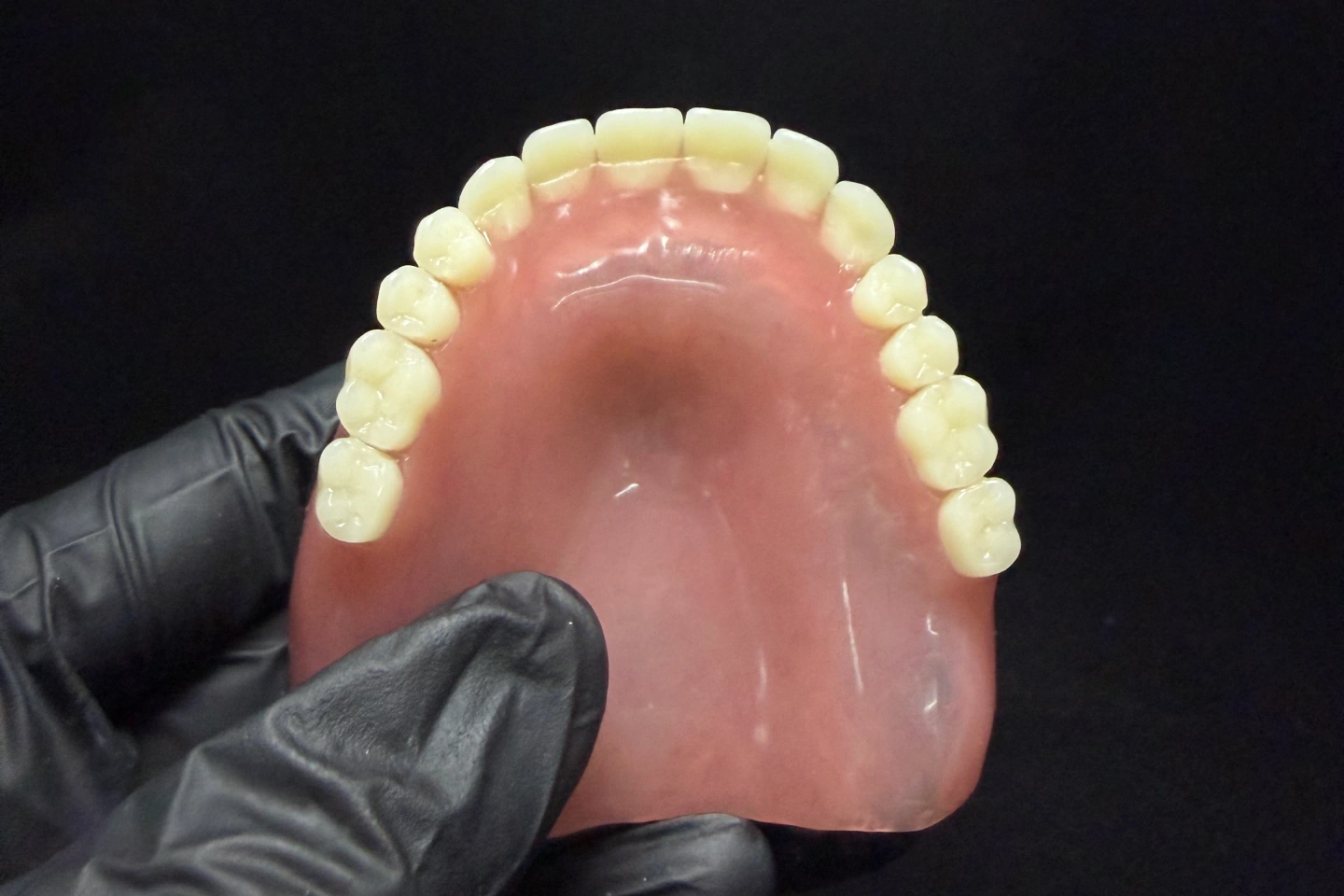
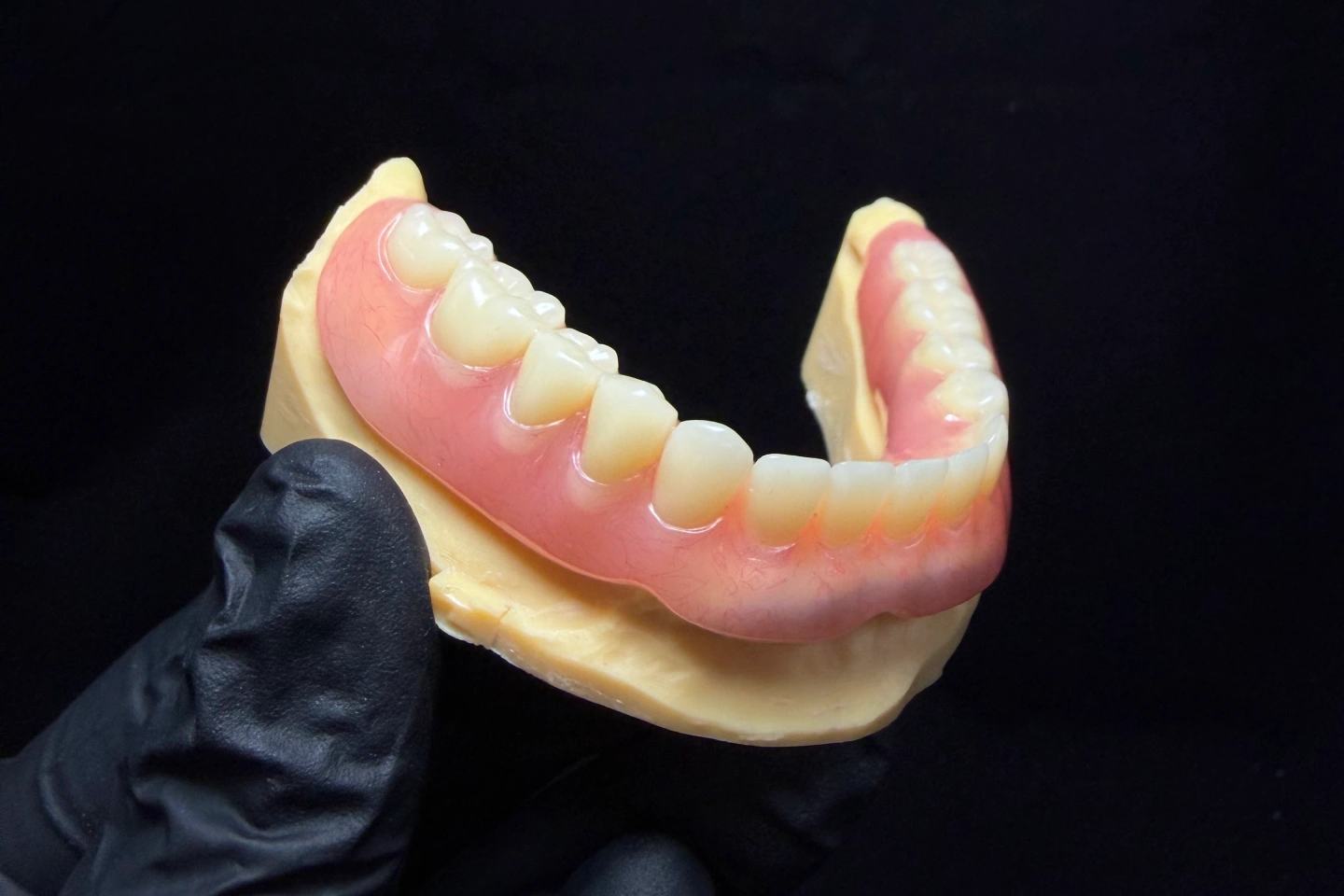
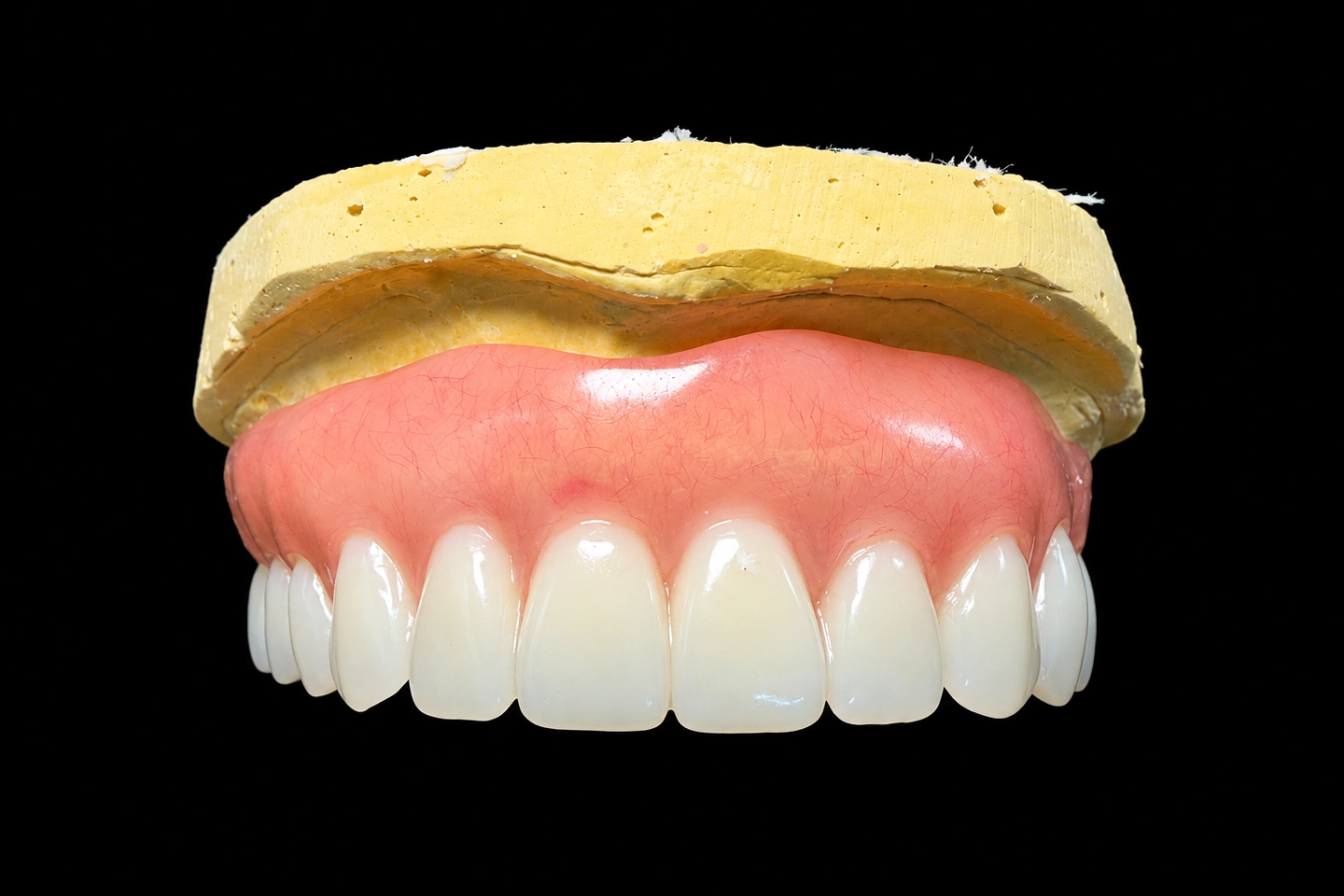
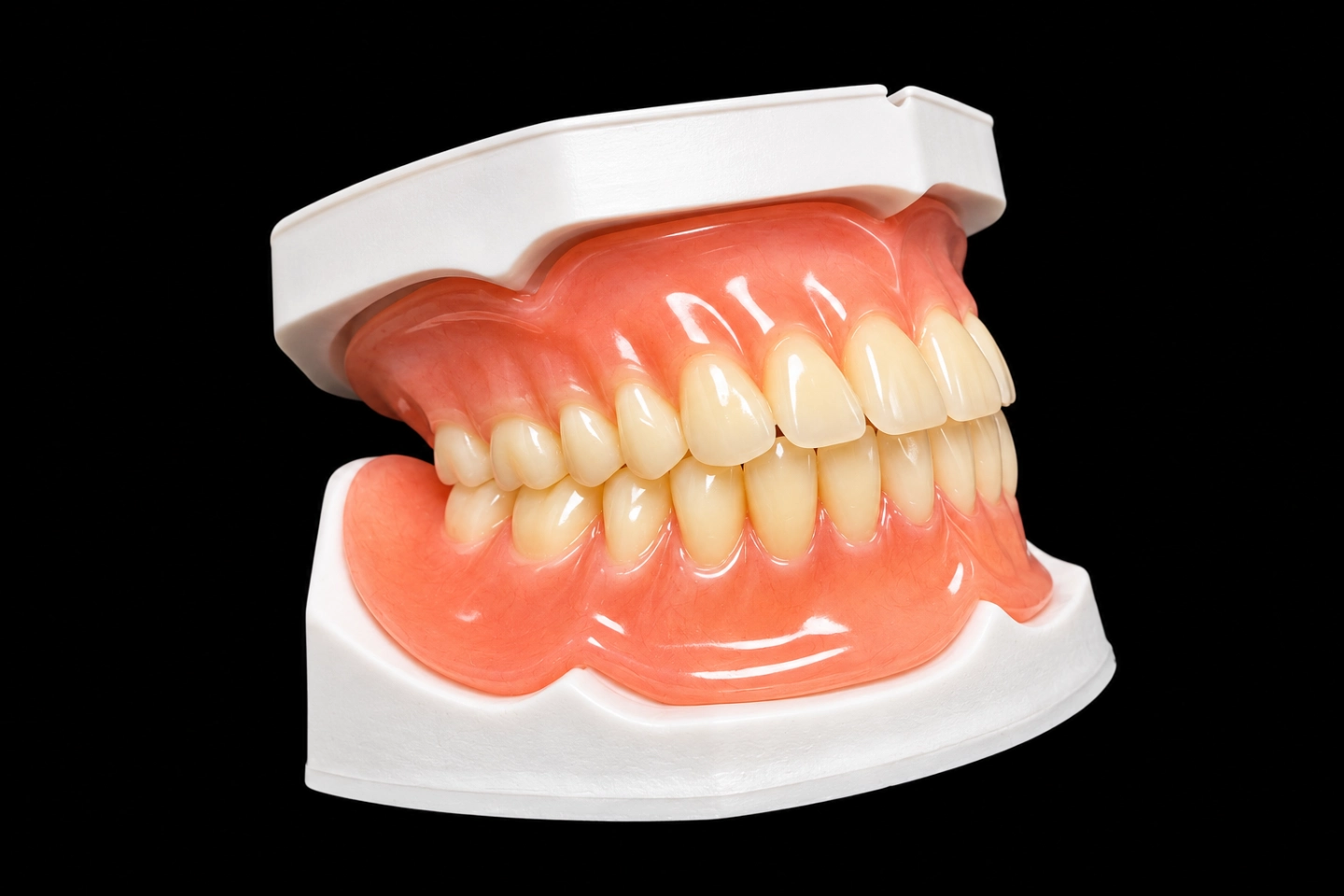
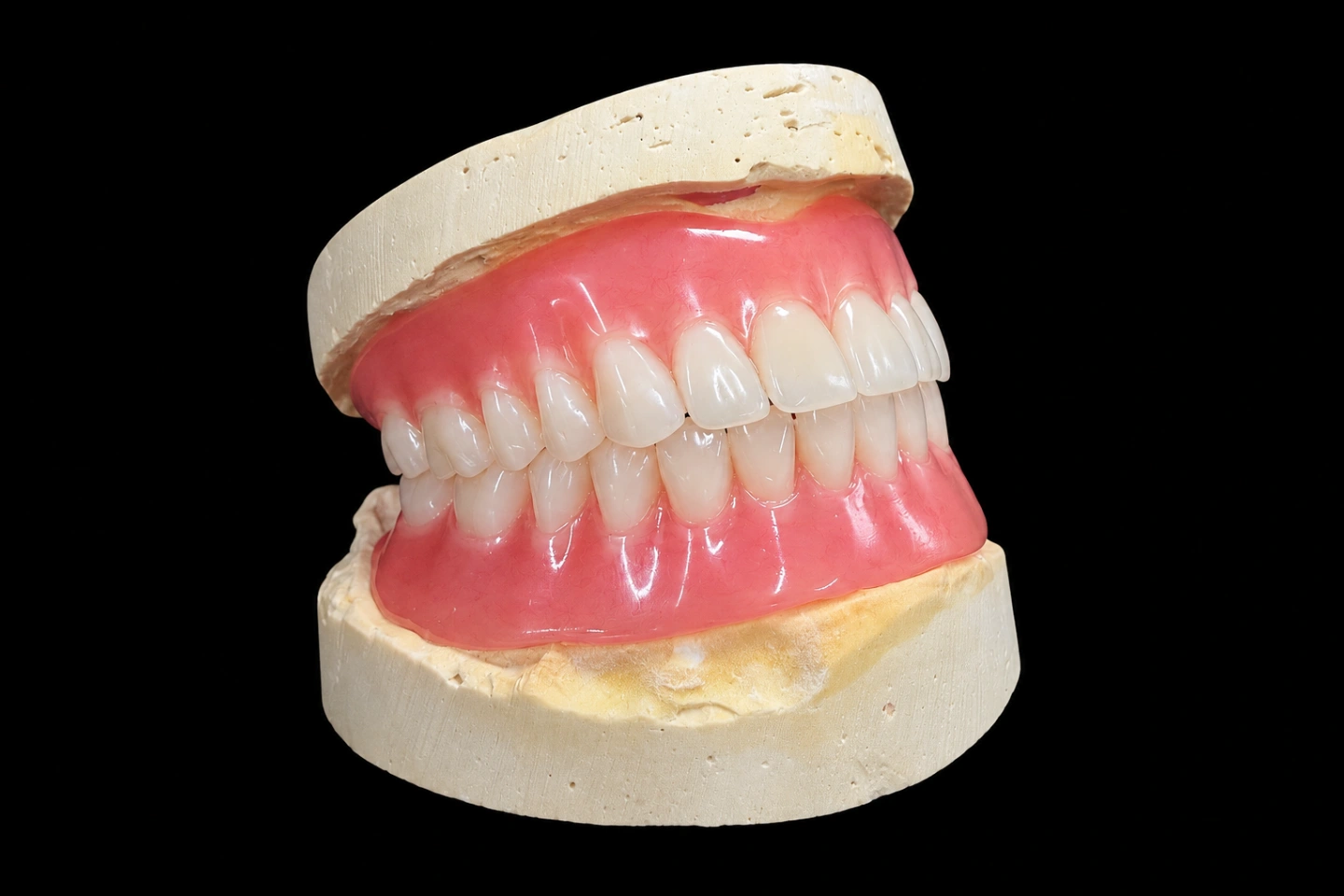
Common Questions We Hear
Can you work from an existing denture?
Yes. If the patient’s current denture fits reasonably well and we’re replacing it like-for-like, scan or impression the surrounding tissue and send the old denture. We can duplicate form, and confirm occlusion and vertical dimension with a bite registration. The duplication-plus-adjustments route is often faster than starting from scratch.
How is a digital try-in different from a wax try-in?
A digital try-in is a printed or milled mock-up of the planned arrangement in resin, seated in the mouth. It won’t flow against the mucosa the way wax does, so it doesn’t let you read soft-tissue displacement. What it does hold is the arrangement itself, rigidly and identically to the file, which some clinicians prefer for photographic review with the patient.
What do I send for a reline, rebase, or add-a-tooth?
The upper and lower models or scans, the existing denture, and a bite registration. Compatibility between the original acrylic and the repair resin is case-dependent, so we test the bond on the repair before it ships.
Can my scan files or case data be used for anything other than my case?
No. Scan files, prescriptions, photographs, and any patient data stay yours. We hold a processing right for the duration of the case, we don’t use the data to train anything, and we’ll sign a confidentiality agreement on request.
Who do I talk to if there's a technical question mid-case?
A project coordinator is assigned to the case and routes technical questions to the lead technician on the removable floor. Complex or repeat cases get a senior technician’s review before the set-up is finalized.
Request a Case Review
The fastest way to know whether we fit your practice is to send us a case. Prescription, scans or impression plan, and a short note on anything unusual.
Start with one case. If it doesn’t come back the way you would have made it yourself, you’ve lost a case, not a supplier relationship.
Send a case to our case-review inbox, or ask us to open an account first. Either path starts the same conversation.
Sources
- Anadioti E, Musharbash L, Blatz MB, Papavasiliou G, Kamposiora P. 3D printed complete removable dental prostheses: a narrative review. BMC Oral Health. 2020;20:343. PMID 33246466.
- Srinivasan M, Kamnoedboon P, McKenna G, Angst L, Schimmel M, Özcan M, Müller F. CAD-CAM removable complete dentures: a systematic review and meta-analysis of trueness of fit, biocompatibility, mechanical properties, surface characteristics, color stability, time-cost analysis, clinical and patient-reported outcomes. J Dent. 2021;113:103777. PMID 34400250.
- Dimitrova M, Vlahova A, Hristov I, Kazakova R. Bonding efficiency between artificial teeth and denture base in CAD/CAM and conventional complete removable dentures. Materials (Basel). 2024;17:3138. PMID 38998221.
- Goldstein G, Kapadia Y, Campbell S. Complete denture occlusion: best evidence consensus statement. J Prosthodont. 2021;30(S1):72-77. PMID 33336857.
- Bhutta HE, Moharamzadeh K, Martin R, Martin N. Patient satisfaction with upper and lower complete dentures: a service evaluation report. Eur J Prosthodont Restor Dent. 2023;31(1):59-71. PMID 35852120.
- McGarry TJ, Nimmo A, Skiba JF, Ahlstrom RH, et al. Classification system for complete edentulism. The American College of Prosthodontists. J Prosthodont. 1999;8:27-39. PMID 10356552.