Chrome Cobalt Partial Denture: Cast or Milled Framework, Made In-House
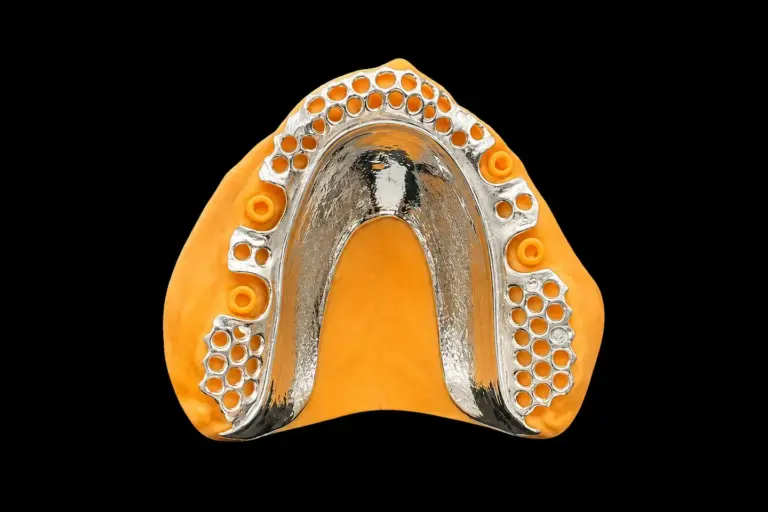
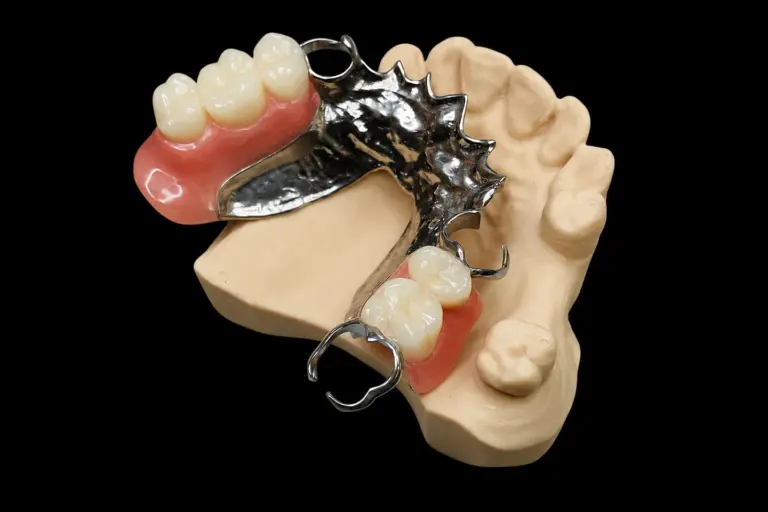
A chrome cobalt partial denture is a removable prosthesis built on a cobalt-chromium framework that rests on the remaining teeth and the ridge, carrying acrylic saddles and acrylic or composite teeth. Four things decide whether a lab is the right fit for one: what it can take on, how long the turnaround really runs, what has to travel with the case, and who pays when something comes back.
We have run one dental laboratory since 2012, not a trading desk, with production in Shenzhen and Huizhou. Cases are not sublet. The removable department alone runs about 55 bench technicians, and that is the part of the building where a cobalt chrome partial denture is actually made. For the wider picture, the laboratory and its departments are described separately.
Specifications you can send to a case coordinator today
Ten rows for a chrome cobalt partial denture, each one a line on the Rx or a question that comes up on the first call.
| Field | What we support |
|---|---|
| Framework material | Cobalt-chromium (default); Vitallium, commercially pure titanium, and PEEK available |
| Framework route | Cast or 5-axis milled; the route is fixed at design approval |
| Base material | Heat-cure PMMA, injection PMMA, 3D-printed denture base, or milled puck; Lucitone 199 on request |
| Teeth | VITA, Ivoclar, Shofu, or resin-composite; mold and shade per Rx |
| Case records accepted | Intraoral scan (STL, PLY, OBJ, DCM, 3Shape native) or VPS, polyether, or polysulfide impression with a bite registration |
| Scanner platforms | 3Shape Trios, iTero, Medit Link, Shining 3D, Primescan, DS Core, Dexis, Ori, Panda, or any STL by WeTransfer |
| Try-in options | Wax try-in, printed try-in, or framework-only try-in before processing |
| Response window | Within 1 hour in working hours; up to 12 hours outside them |
| Rush service | Any case type; no surcharge while monthly volume stays under 10 cases |
| Paperwork | Certificates, registration numbers, and per-case material certificates, supplied on request |
Framework material: when cobalt-chromium is right, and when it is not
Cobalt-chromium, written the other way round as chromium cobalt in plenty of European lab work, is our default. It is the most-used alloy in removable prosthodontics because its modulus is high enough that a thin major connector does not flex under function, and because it stays dimensionally stable through casting and heat treatment.
ISO 22674 is the standard that governs it. The 2022 edition sets requirements and test methods for metallic materials in fixed and removable restorations, and sorts alloys into Types 0 to 5 by proof stress, elongation, and modulus. Type 4 covers removable partial denture frameworks and clasps; Type 5 adds a modulus floor of 150 GPa for thin-section work. Our CoCr and titanium frameworks are supplied with conformance documents against those criteria.
| Material | When it is the right call | What you give up |
|---|---|---|
| Cobalt-chromium | Kennedy I to IV, bilateral free-end, long edentulous spans that need a rigid major connector | Heavier than titanium; a patient with confirmed Co or Cr sensitivity needs another option |
| Vitallium | Where a named premium alloy is specified for warranty or house-brand reasons | Same lead time as CoCr; higher cost |
| Commercially pure titanium | Confirmed cobalt or chromium contact sensitivity, or a documented preference for a lower-density framework | Clasp behavior over time differs; in our workflow it is milled rather than cast |
| PEEK | Confirmed metal allergy, no-metal aesthetic cases, and function that tolerates a polymeric frame | Lower modulus than CoCr; not a drop-in substitute, rest seats and clasp geometry change |
The clinically useful question is whether this patient has reacted to cobalt, chromium, or nickel before. If the answer is yes, the plan moves to one of the alternatives above and we work through the design trade-offs before anything is cast. We do not describe cobalt-chromium as inert or low-allergy, because the patch-test literature does not support it. Biological evaluation of the materials follows ISO 10993-1.
Three questions worth asking before the impression
- Any reaction to costume jewelry, watch cases, or metal zippers?
- Any reaction to a previous metal denture, orthodontic appliance, or cast crown?
- A dermatologist-confirmed patch test showing cobalt, chromium, or nickel?
A yes to any of them moves the plan to titanium or PEEK, and changes the design conversation.
Fabrication, in-house
Two routes.
Investment casting, with investment, burnout, induction melt, and bench finishing. We use it for complex clasp geometry and where a specific alloy supplier has to be honored.
5-axis milling from a CoCr or titanium puck, with sintering and heat treatment where the material calls for it. We use it for repeatable geometry and tighter control on connector cross-section.
Either way the frame arrives in the removable department as metal and leaves as a finished prosthesis. The mesh and bead surface is sandblasted and cleaned before the saddle is packed; chemical primers are an adjunct, and the mechanical lock does the structural work.
Base processing runs three ways. Injection is dimensionally quieter and costs more. Milling is the most repeatable for a digitally designed case but is weaker at the finest soft-tissue detail. Heat-cure is still the right answer when a flange has to be reworked at try-in. We suggest a route when we see the case; the decision stays with you.
Quality control: three gates and an independent release
Every case passes three checks. Incoming records are reviewed before design starts. In-process checks run between departments, so a framework does not leave metal until someone other than its maker has inspected it: voids and porosity under the microscope, clasp arm form, seating on the master cast with no visible rock. The last gate is release QC, run by a 25-person team that reports outside production. A case that fails release is rebuilt without asking the client to approve the rework first.
Clients can write their own acceptance criteria into the case file at approval: a defined vertical overlap on a clasp arm, a tolerance on rest seat adjustment, a shade that has to match a prosthesis the patient already wears. Criteria set in writing at approval become part of the QC record.
Photographs at release are available on request. Every case carries a number that binds to the operating technician, the CAD designer, the machine, the alloy heat and lot, and each checkpoint, and records are held for three months by default with longer retention for cases likely to face a complaint or an audit.
How we count turnaround, and what pauses it
Turnaround for a partial depends on arch complexity, the framework route, and whether a try-in sits in the schedule. A single number quoted before anyone has seen the case tends not to survive contact with it, so we return a working-day commitment with the case acknowledgement instead.
Working days only. Weekends and Chinese public holidays are outside the committed count.
The clock starts the day the complete case lands, not the day you ship it. For a scan that means the upload timestamp; for physical records, the day our receiving team confirms the impression is usable.
Three things pause it: design-approval wait, a missing record, and a material-change request. When the case resumes, the committed days restart from the point of resumption.
Transit is quoted apart from all of this. Customs clearance and remote-area delivery sit outside the carrier’s stated time, and none of it is padded into our figure to make the lab side look shorter.
If a chair appointment is already on the calendar, tell us the date when the case goes in and we will back-plan the schedule from it.
Who pays for a remake
A chrome cobalt partial denture that comes back is where goodwill gets spent, and it is the question that rarely gets asked up front. We apply the same rule every time.
| Reason the case comes back | Treated as |
|---|---|
| Framework will not seat, or rocks on the master cast at try-in | Remake at our cost |
| Clasp arm non-retentive, over-contoured, or off the survey line we agreed | Remake at our cost |
| Occlusion high at delivery against the records supplied | Adjustment or remake at our cost |
| Base porous, warped, or showing undercut saddles | Remake at our cost |
| Aesthetic flaw inside the approved shade and mold | Remake at our cost |
| Shade or mold changed after approval | Rework quoted; re-processing carries a new case fee |
| Material swapped after fabrication starts, CoCr to titanium say | New case; prior work credited where possible |
| Impression or scan flagged as marginal and you asked us to proceed | Rework at list price |
| Prep or abutment changed clinically after seating | New case |
| Framework needs modification because a design you supplied as a finished STL did not seat | Rework at list price; see the note below |
A problem should reach us within 24 hours of the practice seating the restoration. We ask for the case number, patient alias, product, the reason, and photographs. Returns go onto the next-rush track and most ship back within 3 to 5 working days of landing in QC. Return freight and implant components sit outside the remake. If a second attempt still misses, the fee is refundable.
When the design file comes from you
If you send a locked file to mill or print, we do not re-engineer it. Thickness, clasp geometry, connector cross-section, and major-connector relief go to the mill as drawn. We will flag a hard failure, a connector under the alloy minimum for instance, but we will not redesign without instruction.
That is the honest version of the split. Labs send us CAM work because they want their own design honored, not revised, and this is what that costs: the design responsibility stays with the sender. Full-service cases, where our CAD team draws the framework, run through approval and the table above.
What to send with the case
Five inputs decide most of the outcome on a chrome cobalt partial denture. Get them right and the framework seats without chairside grinding.
- A model or scan that captures the undercuts cleanly. An intraoral scan runs 2 to 3 teeth distal to the abutments and includes the retromolar pad on the lower and the hamular notch on the upper. For VPS, the tray needs full extension and a molded border; a short tray loses the saddle extension.
- The survey analysis and the path of insertion you want. This is the input most often skipped, and agreeing on the path before fabrication is cheaper than redesigning after a try-in fails to seat.
- Measured undercut depth at each clasp site. 0.25 mm and 0.5 mm cover most cast CoCr clasp designs. Give the figure; the arm gets drawn to it rather than guessed from a generic retentive value.
- A bite record you trust. Centric relation where the case allows, otherwise maximum intercuspation with a note. Records that disagree with the opposing arch are the commonest cause of a high framework at delivery.
- The design plan. Clasp type (I-bar, circumferential, RPI, combination), rest seat position, major connector (palatal strap, lingual bar, lingual plate), and how far the minor-connector mesh extends.
For full-service CAD, the designer returns a 3D preview and a top-down drawing for approval. Sign-off covers four things: clasp type at each abutment, rest seat positions, major-connector dimensions, and mesh coverage. Two rounds of design modification are inside the base fee. Re-opening an approved design for a path change adds one to two working days.
Cross-border logistics
Transit is the part of the schedule we do not fully control, so it gets stated plainly.
Carriers are DHL, FedEx, UPS, and SPIDER in France. A client can ship on their own account or on ours at the negotiated rate. Outbound freight on a first case is the client’s; on a remake we cover the return leg above a case-value threshold. Duties, taxes, broker fees, and remote-area surcharges belong to the importer, and none of it is folded quietly into a unit price.
Insurance is not included by default. Declared-value cover is available at cost and pays the processing fee or the declared value, not the cost of a re-booked chair. Cases can be consolidated, and a weekly packout suits most practices. A change of address or an urgent split works before packout, gets difficult after sintering, and stops once a carrier has scanned the parcel. Tracking goes out the day the case ships, and a named handler on our side follows it until it clears customs.
Compliance and paperwork
The quality system runs under ISO 13485. We hold establishment registration with the US Food and Drug Administration, and the device listings cover custom crowns, bridges, inlays, veneers, custom implant abutments, full and partial dentures, and temporaries. For the EU we file Annex XIII custom-device declarations for the Class IIa restorations we ship into member states through our authorized representative. For the UK we hold MHRA registration. Certificate copies and current registration numbers go out on request, and we answer supplier questionnaires and sit through on-site or video audits.
One point of terminology: the FDA does not approve custom dental restorations. The accurate description is that we are a registered establishment and the device types we ship are listed on the agency’s public database. Both are checkable in a few minutes, which is the reason for stating it that way.
Material certificates are issued per case with alloy brand, country of origin, lot number, and the manufacturer’s declaration. ISO 22674 requires nickel above 0.1% to be declared and caps beryllium, cadmium, and lead at 0.02%, so those figures are on the sheet when nickel matters to the patient in front of you.
Working with us on a first case
Send a scan, or ship a VPS impression with the Rx. A shipping label can be issued if a courier account is not set up yet. A single case is fine as a trial. Sustained one-case-at-a-time shipping is the pattern we struggle with, because international freight on a lone unit swallows the margin at both ends.
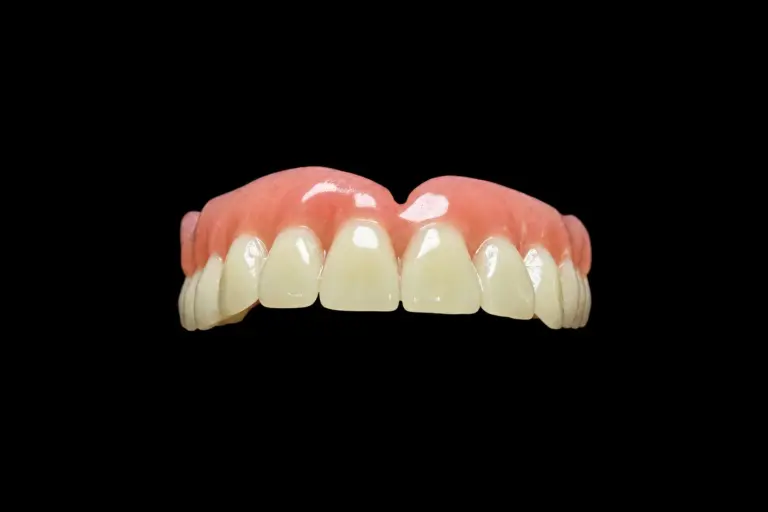
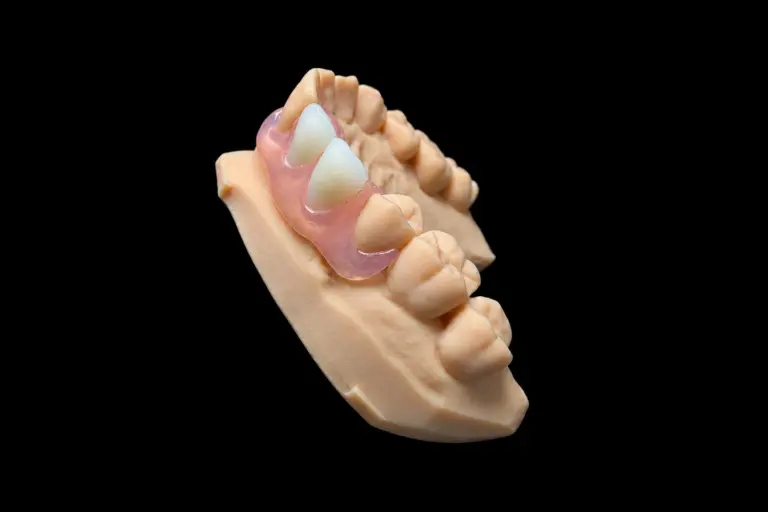
Cases outside this one’s scope run through the same building: full dentures, flexible partials, guards, and repairs all sit in the removable department, which is worth knowing if a patient needs a cobalt chrome frame plus a new lower at the same time.
Fees are set by units, material, and design complexity, and design, model, components, packaging, and freight are all inside the quoted figure rather than added after. You get a written fee for the specific case before fabrication starts. Bank transfer or PayPal, one-month terms on application, invoicing per batch with monthly statements for anyone who wants them.
Each client gets a sales manager and a case coordinator. Working hours are 09:30 to 18:00 China time, and managers stretch that for urgent cases. NDA, quality agreement, and supplier questionnaire are all signed on request. A lab client can run on its own naming, labeling, and packaging standards, and we do not approach its customers.
If the gap between what a practice expects and what a lab receives is the part that usually costs you a remake, there is a separate note on that handover. Otherwise, start with one routine case you can read quickly at delivery, and scale once it reads clean.
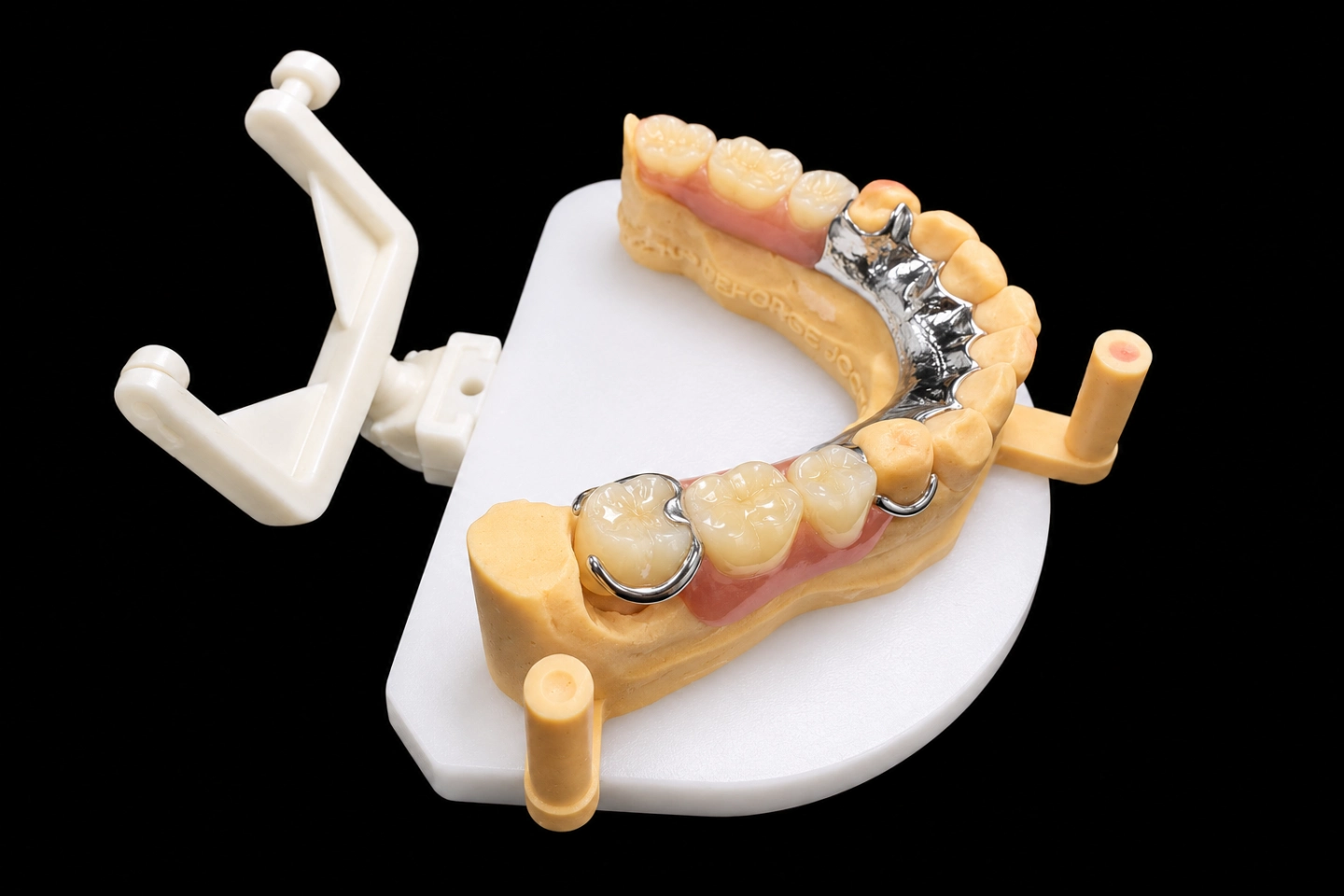
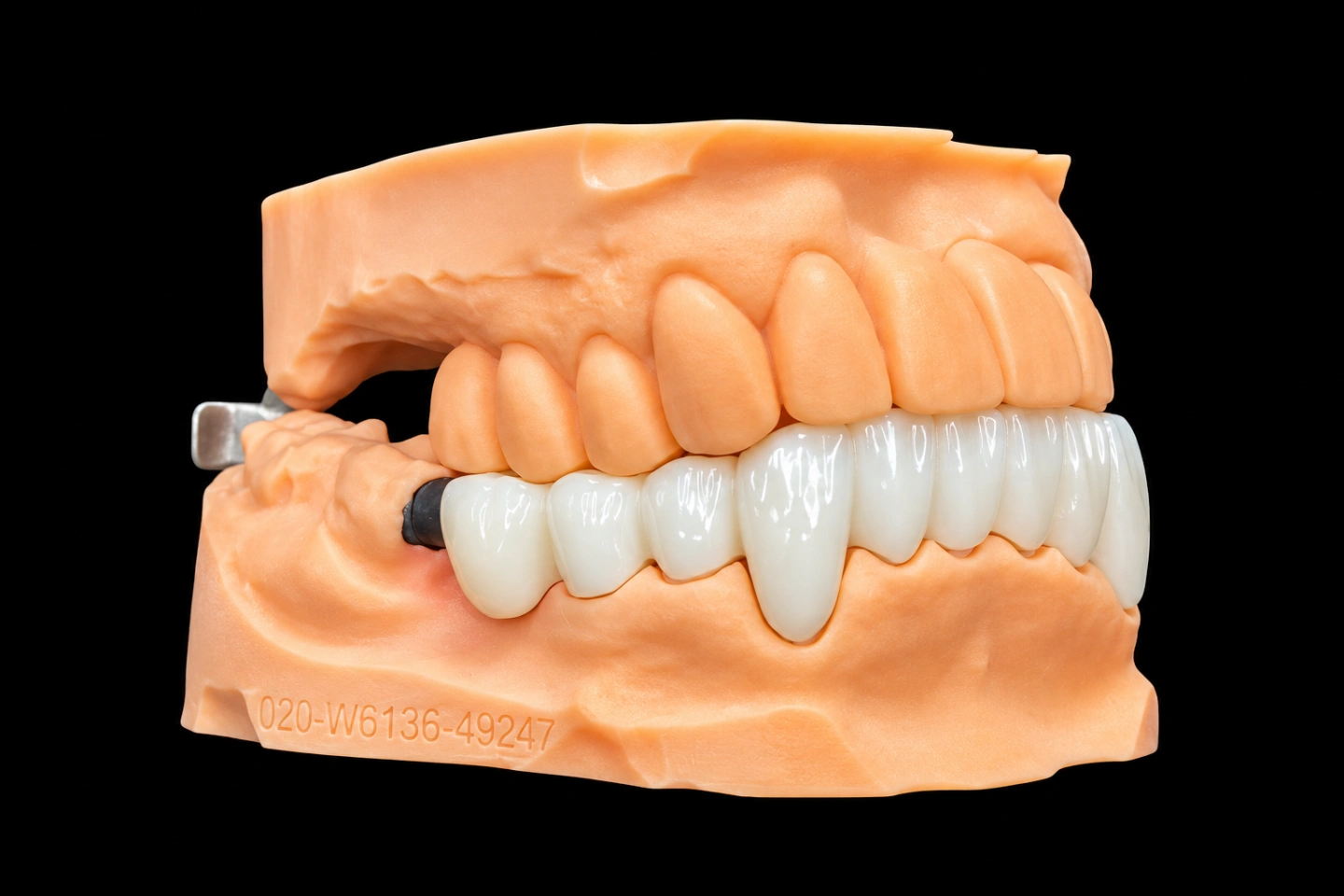
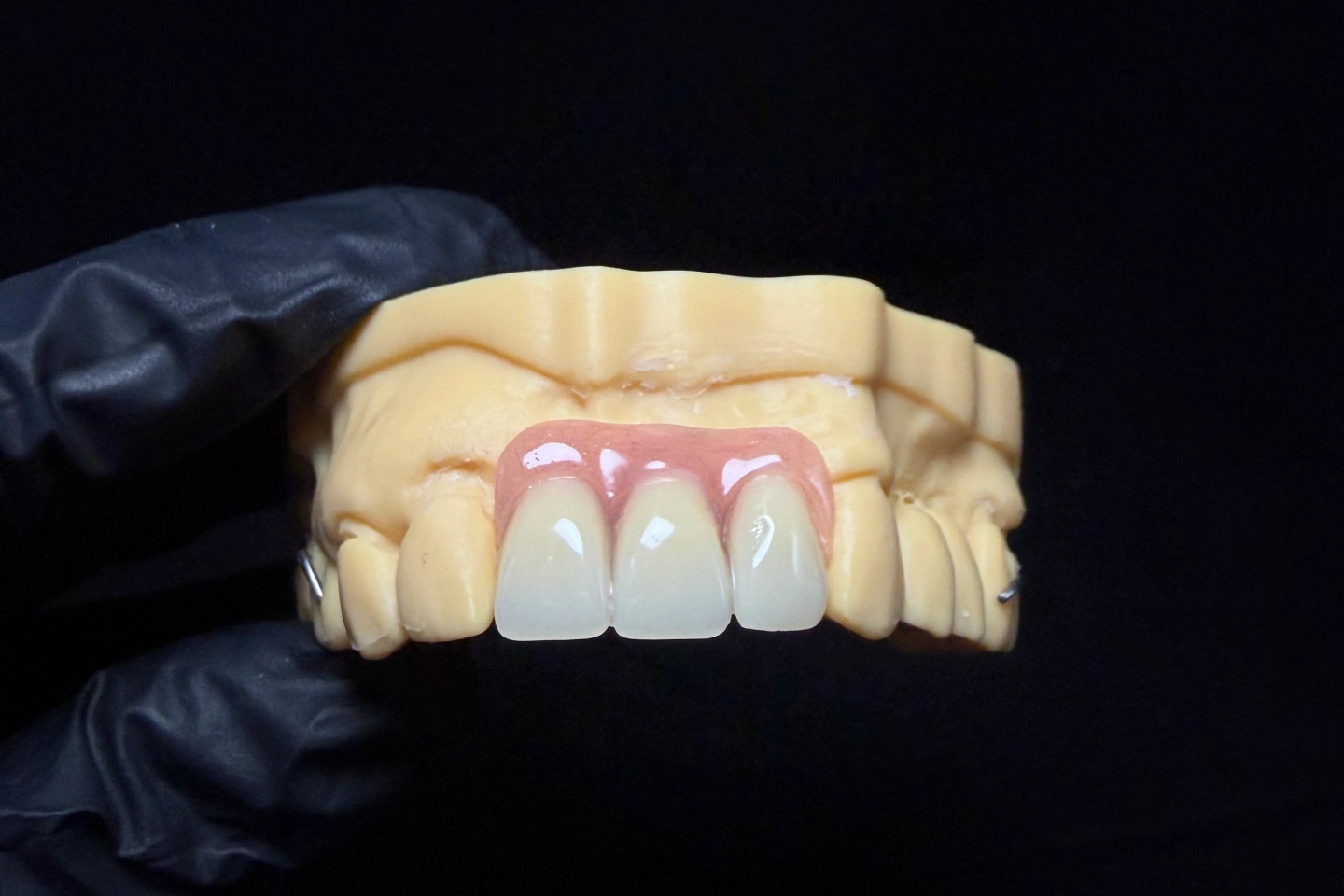
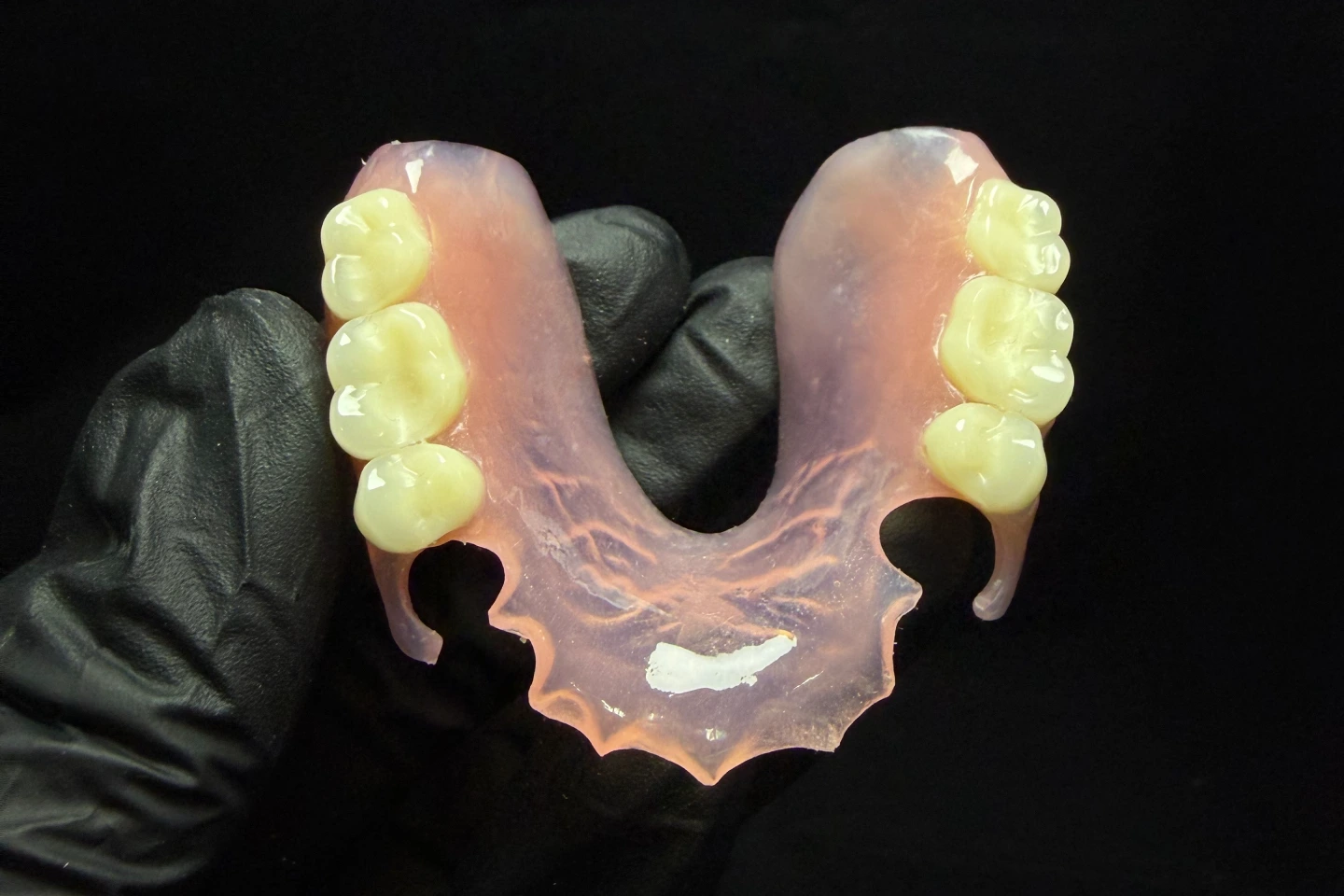
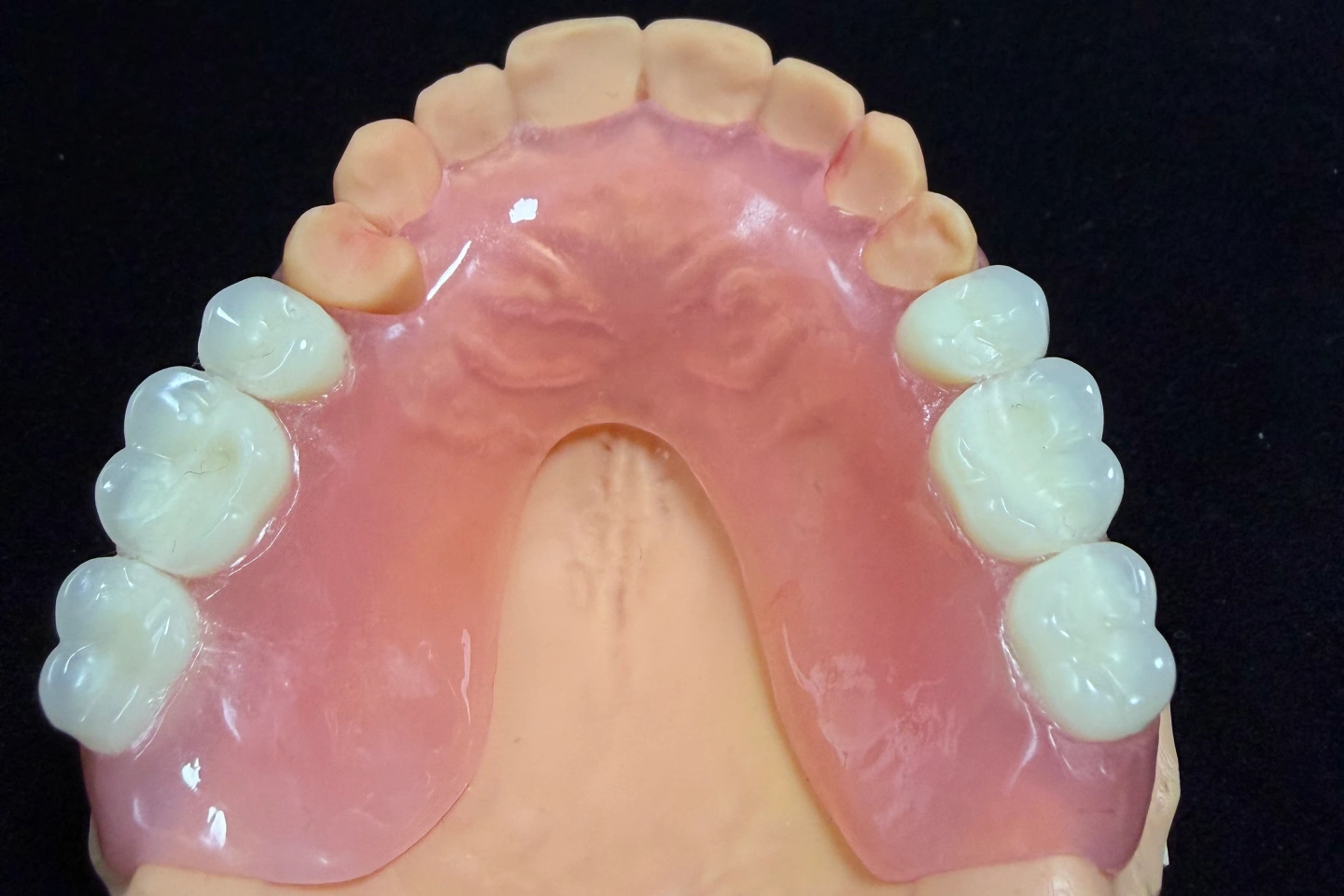
Cases from our lab
Questions that come up before a first case
Do we get the design files?
Yes, on request. Files go to the practice or lab that ordered the case, by email or through the case work group. Some lab clients archive them as their own record for a repeat case; others use them to brief a local mill on a rush job.
Can you take CAD-only or CAM-only work?
Both, plus the whole case. Design only, mill-and-sinter only from a file you send, or full service. Labs with their own design department usually send the CAM half; practices without a scanner send everything.
Can you add a tooth to a framework another lab made?
Usually. We need the upper and lower casts, the existing prosthesis, and a wax record. If the frame is already fractured, add an impression and a bite record to that list. We look at what is there and quote the addition before touching it.
What happens if the records arrive incomplete?
The case is paused rather than started and corrected later. We come back to the practice the same day, then every second day until the missing item arrives, because a framework designed around an assumption is a remake waiting to happen.
Is a digital case faster than posting an impression?
Fabrication time is identical. The difference sits in the leg between practice and lab: a scan arrives in minutes and never sees a customs desk, while a physical impression adds transit and clearance. Call it a day or two, with lower freight.
Can you copy the shape of the patient's existing denture?
Where the scan or impression captures the neighboring teeth, the shape can be duplicated. Bite and vertical dimension come from a wax record, not from the old prosthesis on its own.
Send a case for a quote
Send the Rx, the records, and the appointment date. You get back a working-day commitment, a fee for that specific case, and a proposed framework design within one working day of complete records arriving. Say in the note that it is a first case and it goes onto the priority receiving track.