Acrylic Partial Denture
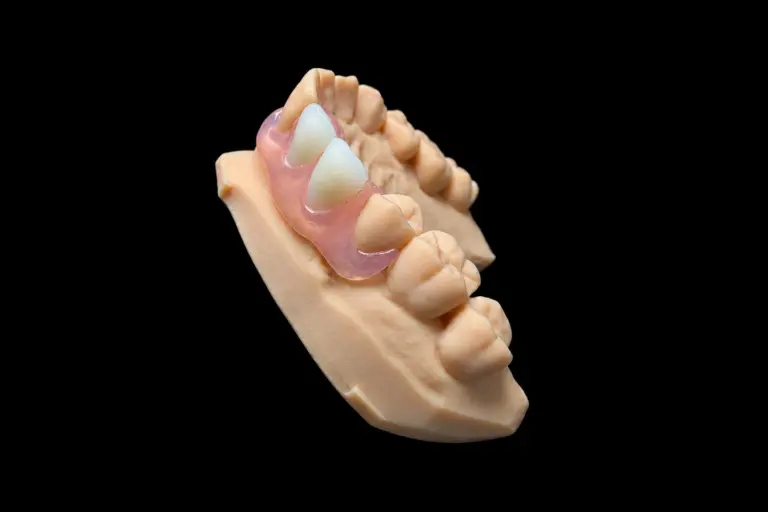
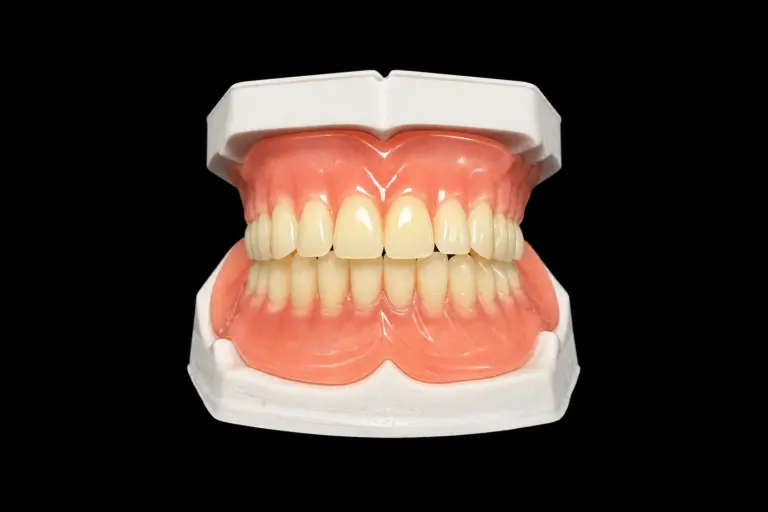
An acrylic partial denture — or acrylic removable partial denture, depending on how your office refers to it — is not a single product. It is a combination: a pink PMMA base that rests on the patient’s residual ridge and remaining teeth, a set of artificial teeth, and, in most prescriptions, wrought-wire or cast clasps. What separates two quotes for the same case is rarely the material family. It is how the base is processed and which resin tier the lab actually fills with.
One prescription, four ways to build the base
At Istar Digital Dental Lab — a full-service manufacturing laboratory operating since 2012, with facilities in Shenzhen and Huizhou — the removable department runs about 55 technicians inside a team of roughly 460. Records, model and CAD work, processing, finishing, and QC all stay in-house. Heat-cured, injection-processed, milled, and 3D-printed acrylic bases run on the same floor, so the route can be matched to the clinical constraint instead of defaulting every case to the one method the lab happens to be set up for.
Four decisions determine what you get: the processing route, the base resin tier, the tooth tier, and the design. The first three are where labs quietly differ.
Where an acrylic partial sits in the product range
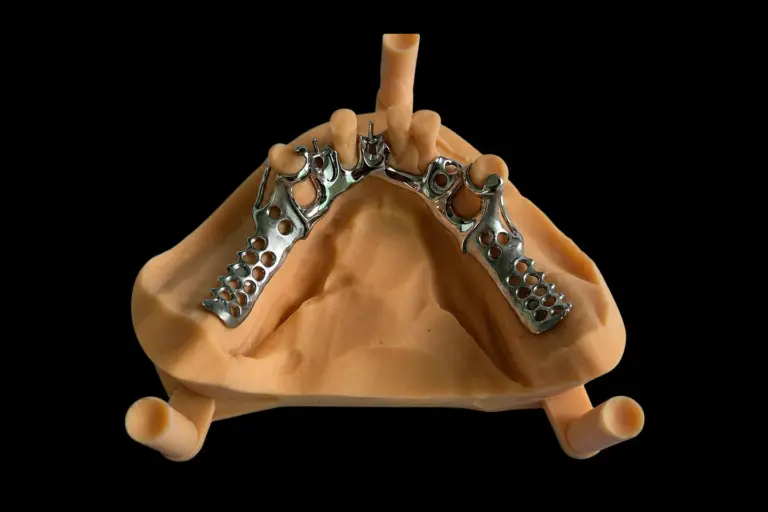
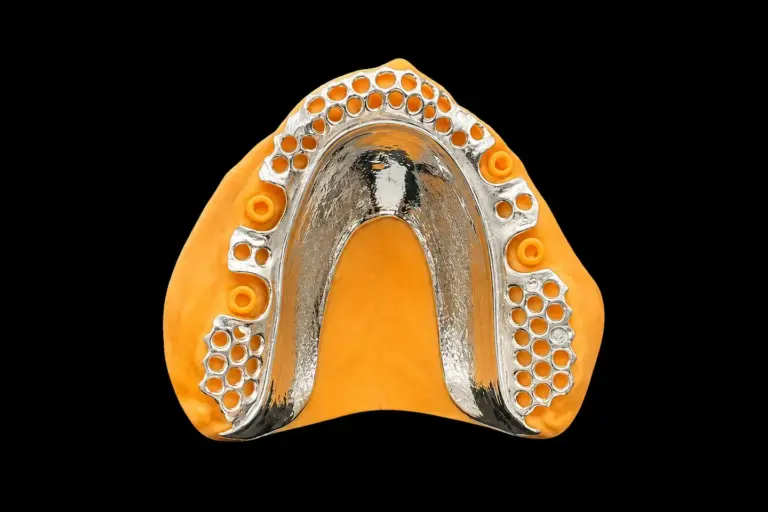
In our shop, an acrylic partial denture — the acrylic removable partial denture many practices call an “acrylic RPD” — is a removable prosthesis whose entire base is PMMA (polymethyl methacrylate). Retention comes from base extension and, where prescribed, clasps embedded in the acrylic. There is no cast metal framework. Cases needing rests, major connectors, and surveyed abutments belong on the cast metal framework partial denture line; cases of one or two units needing aesthetic clasps with no occlusal load concern usually belong on the flexible partial line.
Two case types dominate what referring dentists send us:
- Transitional and immediate work. A stable, reproducible prosthesis worn while implants integrate or while a definitive plan is settled.
- Economy long-term partials. Patients who need function and acceptable aesthetics now, on the understanding that an acrylic base is mucosa-borne and holds its fit only if relined on a schedule. The reline interval is a clinical judgment; the lab’s job is to return a base that keeps its dimensions between visits and a set-up that can be re-articulated when maintenance comes due.
The four processing routes, and when each one is the right call
Route selection changes four things: dimensional stability, how faithfully the fitting surface reproduces soft tissue, how much thickness can be recovered in anatomy-limited areas, and cost. The material class stays the same.
| Route | What happens | Best suited for | What it gives up |
|---|---|---|---|
| Heat-cured PMMA (packed) | Dough-stage pack into flasks, pressure-closed, staged water-bath polymerization, slow cooling in the bath | Conventional partials where cost control and a well-characterized acrylic matter most | Longer floor time; polymerization shrinkage has to be managed by cycle rather than avoided |
| Injection-processed PMMA | Resin injected under pressure into the closed flask, then polymerized | Cases where seating on the ridge is the success criterion — flabby ridges, undercut tissue surfaces, retained roots, patients with little tolerance for post-insertion adjustment | Higher cost per unit |
| Milled (CAD/CAM) pre-polymerized puck | Design in CAD, mill the base from a cured PMMA puck, join teeth mechanically or by bonding | Digital workflows, cases needing repeatability across visits (duplicate or backup prostheses, iterative try-ins), fully digital protocols | Strong on repeatability, weaker on fine soft-tissue expression; borders and vestibular anatomy may need manual refinement |
| 3D-printed denture base resin | Print the base in a certified denture-base resin, post-cure, assemble | Fast interim, backup, or try-in bases; practices already working in a print workflow | Needs a certified resin, controlled post-cure, and a clinical track record for the specific resin requested |
Two rules of thumb we apply when advising on route: a case that has to sit on a difficult soft-tissue bed is usually an injection case, and a case that has to be reproducible because a second identical prosthesis is planned is usually a milled case.
Base resin and artificial tooth tiers
Two decisions sit under an acrylic denture base: which resin brand, and which polymerization class. We carry three tiers, so a practice choosing between a long-wear partial and a budget-sensitive transitional case does not have to accept the same material for both:
- High-impact imported — Dentsply Sirona Lucitone 199. The default for long-wear partials and for patients with a history of base fracture.
- High-impact domestic — a Chinese-market high-impact PMMA, used when heat-cured high-impact performance is required but the budget is tighter.
- Conventional heat-cured PMMA — standard denture-base acrylic for transitional, interim, and economy cases.
Milled and printed lanes use PMMA pucks (Ivoclar, Upcera) and certified denture-base resins respectively. If your office specifies a brand that is available on the mainland market, we can run it; the substitution is recorded in the case file against your written approval.
Artificial teeth come in composite resin, acrylic, and porcelain, and we routinely stock VITA, Ivoclar, Shofu, and a domestic resin tooth line. Tooth tier does not have to follow base tier — the two are specified independently on the prescription.
For each case we can supply the resin brand, country of origin, lot number, and the supplier conformity document, keyed to the case ID. That is a lot-level record, not a generic materials statement. Material behavior over time in denture-base polymers is reviewed in Ivoclar’s technical note on material properties that define long-term denture performance.
The process controls that hold dimension
Base distortion in an acrylic partial denture rarely comes from the resin. It comes from how the resin is mixed, packed, and cooled.
- Powder-to-liquid ratio and dough-stage packing. Resin is filled during its workable dough phase. Packing early traps monomer; packing late strands fibers of partially set polymer.
- Flask closure under pressure. Flasks are closed and locked to a defined pressure before the bath. A soft close is among the most common sources of flash and loss of ridge contact.
- Staged water-bath polymerization. A stepped temperature profile rather than a direct boil. Direct heating is the largest single contributor to internal porosity in heat-cured bases.
- Slow cooling in the bath. The flask cools with the water. Quenching warps a base even when every earlier step was correct.
Injection and milled lanes shift the controls — injection pressure and gate position, puck orientation and tool paths — but the principle does not change: the dimensional work happens before the finish, never during it.
Where the design decision stops
Rest positions, direct and indirect retention, major and minor connector form, clasp selection, path of insertion, and tooth positions are prescribing decisions. We do not design a partial on your behalf. What we do is prepare the model and digital record so your design can be executed, and return the case when the record cannot carry it.
Three situations where a case comes back to you with a question rather than moving forward:
- The prescription calls for a cast clasp arrangement, but the master cast has no clear survey line and no documented undercut. We ask.
- Occlusal space is insufficient for the prescribed tooth. We flag it before set-up rather than reducing enamel or tooth height on our own judgment.
- A prescribed clasp sits on an aggressive undercut. You get a short note with the measurement before the clasp arm is engaged.
What the lab does own: set-up accuracy to the recorded jaw relation, base extension to the recorded border molding or scan-captured vestibular record, occlusal equilibration on the articulator, and the finish.
The current British Dental Journal guidance on acrylic removable partial dentures is a useful reference point for where the design limits sit: Top tips for removable partial dentures: Part 2 — acrylic removable partial dentures.
What gets checked before a case ships
Every case passes three formal inspection points — incoming records, in-process checks between stations, and a final release — and the final release is made by a QC technician who does not fabricate cases. Within the removable department, a four-stage check follows the sequence of clinical visits:
| Stage | What is verified | Why this stage matters |
|---|---|---|
| Cast or scan review | Ridge anatomy readable, no voids on bearing surfaces, articulation records legible | A compromised cast is the most common root cause of post-insertion rework |
| Wax trial | Tooth mould, shade, midline, vertical dimension, border extension on wax rims where used | The last stage at which a major change is still inexpensive |
| Set-up verification | Occlusal plane, interproximal contacts, aesthetic symmetry | Catches what would otherwise need a second remount |
| Processed denture, pre-ship | Seating on cast, border extension, clasp passivity, occlusion in centric and excursions, polish | Final release before packaging |
Porosity and base thickness are verified on the processed denture with calipers at the palate, border, and transition areas, plus a transmitted-light pass for internal voids, and a re-seating check on the master cast after polishing. A base with internal or multi-site porosity in a load-bearing area is remade, not patched.
Case photographs — fit on cast, intaglio surface, occlusal view — can travel with the shipment; request them on the prescription. Published reviews of technical complications in removable partial dentures are a reasonable frame for what fails and why: Technical complications of removable partial dentures in the moderately reduced dentition.
Case submission: physical, digital, or mixed
Physical impressions and models
PVS addition silicone is the first choice for international shipping, followed by polyether; poured stone models are accepted. Alginate is a poor candidate for international transit — the hydrocolloid dehydrates and distorts, and several destination countries hold or return unsanitized impressions at customs. Disinfect impressions per your office protocol and note the agent and contact time on the case form.
Digital files
STL, PLY, OBJ, DCM, and native 3Shape, exocad, and comparable design files are accepted, via 3Shape Communicate, Medit Link, iTero, Shining3D, Dexis, DS Core, and WeTransfer. Where tooth and gingival color is part of the record — anterior aesthetic partials — send PLY with color, because STL discards it. On long-span scans, keep at least 30% overlap at joins and avoid breaking the pass across stable anatomic landmarks.
Scan validation
Scans are validated before a case enters production. An insufficient margin, an occlusal mis-registration, or a stitching step over the ridge comes back as a specific rescan request rather than something we work around.
Mixed workflow
Where the master cast is physical but the clasp arrangement is designed digitally, the cast is digitized on our side and the case runs as a hybrid. For international partial work this is the most common path.
What a complete submission contains:
- Master cast or digital record of the arch to be restored
- Opposing arch
- Interocclusal record
- Shade and mould selection, or an instruction to match the adjacent teeth
- Clasp arrangement and tooth positions by FDI or Universal numbering
- Any space, undercut, or soft-tissue limitation already identified in the chair
- Any existing prosthesis the patient wears
Missing or contradictory records are returned with a specific question instead of being worked around.
How price and lead time are built
Pricing is built per case, because the inputs live in the prescription. The structure is consistent:
- Units and arch — upper, lower, or both
- Base resin tier — conventional heat-cured, high-impact domestic, Lucitone 199, milled puck, printed base
- Tooth tier and brand
- Processing route — packed, injection, milled, printed
- Design complexity — number and type of clasps, aesthetic requirements, duplicate prostheses
The quote covers design, model work, standard packaging, and outbound shipping where applicable.
Lead time is counted in business days from the day a complete record reaches our facility. Waiting on design approval, on missing records, or on a reply from your office does not count; the clock restarts once the record is complete. Transit, customs clearance, and remote-area delivery are quoted separately from fabrication. A case-specific figure comes back with the case review.
Rush work is accepted on all materials. Rush eligibility depends on the department load at the time, and the rush date is committed before the case is accepted, not after.
When a case needs to come back
Rework terms are stated on the quote and applied case by case. These are treated as laboratory responsibility and remade at no fabrication charge:
- The base does not seat on the ridge as recorded
- Visible rocking or flange lift against the master cast
- A clasp arrangement that does not match the prescribed path of insertion
- An occlusal error traceable to set-up rather than to the clinical records
- A shade or tooth-mould error against the written prescription
- A visible aesthetic defect, such as obvious porosity on a polished surface
Not absorbed: shade or material changes requested after delivery; fit discrepancies arising from a submitted impression, scan, or jaw-relation record that we flagged before fabrication and the practice elected to proceed with; shipping in both directions on a remake; and any implant or restorative component cost.
Rework moves ahead of the standard queue, with a typical turnaround of three to five business days once the piece and any new records arrive. A case that fails a second attempt escalates to a direct technician-to-dentist call; if that still does not resolve it, the fabrication portion is refunded. Every rework carries a root-cause note — record, process, or communication — so recurring patterns are visible to the account manager.
Working with Istar Digital
- Named contacts. Every account has an account manager and a case coordinator. Technical calls and video case reviews are conducted in English.
- Response times. During China Standard Time business hours (roughly 9:30–18:00, with extended coverage through the account manager), technical questions are answered within an hour; after-hours questions are answered within twelve hours.
- Trial cases. Single trial cases are accepted for new accounts. Sustained one-case-at-a-time shipping is marginal on international freight, so most working relationships settle into a weekly or batched cadence.
- Agreements and audit. NDA, quality agreement, and supplier agreement available. Standard supplier qualification questionnaires are completed, and annual audits are supported in person or as scheduled video audits.
- Regulatory status. Istar Digital operates an ISO 13485–based quality system, is FDA-registered and FDA-listed for the custom restorative categories exported (crown and bridge, custom abutments, implant superstructures, full and partial dentures), issues an MDR Annex XIII custom-made device declaration per prescription for the EU with our authorized representative, and holds MHRA registration for UK market access. Registration numbers are supplied on request and are verifiable in the public databases. These are market-access registrations, not product endorsements.
- Shipping. DHL, FedEx, UPS, and SPIDER in France. Cases can ship on your account or on Istar Digital’s contract rates, with insurance available on request. Destinations routinely served are North America, Western and Northern Europe, Oceania, and most of Asia.
FAQ
Can you duplicate a denture the patient is already wearing?
Yes, and it is a common request for a spare or backup prosthesis. Send an impression or scan that captures the adjacent teeth so the tooth forms can be reproduced, plus a bite registration for the vertical dimension and centric relation — the existing denture on its own does not carry the jaw relation. Where the patient’s current partial is broken, an impression and a bite record are still required alongside the pieces.
Can you add a tooth or repair a partial another lab made?
Yes. Send upper and lower casts, the existing prosthesis, and a bite registration. Additions and repairs are done in the same resin family as the original, with the old base cleaned and roughened and the processing temperature controlled so the existing acrylic is not distorted. The joint is strength-checked before the case is released.
What if the patient has a known metal sensitivity?
Nickel-free and beryllium-free options are available for clasps and any metal component. Tell us the specific sensitivity on the prescription, because the alloy choice changes with it and the substitution has to be documented on the case.
What photographs help you match shade and mould?
Ring flash or twin macro flash with diffusion, 5500 K, and no natural light. Face shots at eye level; intraoral shots with the lens perpendicular to the tooth surface and a mirror for occlusal views. Shoot at ISO 100, 1/125–1/200 s, f/8–11 for facial views and f/22 for intraoral. Include a shade tab in frame next to the natural teeth, and note any metal backing behind the tooth being matched.
How many design revisions are included?
One design pass with two free revisions. If a further change is approved early enough, it affects neither the delivery date nor the price.
Will an acrylic partial denture last five, ten, or more years?
Service life is a clinical and maintenance question rather than a material one. It depends on the opposing dentition, hygiene, the reline schedule, and how the residual ridge changes. Resin tier influences fracture resistance; it does not influence ridge resorption. A specific number would be a guess dressed up as a specification.
Send one case, get three things back
Put a real case in front of us — scan, impression, or a prescription draft — and the reply carries three things on the first business day:
- Whether it can be built as written — a short, specific read of what we would do and what we could not execute.
- What we would ask you to change — record gaps, undercut and space measurements that affect the prescribed clasp arrangement, and anything the prescription leaves open.
- A price and lead-time envelope — built from the prescription and the route we would recommend, not a flat per-unit list.