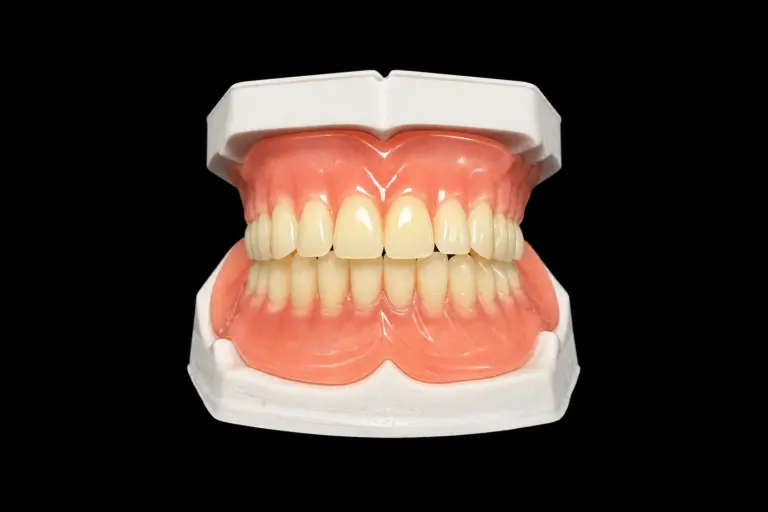
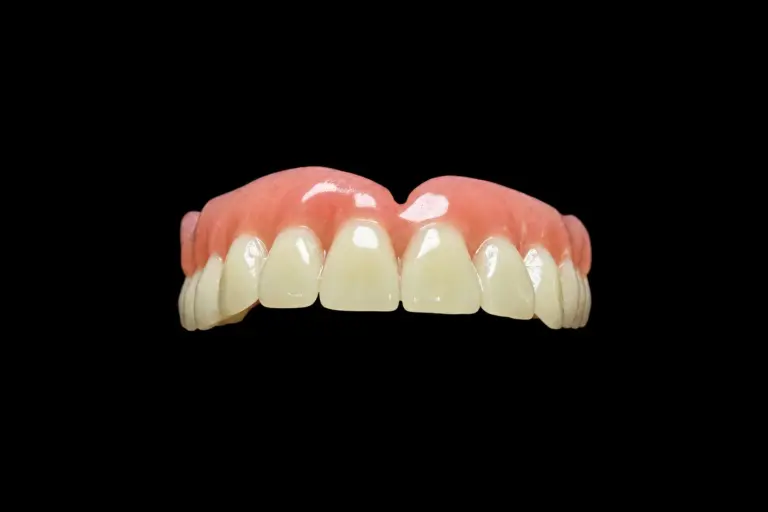
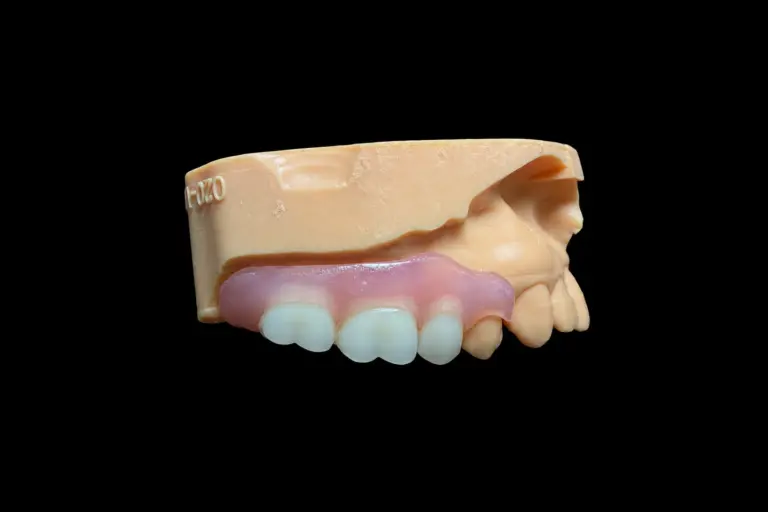
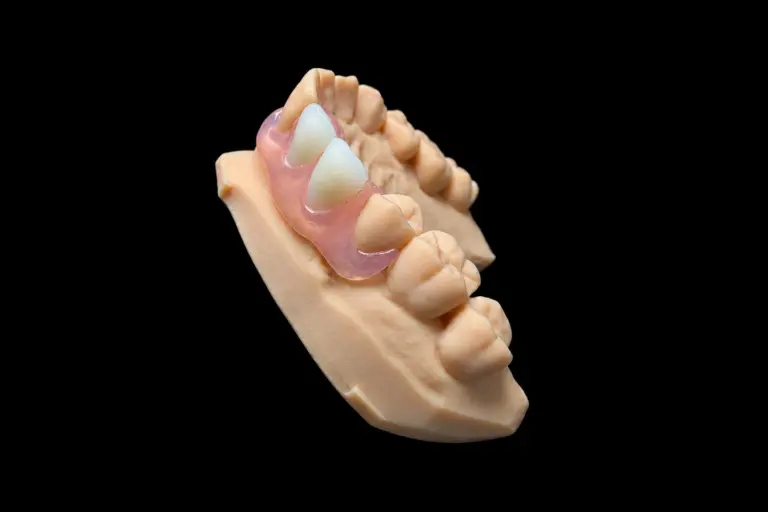
Patient Situation Behind These Dentures for Seniors
The patient was 86 and lived in an assisted living home. A family member drove her to the clinic, so every visit took planning .
Her dentures were 17 years old . Here’s what the dentist found:
The ADA lists exactly these signs as reasons to have a denture checked: wear, a looser fit, and needing more adhesive. A reline would’ve fixed the fit, but not the worn teeth or the bite .
The bigger issue was her. She told the dentist she didn’t want to “learn new teeth” at her age . At 86, the dentist wasn’t keen to bet on her getting used to a whole new set from scratch.
What the Dentist Asked For
The Rx was short :
The dentist couldn’t spare the old dentures for shipping, because she had nothing else to wear . So both were scanned at the clinic, inside and out, and the files came to us with the Rx, photos, and the dentist’s bite measurements .
It’s a typical Rx for dentures for seniors: keep what works, fix what’s worn. The dentist kept every chairside call: the bite measurement, the records, the try-in sign-off, and anything to do with her health. Our job was to design and make the copy, and to tell the dentist early if two parts of the Rx pulled against each other.
Why the Best Dentures for Seniors Aren't Always Brand New
You’d think the best dentures for seniors are the newest, most “correct” ones. Not always. A 2024 review of duplicate dentures in the Japanese Dental Science Review notes that older people’s ability to adapt drops with age. It says copies of an existing denture feel familiar and cause less stress.
Familiar matters because the lips, cheeks, and tongue have spent years learning the old shape. Change the outside of the denture and they have to learn again.
We’ll be straight about the evidence, though. The same review says only a few studies have actually tested whether duplicates work better. And in a Gerodontology study of 65 patients, copy and conventional replacement dentures came out about the same on oral-health quality of life. So copying isn’t magic. It’s a sensible choice for a patient who’s already shown she struggles with change.
The Technical Problem: A 4 mm Bite Change Breaks the Copy
Items 1 and 4 on the Rx didn’t sit well together. That’s the part we spotted once both old dentures were on screen, and it’s the trade-off that shows up with dentures for seniors who’ve worn one set for years.
What opening the bite does to a copied set
Opening the bite isn’t just making the back teeth taller. The lower jaw swings open around the joints, so the lower front teeth drop and move back relative to the uppers.
We mounted the old dentures’ scans on a virtual articulator from the dentist’s records and opened the bite step by step . At 4 mm, the copied lower front teeth ended up about 2 mm further behind the uppers than she’d ever had . To close that gap, we’d have to move teeth, and moving teeth is exactly what a copy is meant to avoid.
There were two more things. Her lower lip and cheeks would sit differently over taller teeth. And her speech had settled at the old height for 17 years .
A two-stage case report in Case Reports in Dentistry links lost vertical dimension in long-term denture wearers mainly to resorption of the lower ridge. The authors brought the bite back in two steps instead of one. That’s a single case, not a rule. But it lined up with what the dentist was already worried about.
The options we sent
We flagged the conflict and sent three options with screenshots of each setup :
| Option | What changes | What it costs |
|---|---|---|
| A. Full 4 mm | Tallest back teeth, the most room for cusps, matches the dentist’s estimate | The front relationship changes the most (about 2 mm more overjet); she gets a new height, new teeth, and new lip feel all at once |
| B. 2 mm now | Real cusps on the back teeth; front teeth stay where she’s used to them, with about 1 mm more overjet | Doesn’t restore the full estimate; the bite stays lower than the numbers say |
| C. Keep the old height | Closest copy; only the teeth surfaces and fit are new | Little room to put cusps back, so chewing barely changes |
The dentist picked B . The reasoning was simple. For this patient, the best dentures for seniors were the ones she’d actually wear, not a “correct” set she might leave in a drawer. We noted that anything beyond 2 mm later would be a separate decision for the dentist, not something built into this set.
How We Made These Dentures for Seniors
Step 1: Printed copies as trays and bite blocks
From the scans, we printed a copy of each old denture in resin . They weren’t for wearing. They were tools.
The review above describes this use too: duplicates as impression trays and for bite registration, cutting down on visits. The dentist border-molded, took the wash impressions, checked her speech and rest at the new height, and locked the bite with VPS between the copies .
We wanted a real impression here, not only an intraoral scan. A 2025 scoping review found that digital methods still can’t fully record the functional borders of an edentulous arch. For a 17-year-old fit going to a brand-new base, the borders were the part we didn’t want to guess.
Step 2: Setup that copies the outside and changes the inside
On the articulator, the setup followed one list :
When the Rx, photos, and old denture disagree, we ask rather than guess. Here, the scans showed her old midline about 1 mm to her left of the facial midline . Copy or correct? The dentist said copy it, since nobody had noticed it in 17 years .
Step 3: One wax try-in
The dentist tried the wax setup in, sent photos and a short video, and had her count and say a few sentences . The bite height, speech, front tooth positions, and lip support all passed .
One thing didn’t: she caught her left cheek twice while talking . The new back teeth were a little fuller on the cheek side than her worn ones had become. We narrowed the lower left premolars and first molar slightly and moved the buccal contour in, then sent new photos . The dentist approved them in writing without another visit .
Step 4: Processing without losing the copy
After approval, nobody’s designing anymore. The job is to keep everything the try-in signed off.
Our QC team checked the case at the model, wax, setup, and final stages. An independent inspector signed off the final release.
Finished Dentures for Seniors: Design Goals and Results
| Design goal | How it was checked | Result |
|---|---|---|
| Feels like the old set | Patient’s first comments at delivery | “Same teeth, just tighter” |
| Bite height | Speech and rest check at delivery | Accepted, no change |
| Chewing | Patient report at two weeks | Back to biting instead of sliding, soft foods first |
| Cheek biting | Patient report at one week | None |
| Fit without adhesive | Patient report at one month | No adhesive used |
| Visits after the records | Clinic schedule | Two: try-in and delivery |
At the one-week check there was one sore spot under the lower right flange, and a small relief took care of it .
Dentist and patient feedback after the fitting
The copies did three jobs in one visit: impression, bite, and a preview of the height. The final set matched the try-in, so the delivery appointment was short .
It looked like her old teeth, and she could finally bite into toast again. The new height felt “a bit tall” for the first few days .
What this copy set can't do
It doesn’t bring back the other 2 mm. The bite is still lower than the dentist’s estimate, and that was the choice.
Copy dentures for seniors also sit on ridges that keep changing. Cleveland Clinic suggests a reline about every one to two years, or whenever the fit changes. The dentist set up recalls on that basis .
What to Send Us for Copy Dentures for Seniors
Our how-to-send guide covers packing, and our digital workflow takes the scans. Complete dentures generally take 5–7 working days in our lab. Clinic visits and shipping between stages come on top of that.
Who Made It
This case ran through our removable denture department of about 55 people, with support from a CAD design team of about 100 and a separate QC team of about 25. Those teams work inside Istar Digital Dental Lab’s four labs in Shenzhen and Huizhou, China. We started in 2012, we’ve got about 460 staff, and we don’t outsource. Removable work runs about 4,000 to 6,500 cases a month, depending on the season.
We’re an FDA-registered establishment (Registration Number 3039441248), which you can check in the FDA establishment registration database. Our labs run an ISO 13485 quality management system, and custom-made dentures for EU clinics follow the MDR custom-made device procedure.
Dentures for Seniors FAQ
Can you copy a denture another lab made?
Yes. Whoever made the original, we can copy dentures for seniors from the denture itself or from scans of it, plus a bite record.
What can I still change after approving the try-in?
Shade, surface finish, slight shape changes, and contacts can still be adjusted. A different tooth size or position after approval can be done, but it isn’t a free remake.
Do you work fully digital on complete dentures?
We work conventional, digital, or a mix. A scanned case can save a day or two compared with one that ships as physical models, and the data stays on file for a remake. When soft tissue is tricky, we suggest an injection-molded or heat-processed final base, because milling isn’t as good at reproducing fine border detail.
What other base and tooth options are there?
Bases can be heat-processed or self-cure acrylic, injection-molded acrylic, or 3D printed resin. Teeth can be composite, acrylic, or porcelain. We also make complete dentures with metal bases, in cobalt-chromium or with titanium palatal plates.
What if the patient still has a few teeth?
Then it’s a partial. See our partial dentures.
What if I stick with a design you've flagged as risky?
We’ll make it to the Rx, no sign-off form needed. Problems caused by that design, remakes included, aren’t on us.
What's free to redo?
A denture that won’t seat, a lifting edge, an inaccurate bite, a poor look in the mouth, or a base color you’re unhappy with. Changing the tooth shade or material afterward isn’t free, and neither is a case you asked us to make on an impression we’d flagged as poor.
What about the warranty and shipping?
Acrylic denture work carries a 1-year warranty. You pay to send a case in, and we pay to ship finished work back, remakes included.
Can you rush a case?
Rush service is free for clients sending 10 or more cases a month. We guarantee the ship date, but not the arrival date, because customs times vary.
How's pricing handled?
We don’t publish prices on the website, but you can ask for our price list. Quotes are itemized to what you ask for, not one bundled number.
Send Us Your Next Dentures for Seniors Case
Got an older patient who loves a worn-out set? For a lot of them, the best dentures for seniors start with the set they already have. Send us the old dentures or the scans, and tell us what has to stay. Single trial cases are welcome, and regular case flow suits an ongoing partnership. You can also browse our complete dentures, or book a factory visit or video tour.