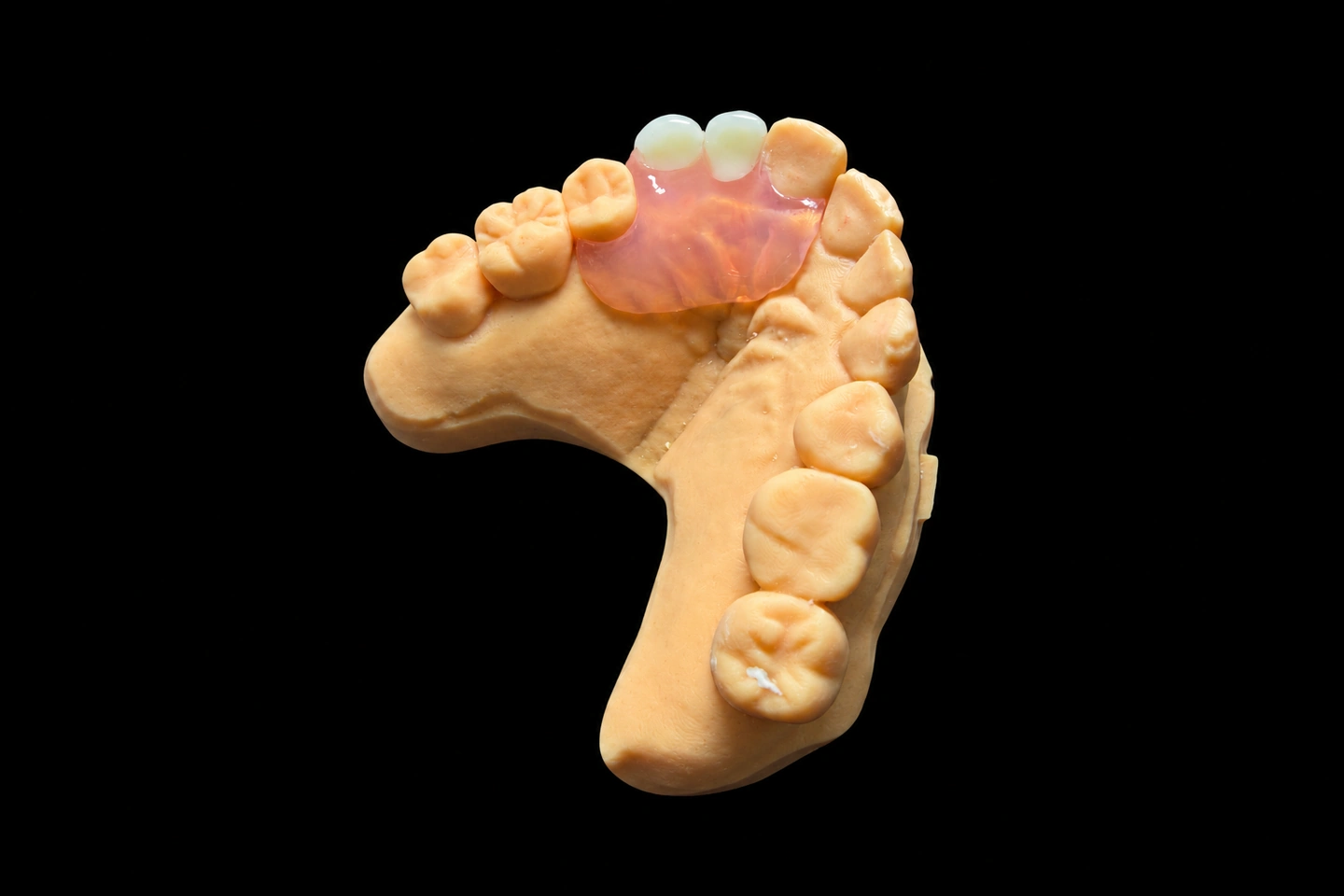
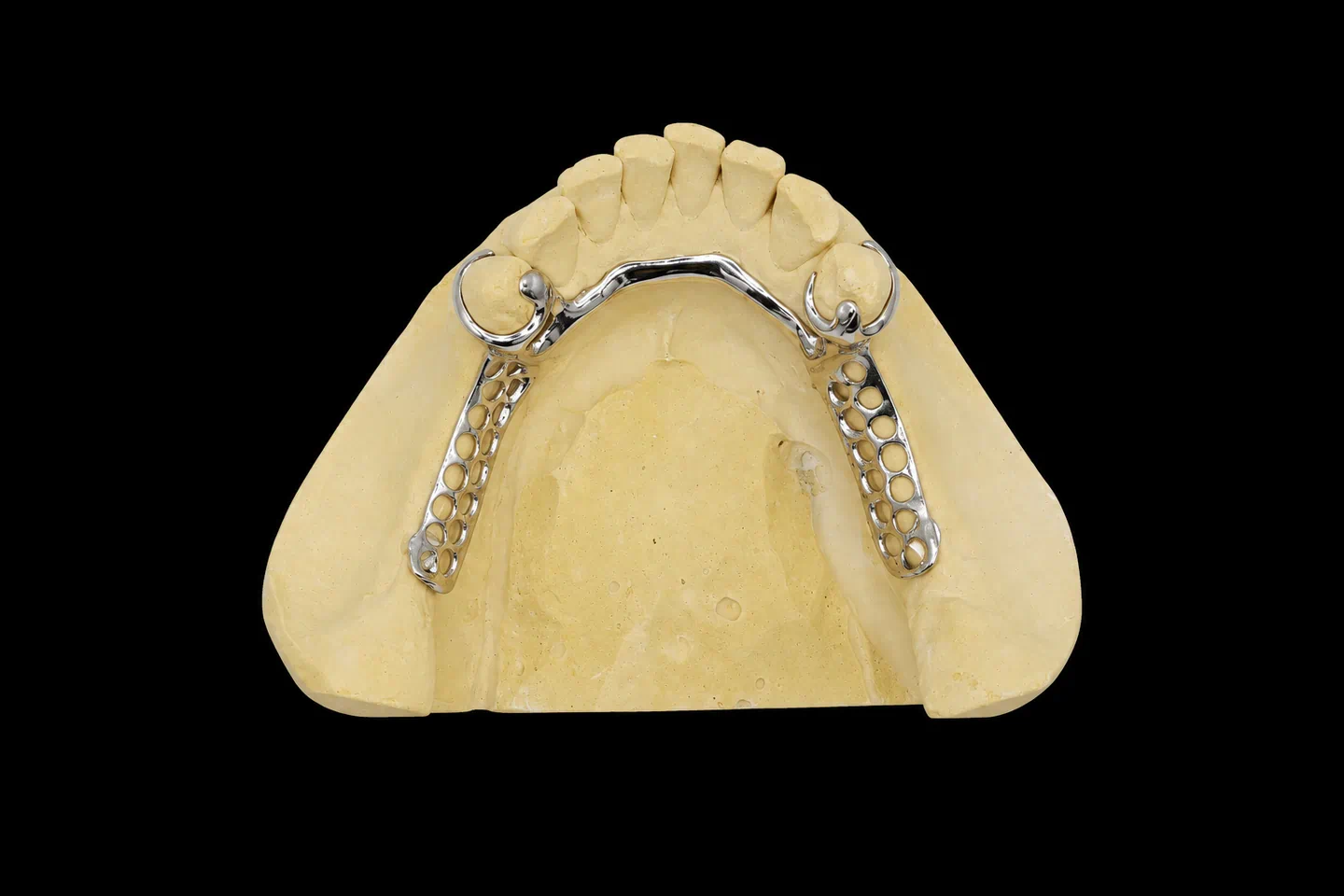
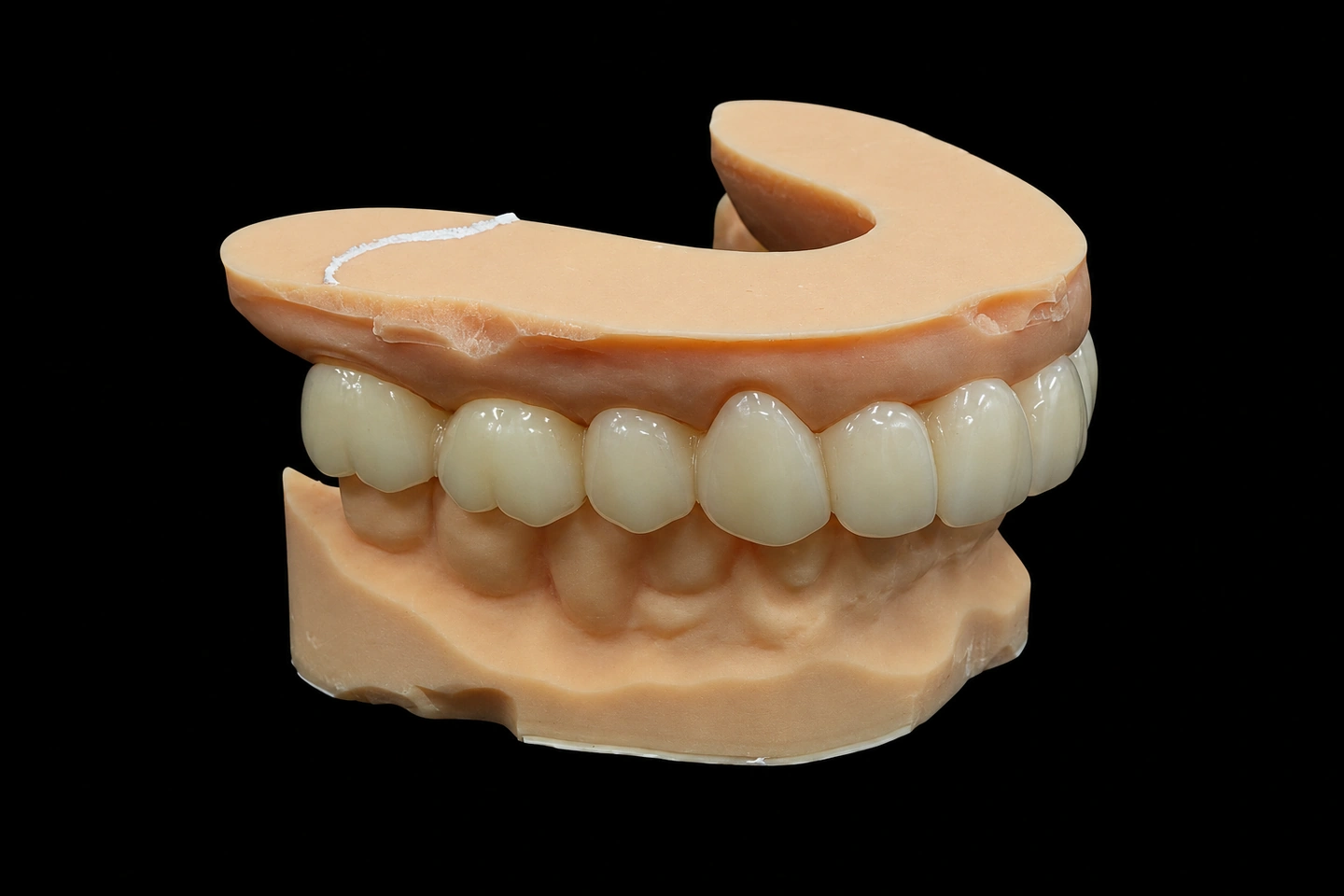
Patient Situation
The old full-palate upper denture wasn’t failing all at once. A few things had just built up:
Both the denture’s age and that adhesive habit are on the ADA’s list of reasons to have a denture evaluated. The dentist looked at a reline first and decided against it, because a reline couldn’t change the teeth .
There was also a practical problem. The patient had no spare and couldn’t go without teeth, so the old denture couldn’t come to China . The dentist scanned it instead.
What the Dentist Asked For
The Rx basically split the old denture into two lists :
| Keep from the old denture | Change |
|---|---|
| Upper lip support | Smaller teeth: centrals about 8.5 mm wide and 10.5 mm long |
| Palate shape, since speech was fine | Midline moved onto the facial midline |
| Shade A3, to sit with the natural lowers | |
| Vertical dimension up about 1 mm, as recorded on the wax rims | |
| Fresh fit, from a new border-molded impression |
The dentist also asked for two things in the process: a wax try-in before any processing, and even contacts on the back teeth against the natural lowers . Tooth choice, setup, and the base were ours to carry out. The bite, the tooth position sign-off, and every chairside decision stayed with the dentist.
Why This Full Upper Denture Was Harder Than It Looked
On paper, it’s a routine full upper denture. It wasn’t quite.
Smaller teeth and a new midline had to land somewhere
Going smaller took 4 mm off the six front teeth: 50 mm along the arch on the old denture, 46 mm on the new one . Where does that space go?
Here’s the part we only saw once we had the old denture’s scan on screen. With the midline off, the front teeth ran 27 mm to the right of the facial midline and 23 mm to the left . The old set made that fit with narrowed right premolars, #4 and #5, about 2 mm each .
Center the new teeth, and each side measures 23 mm. The left canine barely moves. The right canine comes in 4 mm, and that’s exactly the room the full-width premolars needed . So the two changes on the Rx actually helped each other, and the first molars could stay where they were.
Keeping the lip support meant picking a reference
The Rx said to keep the lip support, so our first move was to copy the old central position. Measured from the center of the incisive papilla, that was 9.5 mm .
Measurements like this are a traditional guide taken from people with natural teeth, and a University of Iowa thesis suggests the usual 8–10 mm rule may not work well for edentulous patients, especially with very resorbed ridges. That’s why we used the old denture’s number, not a textbook one.
Retention had to hold up against natural lowers
A conventional upper relies on fit, borders, saliva, and the seal at the back of the palate. A review of the posterior palatal seal ties careful placement of that seal directly to retention.
Natural lowers add a twist. In a small study of five people with an edentulous maxilla and natural lower teeth, lingualized contacts, a properly filled vestibular sulcus, and palatal coverage to the vibration line all improved retention. Five people isn’t much, but those are three things a lab can actually mess up, so we watched all three.
How We Made These Upper Dentures
We worked in stages, and the dentist saw each one before the next started .
Records check: the Rx and the wax rim disagreed
The Rx said to move the midline “about 3 mm.” The line scribed on the wax rim, compared with the old denture’s scan, came to 2 mm . When the Rx, photos, and old denture don’t agree, we don’t pick one and hope. We asked on WhatsApp, and the dentist said to follow the rim, since it was marked on the patient’s face .
The records came to us in the usual order for a complete denture. Preliminary impression first, then our custom tray, then a border-molded final impression, then a record base with wax rims . Spear’s nine-step outline follows the same sequence. The bite on the rims was locked with VPS and backed up with a facebow record for mounting .
Setup: picking teeth to fit the list
Our removable team mounted the casts . Then:
The try-in: where the first plan moved
The dentist tried the wax setup in, sent photos and a short video, and the patient read a few words out loud . VDO, midline, shade, and tooth size all passed . Two things didn’t:
| What showed up at try-in | Likely reason | What changed |
|---|---|---|
| Upper lip looked flatter than with the old denture | The old thick labial flange had been adding support, and the new impression recorded a slimmer, functional border | Centrals forward 1 mm, laterals 0.5 mm, canines unchanged, plus 0.5 mm more contour at the necks of #7 to #10 |
| “V” sounded close to “F” | Teeth a little short: a speech review describes that exact pattern | Length up 0.5 mm, to 11 mm |
The lip fix was the real decision. The dentist’s first thought was to bring the centrals forward about 2 mm . We flagged two concerns: more leverage on a tooth that natural lowers could hit, and the same review notes that upper front teeth set too far labially can distort “F.” Our suggestion was 1 mm of tooth movement, with the rest coming from contour at the necks .
The dentist went with it . We reset the teeth and sent new photos beside the first setup, and got written approval . No second trip to the chair was needed .
Processing: holding on to what was approved
After approval, the job’s different. Nobody’s designing anymore. It’s about not losing anything between the wax and the acrylic.
Our QC team inspected the case at the model, wax, setup, and final stages, with an independent inspector signing off the final release.
Finished Upper Dentures: Design Goals and Results
| Design goal | How it was checked | Result |
|---|---|---|
| Midline | Photos at delivery | Centered |
| Central width | Caliper on the finished teeth | On target |
| Speech | “F” and “V” words at delivery | Both clear |
| Lip support | Side-by-side profile photos | Dentist and patient accepted it |
| Shade | Photos with both arches visible | No change requested |
| Back-tooth contacts | Articulating paper at delivery | Light adjustment on #13 only |
| Fit without adhesive | Patient report at follow-up | No adhesive used at the one-month visit |
The dentist followed the 24-hour, one-week, and one-month schedule . Nothing came up at 24 hours. At one week there was a sore spot under the left buccal flange, which a small relief took care of .
Dentist and patient feedback after the fitting
The acrylic matched the approved setup, so no teeth had to be questioned at the chair. The borders and post dam needed no work at delivery, and the two lists on the Rx kept the appointments short .
The teeth on the new full upper denture finally looked like they belonged, and the palate felt familiar from day one. The fuller area behind the upper lip took a few days to get used to .
What these upper dentures can't do
The ridge keeps changing, and a new denture doesn’t stop that. Cleveland Clinic puts relines at about every one to two years, or when the fit changes. With natural lowers biting against it, this upper also needs its contacts and teeth checked at recall. The dentist set up that schedule with the patient .
The speech result has limits too. It’s one patient’s check in one office, not a promise that a given tooth length works for everyone.
What to Send Us for Upper Dentures
Single-arch upper dentures are a normal order for us. Along with the records above, include:
Upper dentures generally take 5–7 working days in our lab. Clinic visits and shipping between stages come on top of that.
Who Made It
This case ran through our removable denture department of about 55 people, with support from a CAD design team of about 100 and a separate QC team of about 25. Those teams work inside Istar Digital Dental Lab’s four labs in Shenzhen and Huizhou, China. We started in 2012, we’ve got about 460 staff, and we don’t outsource. Removable work runs about 4,000 to 6,500 cases a month, depending on the season.
We’re an FDA-registered establishment (Registration Number 3039441248), which you can check in the FDA establishment registration database. Our labs run an ISO 13485 quality management system, and custom-made dentures for EU clinics follow the MDR custom-made device procedure.
Upper Dentures FAQ
What can I change after approving the try-in?
Shade, surface finish, slight shape changes, and contacts can still be adjusted. If the patient wants a different tooth size or position after approval, we’ll do it, but it isn’t a free remake.
What other base and tooth options are there for a complete upper denture?
Bases can also be standard heat-processed PMMA, injection-molded acrylic, 3D printed resin, or milled. Teeth can be composite, acrylic, or porcelain, with Ivoclar and Shofu among the other brands. We also make complete dentures with metal bases, in cobalt-chromium or with titanium palatal plates.
Do you work digitally on upper dentures?
Yes, conventional, digital, or a mix. A scanned case can save a day or two compared with one that ships as physical models, and the data stays on file for a remake. When soft tissue is tricky, we suggest a hybrid route with an injection-molded or heat-processed final base, because milling isn’t as good at reproducing fine border detail.
Can the palate be left off?
On a conventional upper, removing palate coverage is a trade-off. In a 20-patient study, trimming dentures to a U-shape didn’t significantly change resistance to tilting, but several patients reported poorer retention between meals. See our upper implant denture case for an open palate on implants.
What if the patient still has some upper teeth?
Then it’s a partial. See our partial dentures.
What if I stick with a design you've flagged as risky?
We’ll make it to the Rx, no sign-off form needed. Problems caused by that design, remakes included, aren’t on us.
What's free to redo?
A denture that won’t seat, a lifting edge, an inaccurate bite, a poor look in the mouth, or a base color you’re unhappy with. Changing the tooth shade or material afterward isn’t free, and neither is a case you asked us to try on an impression we’d flagged as poor.
What about the warranty and shipping?
Acrylic denture work carries a 1-year warranty. You pay to send a case in, and we pay to ship finished work back, remakes included.
Can you rush upper dentures?
Rush service is free for clients sending 10 or more cases a month. We guarantee the ship date, but not the arrival date, because customs times vary.
How's pricing handled?
We don’t publish prices on the website, but you can ask for our price list. Quotes are itemized to what you ask for, not one bundled number.
Send Us Your Next Complete Upper Denture
Got a patient who likes half of their old denture? Single trial cases are welcome, and regular case flow suits an ongoing partnership. You can also browse our complete dentures, or book a factory visit or video tour.