Patient Situation
The upper had been fine for three years, and the patient liked it . All the trouble was down below:
None of that was a surprise anatomically. A lower denture has about half the covered area of the upper, with the tongue working right next to it. But the age of the denture and the adhesive habit are both on the ACP’s list of reasons to evaluate a denture for replacement, so the dentist went for a new lower denture instead of a reline .
The patient had talked through an implant-supported denture and decided against it . That left a conventional lower complete denture, and a clear question about what it could realistically do.
The dentist also ruled out chasing suction as the main goal . In a 175-case questionnaire study on suction-effective lower dentures, reported success was 72.3% with Type III and IV ridges against 95.5% with Type I and II, and 68.2% with limited retromylohyoid space against 93.1% with enough of it. Those are experienced clinicians’ own cases, so it’s no prediction for one patient. But this patient had both of those unfavorable signs .
What the Dentist Asked For
The Rx was short and pretty firm :
| Request | The dentist’s reason |
|---|---|
| Keep the lower back teeth inside the recorded zone, even if that means narrow teeth | Stop the tongue from lifting the lower denture |
| Shape the lingual and buccal polished surfaces from the record | The muscles should help hold it down, not push it up |
| Leave the upper denture alone | It fits, and the patient likes it |
| Keep the vertical dimension from the bite record | Nothing to gain from changing it here |
| Don’t trim the borders on the final impression | They were border-molded, and they stay where they are |
| Wax try-in before processing, with a function check | Prove it in the mouth first |
The diagnosis, the bite, and the final say on tooth position stayed with the dentist. Tooth choice, setup, and carrying the record into acrylic were on us.
Records that came with the Rx
The Technical Problem in This Lower Complete Denture
The old teeth were too wide for the space
The neutral zone is where tongue pressure and cheek and lip pressure balance out. We scanned the record and lined it up with the scan of the old lower denture . The front teeth were fine. The back teeth weren’t :
| Tooth | Width of the recorded zone | Old tooth width | Old tooth past the zone, tongue side | New tooth width |
|---|---|---|---|---|
| #30 | 8.0 mm | 10.0 mm | 2.5 mm | 8.0 mm |
| #29 | 6.5 mm | 7.5 mm | 1.0 mm | 6.0 mm |
| #20 | 6.0 mm | 7.5 mm | 1.5 mm | 6.0 mm |
| #19 | 7.0 mm | 10.0 mm | 3.0 mm | 7.0 mm |
That lined up with the complaint. Up to 3 mm of molar was sitting where the tongue wanted to be.
The narrow left molar needed one extra step. The mold we picked runs 8.0 mm, so #19 got reduced on its lingual side before it went in .
Narrow teeth broke the bite
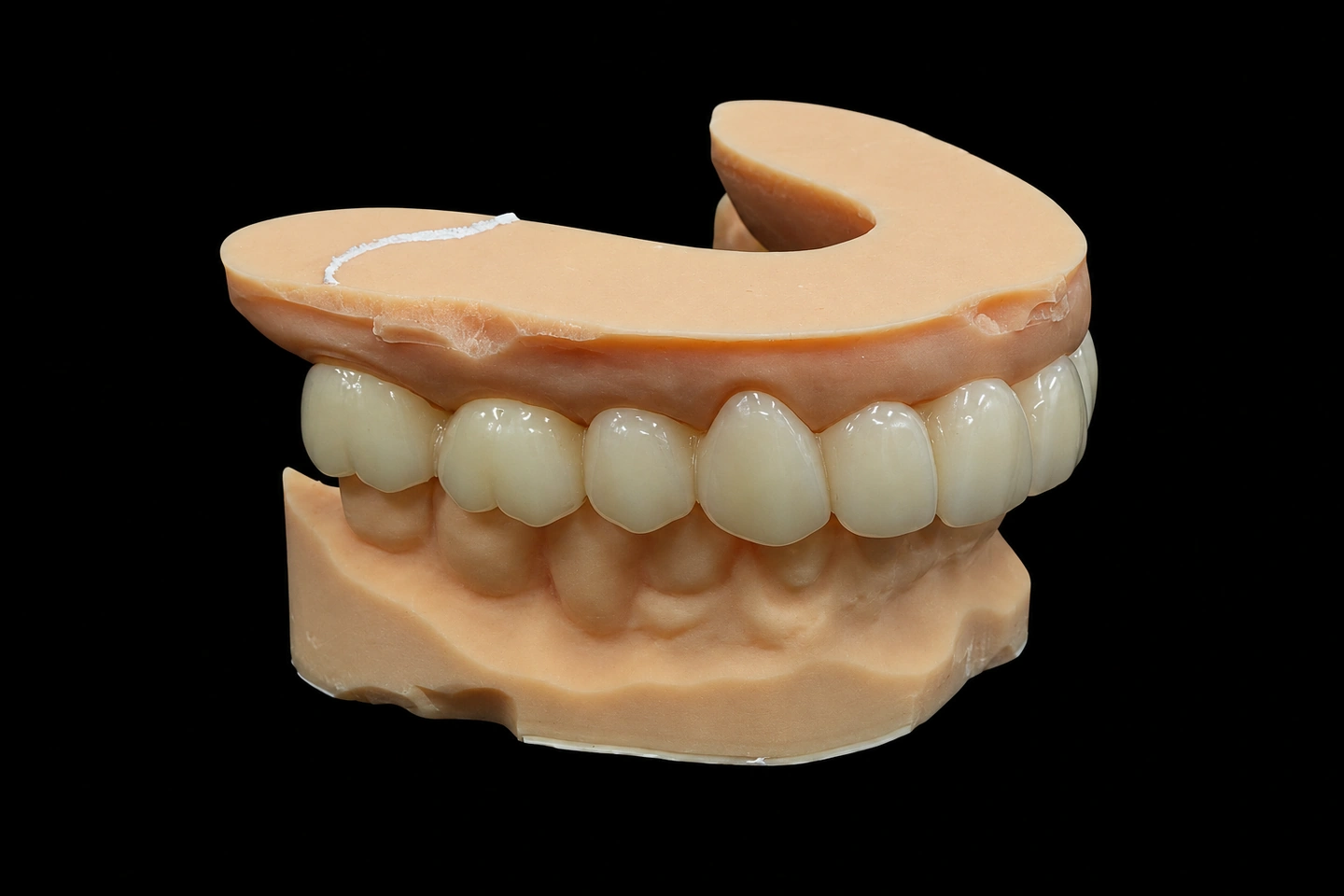
Here’s the catch. Putting the molars inside the zone moved their centers 1.5 mm toward the cheek . The upper denture wasn’t moving, so its palatal cusps no longer landed in the lower fossae. They landed 1.5 mm to the tongue side of center .
We sent the dentist section views of three ways to handle it :
| Option | What you get | What it costs |
|---|---|---|
| Move the lower molars back toward the old position | Clean cusp-to-fossa contact | Teeth back in the tongue’s space, so back to the original complaint |
| Remake the upper too | Both arches can be set to the zone | A new upper for a patient who’s happy with the current one, more cost and more getting used to |
| Keep the upper and give the lower molars a flat table | Teeth stay in the zone, and the upper cusps can land off center | No fossa to guide the bite, so contacts need careful work at remount |
The dentist took the third one . On our setup, the upper palatal cusps would land about 2.0 mm inside the lingual edge of #19 and 2.5 mm inside the lingual edge of #30 . That’s a small target, but it’s on the tooth.
The old denture had second molars, and the dentist told us to leave them out this time . The ridge climbs steeply back there on this patient, and nobody wanted a contact on that slope sliding the denture forward . That left upper #2 and #15 out of contact on purpose .
How We Made These Lower Dentures
Setup: the record built the wax
Our removable team poured the casts, and mounted them with the facebow and bite . The putty matrix went around the record, and the soft material came out, leaving a mold of the zone . Our technician then set the teeth by hand inside that space, front to back.
For the polished surfaces, we copied the record’s outer shape in wax instead of building a standard flange . On the tongue side, that gave the back of the lower denture a slight hollow, and the base still covered the retromolar pads as the impression showed .
Try-in: one spot on the right
The dentist tried the wax setup and sent photos and a short video . The patient opened slowly, swallowed, stuck out the tongue, and counted out loud .
| Check | What happened |
|---|---|
| Opening halfway | Base stayed down |
| Swallowing | Base stayed down |
| Counting | Clear, no complaints |
| Tongue forward | Base lifted on the right side |
The dentist felt extra wax behind #28 and #29 . We took 1 mm off that lingual contour , sent new photos, and got written approval without another trip to the chair .
Processing: don't lose the shape
Once the wax is approved, it’s all about not losing anything in the acrylic.
Our QC team inspected the case at the model, wax, setup, and final stages, and an independent inspector signed off the final release.
Finished Lower Dentures: Design Goals and Results
| Design goal | How it was checked | Result |
|---|---|---|
| Back teeth inside the zone | Finished denture scanned and overlaid on the record | Within 0.3 mm |
| Even back-tooth contact against the kept upper | Articulating paper at delivery | Both sides marking; light adjustment on #30 only |
| No lift on tongue movement | Same function check as the try-in, at delivery | Base stayed down |
| Wide opening | Full yawn at delivery | Slight lift at the very end |
| Less adhesive | Patient report at the one-month visit | Once in the morning |
| Eating with it in | Patient report at the one-month visit | Wearing it for meals; still cuts up hard food |
At the one-week visit there was one sore spot on the left lingual flange near #20, and a small relief took care of it .
Dentist and patient feedback after the fitting
The flange shape matched the record, the borders needed no work, and the flat tables took less adjusting than expected .
The narrower teeth left more room for the tongue, and that was the first thing the patient noticed. The lower denture still isn’t as steady as the upper .
What this lower denture can't do
It didn’t turn a low ridge into a high one, and it didn’t remove the adhesive completely. It’s one patient’s result, too.
The evidence is modest as well. A 2024 systematic review in BDJ Open found better patient-reported results with neutral zone techniques, but speech and chewing measures mostly came out about equal with conventional dentures. And the ridge keeps changing, so Cleveland Clinic’s one-to-two-year reline guide, or sooner if the fit changes, still applies. The dentist set up recalls with the patient .
What to Send Us for Lower Dentures
We accept neutral zone records. Beyond the records above, tell us:
Lower dentures generally take 5–7 working days in our lab. Clinic visits and shipping between stages come on top of that.
Who Made It
This case ran through our removable denture department of about 55 people, with support from a CAD design team of about 100 and a separate QC team of about 25. Those teams work inside Istar Digital Dental Lab’s four labs in Shenzhen and Huizhou, China. We started in 2012, we’ve got about 460 staff, and we don’t outsource. Removable work runs about 4,000 to 6,500 cases a month, depending on the season.
We’re an FDA-registered establishment (Registration Number 3039441248), which you can check in the FDA establishment registration database. Our labs run an ISO 13485 quality management system, and custom-made dentures for EU clinics follow the MDR custom-made device procedure.
Lower Dentures FAQ
What can I change after approving the try-in?
Shade, surface finish, slight shape changes, and contacts can still be adjusted. If you want a different tooth size or position after approval, we’ll do it, but it isn’t a free remake.
What if I want the teeth outside the recorded zone?
We’ll tell you what we see and ask what you want. If you stick with it, we make it to the Rx, no sign-off form needed. Problems caused by that design, remakes included, aren’t on us.
What other base and tooth options do you have for lower dentures?
Bases can also be heat-processed, 3D printed, or milled. Teeth can be composite, acrylic, or porcelain. We also make complete dentures with metal bases.
Can you work digitally on a lower complete denture?
Yes: conventional, digital, or a mix. A scanned case can save a day or two compared with physical models, and the data stays on file for a remake. When the soft tissue is tricky, we suggest a hybrid route with an injection-molded or heat-processed final base, because milling isn’t as good at picking up fine border detail.
Do you reline or repair an existing lower denture?
Yes, and we’ll repair one even if we didn’t make it. For a reline, send the upper and lower models, the old denture, and a wax rim.
What if the patient changes their mind on implants or still has some lower teeth?
For implant-retained work, see our implant lab services. If teeth remain, it’s a partial, so see our partial dentures.
What's free to redo on lower dentures?
A denture that won’t seat, a lifting edge, an inaccurate bite, a poor look in the mouth, or a base color you’re unhappy with. Changing the tooth shade or material afterward isn’t free, and neither is a case you asked us to try on an impression we’d flagged as poor.
What about the warranty and shipping?
Acrylic denture work carries a 1-year warranty. You pay to send a case in, and we pay to ship finished work back, remakes included.
Can you rush lower dentures?
Rush service is free for clients sending 10 or more cases a month. We guarantee the ship date, but not the arrival date, because customs times vary.
How's pricing handled?
We don’t publish prices on the website, but you can ask for our price list. Quotes are itemized to what you ask for, not one bundled number.
Send Us Your Hardest Lower Complete Denture
Got lower dentures that keep lifting, and a neutral zone record you’ve been meaning to try? Single trial cases are welcome, and regular case flow suits an ongoing partnership. You can also browse our complete dentures, or book a factory visit or video tour.