Patient Situation
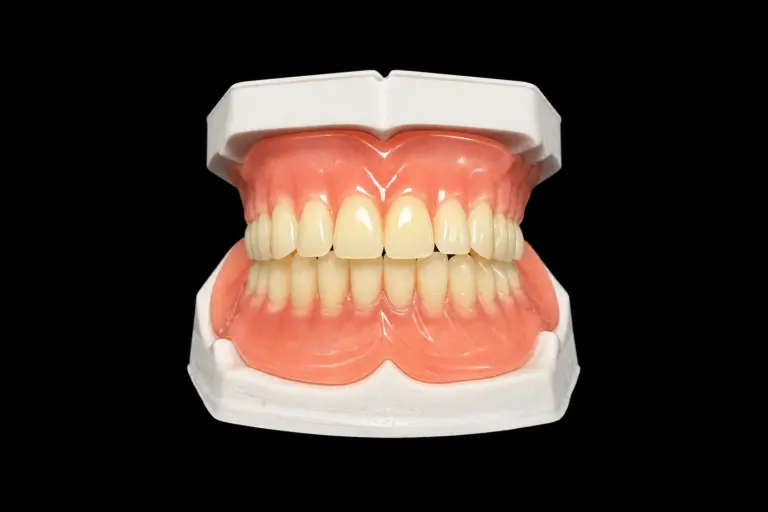
She’d worn the same upper and lower complete dentures for about ten years . They fit well enough. What bothered her was how they looked when she really smiled . She wanted natural looking dentures that still held up when she laughed, not just in a closed-lip photo .
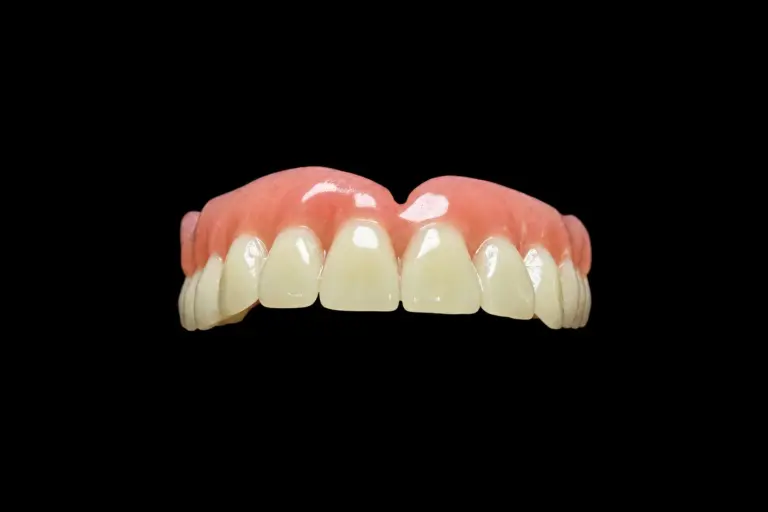
Here’s what the dentist’s photos showed on the old upper:
So the old set had tried to hide the gum by making the teeth longer. It didn’t hide the gum, and it made the teeth look wrong too. It’s a familiar pattern. A published case report on denture characterization describes an old denture with uniform, dull teeth and a flange whose color and texture added to the fake look.
What the Dentist Asked For
The Rx asked for new upper and lower complete dentures, with these points written out :
| Rx item | What it said |
|---|---|
| Overall goal | “Dentures that look real when she laughs, not just at rest” |
| Front tooth length | Shorter than the old set: centrals about 10.5 mm, natural proportions |
| Incisal edge | As marked on the wax rim: 1.5 mm below the upper lip at rest |
| Lip support | As recorded on the wax rims, no fuller |
| Tooth shade | A2, checked against the whites of her eyes |
| Gum | Color zoning and stippling on the visible upper flange, matched to a gum shade photo |
| Vertical dimension and bite | As recorded on the rims, no change |
The dentist checked the shade tab against the sclera before picking A2. A complete denture esthetics course from Inside Dentistry suggests that check: if the tab is significantly brighter than the whites of the eyes, the value is too high. The same course gives 1–2 mm below the lip at rest as a common incisal position, which is where the dentist marked the rim .
Tooth length, gum shape, gum color, and the setup were ours to carry out. The bite, the incisal position, and every chairside call stayed with the dentist.
The Technical Problem: Shorter Teeth Mean More Gum on Show
Two Rx items pulled against each other. The dentist wanted shorter, natural-looking teeth. But the incisal edge was fixed by the rim, and her lip line at full smile is fixed by her own face . So every millimeter we took off the teeth would show up as another millimeter of pink.
We measured it on the full-smile photo, scaled to the old central length . At the Rx’s suggested 10.5 mm, about 3.5 mm of denture gum would show above the centrals when she laughs . That pink would sit right in the middle of her smile. For dentures that look real, it couldn’t look like a denture base.
Why the gum design also touches the lip
There’s a second catch. On an upper denture, the root eminences over the canines help support the lip. The Foundation for Oral-facial Rehabilitation’s notes on final wax contouring say it plainly: additional contour there raises the lip and the corner of the mouth.
For most patients that’s fine. For a high smile, it’s a problem: lift the lip further and even more gum shows. Plus the Rx said no fuller lip. The same notes add that flange thickness is mainly set during border molding, so we kept the borders the impression recorded and worked only on contour .
Three ways to handle it
Each option answers the same question: how do you get natural looking dentures when the lip lifts this high? We sent the dentist all three, each with a mock-up on the full-smile photo :
| Option | Front teeth | Gum on show at full smile | What it costs |
|---|---|---|---|
| 1. Keep the teeth long | Centrals 12.5 mm, like the old set | About 1.5 mm | The same long, narrow teeth she didn’t like |
| 2. Natural length, full gum anatomy | Centrals 10.5 mm, pronounced root eminences | About 3.5 mm, maybe more once the eminences lift the lip | Most lifelike up close, but a fuller lip and more pink |
| 3. Near-natural length, gum shaped where it shows | Centrals 11.0 mm, shallow eminences | About 3.0 mm | Teeth 0.5 mm longer than the Rx asked |
We flagged option 1 as the old problem again. We flagged option 2’s lip effect, since the Rx said no fuller lip .
The dentist picked option 3 . The extra 0.5 mm on the centrals took about half a millimeter off the pink, without bringing back the long-tooth look . The rest of the gum would have to look real on its own.
How We Made These Natural Looking Dentures
Records check
The records came in as border-molded final impressions, record bases with wax rims, and a facebow record . The dentist marked the facial midline, the lip line at rest, and the high lip line at full smile on the upper rim .
On natural looking dentures for a high smile, color records count as much as the bite. We got the full-smile and rest photos, plus a photo of her own lower gum with a gum shade tab in the same frame . The photos were taken with a 5500K flash, not window light, with the tab and the shade guide in shot. Camera, flash, and white balance all shift color, so we use the photos as a map of which zone gets which shade, not as a color to copy off the screen.
Setup: tooth length to the decision
Our removable team mounted the casts and set the teeth to the rim :
Wax contouring: the gum on natural looking dentures
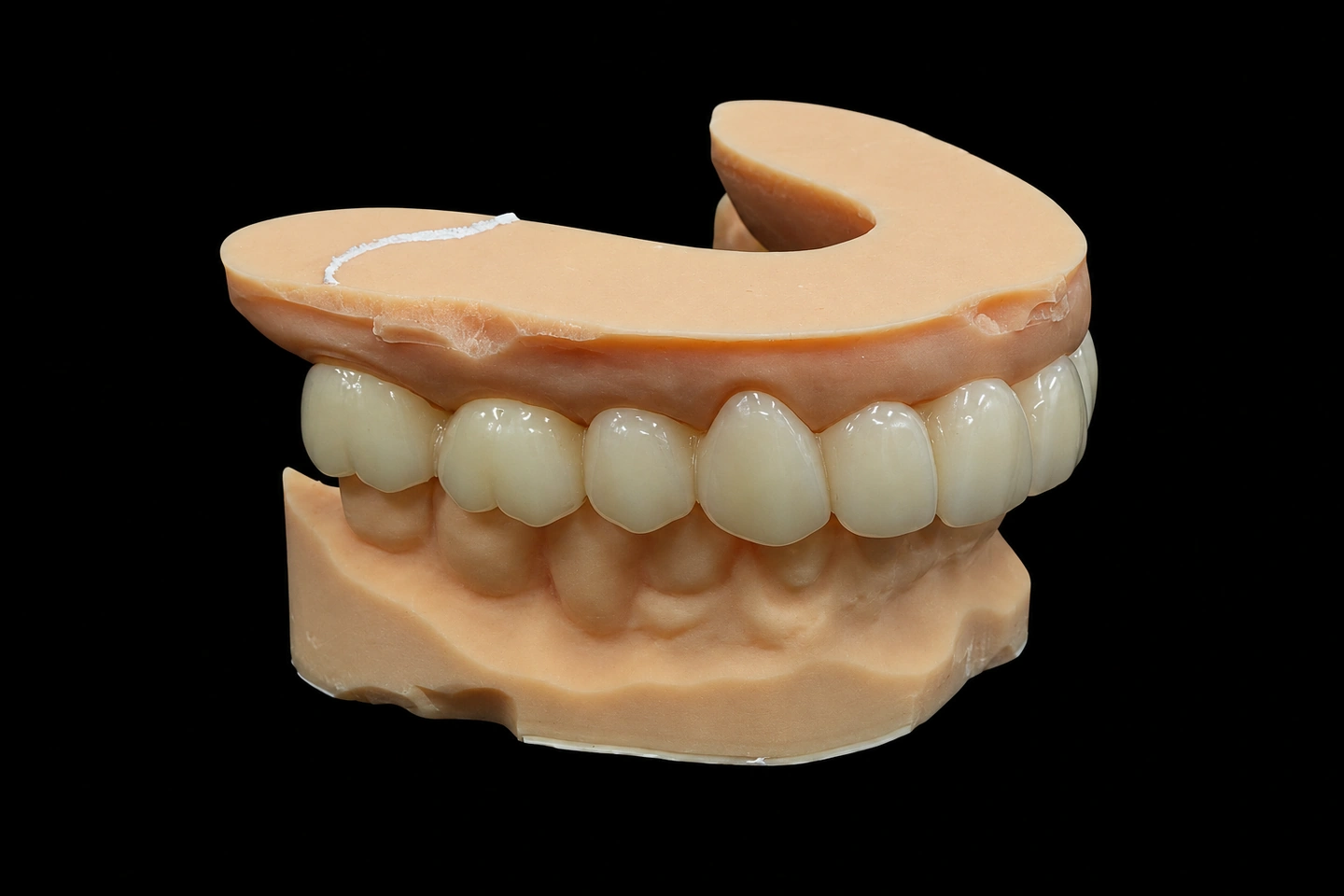
This is where most of the work on dentures that look real happens, before any acrylic is processed. On the upper labial flange we carved :
Wax try-in: the gum line moved
The dentist tried the wax setup in and sent a full-smile photo, a rest photo, and a short video of her talking . The Foundation for Oral-facial Rehabilitation’s trial denture checklist covers what got checked: vertical dimension, centric relation, mold, shade, and the front tooth arrangement.
| Check at try-in | Result |
|---|---|
| “F” and “V” | Clear, upper edges meeting the lower lip |
| “S” | No tooth contact, no hissing |
| Vertical dimension and centric relation | Confirmed by the dentist |
| Lip at rest | Accepted, no fuller than the old set |
| Gum on show at full smile | About 3.0 mm, as planned |
| Gum line | Changed: see below |
One thing didn’t work. In the full-smile photo, the gum margins over the laterals sat almost level with the centrals and canines . At rest you couldn’t tell. When she laughed, the gum line read as a flat curve, and the dentist said it still “looked set” .
We carried the wax 0.5 mm further down the laterals’ necks, so their margins sit a bit lower than the centrals and canines on both sides . Tooth positions didn’t move. We sent new photos beside the first setup and got written approval without a second chair visit .
Processing: adding the color without losing the shape
After approval, the job is to keep everything in the wax, including the texture. Natural looking dentures can lose a lot here if the stippling gets polished flat or the teeth drift.
Before release, we compared the finished pink with her photo under our standard light, zone by zone . Our QC team inspected the case at the model, wax, setup, and final stages.
Finished Natural Looking Dentures: Design Goals and Results
We checked the finished set against the same photos the plan started from .
| Design goal | How it was checked | Result |
|---|---|---|
| Gum on show at full smile | Full-smile photo, scaled to the central length | About 3.0 mm, scalloped and stippled |
| Gum color | Photo with her lower gum and the shade tab | Dentist accepted it, no change asked |
| Gum line pattern | Full-smile photo | Laterals’ margins a little lower than centrals and canines |
| Tooth proportions | Caliper on the finished centrals | 11.0 mm by 8.5 mm |
| Lip at rest | Side-by-side profile photos | Same support as the wax rims |
| Speech | “F”, “V” and “S” words at delivery | Clear |
| Bite | Articulating paper at delivery | Light adjustment on #30 only |
Dentist and patient feedback
“The pink finally reads as gum, even in the laughing photos. Nothing on the flange needed touching at delivery” .
She said the teeth didn’t look “too long” anymore. The textured gum felt a little different to her tongue for the first few days .
Where this result has limits
The gum is still acrylic. It’ll look its best while the surface stays clean and the fit holds. The ridge keeps changing, and Cleveland Clinic puts relines at about every one to two years, or whenever the fit changes. The dentist set up recalls with her .
The numbers in this natural looking dentures case belong to her face and her lip line. Another high-smile patient may land on a different tooth length, depending on how high the lip goes and how much the dentist wants the teeth to carry.
What to Send Us for Natural Looking Dentures
If the gum will show, dentures that look real at full smile start with the photos. They matter as much as the impressions. Along with your usual complete denture records, send:
Complete dentures generally take 5–7 working days in our lab. Clinic visits and shipping between stages come on top of that.
Who Made It
This case ran through our removable denture department of about 55 people, with support from a CAD design team of about 100 and a separate QC team of about 25. Those teams work inside Istar Digital Dental Lab’s four labs in Shenzhen and Huizhou, China. We started in 2012, we’ve got about 460 staff, and we don’t outsource. Removable work runs about 4,000 to 6,500 cases a month, depending on the season.
We’re an FDA-registered establishment (Registration Number 3039441248), which you can check in the FDA establishment registration database. Our labs run an ISO 13485 quality management system, and custom-made dentures for EU clinics follow the MDR custom-made device procedure.
FAQ on Dentures That Look Real
Can you do gum color zoning and stippling on the lower denture too?
Yes. We do it on regular acrylic complete denture bases, upper or lower. Just mark it on the Rx. Most lower gum doesn’t show, but some patients with a low lip want natural looking dentures on both arches.
What can still change after the wax try-in is approved?
Shade, surface finish, slight shape changes, and contacts. A different tooth size or position after approval can be done, but it isn’t a free remake.
What if the finished gum color isn't right?
If you’re unhappy with the base color, or the denture doesn’t look right in the mouth, we redo it free. Changing the tooth shade or material after the fact isn’t free.
What base and tooth options are there?
Bases can be standard heat-processed PMMA, high-impact acrylic, Lucitone 199, injection-molded acrylic, 3D printed resin, or milled. Teeth can be composite, acrylic, or porcelain, from VITA, Ivoclar, or Shofu. We also make metal dentures with cobalt-chromium bases or titanium palatal plates.
Do you work digitally on complete dentures?
Yes, conventional, digital, or a mix. When soft tissue is tricky, we suggest a hybrid route with an injection-molded or heat-processed final base, because milling isn’t as good at reproducing fine border detail.
What if the patient still has some teeth?
Then it’s a partial. See our partial dentures.
What if I stick with a design you've flagged as risky?
We’ll make it to the Rx, no sign-off form needed. Problems caused by that design, remakes included, aren’t on us.
What about warranty, shipping, and rush cases?
Acrylic denture work carries a 1-year warranty. You pay to send a case in, and we pay to ship finished work back, remakes included. Rush service is free for clients sending 10 or more cases a month. We guarantee the ship date, but not the arrival date, because customs times vary.
How's pricing handled?
We don’t publish prices on the website, but you can ask for our price list. Quotes are itemized to what you ask for, not one bundled number.
Send Us Your Next High-Smile Denture
Got a patient who wants natural looking dentures that still look right when they laugh? Send it to us as your own natural looking dentures case. Single trial cases are welcome, and regular case flow suits an ongoing partnership. You can also browse our complete dentures, or book a factory visit or video tour.