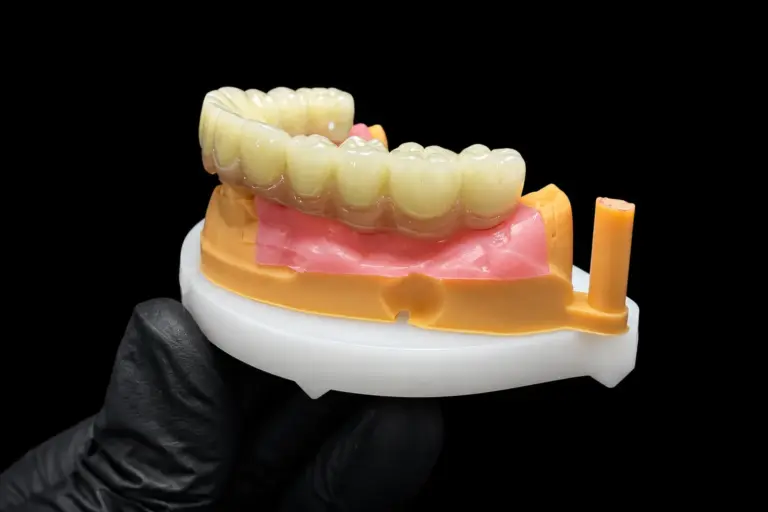
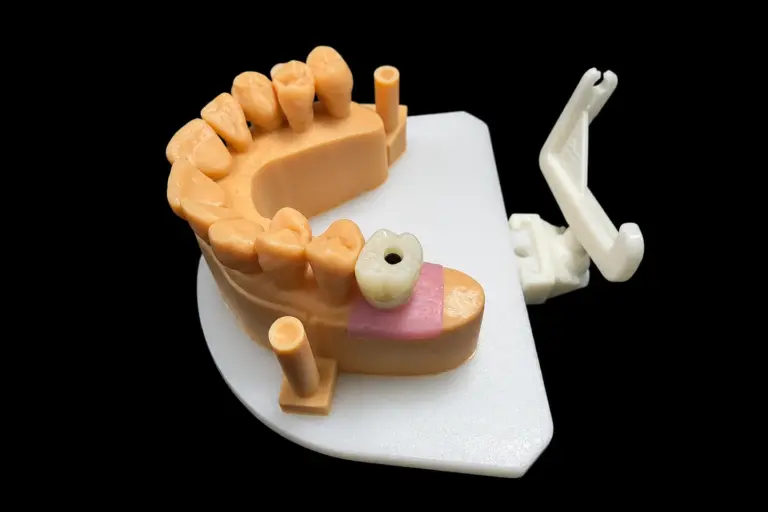
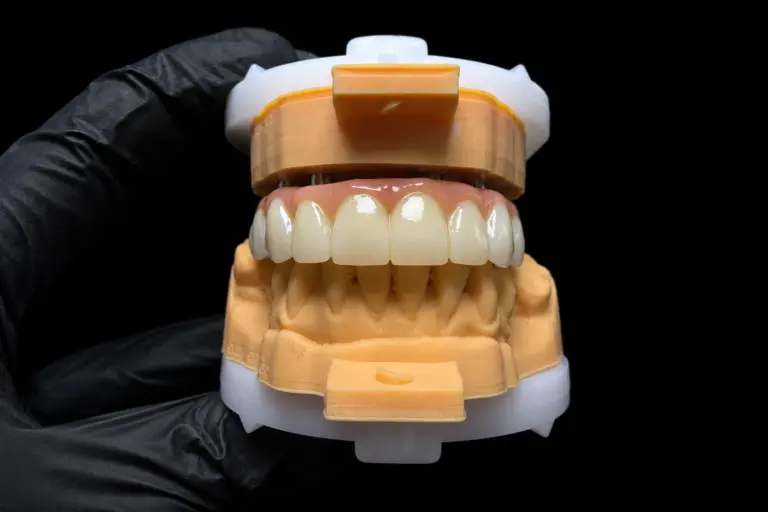
Implant Overdenture Fabrication for Dental Labs and Clinics
What we fabricate
Implant overdentures on your prescription. Scope covers:
- Removable implant overdenture retained by the clinician-specified attachment system (Locator-type, ball, bar, magnetic, telescopic). We source attachments to your specified brand and model — we do not substitute attachment systems and do not make selection recommendations in place of the treating dentist.
- Full-arch structures when the case calls for a milled bar or screw-retained hybrid: monolithic zirconia, titanium bar + zirconia or resin teeth, titanium bar + PMMA, or PFM, with the structure chosen “based on occlusal space and strength requirements” per prescription.
- Repairs, relines, re-bases and tooth additions against the original or a supplied overdenture.
We do not fabricate the endosseous implant itself; that is a separate device class (see regulatory framing).
The clinical consensus for the edentulous mandible — that a two-implant overdenture should be the first-choice standard of care — comes from the McGill 2002 and the York 2009 statements. “First choice” and “minimum” are the authors’ words, not a performance claim about any specific case; a three- or four-implant design can produce higher satisfaction in some patients. The treating dentist decides.
Configuration summary
Everything below is a line we build to your prescription. Pricing follows the same structure: unit count is the base, material sets the base price, and attachments and design complexity are add-ons. The full cost is confirmed in writing before production starts.
| # | Configurable line | Options we actually process | Trade-off we flag | Who decides |
|---|---|---|---|---|
| 1 | Denture-base processing route | Heat-cure • Auto-cure • Injection • 3D-printed resin | See Base processing. Soft-tissue detail still favors heat-cure / injection on terminal bases. | Clinician + lab review |
| 2 | Base-resin grade | Lucitone 199 (Dentsply, imported) • high-impact (break-resistant) • standard heat-cure PMMA (domestic) | Grade affects impact behavior and cost. Lot and brand are recorded per case. | Clinician specifies; we quote accordingly |
| 3 | Teeth | Composite resin • acrylic resin • porcelain; brands VITA, Ivoclar, Shofu, Suken | Porcelain is harder on an opposing restoration; composite rebonds easier at chairside. | Clinician specifies mould, shade, length |
| 4 | Attachment interface | Locator-type, ball, bar, magnetic, telescopic — sourced to the brand and model you prescribe | Attachment type drives maintenance pattern (see Maintenance expectations). We do not substitute brands. | Clinician |
| 5 | Bar / superstructure | Pure or Ti-alloy milled bar, multi-unit abutments (MUA), temporary cylinders, screws, driver tools (chargeable) | Milled bar requires passive fit and MDP-primed, dual-cure cementation to the superstructure. | Clinician + lab (design approval required) |
| 6 | Full-arch structure (when applicable) | Monolithic zirconia • titanium bar + zirconia or resin teeth • titanium bar + PMMA • PFM | Picked based on occlusal space and strength requirements per prescription. | Clinician |
| 7 | Material traceability | Brand, country of origin, lot number, certificate of conformity available per case on request | We record them whether you ask or not; we release them on request. | Lab (standard) |
What is not on this list
Attachment selection advice, housing color (retention level), implant brand compatibility beyond sourcing to your model — these are clinician decisions. We ship the attachment the prescription names.
Base processing route: heat-cure vs. injection vs. CAD-milled
Choosing a base-processing route is the most consequential technical decision on an overdenture case. The three routes we actually process behave differently, and the right pick depends on what the case needs more — margin fidelity against soft tissue, dimensional stability, or digital reproducibility.
- Heat-cure (water-bath polymerization). Lower cost, broadly compatible. Prone to porosity and warpage if the cycle is rushed. We use stepped water-bath heating, in-flask pressure through pack-and-press, and slow cooling in the bath to room temperature before deflasking — no rapid cooling. These controls exist to reduce porosity, polymerization shrinkage and base warpage.
- Injection. Pressurized packing. Lowest shrinkage and best intaglio adaptation of the three; our default when the case needs tight fit against a thin, mobile ridge or complex frenal attachments.
- CAD-milled from pre-polymerized puck. Best digital reproducibility, but less able to reproduce fine soft-tissue margin detail. We use milling in fully digital workflows; where the ridge is anatomically complex we recommend a hybrid flow — digital design, injection or heat-cure for the terminal base.
Internal controls we actually run
- Thickness is measured with a caliper, not estimated. Palatal mid-arch and transitional corners are the first inspection points.
- Internal porosity is checked with magnified visual inspection under strong transmitted light. A base with internal or multi-site porosity is remade — it is not polished out.
- Finished prostheses are graded against the prescription for centric, protrusive and lateral occlusion, midline arch form, overjet/overbite, base extension and lift-off, clasp seat and retention (where applicable), and polish.
Denture-base polymers used on finished prostheses fall under ISO 20795-1; the standard specifies classification by curing method and the mechanical and biological tests the material must pass. We select stock in that framework; the exact Type is pulled from the material certificate on request.
Submission requirements
A clean submission is the single biggest predictor of a quiet case. We check the data within one working day of upload and flag what has to be redone; a complete record pack usually looks like this.
For a conventional implant overdenture (mandibular or maxillary)
- Impressions. Preliminary + definitive (preferred: addition-silicone/VPS); intraoral scan is acceptable if the margin and ridge are captured without voids. Already-poured stone models are accepted if free of bubbles, chips, warpage and cracks.
- Jaw relation. Occlusal rims with centric relation and vertical dimension recorded; facebow transfer on full-arch reconstructions, occlusal plane corrections, All-on-X, long multi-unit bridges, and TMJ cases.
- Interocclusal record.Addition-silicone / VPS is preferred; polyether is acceptable. We do not recommend wax for international shipping — dimensional changes over distance and temperature degrade the record.
- Esthetic reference. Shade (hue, chroma, translucency, incisal effects), front smile photo, resting-lip photo, side profile, and — when the case is esthetic-driven — the patient’s previous denture if available.
- Attachment and implant data (critical). Implant brand, model, connection, diameter, number and arch positions, plus the attachment type and model you have prescribed (Locator / Bar / other).
- Design-approval items. Any case involving full-arch implants, implant bridges, custom abutments, long bridges (≥4 units), occlusal rehabilitation, telescopic crowns, overdenture attachments, complete dentures, framework partials, insufficient space / thin-wall risk, or occlusal interferences requires written design approval before production — we send you the digital design file and wait for the written sign-off.
What triggers a re-scan or re-impression (and why we insist)
We will ask you to redo the record when:
- The finish line / shoulder is blurred, missing or occluded by soft tissue.
- The scan has large mesh holes or stitching errors that create occlusal mis-registration.
- Scan range is incomplete — missing opposing arch, missing adjacent teeth, missing occlusal reference.
- Severe soft-tissue deformation or heavy reflection noise.
- Bubbles, drags, voids or deformation fall on the preparation shoulder, subgingival margin, contact area or key occlusal zone of a physical impression.
The reasoning is practical, not procedural: a laboratory cannot invent a margin that was never recorded, and a case that enters production on bad data generates a remake and a lost week for the clinic.
Bar and superstructure: how we build it
For bar-retained overdentures and milled suprastructures we design the bar for passive fit, with sufficient hygienic clearance between bar and mucosa and adequate cement surface area to the superstructure. The bar is sandblasted and ultrasonically cleaned, MDP primer applied, screw channels blocked, and the superstructure is seated with a dual-cure resin cement, with excess removed in the gel phase. The combination is picked based on occlusal space and strength requirements — monolithic zirconia, titanium bar + zirconia or resin teeth, titanium bar + PMMA, or PFM.
Design approval on bar and full-arch cases is non-negotiable and happens before any milling. We ship nothing to a bar case we have not had a design sign-off on.
Maintenance expectations you should plan for
A product page that quotes an implant overdenture without disclosing its maintenance profile is not useful to a prescribing clinician. The following numbers are drawn from the published literature, not from our internal records; they describe behavior at the device level and are not performance claims about any specific case.
- Short-term maintenance is common. In a one-year systematic review of mandibular implant overdentures, 45.7% of patients had at least one prosthetic maintenance event, with matrix/insert replacement in 24.7%, relining in 14.0%, and denture fracture in 3.1% (PMC — maintenance of mandibular IODs).
- Base fracture is a real five-year event. In Locator-retained cohorts the five-year denture-base fracture rate has been reported around 26.15%, with artificial-tooth fracture around 16.92% (systematic review of overdenture complications) — one of the reasons we take base thickness and porosity QC seriously.
- Ball vs. Locator maintenance is not what the catalog price suggests. A seven-year prospective comparison recorded 438 technical events — 121 for ball and 317 for Locator (with 179 insert replacements vs. 12 ball retention-cap replacements). Despite the much higher Locator event count, total maintenance cost ran at roughly 19% of initial treatment cost in both groups (seven-year ball vs. Locator).
These numbers are the reason we flag two things on every bar or attachment case: (a) base thickness around the housings and (b) occlusal clearance for the retention mechanism. If either is tight at design, we send the design back to you before milling or packing.
In-house workflow — the removable path
CAD/CAM handles data scanning, virtual design, milling and printing. Technicians handle flasking, metal casting (where applicable), ceramic layering, polishing, tooth setup and base finishing. Four defined inspection gates: model, wax, tooth setup, final after packing. A case with bubbles, honeycomb porosity, occlusal interference or lack of intimate fit at any gate goes back to the step that produced it — it does not advance.
Every case is bound to a unique case ID that records the operating technician, equipment used, material lot, and inspection results at each stage. On request we provide the brand, country of origin, lot number and certificate of conformity for the materials used.
Lead times and what they include
| Case profile | Typical in-lab time |
|---|---|
| Routine fixed restorations | 2–3 working days |
| Routine removable work (per the removable path) | 2–3 working days |
| Complex implant or complete-arch cases | 5–7 working days |
| Diagnostic wax-up / surgical guide stage | 2–3 working days |
| PMMA try-in (interim) | 2–4 working days (clinic try-in in between) |
| Custom abutment stage | 3–4 working days |
| Final zirconia / layered-ceramic restoration | 3–5 working days |
Rush cases ≤10 units/month carry no rush fee. Shipping is quoted into the final cost. Where a redo or re-impression is caused by a data issue, the case is treated as expedited and we re-sequence the schedule, not the quality gates.
Regulatory framing
- United States. The removable implant overdenture is a custom-made Class II device. The FDA regulates the finished prosthesis under 21 CFR 872.3760 (NSL) category; the implant abutment, including Locator-type and ball abutments the prescription names, is a separate device under 21 CFR 872.3630 (product code NHA). The endosseous implant itself is cleared separately under 21 CFR 872.3640 (DZE). Facility registration and device listing cover the restorations we ship; they do not extend to the implant body itself.
- European Union. Removable denture prostheses are custom-made devices under MDR Annex XIII; each case ships with a custom-device statement.
- Quality management. The lab holds ISO 13485 registration; copies of registrations and certificates can be shared within the scope of your use case.
- Base resins. Finished denture-base polymers follow ISO 20795-1 for classification and testing.
The relationship between a prescribing dentist and the lab is defined in the ADA/ACP “Dental Laboratory / Dentist Relationship” framework — authority for case selection and attachment selection stays with the clinician; the lab fabricates to the prescription. That framework is why this page lists a “who decides” column on every configurable line.
Data, records, and patient privacy
- Original case data, scans and uploads remain the clinic’s property. We use them only for the specific case.
- Case photos are not used for marketing or training without written authorization from the clinic and patient. Where authorization is granted, patient-identifying data is removed.
- Internal production records (case ID, technician, equipment, lot, QC) are retained for three months by default; extended retention is available on request.
- We can sign a mutual confidentiality agreement for client-facing documentation.
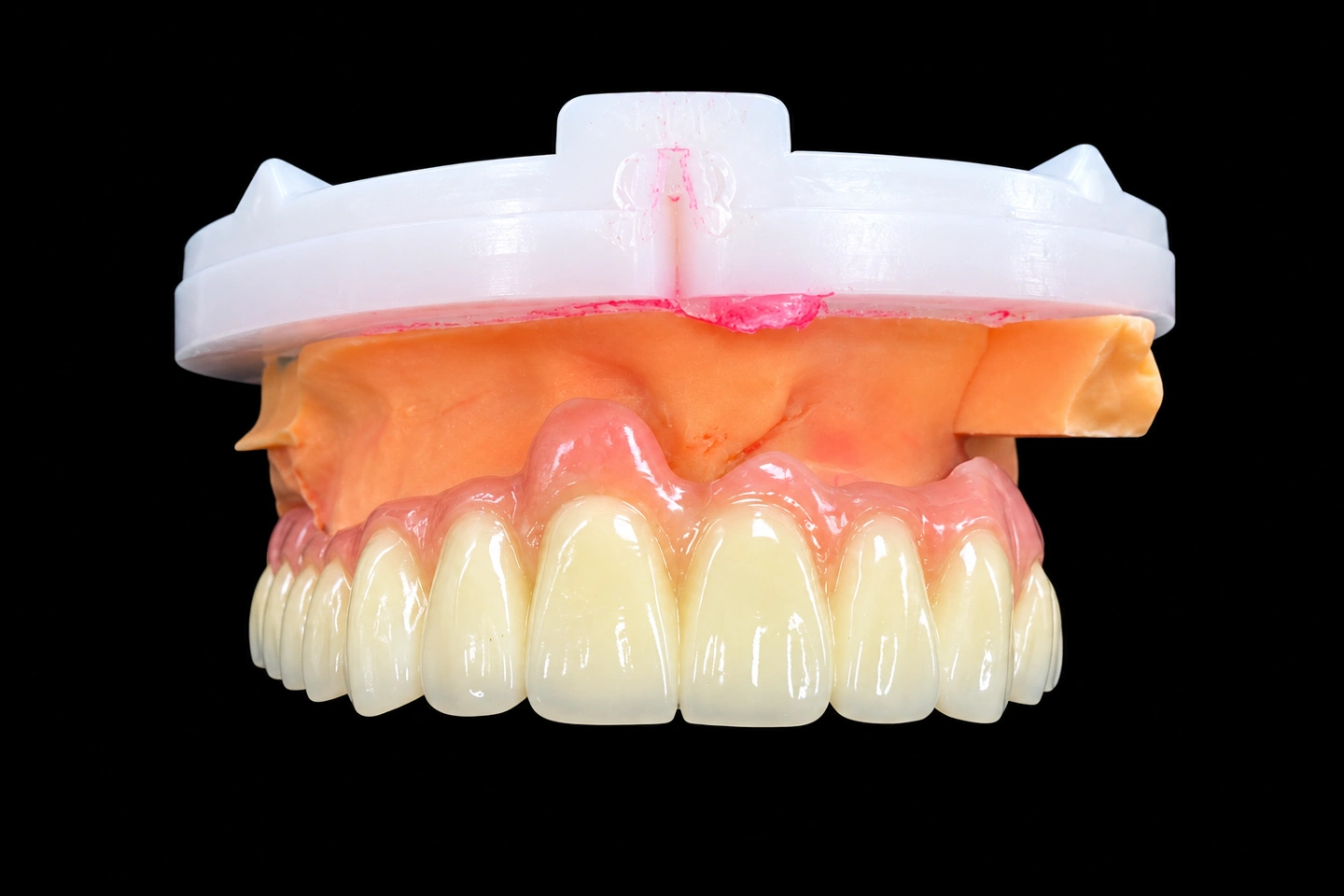
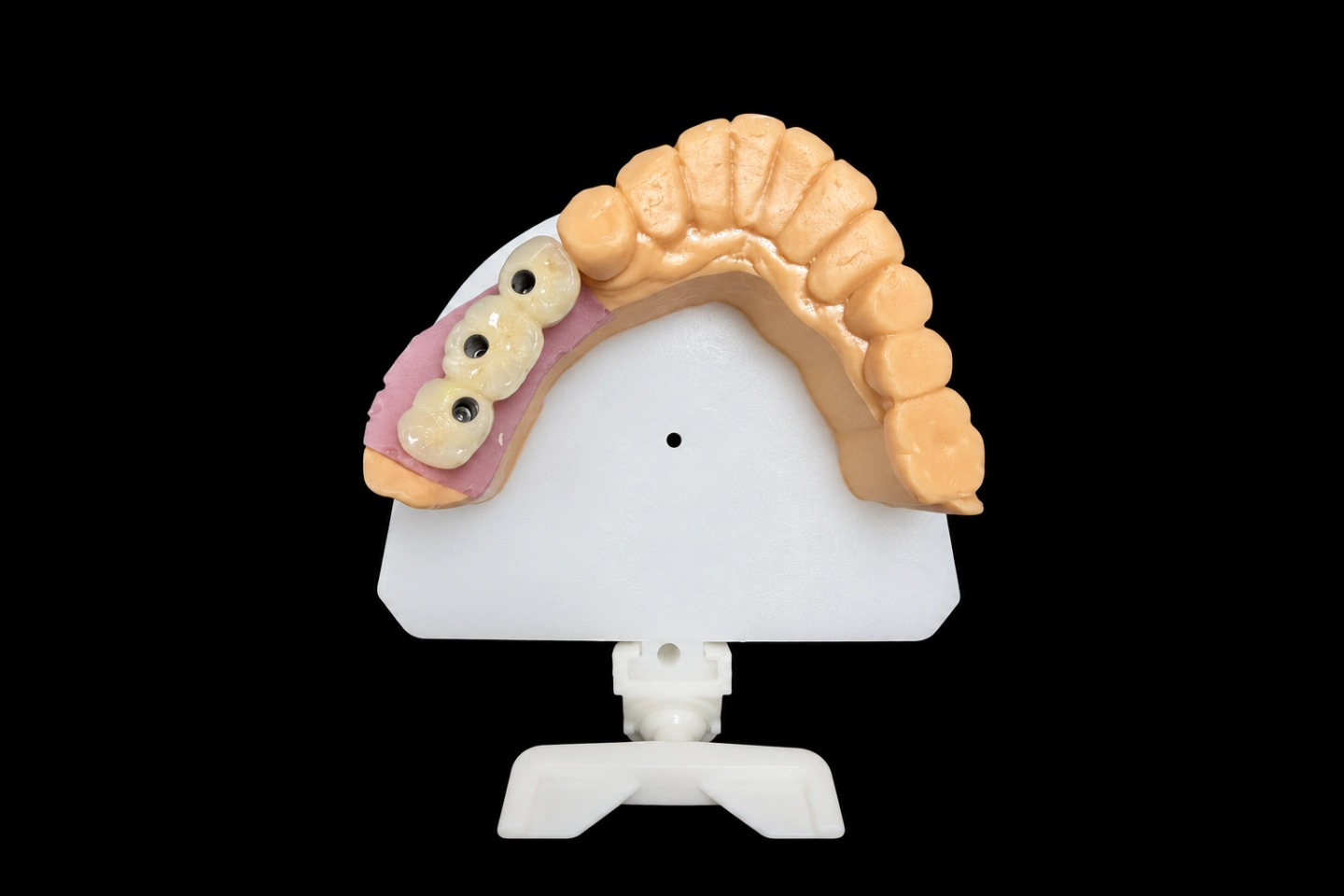
Cases from our lab
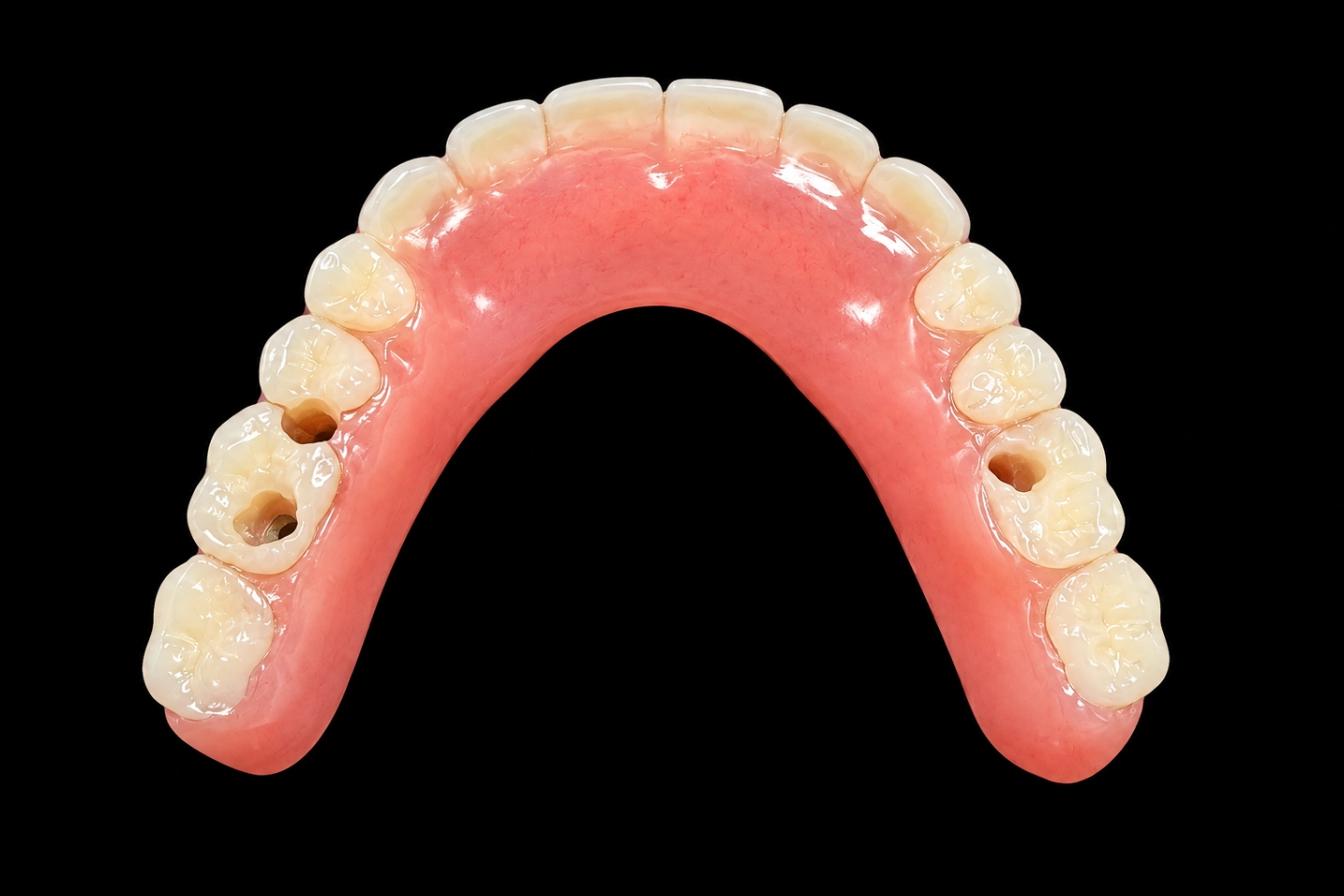
FAQ
Q. Can you fabricate an implant overdenture if we send the physical impression rather than a scan?
Yes. We accept VPS, polyether, condensation silicone impressions and poured stone models (free of bubbles, chips, warpage, cracks). Country import rules on biological material vary — most EU states, the US, Canada, Australia and New Zealand require disinfection documentation on physical impressions, so budget shipping time accordingly.
Q. Which attachment brand and model will the lab use?
The brand and model that your prescription names. We source to that model. If you have not specified, we will stop and ask — attachment selection sits with the treating dentist, not the lab.
Q. Can you duplicate the patient's existing overdenture?
Yes, when you send the old prosthesis along with new impressions and a new bite record. For breakage repair, bring the broken denture and new occlusal and intraoral records; a repair without new records is a predictable source of remake.
Q. How is base-fracture risk managed on a bar overdenture?
At design, by preserving adequate base thickness around the housings and sufficient occlusal clearance for the retention mechanism; at manufacture, by controlling polymerization shrinkage, enforcing in-flask pressure, slow cooling, and remaking any base with internal or multi-site porosity. On any bar case we return the design to the clinic for approval before milling.
Q. Do you provide material certification?
Yes. On request we provide the brand, country of origin, lot number and certificate of conformity for all materials used in a case. The information is recorded by default; the paperwork is produced on request.
Q. Is there a public price list?
Not on this page. Cases are configured; the quote is built from unit count, material grade, attachment and design complexity, and the complete cost is confirmed in writing before production. Contact your sales manager for a scoped quote.
Q. Are implant retained dentures and implant supported dentures different products from your side?
The clinical literature uses both terms, and the ACP glossary distinguishes them (support = load path to the implants; retention = resistance to dislodgement). From a laboratory perspective, the fabrication record set is the same — what differs is implant count, attachment interface, and whether the design is tissue-borne, implant-tissue borne, or fully implant-borne. Specify the design on the prescription and we build to it.
Submit a case or request a quote
Fastest route: send the records and the prescription to your account coordinator. If you are a new client, email us the implant brand/model/arch positions, the attachment type you have prescribed, your preferred base processing route and resin grade, and we will return a scoped quote and a records checklist within one working day.
Factory visits and video audits of the Shenzhen and Huizhou plants can be arranged with the sales team.
Terms used on this page
- Implant supported dentures — a prosthesis whose vertical and horizontal support is transmitted through the implants (and attachments), as distinct from a tissue-borne complete denture.
- Implant overdenture — the removable prosthesis engaging implants via an attachment system (studs, bars, magnetic or telescopic couplings).
- Implant retained dentures — a term also used in the literature for removable implant overdentures; the clinical boundary with “supported” is defined by the load path, not the vocabulary.