Patient Situation
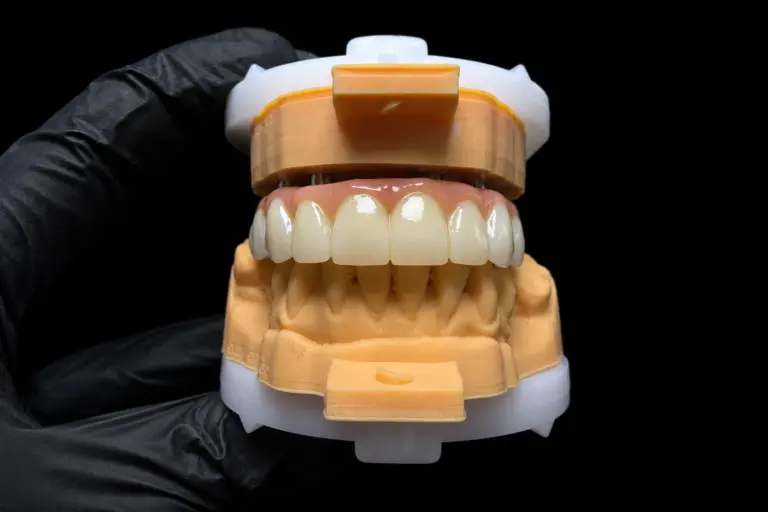
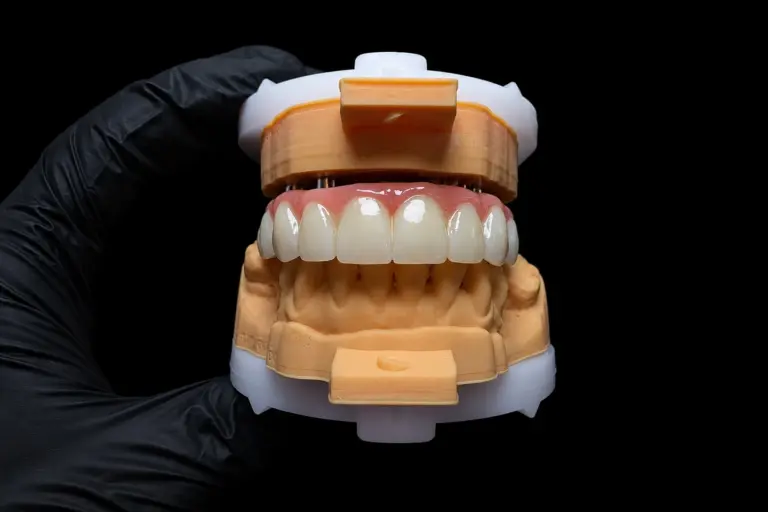
The patient was in their early 80s , retired , and had worn complete dentures for about 14 years . The upper was fine. The lower floated on a flat ridge and moved with every meal .
Four things shaped this dental implants for seniors case, and only one of them was in the mouth:
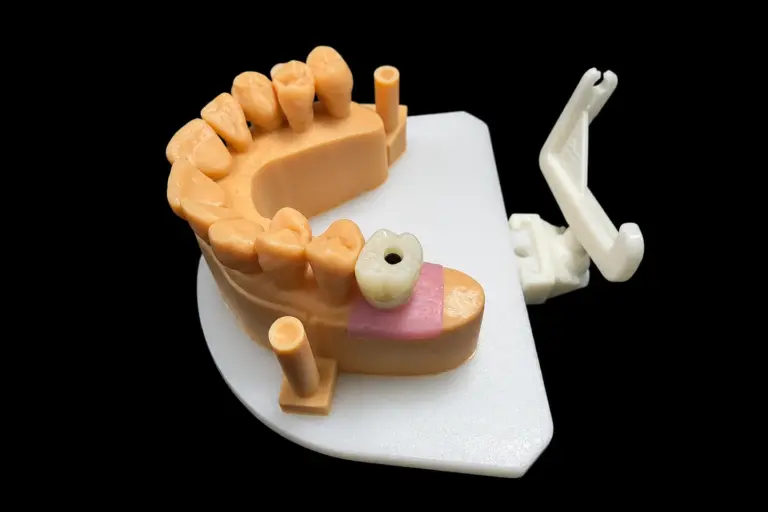
The dentist had already placed two implants at #22 and #27 , and they were ready to load when the case reached us . Number of implants, position, and timing were all clinical calls made before we got involved. We make the denture, not the implants.
Why Dental Implants for Pensioners Called for Fewer Trips
The patient lived on a pension , and every clinic visit meant the daughter taking time off . Dental implants for pensioners don’t need a different lab process, but this one did need a tighter visit plan. The dentist wanted to cut out every trip that didn’t change a decision.
That’s also why the old dentures never came to us. With dental implants for pensioners, a week without teeth is a hard ask. This patient couldn’t go without, so the dentist scanned both of them and kept them in the patient’s mouth .
What the Dentist Asked For
The Rx came down to seven points :
Why removable and not fixed? The dentist didn’t think these hands could clean under a fixed bridge, and the daughter couldn’t reach under one every night either . A denture that comes out can be cleaned at the sink by whoever’s there. The ADA notes that hand arthritis can make home care harder, and it advises taking removable appliances out to inspect and clean them before bed.
That lines up with how the ITI consensus on advanced age and implant survival frames dental implants for seniors. Age alone isn’t a contraindication, but the patient or a care provider has to be able to maintain the implants and the prosthesis. It doesn’t tell you which design to pick. That part stayed with the dentist.
There’s also long-term data behind this kind of dental implants for seniors build. In a prospective study of two-implant lower overdentures with 20-year follow-up, implant survival was 92.5% and 64.3% of the patients assessed at 20 years were frail. Only 15 of the original 53 patients completed the follow-up, so it’s a small group, not a promise. Still, it’s useful when the person in the chair is already in their 80s.
The Technical Problems in This Dental Implants for Seniors Case
Retention and removal pull in opposite directions
Stiff hands need less retention. A lower denture on a flat ridge needs more. No insert solves both, so we didn’t try to pick one from the bench. The dentist chose to test two strengths on the patient at try-in .
Two implants leave the back of the denture on its own
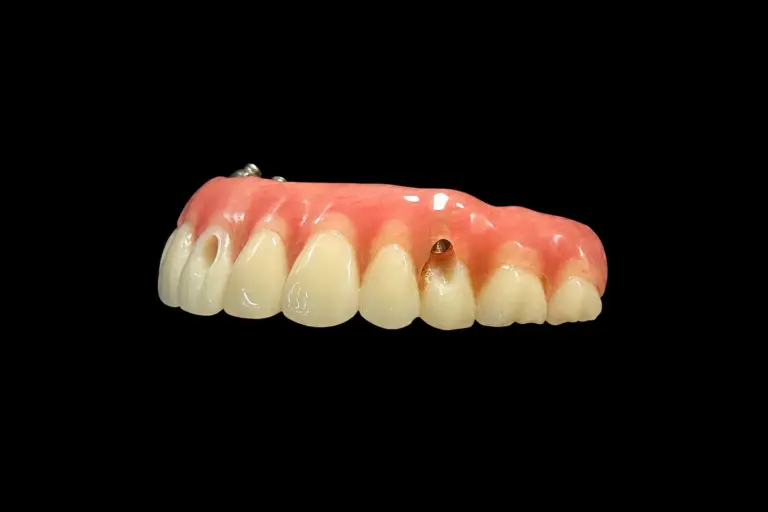
Two implants at the canines work a bit like a hinge. The denture can rotate around the line between them, so the back end still depends on the ridge. That’s why the dentist wanted full borders over the retromolar pads . Shaving the base down to make it lighter or easier to handle wasn’t on the table.
The space at #27 was tight
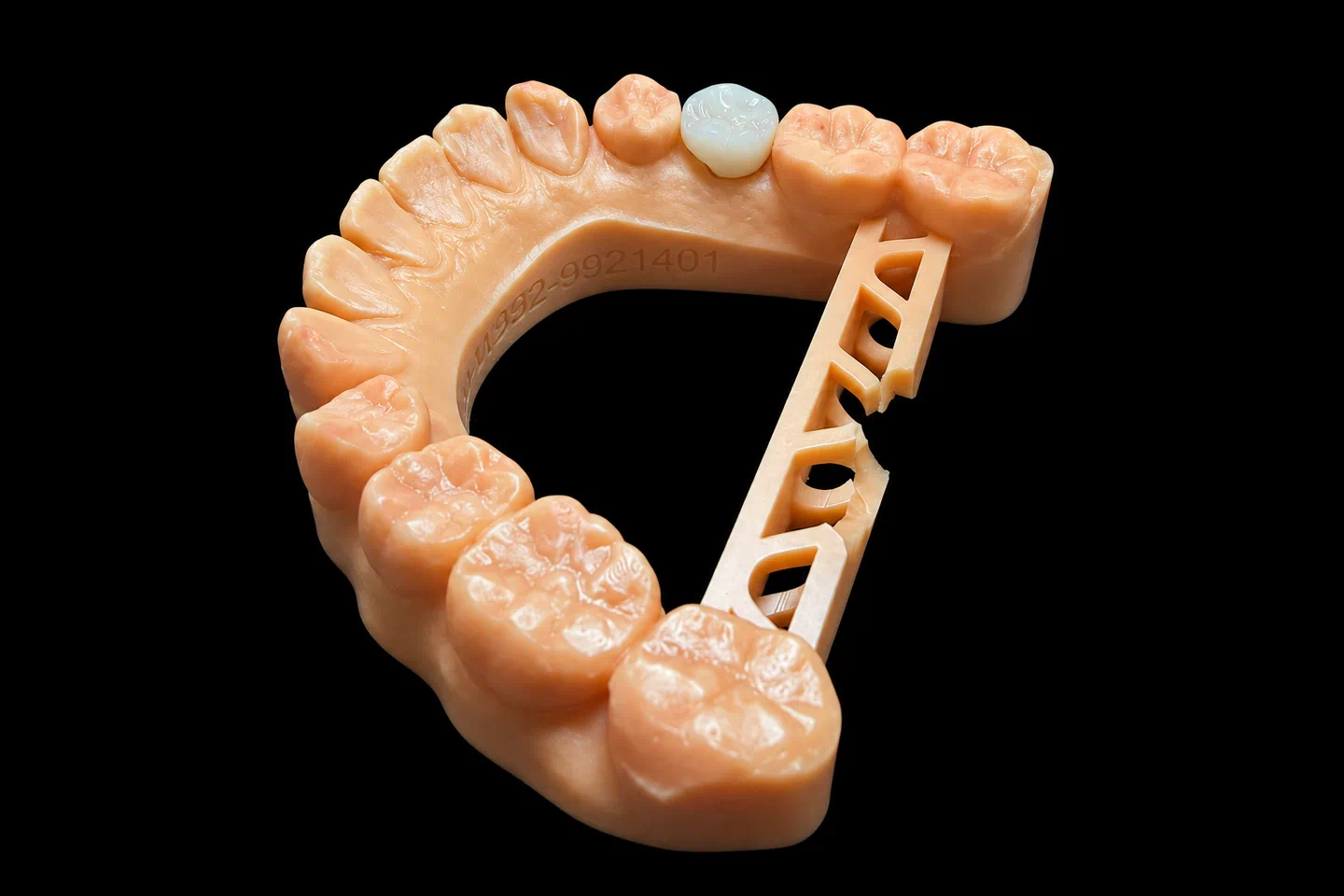
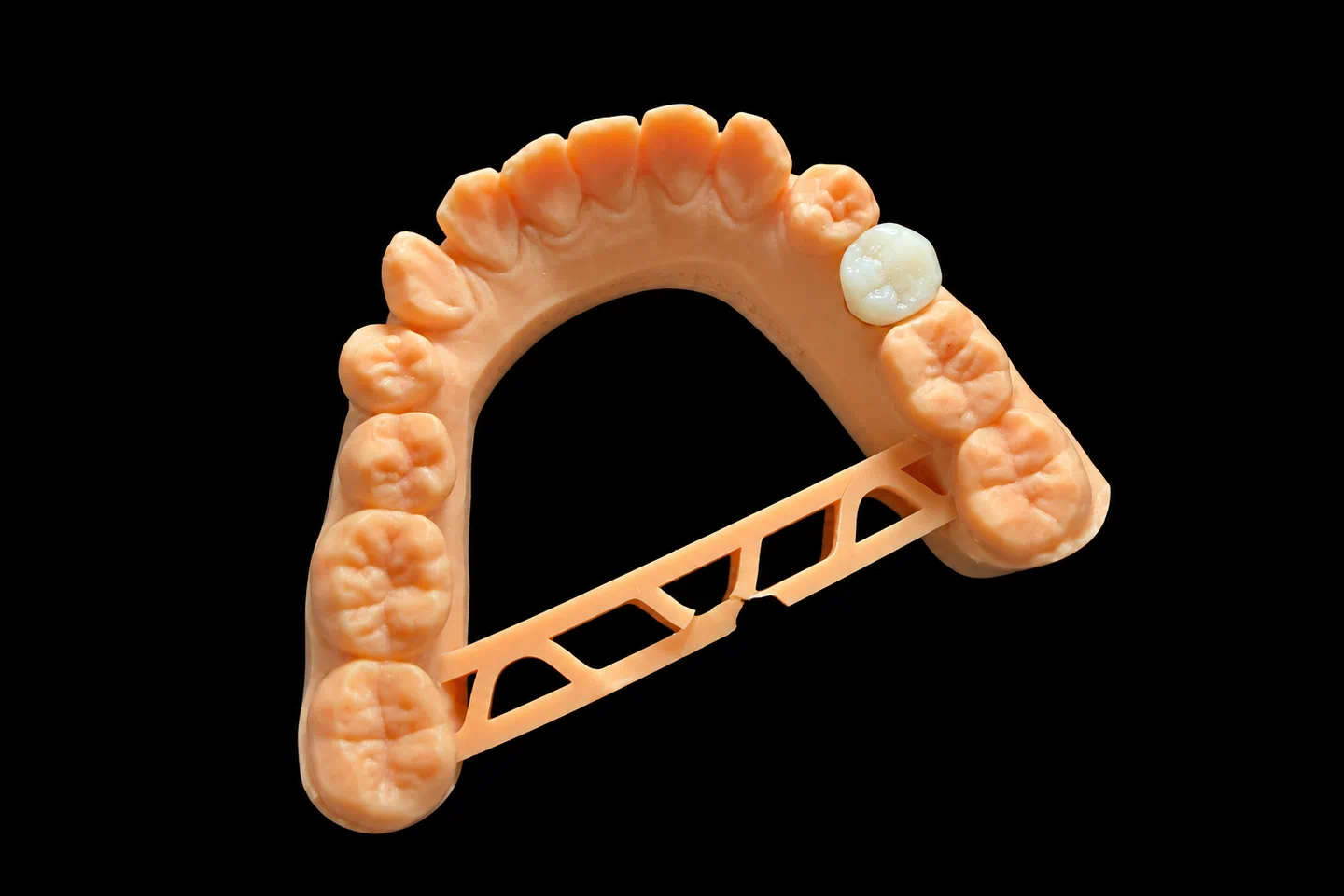
The implant at #27 sat slightly to the lingual, about 6° off #22 . Vertical space was fine, around 13 mm at both implants . But our first design preview showed only 0.7 mm of acrylic behind the #27 housing . That’s thin for a spot that takes load and gets handled every day.
We could’ve pushed the #27 tooth forward, but the Rx said to keep the front tooth position.
New bite, old habits
The worn back teeth had to come up, but a patient who’s spent 14 years with this tongue space won’t always accept a bulkier lower denture. Any acrylic we added behind #27 was going to land right where the tongue rests.
How We Met Each Requirement
| Dentist’s requirement | What we did | How we checked it |
|---|---|---|
| Two LOCATOR abutments, new upper against the lower | Housings set on one shared path; both arches set up together | Denture seated and came off the model with no binding |
| Patient can take it out | Trial denture tested with two insert strengths; thumb ledge added to the buccal flange at #28 and #29 | Patient’s own hands at try-in; ledge compared with the returned trial denture |
| Keep front teeth and tongue space | Old denture scans overlaid on the new design | Dentist checked speech and tongue comfort at try-in |
| Add about 1.5 mm of bite height | Back teeth rebuilt to the new height; front position held | Remounted on the original records |
| Full lower borders | Border form taken from the molded impression and kept through finishing | Borders protected in polishing, then checked on the model |
| One try-in | Trial dentures carried everything the dentist needed to test | No second try-in requested |
| Initials in the base | Marked in the lingual flange area of the base | Checked at final inspection |
Giving #27 more acrylic
We sent the dentist the preview with the 0.7 mm reading marked and two options. One was to move the #27 tooth forward. The other was to keep the tooth where it was and add a little bulk on the lingual. The dentist went with the bulk, as long as speech held up at try-in .
We added about 0.6 mm on the lingual side, which brought the acrylic to about 1.3 mm . We also talked about a metal frame. With 13 mm to work with, the dentist decided to go without one and keep later repairs simple . If the dentist had wanted a frame, we’d have put it in the design and shown it in the preview.
Copying what the patient already knew
Old dentures tell you a lot, especially with dental implants for seniors, where the patient has often spent years getting used to them. We kept the fullness, the tooth size, and the front tooth position the patient had adapted to, and we corrected what had gone wrong: the worn back teeth and the collapsed bite . Where the Rx, photos, and old dentures disagreed, we asked before changing anything.
| From the old dentures | Decision |
|---|---|
| Front tooth position | Kept |
| Lip fullness | Kept |
| Tooth size | Kept |
| Tongue space | Kept, except about 0.6 mm at #27 |
| Worn back teeth | Replaced |
| Bite height | Raised about 1.5 mm |
How We Made It
Stage 1: Records and trial dentures
The try-in
This appointment was the whole point of the printed trial. For dental implants for seniors, it’s the test we’d want most, since a wax setup can’t really be snapped on and pulled off by the patient.
With the 3 lb inserts, the lower sat firmly, but the patient couldn’t lift it with either hand. The daughter could, with some effort . With the 1.5 lb inserts, the patient got it moving, then the thumb slid off the smooth flange . So grip was the problem as much as force.
The dentist kept the 1.5 lb inserts, added a small wax ledge on the buccal flange at #28 and #29, right where the patient’s thumb landed, and tried again . On the third try, it came off . The bite height looked right, and speech was fine with the extra bulk behind #27 . The dentist sent the trial dentures back to us with the wax still on .
Stage 2: Final design
We scanned the ledge and rounded it off, so it’d give the thumb something to catch without turning into a food trap . The dentist approved the updated screenshots the next working day .
Stage 3: Processing and final checks
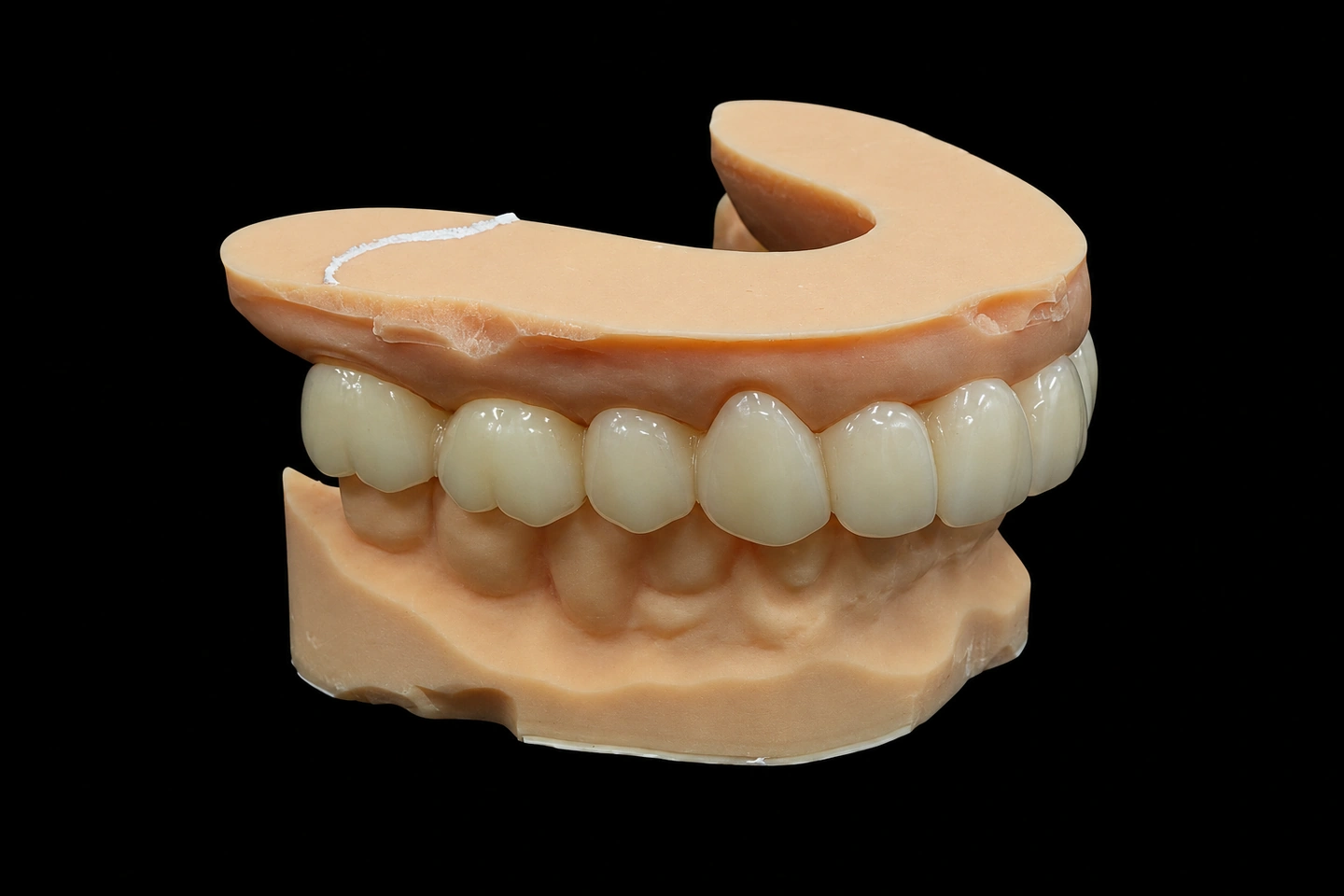
The Finished Dental Implants for Seniors Case
Here’s what the final design aimed for, and where it landed at final inspection:
Dentist and Patient Feedback After Fitting
The dentures seated at the first appointment. There was one sore spot under the right lingual flange at the one-week check, and a small adjustment took care of it .
The patient took the lower out alone on the second try at fitting and on the first try by the two-week check .
Cleaning the lower at the sink took a couple of minutes, housings included .
What This Design Still Can't Do
The lighter inserts cost something. Sticky food can still lift the back of the lower, and the dentist warned the patient about that up front . That was the trade: a denture that’s a little less firm, and one this patient can actually take out.
Better chewing has limits too. In one study of 35 adults aged 50 and over, chewing difficulty fell from 91.4% to 51.4% six months after moving to implant overdentures, so about half still had some trouble.
In a randomized trial of 255 edentulous adults over 65, lower implant overdentures didn’t improve nutritional state more than new complete dentures at 6 or 12 months, though those patients were more likely to eat fresh fruit and vegetables. So nobody on this case promised better nutrition, just a denture that’s steadier to eat with.
Hands can also get worse, and dental implants for seniors have to allow for that. The inserts will wear, and a day may come when the daughter does all of the removing . The dentist set a recall schedule with that in mind .
Sending Us Dental Implants for Seniors Cases
Dental implants for seniors go smoother when the Rx tells us about the person as well as the mouth, so don’t leave that part out. Along with the usual records, send us:
A lower overdenture generally takes 5–7 working days in the lab, counted from the day we get the case. Clinic visits and shipping between try-ins come on top of that.
Who Made It
Two of our departments worked on this dental implants for seniors case. Our implant dental laboratory team of about 80 technicians handled the implant data and parts, and our removable department of about 55 did the setup and the bases. A separate QC team of about 25 checks work before it ships.
Istar Digital Dental Lab has four labs in Shenzhen and Huizhou, China. We started in 2012, we’ve got about 460 people, and we don’t outsource. We’re an FDA-registered establishment (Registration Number 3039441248), which you can check in the FDA establishment registration database. Our labs run an ISO 13485 quality management system, and custom-made dentures for EU clinics follow the MDR custom-made device procedure. You’re welcome to visit the factory or book a video tour.
Dental Implants for Seniors FAQ
How does pricing work on dental implants for pensioners?
We don’t publish prices on the website, but you can ask for our price list. Quotes are itemized to what you ask for, so you’ll see what parts and try-ins add.
Do you work with my implant system?
Most likely, yes. We support most systems on the market. Tell us the brand and model, and include any library files you’ve got.
Can you supply the abutments and attachments?
Yes. Give us the model you want and we’ll buy parts to match. Parts are charged separately.
Can you build it on a bar, or go fixed?
Yes, we make bar-retained and fixed builds as well. Our denture implants page covers removable options, and our All-on-X page covers fixed ones.
What if I want a design you think is risky?
We’ll tell you what we see and why. If you want to change it, we change it. If you’d rather keep your design, we’ll build it to your Rx. No sign-off form, but remakes caused by that design aren’t on us.
What does the warranty cover?
You get a 1-year warranty. Problems on our side, like a denture that won’t seat, lifted borders, or an off bite, get adjusted or remade free. Changing the material or shade later, or asking us to go ahead on an impression we’ve flagged, is charged. You pay to send the case in, and we pay to ship finished work back, remakes included.
Got a Patient Whose Hands Have Slowed Down?
Send us one of your dental implants for seniors cases as a test. Tell us what the patient can and can’t manage, and we’ll send the design back with any tight spots marked before we make anything. Single trial cases are welcome, and ongoing partnerships suit clinics with a regular case flow.