The Patient and the Old Denture
The patient was in their late 60s and had worn complete dentures for about ten years . The upper stayed put. The lower didn’t. It lifted when they ate and slid forward when they talked, on a ridge that was low and flat at the front .
Both lower denture implants were integrated by the time the case reached us . Where they went and when they were ready to load were the dentist’s calls. Our part started with the denture.
One detail made a lab conversion workable. The patient still had their previous lower denture and wore it while this one was with us . A conversion takes the denture out of the mouth for the whole round trip, so that has to be planned with the patient first.
What the Dentist Asked For
The Rx for these lower denture implants had five points :
Why an implant overdenture conversion?
The patient was used to these teeth, and nobody wanted to start over with a new setup . An implant overdenture conversion is also a well-trodden route for lower denture implants. The McGill consensus statement named the two-implant overdenture the first-choice standard of care for an edentulous lower jaw.
Converting the denture a patient already wears has been tested too. In a randomized trial in very old adults, existing lower dentures were converted to overdentures on two implants or given conventional relines. The implant group reported higher denture satisfaction and better oral health quality of life, though chewing efficiency didn’t differ. Those patients were older and frailer than this one, so it backs the route, not a promised result.
Can This Denture Take Lower Denture Implants?
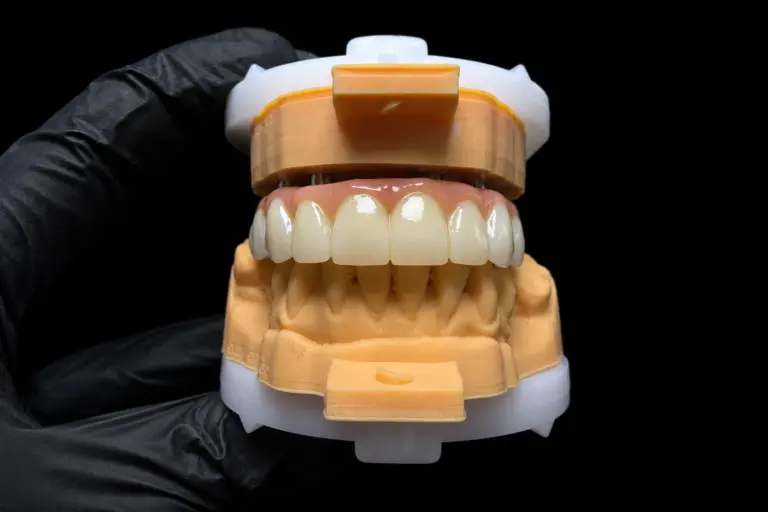
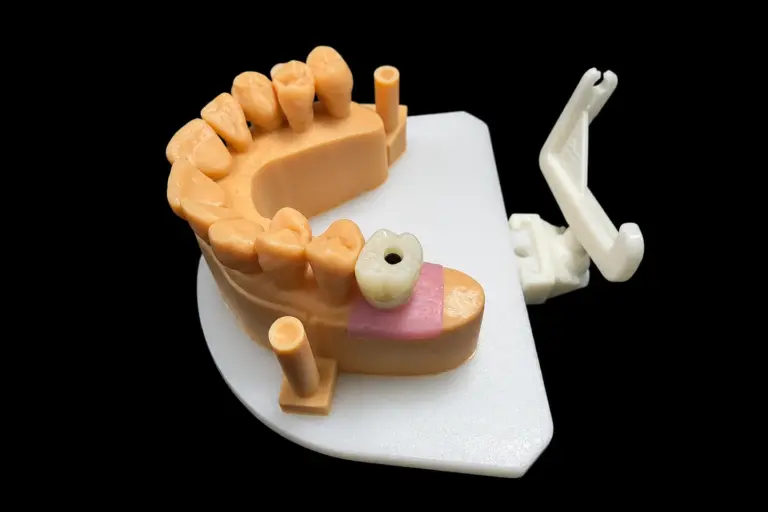
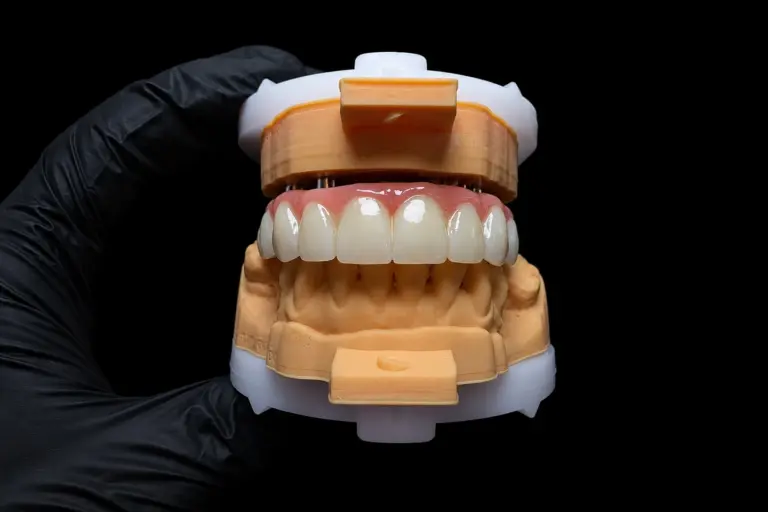
We got the old denture with a closed-mouth reline impression inside it, a bite record, a scan of the upper denture and photos of the implant labels . We matched the brand, connection, diameter and position of both lower denture implants to the Rx, then poured the model with analogs and mounted it against the upper.
An implant overdenture conversion only makes sense if the denture passes nearly every check.
| Check | What we found | Verdict |
|---|---|---|
| Bite height against the bite record | Within about 0.5 mm | Keep |
| Tooth wear | Light wear on the back teeth, contacts still even on both sides | Keep |
| Teeth over the implants | Both implants sat under the denture canines, with no tooth in the way of a housing | Keep |
| Cracks, old repairs, bubbles | None under strong light | Keep |
| Base fit at the back | Lifted off the ridge, about 1–1.5 mm over the retromolar pads | Reline |
| Angle between the implants | About 8° , within the attachment maker’s range | Keep |
| Acrylic around each housing | Fine at #22; about 0.8 mm on the lingual at #27 once the recess was cut in the plan | Problem |
Why #27 came up thin
The old denture’s lingual flange was thin at the right canine, and the implant at #27 sat slightly to the lingual . Cut a recess for a housing and a block-out spacer into that, and there isn’t much left on the tongue side.
That spot matters. A systematic review on implant numbers for lower overdentures found that repairing a denture fractured around an implant was one of the most common maintenance jobs in the one- and two-implant groups. A converted denture is most likely to get thin right there, because it was never designed around a housing.
Reline and housings in one step
The back of the base floated, so the housings couldn’t go in on their own. Set them while the back still sits off the ridge, and the denture rests on the attachments and pivots on them every time the patient bites.
So the reline and the housings had to come from the same impression, with the denture held where the dentist seated it. The dentist had snapped LOCATOR impression copings onto the abutments and picked them up inside the reline impression , which gave us the tissue and the abutment positions in one record.
The Implant Overdenture Conversion Options We Sent
We sent the dentist photos of the denture and the readings the same day we mounted it . Attachment cases get a design sign-off before production anyway, so this round doubled as that.
| Option | What it fixes | What it costs |
|---|---|---|
| Convert as it is | Quickest, nothing about the denture changes | Only about 0.8 mm of acrylic at #27 |
| Convert and add acrylic on the lingual at #27 | Brings the wall to about 1.5 mm by adding about 0.7 mm | A little more bulk under the tongue at the right canine |
| New denture copied from this one | A full-thickness flange at #27 with no added bulk | New teeth, a try-in, more appointments and more cost |
When a design carries a risk, we flag it and the dentist decides. Had the dentist picked the first option, we’d have built it to the Rx, and a crack at #27 caused by that choice wouldn’t be on us.
Why the dentist picked the add-on
The patient’s tongue wasn’t large, and the extra acrylic would sit low on the flange . The dentist went with option two and set one limit: no more than 0.8 mm beyond the old lingual contour .
How We Turned It Into a Snap-In Lower Denture
Stage 1: Reline and housings
Stage 2: Bite, finish and final checks
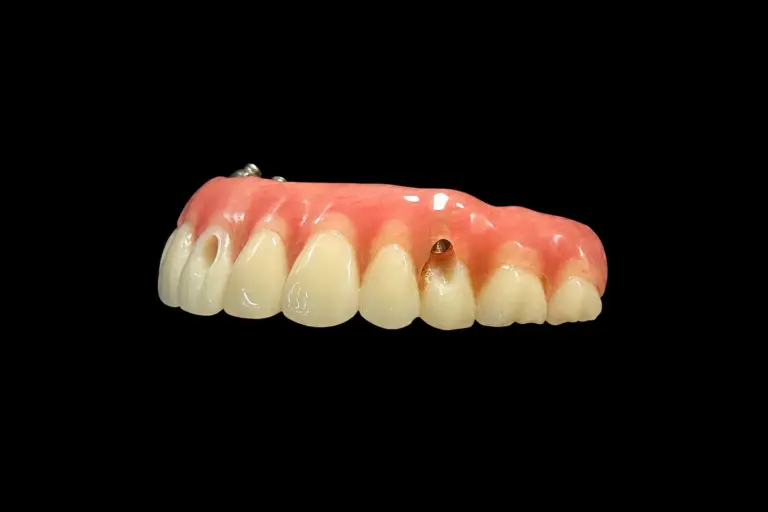
The Finished Lower Denture Implants Conversion
Dentist and Patient Feedback After Fitting
The denture snapped on at the fitting visit with no adjustment to the housings. One sore spot at the back of the right side came off with a small adjustment at the one-week check .
The snap-in lower denture stayed down through meals and conversation. They noticed the extra acrylic at #27 for a few days, then stopped noticing it .
What This Conversion Still Can't Do
The old teeth will keep wearing at their own pace. When they’re worn out, a new denture is back on the table . And two lower denture implants at the front only hold the front. The back of the base still rests on the ridge, so it’ll need relines as the ridge keeps changing.
Sending Us a Lower Denture Implants Conversion
A conversion goes smoother when a few things are sorted before the denture ships:
A lower denture implants conversion generally takes 5–7 working days in the lab, counted from the day we get the case. Shipping both ways comes on top of that.
Who Made It
Our implant dental laboratory team of about 80 people handled the implant side of this lower denture implants case, and our removable department of about 55 built the denture side. A separate QC team of about 25 checks work before it ships.
Istar Digital Dental Lab has four labs in Shenzhen and Huizhou, China. We started in 2012, we’ve got about 460 people, and we don’t outsource. We’re an FDA-registered establishment (Registration Number 3039441248), which you can check in the FDA establishment registration database. Our labs run an ISO 13485 quality management system, and custom-made devices for EU clinics follow the MDR custom-made device procedure. You’re welcome to visit the factory or book a video tour.
Lower Denture Implants FAQ
Can you convert a denture another lab made?
Yes. We convert and repair dentures from other labs and clinics, and an implant overdenture conversion runs the same way whoever made the denture. Our denture implants page covers the implant dentures we build from scratch.
Do you work with my implant system?
Most likely, yes. We support most systems on the market. If you’re working digitally, send the scan library name too.
How does pricing work?
We don’t publish prices on the website. Quotes are itemized to what you ask for, so a reline, housings and an add-on each show up as their own line.
What does the warranty cover?
Implant dentures carry a 3-year warranty. Problems on our side, like a denture that won’t seat, lifted borders or an off bite, get adjusted or remade free. Changing the material or shade later is charged. Implant parts aren’t part of a free remake. You pay to send the case in, and we pay to ship finished work back, remakes included.
Got a Lower Denture Worth Keeping?
Send us one of your lower denture implants cases as a test. Single trial cases are welcome, and ongoing partnerships suit clinics with a regular case flow.