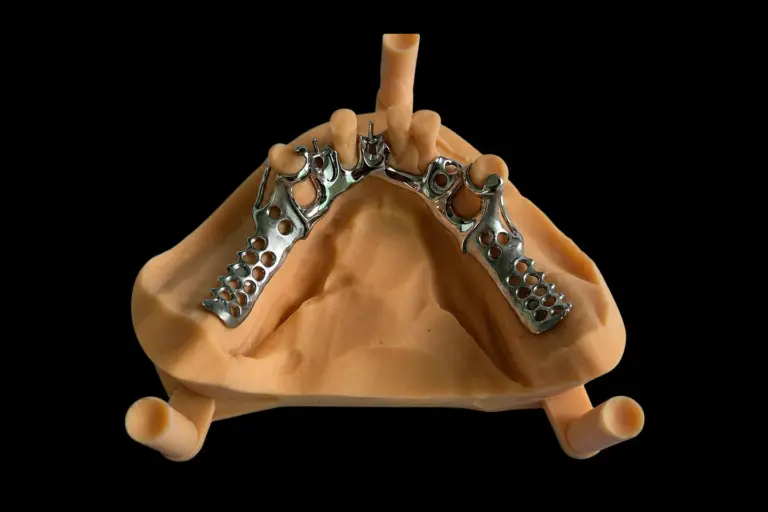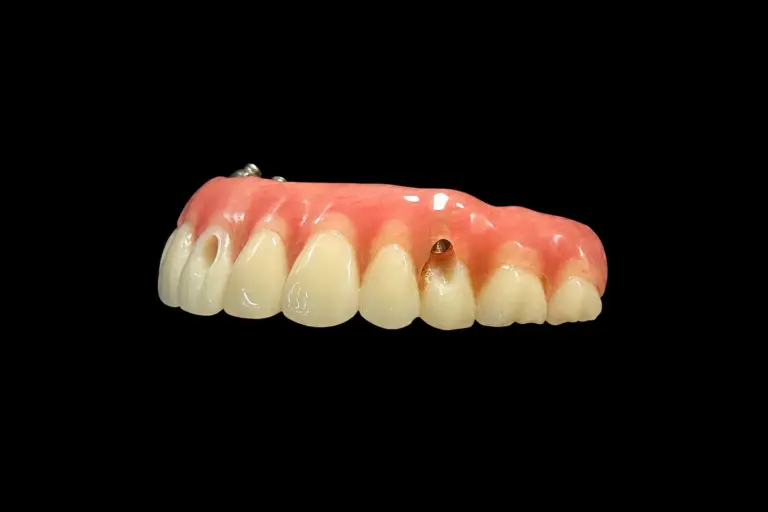
Every removable partial or overdenture has to hold on to something in the mouth. Dentures with clasps grip undercuts on natural teeth. A precision attachment denture locks into a connector built into a crown. A Locator denture snaps onto a stud on an implant, or on a prepared root. Which one suits a case depends less on the hardware than on the abutments, the space, the smile line and how the denture will be looked after and repaired years from now.
The evidence doesn’t crown a winner. In a systematic review of 46 studies covering 4,359 partial dentures, estimated five-year survival was 95.1% for cast-clasp partials and 91.7% for partials retained by telescopic crowns, with no significant difference between them. For implant overdentures, a Cochrane review of attachment systems found too little evidence to recommend one system over another. So this guide is about matching the retention to the case, not ranking the options.
Three Ways a Removable Denture Holds On
| Clasps on natural teeth | Attachments on crowns | Studs on roots and implants | |
|---|---|---|---|
| Holds on to | Undercuts on unrestored or already restored teeth | A male or female part built into, or onto, a crown | An abutment on an implant, or on a root cut down to the gingival level |
| Tooth work | Rest seats and guiding planes, usually in enamel | Crowns on the abutments, often splinted | Root treatment and a root abutment, or implant surgery |
| Space needed | Very little beyond the framework | Room for the attachment, its housing and the denture teeth | Usually the most vertical room of the three |
| Trade-off | Metal can show, depending on where the clasps sit | No visible clasp, but more restorative work and more parts to maintain | Good retention and no clasps, but nylon inserts wear and need replacing |
Choosing for the Case in Front of You
Run the case through these questions before you pick hardware.
Do the abutments need crowns anyway? If the teeth next to the space are heavily restored or need crowns for their own sake, building an attachment into those crowns costs relatively little extra. If they’re sound, an attachment means crowning healthy teeth just to hide a clasp, and a well-designed clasp is often the better trade.
Will metal show? Map the smile line on the teeth that would carry clasps. Premolar and canine clasps are where most esthetic complaints start. Clasp design can solve a lot of this before you need an attachment (more on that below).
How much room is there? Attachments and studs need vertical space for the component, its housing, the acrylic around it and the denture teeth. A short interarch distance rules some options out before anything else does.
Is there a distal extension? A base that rests on soft tissue moves more than the teeth do. That affects whether a rigid attachment is safe, as the precision attachment section explains.
Can the patient clean it and handle it? Every option here needs daily removal and cleaning. Attachments and studs add components that collect plaque and wear out, plus recall visits to check them.
What happens if an abutment fails? This one is easy to skip at the planning stage and expensive later. It’s covered under upkeep and repairs.
When Attachments Are the Wrong Choice
Attachments and studs are a poor fit for patients with poor hygiene or compliance, active caries or periodontal disease, weak or unrestorable abutments, too little space, limited dexterity for seating and removing the denture, or no realistic way to attend follow-up and pay for replacement parts. In those cases, a conventional clasp partial is usually the more predictable plan.
Dentures With Clasps: Design Decides How Much Shows
A clasp is only one part of a clasp assembly. The retentive tip flexes over the height of contour and engages the undercut. A rigid reciprocal arm opposes it during insertion and removal. Rests carry vertical load onto the teeth, and bracing elements resist sideways movement. When the assembly is designed well, it sits passively when the denture is seated and only engages when something tries to lift the denture. The Dalhousie RPD manual covers these principles in depth.
Circumferential (Akers) Clasp
Approaches the undercut from the occlusal side and wraps around the tooth. It’s versatile and braces well in tooth-supported cases, but it covers more tooth and shows more metal.
Bar Clasp and I-Bar
Approaches the undercut from the gingival side, so less metal shows on the buccal surface. It isn’t suitable where the approach arm would cross a shallow vestibule, a frenum or a large soft-tissue undercut.
RPI and RPA
For distal extensions: a mesial rest and a distal proximal plate, with an I-bar (RPI) or an Akers-type arm (RPA) where an I-bar won’t fit. Both are designed to let the extension base rotate under load without torquing the abutment.
Wrought-Wire Combination Clasp
A round wrought-wire retentive arm on a cast framework. It’s more flexible and easier to adjust, which can help on some distal extensions and on teeth with awkward undercuts.
Hiding Clasps Without Giving Up Support
Most visible metal can be reduced by design rather than by switching to a clasp-free denture:
- Use a gingivally approaching clasp on premolars where the tissue allows it.
- Place retention on the lingual surface where the path of insertion permits it.
- Put tooth-colored clasps only where they would show, and keep metal clasps, rests and connectors everywhere else.
- Show the patient the framework at try-in and agree on what will be visible. Don’t leave it to delivery day.
What the Clasp Material Changes
Cobalt-chromium is the reference. A cast CoCr retentive tip is typically placed in an undercut of about 0.25 mm. Other materials don’t simply swap in:
- Titanium is lighter and has a lower stiffness than CoCr, so a titanium clasp is designed differently, with a different arm form or undercut, rather than copied from a CoCr design.
- Acetal resin clasps showed significantly lower retentive force than CoCr clasps after 36 months of simulated use in an in vitro comparison, though they didn’t deform the way the CoCr clasps did.
- PEEK clasps generally retain with less force than CoCr, and comparative clinical evidence is still limited, according to a systematic review of PEEK and CoCr partials.
- Flexible (Valplast-type) partials suit selected cases where hiding metal matters or the patient can’t have metal. They aren’t suitable for heavy bites, large base coverage or very deep undercuts, because they deform and are harder to reline and repair. A 2025 review of flexible and non-metal clasp dentures found better short-term satisfaction in some studies but weak evidence on clinical performance, with mucosal redness and loss of retention reported in some polyamide designs.
We make frameworks in cobalt-chromium, Vitallium, pure titanium and PEEK, cast, milled or laser-printed, plus flexible partials. See metal framework and flexible partials .
From the bench: Nothing is cast or milled until you’ve approved the design. Clasp type at each abutment, such as an I-bar or a circumferential clasp, rest positions, connector dimensions and the extent of the retention mesh are all marked on the design you approve.
Precision Attachment Dentures: What “Precision” Really Means
An attachment is a pair of mating parts, a patrix (male) and a matrix (female). One part sits on the abutment crown, root or implant, and the other sits in the denture. The classic review of attachments for RPD design sorts them along three separate axes: how they’re made, where they sit and how much they let the denture move. A single attachment can be extracoronal and rigid, or extracoronal and resilient, so the three labels don’t predict each other.
Precision vs Semi-Precision
The difference is in manufacture and fit. Precision attachments are prefabricated, machined parts with very tight tolerances. Semi-precision attachments are made or adapted in the lab, typically from plastic patterns that are cast with the crown or framework. It’s not a statement that one works better clinically, and product names don’t always follow the distinction.
Rigid vs Resilient: The Choice That Matters Most
A rigid attachment allows almost no movement between the denture and the abutment. A resilient attachment allows a controlled amount of hinge, rotation or vertical movement.
This matters most on a distal extension. The tooth barely moves under load, while the free-end base sinks into the soft tissue. With a rigid attachment, that difference becomes torque on the terminal abutment. There are two usual answers:
- Splint the abutments with joined crowns so the load is shared, and keep the joined crowns cleanable.
- Choose a resilient attachment that lets the base move. Sterngold describes its ERA attachment as an extracoronal semi-precision attachment with a universal hinge and vertical resiliency.
Neither one takes the load off the abutment entirely. The base still needs broad, well-fitting tissue support, and relines when the ridge changes.
Intracoronal vs Extracoronal
An intracoronal attachment sits inside the crown’s contour, in a box or slot. It keeps forces closer to the long axis of the tooth but needs a bulky abutment and deeper preparation. An extracoronal attachment sits outside the crown, so it needs less preparation inside the tooth, but its position adds leverage on the abutment and creates an area that has to be kept clean.
Attachment Families at a Glance
Extracoronal Resilient Attachments
Attached to the distal of a crown, with a replaceable, color-coded male in the denture. A common choice for distal extensions.
Studs and Balls
A stud or ball on a root coping or implant engages a replaceable cap or ring in the denture. Simple and low-profile, but alignment and wear need watching.
Bar and Clip
A bar splints two or more roots or implants, and clips in the denture engage it. It adds support and copes with divergent abutments, but needs more space and good access for cleaning under the bar.
Magnets
A keeper on the root or abutment and a magnet in the denture. Easy for patients with limited dexterity to seat, but retention drops as the gap grows, and corrosion can be a concern.
Telescopic (Double) Crowns
A primary crown on the tooth and a secondary crown inside the denture, retained by friction or taper. No clasps and an open labial flange are possible, at the cost of substantial preparation, space and very accurate fabrication.
Why an Attachment Case Tests the Lab
A precision attachment denture is a fixed case and a removable case on one path of insertion. The crowns, the attachment, the framework and the denture base all have to line up. If the crowns and the framework come from different labs, or from different outsourced steps, the errors add up, and the only place you find out is at try-in.
At Istar Digital Dental Lab, crown and bridge and removable work are done in our own labs with no outsourcing, so the attachment crowns and the framework are designed and checked as one case instead of being handed from lab to lab. Attachment and telescopic cases, complex framework partials and cases with tight space always go through design approval before production. We order the attachment system you specify and use original manufacturer components.
Locator Dentures on Implants and Roots
In everyday use, “Locator denture” means a removable implant overdenture that snaps onto Locator abutments. Each abutment screws into an implant, a metal housing is processed into the denture, and a nylon insert in the housing engages the abutment. The patient takes it out to clean it.
Two related products are often lumped in with it:
- Locator Root uses the same idea on a prepared natural root. Zest’s Locator Root technique manual describes straight and angled root abutments and a cast-to option. This is where Locators and tooth-borne attachments meet.
- Locator F-Tx is a fixed hybrid that only the clinician removes. It isn’t an overdenture, and neither is All-on-X. For those, see our fixed full-arch options .
Implant Number and Arch
In the mandible, two implants in the anterior region are a well-established minimum. The McGill consensus statement called the two-implant mandibular overdenture the first-choice standard for the edentulous mandible. With two implants, the denture rotates around the line between them, so the posterior is still tissue-borne. Full base extension and good posterior tissue support still matter.
In the maxilla, four or more implants are usually planned. A systematic review of maxillary implant overdentures found better implant and overdenture survival with splinted designs on four or more implants, and less favorable results with four or fewer unsplinted attachments.
Space for a Locator Denture
Published figures vary because authors measure from different landmarks. A review of restorative space for implant prostheses gives about 7 mm as the minimum vertical space for a standard unsplinted overdenture, 11 mm for a bar overdenture and 15 mm for a fixed hybrid. Horizontal space matters too: the housing needs a ring of acrylic around it, or that’s where the denture will crack. If the space is tight, we raise it at the design stage, before the denture is processed.
Inserts: Color Means Retention, Not Hardness
Insert colors indicate a retention level and the range of implant angulation the insert can handle. They aren’t a hardness scale. Per Zest’s insert color guide:
| System and range | Insert colors (lowest to highest retention) | Angulation per implant | Between two implants |
|---|---|---|---|
| Legacy Locator, standard | Blue (extra light), pink (light), clear (regular) | Up to 10° | Up to 20° |
| Legacy Locator, extended | Gray (zero), red (extra light), orange (light), green (regular) | Up to 20° | Up to 40° |
| Locator R-Tx, standard | Gray (zero), blue (low), pink (medium), clear (high) | Up to 30° | Up to 60° |
| Locator R-Tx, limited | Aqua (low), purple (medium), yellow (high) | For implants with 10° or less of divergence |
Some colors appear in both generations with different meanings, and legacy and R-Tx parts aren’t interchangeable. Always tell us which generation the abutments are. Starting with a lighter insert and stepping up is the usual approach.
Housings: Processed in the Lab or Picked Up Chairside
We do both, so choose the workflow per case:
- Lab processing (indirect): take an impression with impression copings, and we place analogs, process the housings into the denture on the model, and deliver it ready to seat.
- Chairside pickup (direct): we deliver the denture relieved for the housings, and you pick them up in the mouth. The Locator technique manual has you seat a block-out spacer under each housing first. Skip it, and pickup material can flow under the abutment and lock the denture in place. The patient should close only lightly while the material sets.
Converting an existing denture is sometimes possible, by relieving it and picking up the housings chairside. A worn denture, or one with thin acrylic over the abutments or a poor fit, is usually better replaced.
Planning for Upkeep and Repairs
None of these is a maintenance-free denture. Plan the recall and the repair path when you plan the case.
Dentures With Clasps
Watch the clasped teeth: in the 46-study review above, abutment teeth had a higher risk of extraction than other teeth. Expect clasp adjustment and relines as the ridge changes. If an abutment is lost, a tooth and a clasp can usually be added to the existing denture.
Precision Attachment Dentures
Matrices wear and are replaced or reactivated, crowns can come loose and abutments can fail. In a meta-analysis of overdenture abutments with cast copings, covering 1,954 teeth over 9,098 tooth-years, teeth were lost at about 1.76% a year, mainly to caries and periodontal infection. When an attachment abutment fails, the crown, the attachment and often the framework have to be reworked, so caries and gum control around the abutments is part of the treatment plan.
Locator Dentures
Inserts wear. In a retrospective audit of Locator overdenture patients at a UK dental hospital, the first insert change came at about 3.4 months on average in the maxilla and 6.4 months in the mandible, and the second about 10 months later. Treat that as one clinic’s data, not a schedule, and replace inserts based on retention and wear at recall.
For all three, patients should take the denture out every day, clean it with a soft brush and a non-abrasive cleaner, and brush the abutments. For Locator dentures, Zest also advises against biting the denture into place and limits soaking in denture cleanser to 15 minutes or less.
Sending an Attachment or Partial Case to Istar Digital
What to Send
For a framework partial: an accurate model or scan, the survey line analysis, abutment undercut measurements, a bite record and your framework design, or the survey information and we’ll propose a design. For an overdenture: the attachment type, and for implants, the implant brand, model, connection, diameter, number and positions, plus the Locator generation or bar design.
Design Before Production
You approve the design before anything is cast, milled or printed. For attachment, telescopic and tight-space cases, that’s mandatory.
Components You Specify
We order the attachment system and sizes you specify, using original manufacturer components. Titanium bars, multi-unit abutments, screws and tools are also available, priced separately. More on our implant components .
Covered After Delivery
If the cause is on our side, we adjust or remake the denture free, including a denture that doesn’t seat, a lifted border or a poorly placed clasp, and we pay to ship it back. Implant components aren’t included in a free remake. Removable dentures carry a 1-year warranty, and crowns, including attachment crowns, 3 years. Full terms are in our remake and warranty policy . Istar Digital is an FDA-registered establishment, Registration Number 3039441248, which you can verify in the FDA database.
Quotes are itemized. The number of attachments, the abutment crowns, the components and the framework material each add to the price. For the price list, contact our sales manager. Single trial cases are welcome, and an ongoing partnership suits a regular flow of cases.
Send an attachment or partial denture case
Frequently Asked Questions
Should I choose a bar or Locators for an implant overdenture?
A bar splints the implants and can give more retention, but it needs more vertical space (about 11 mm versus 7 mm in the restorative space review above) and careful cleaning under the bar. Individual Locators are lower-profile and simpler to maintain. The Cochrane review found no reliable evidence that either is better overall, so space, the arch and the patient’s ability to clean usually decide.
Do abutments under a precision attachment always have to be splinted?
No. Splinting spreads load and is common for rigid attachments on distal extensions, but it adds restorative work and the joined crowns must stay cleanable. A resilient attachment on a sound abutment is the alternative. Mark your choice on the Rx, or ask us to propose one with the design.
Can a flexible partial be relined, repaired or have a tooth added?
Yes, but it’s more involved than with an acrylic or metal-framework partial, so it’s worth factoring in if the patient is likely to lose more teeth.
How are attachments coded?
Attachments and their replaceable parts are reported separately from the denture, and natural-tooth-borne and implant-borne prostheses follow different codes. The ADA’s 2026 overdenture coding guidance sets this out. Check payer rules before treatment, since some plans exclude precision attachments.