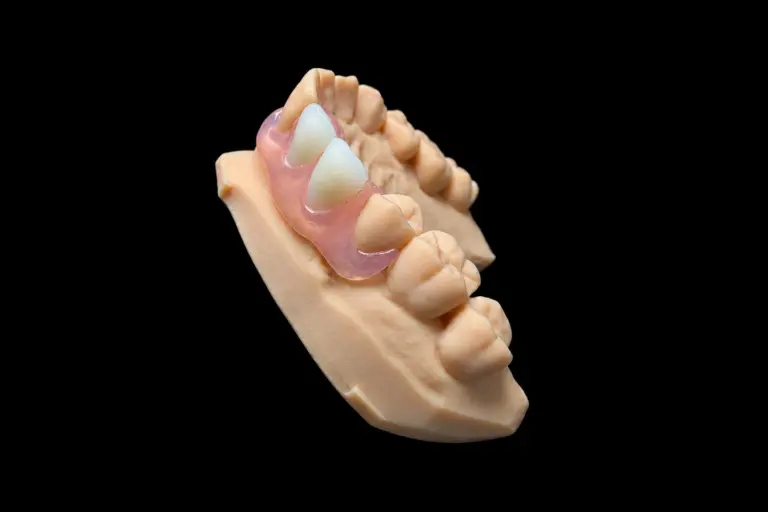
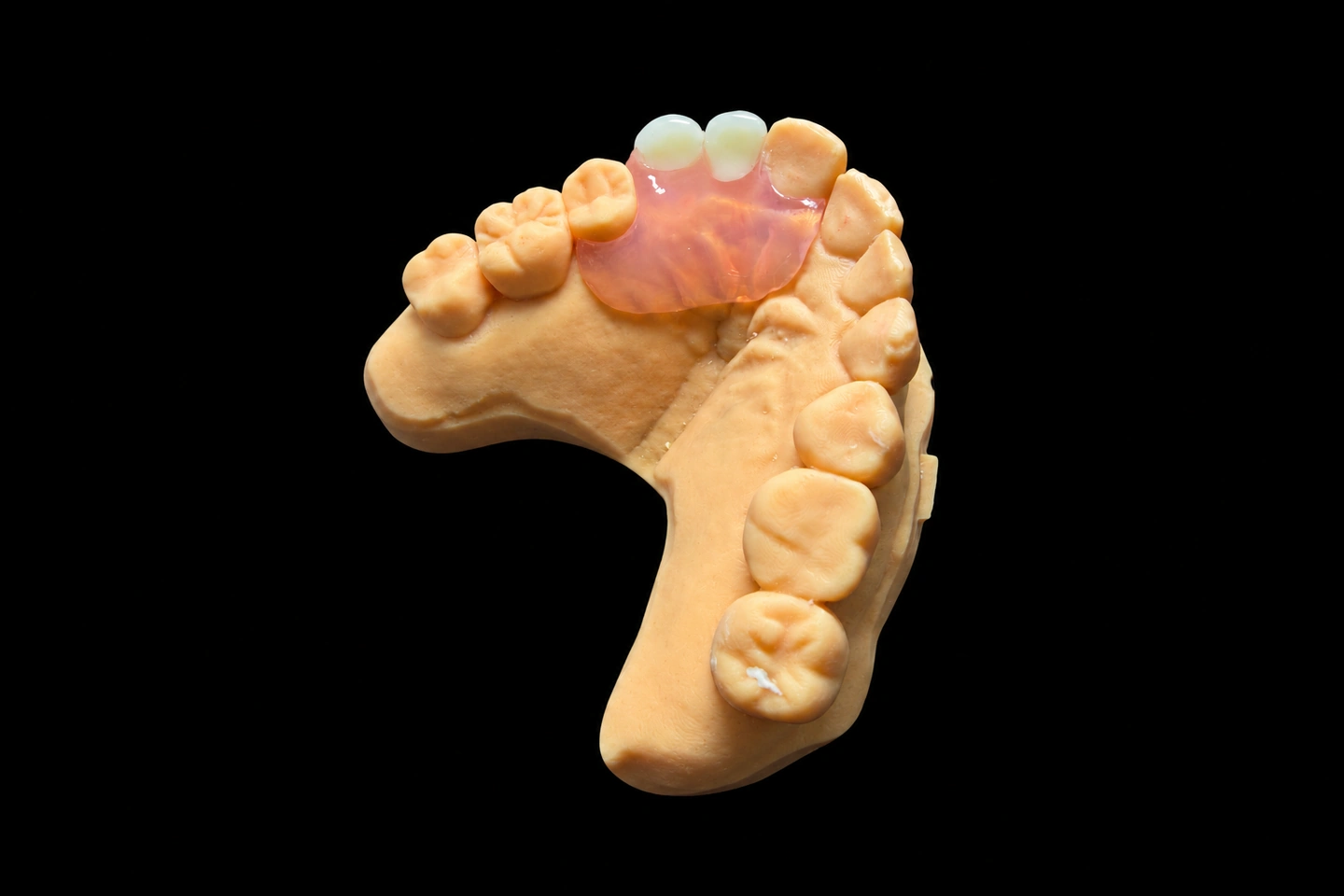
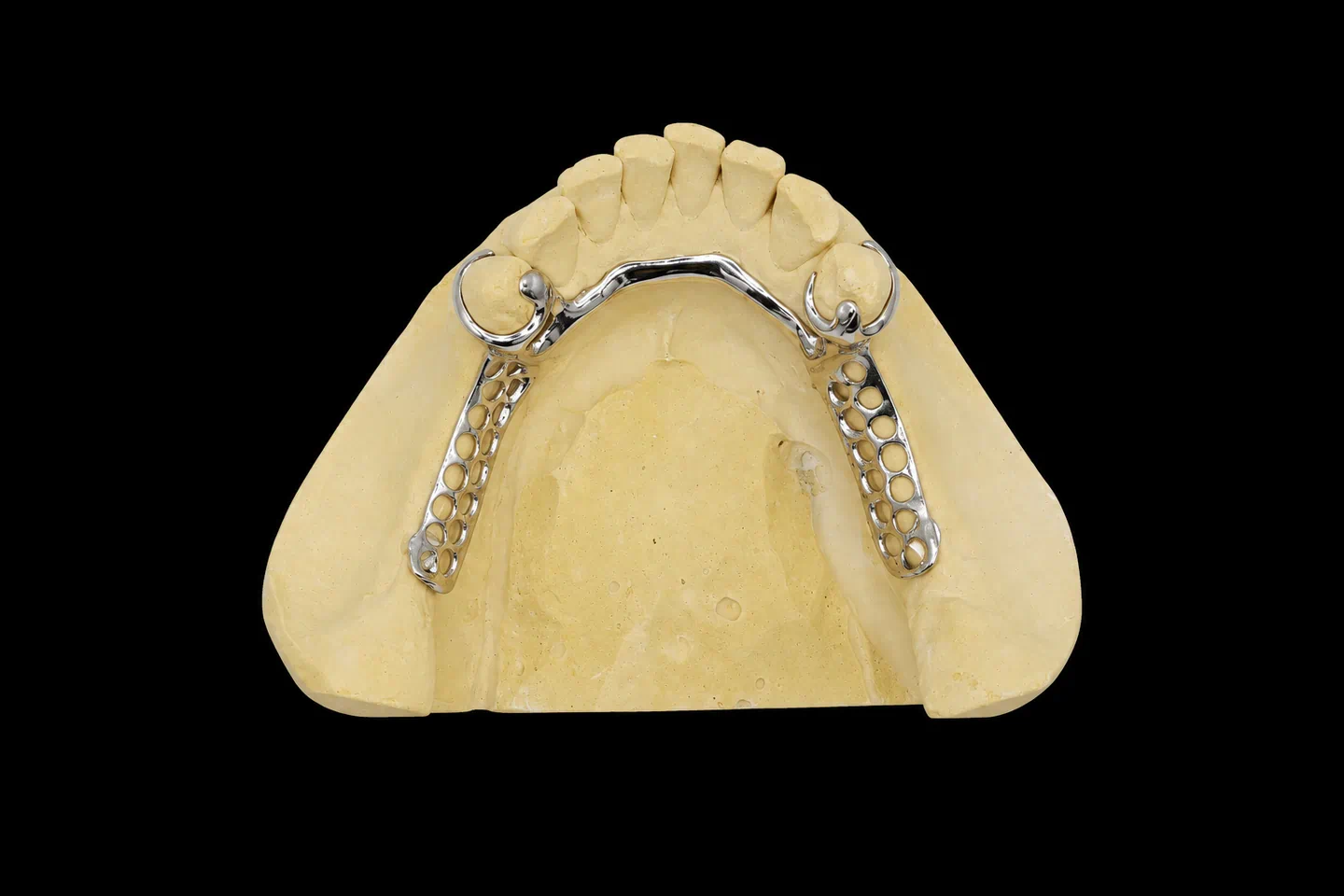
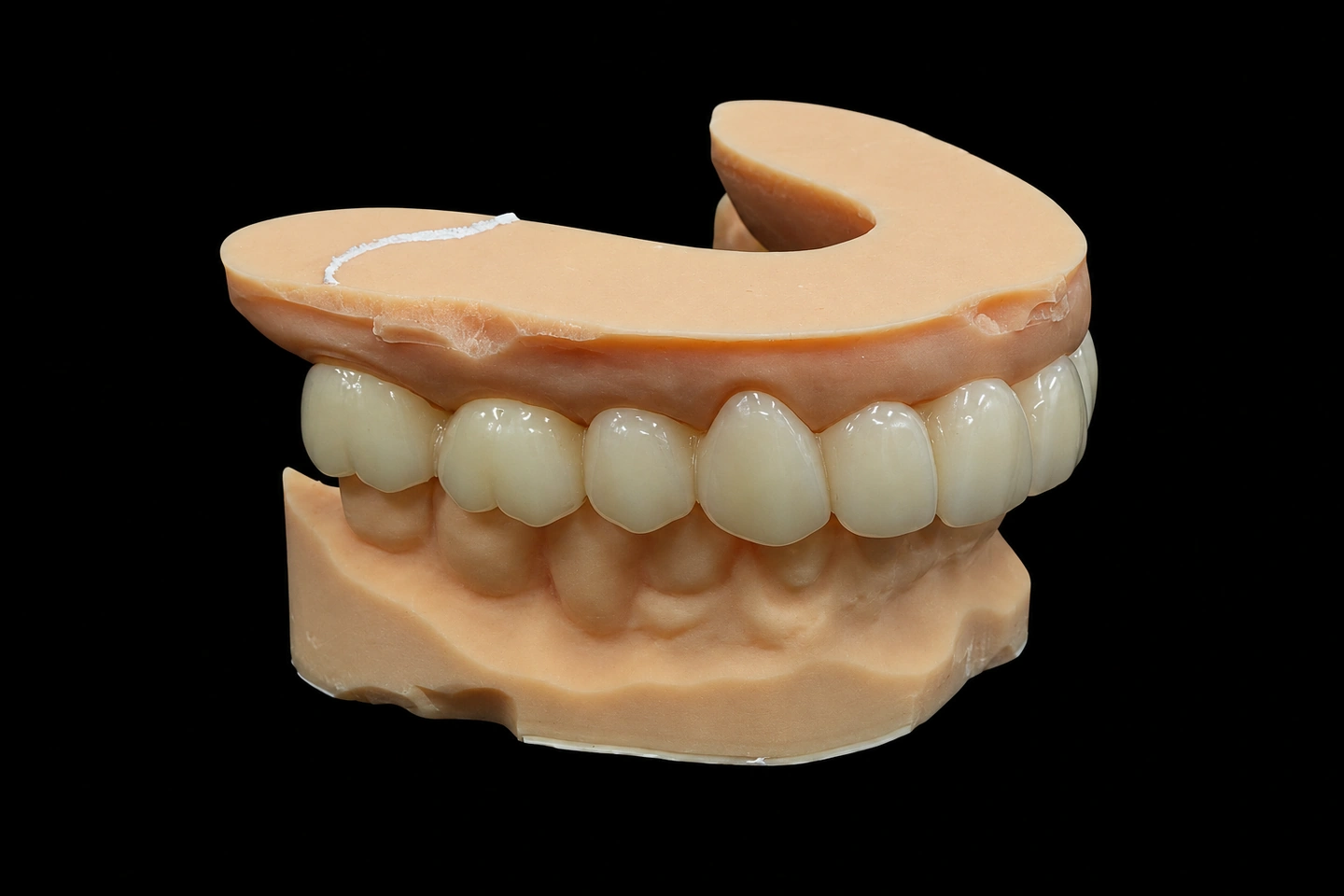
Patient Situation
The patient lost #3 and #4 about 14 months before the case reached us. An earlier acrylic partial with a palatal plate lasted a few weeks: it triggered the patient’s gag reflex and ended up in a drawer . Implants were off the table too, and the patient was firm about that .
The dentist’s notes and the records showed:
What the Dentist Asked For
The Rx for this upper Valplast partial, condensed :
Why We Held Valplast Partial Dentures for Upper Back Teeth on Day 1
Clearance wasn’t the issue here. There was plenty of room. The trouble came from Rx items 1 to 3 taken together, and it showed up in three places.
No bracing from the other side
Chewing pushes on the cheek-side cusps of #3 and tries to roll this upper flexible partial denture outward. A palatal connector and a clasp on the far side would fight that. This design has neither, and no rests either, so the ridge takes the load straight down.
A small piece that could come loose
The one-sided layout measured about 34 mm end to end. That’s small, and small is the worry. The American College of Prosthodontists calls Nesbit-type single-tooth partials generally contraindicated because of aspiration risk. Two teeth isn’t the same as one, but the concern carries over, and we said so.
The best undercut on #5 sits right in the smile
The survey, before and after we changed the path of insertion:
| Spot | Level survey | After 2° path tilt | Shows at full smile? |
|---|---|---|---|
| #5 mesiobuccal | 0.7 mm | 0.6 mm | Yes |
| #5 distobuccal | 0.3 mm | 0.4 mm | No |
| #2 distobuccal | 0.8 mm | 0.9 mm | No |
| #2 mesial, under the saddle | 1.1 mm | 0.6 mm | No |
One lab study of thermoplastic clasps put Valplast’s working floor at more than 0.5 mm of undercut with a 1.0 mm arm. So the hidden side of #5 wasn’t going to do the job on its own. The retention had to come from the side that shows.
The Three Designs We Sent the Dentist
We paused the case on lab day 1 and emailed the survey readings and this table. When a case has a question open, we follow up every other day until it’s settled. This one took one reply .
| Option | Stability comes from | The catch |
|---|---|---|
| A. All Valplast, one side, as prescribed | Clasps on #2 and #5, short palatal arms on both teeth, base on the ridge | No rests, so the base can sink a little. Small piece, no cross-arch backup |
| B. Valplast with a narrow palatal connector to a clasp on #14 | Same as A, plus bracing from the left side | Conflicts with Rx item 2. Might bring the gag right back |
| C. Metal framework partial with rests on #2 and #5 and a palatal strap | Teeth and ridge, through a rigid frame | Conflicts with Rx items 1, 2, and 3 |
We told the dentist Option C would be the steadiest if the patient would take it . The literature leans that way as well. A Japan Prosthodontic Society position paper says flexible designs with no metal framework generally aren’t recommended as definitive dentures, outside limited cases like metal allergy. A 2020 review says to use nonmetal clasp dentures with caution when they aren’t temporary.
There’s another side to it. A British Dental Journal review presents one-sided partials as an option for patients who can’t or won’t tolerate a bigger appliance, as long as the patient presentation is right and the team knows what it’s doing. That was pretty much this patient.
The dentist talked it through with the patient and stayed with Option A , and told the patient to take it out at night and come straight back if it ever felt loose . That’s the dentist’s decision to make. The risks were on the table, so we built this upper Valplast partial to the Rx.
How We Built the Upper Valplast Partial Without a Palate
| Rx item | What we did |
|---|---|
| 1 | Valplast resin only, base and clasps as one piece |
| 2 | Stopped the palatal edge on the slope of the ridge, well short of the vault |
| 3 | Left #2 and #5 as they were and used existing undercuts |
| 4 | Ran the #5 arm low along the gum line and checked it against the smile photo |
| 5 | Set the contacts on an articulated model and marked them with film |
| 6 | Checked teeth and base against the shade photos before and after finishing |
| 7 | Emailed design screenshots and waited for sign-off |
| 8 | Recorded the resin details on the certificate |
Working around the tilt on #2
With #2 leaning into the gap, a level path would’ve jammed the saddle against its mesial side. A 2° tilt fixed most of that and cost us only 0.1 mm on #5, so that undercut stayed usable. We blocked out what was left, duplicated the model, and waxed up on the copy .
Replacing what the palate would've done
Each job went somewhere else, and each one cost something:
| Job | Where it went | What it cost |
|---|---|---|
| Stops the base rolling outward | Short palatal arms on #2 and #5 | More coverage around those teeth, so hygiene matters more |
| Holds it in | Buccal arms on #2 and #5 | An arm on #5 that shows if it’s set too high |
| Carries chewing load | Base spread over the ridge, palatal edge about 5 mm past the crest | Tissue takes the load, not the teeth |
| Cuts down the tipping force | #3 narrowed about 1 mm cheek to tongue, set over the ridge | Slightly less chewing surface |
Valplast flexes, so on an upper Valplast partial those palatal arms brace the base, but they aren’t a rigid frame.
Sizing the clasps
The #2 arm stays out of sight, so it does the heavy lifting: 5 mm wide and 1.4 mm thick , going for the 0.9 mm undercut. The #5 arm is 4.5 mm wide and 1.2 mm thick , since less width means less showing. Those numbers sit inside the 1.0–1.5 mm range the same clasp study gives for a 5 mm wide Valplast arm, though #5 is a bit narrower than what it tested.
Keeping the denture teeth in
Valplast holds denture teeth mechanically, so each one needs room for retention holes, and about 5 mm of clearance is a common rule of thumb. We had more than that, and we kept at least 1 mm of resin under both teeth. It’s worth the care. A 2025 review from Canada’s Drug Agency reports a nonrandomized study with significantly more denture tooth loss on flexible partials at one year.
Lab days, start to finish
The dentist skipped a try-in . With teeth in front of and behind the gap, the bite record was solid, and a wax setup wouldn’t have told us much about the palate edge .
The Finished Upper Flexible Partial Denture
The goal: stay put with nothing on the palate, and keep the #5 clasp low. Final inspection on these Valplast partial dentures for upper back teeth:
| Check | Result |
|---|---|
| Seating on the model | Full seat, no rocking, no lifted edges |
| Base thickness, by caliper | 2.0–2.5 mm over the ridge, no sudden changes |
| Base under strong light | No bubbles (internal bubbles mean a remake) |
| Teeth, under finger pressure | No movement on #3 or #4 |
| Clasp arms, by caliper | Within 0.1 mm of design |
| Articulating film | Light, even marks on #3 and #4, none in side movements |
| Smile photo | #5 arm stays below the lip line at full smile |
Patient and dentist feedback
The dentist: warmed it in hot tap water for 30–60 seconds, per Valplast’s clinical techniques, and it seated with firm retention . One spot on the buccal flange at #3 needed easing, and the clasps needed nothing .
The patient: no gag and nothing on the palate, which was the whole point . The patient liked that the #5 clasp was hard to spot, though it can be seen up close . There was some movement on harder foods , and the dentist had already warned about that.
That feedback comes from delivery, not years of wear , so we won’t promise how long this upper Valplast partial will last. Durability on flexible partials is still an open question, since the studies are short.
The dentist set recall visits to check the ridge, fit, and abutments , and that’s sensible with resin arms around #2 and #5. A 3-month crossover trial found no significant periodontal difference between thermoplastic and metal-clasp partials, but the same Canadian review notes redness around abutments may be more likely with flexible ones.
Sending Valplast Partial Dentures for Upper Back Teeth
Not sure your patient suits Valplast partial dentures for upper back teeth? Send the records first. We offer a pre-shipment feasibility review, and it’s a lot easier to change a design before anything’s been made.
We need:
An upper flexible partial denture generally takes 5–7 working days from the day we receive it. Design sign-off can add 1–2 days, and courier and customs time are separate.
Who Made It
Our 55-person removable department made these Valplast partial dentures for upper back teeth in Istar Dental Lab’s own labs. Istar has four labs in Shenzhen and Huizhou, China, about 460 people, and has been at it since 2012. Nothing gets outsourced. A separate 25-person QC group checks work before it ships, and the removable department handles about 4,000 cases a month in the slow season and about 6,500 at peak.
Istar is an FDA-registered establishment (Registration Number 3039441248), which you can look up in the FDA database, and our labs run an ISO 13485 quality management system. For EU clinics, custom-made partials follow the MDR custom-made device procedure.
Upper Valplast Partial FAQ
Can you reline, repair, or add a tooth later?
Yes, all three, and it’s lab work, not a chairside job. Send the appliance, upper and lower models, and a bite record. Valplast’s clinical techniques page also covers the impression steps. The patient goes without the partial while it’s away, so plan for that.
What if I keep a design you've flagged?
We make it to your Rx, and you don’t need to sign a risk form. Problems caused by that design, remakes included, aren’t on us. If you change your mind before production, we change the design.
What's the warranty?
Istar’s warranty on the base of an upper flexible partial denture is 1 year. A base that won’t seat, lifted edges, badly placed clasps, an off bite, or the wrong gum color get adjusted or remade free. Changing the shade or material later isn’t covered, and neither is going ahead on a poor impression after we’ve warned you. You pay to send a case in, and we pay to ship finished work back, remakes included.
Valplast’s own limited lifetime warranty is separate. It covers breakage of the resin base, not the teeth.
Is the resin genuine Valplast?
Yes. We can ship a Valplast Certificate of Authenticity with the case when you need one, and each certificate has a serial number you can register with Valplast.
Can you do a try-in on an upper Valplast partial if I want one?
Yes. Just write it on the Rx.
What other partials do you make?
Acrylic, cast frameworks, and other flexible partials. The full range is on our partial dentures page.
Can you rush it?
Yes, free of charge, if you send us 10 or more cases a month. We guarantee the ship date, not the arrival date, because customs times vary.
How does pricing work?
Prices aren’t on the website. Quotes are itemized to your requirements, not one bundled price.
Send Us Your Next Upper Back Teeth Case
Got Valplast partial dentures for upper back teeth coming up? Single trial cases are welcome, and ongoing partnerships suit clinics with a regular case flow. Ship us a test case, request the price list, or book a factory or video visit.