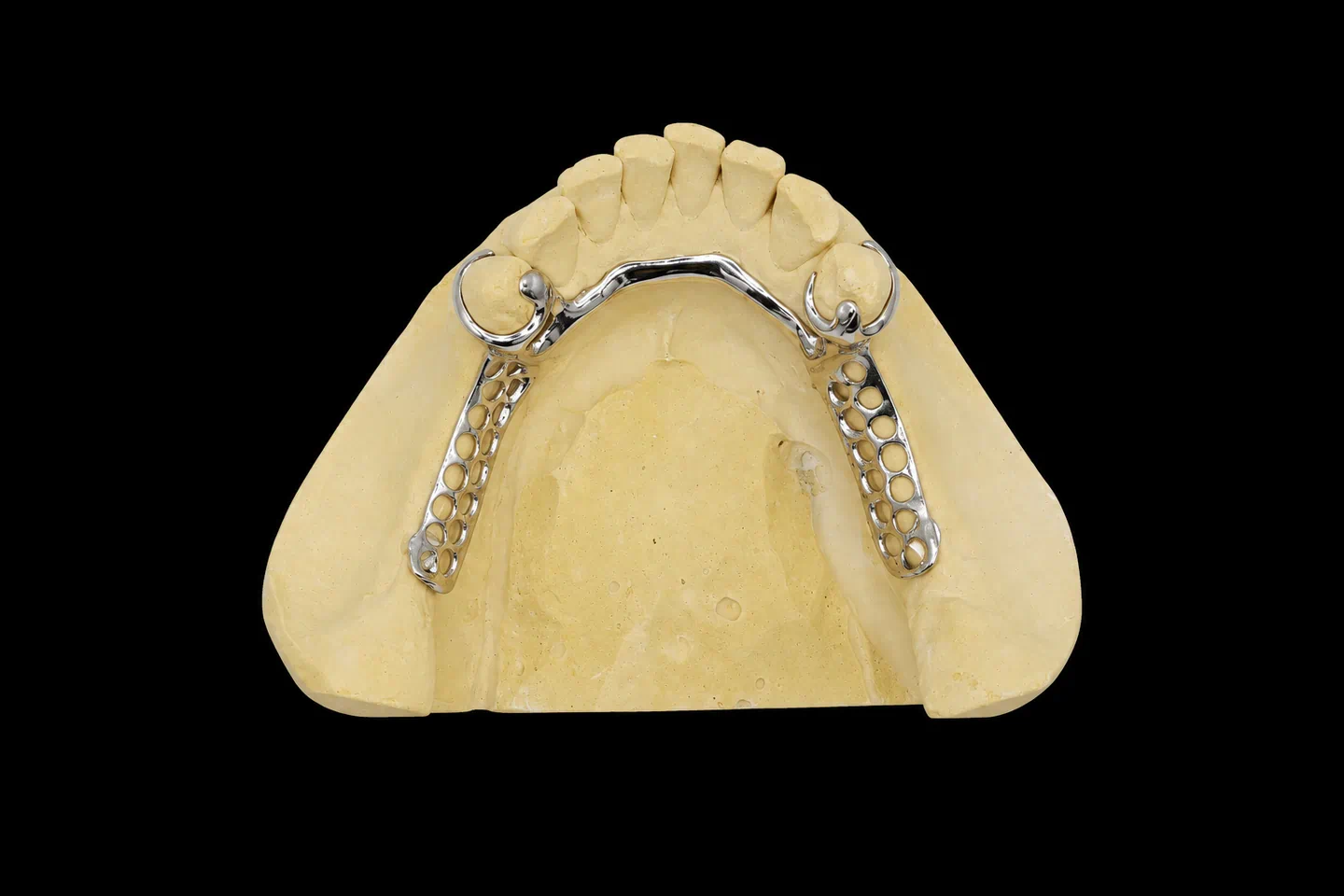
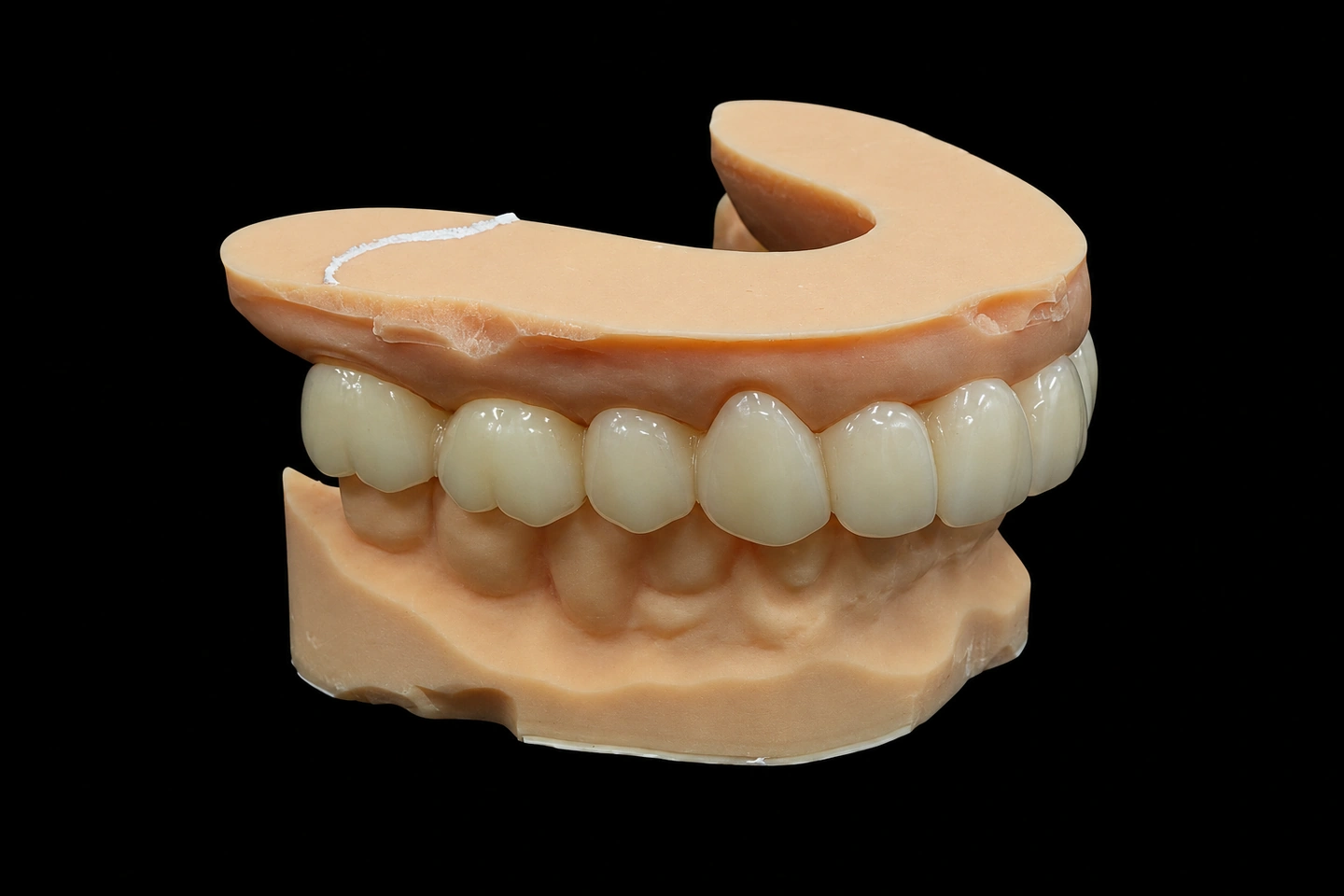
Patient Situation
A female patient, presenting with a missing upper front tooth (tooth #8), sought a solution that would restore her smile without undergoing invasive procedures. Her primary concerns were:
The patient’s medical history included previous restorative work in the anterior region, which raised considerations about the stability and support available from adjacent teeth.
The Clinical Challenge
The dentist’s assessment revealed several critical technical constraints:
| Parameter | Measurement | Clinical Significance |
|---|---|---|
| Interocclusal clearance | 4.8 mm | Adequate for full Valplast design with proper tooth retention holes |
| Adjacent tooth condition | Sound enamel, natural contours | Suitable for undercut-based clasp engagement |
| Missing tooth position | Maxillary anterior | High aesthetic demand; requires precise shade matching |
| Opposing dentition | Natural mandibular teeth | Standard occlusal forces; no special load considerations |
| Treatment timeline | 6–12 months interim | Bridge to future implant treatment |
The dentist’s requirements were clear but nuanced:
How We Addressed the Requirements
Design Strategy: Single-Point Flexible Clasping
Our approach prioritized the clinical constraint that this was an unilateral, single-tooth gap. Unlike multi-tooth partial dentures, single-tooth cases present a unique challenge: the denture has limited support from a single contact point, and traditional rigid clasps are both mechanically inefficient and aesthetically unacceptable.
Our solution:
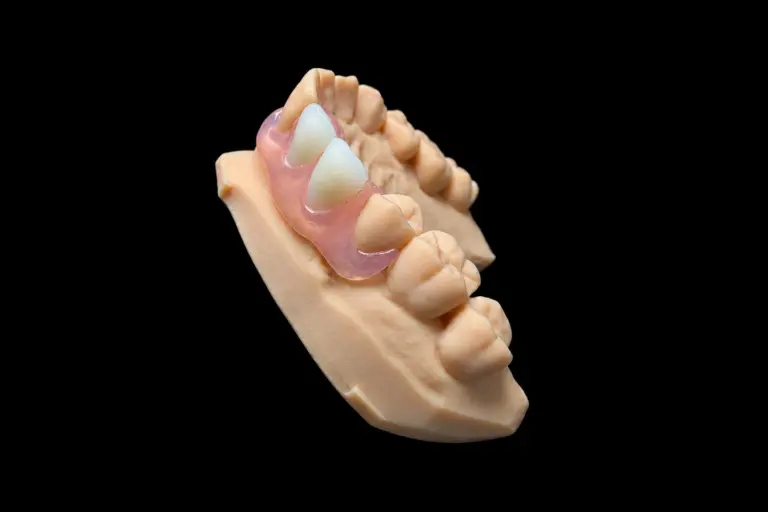
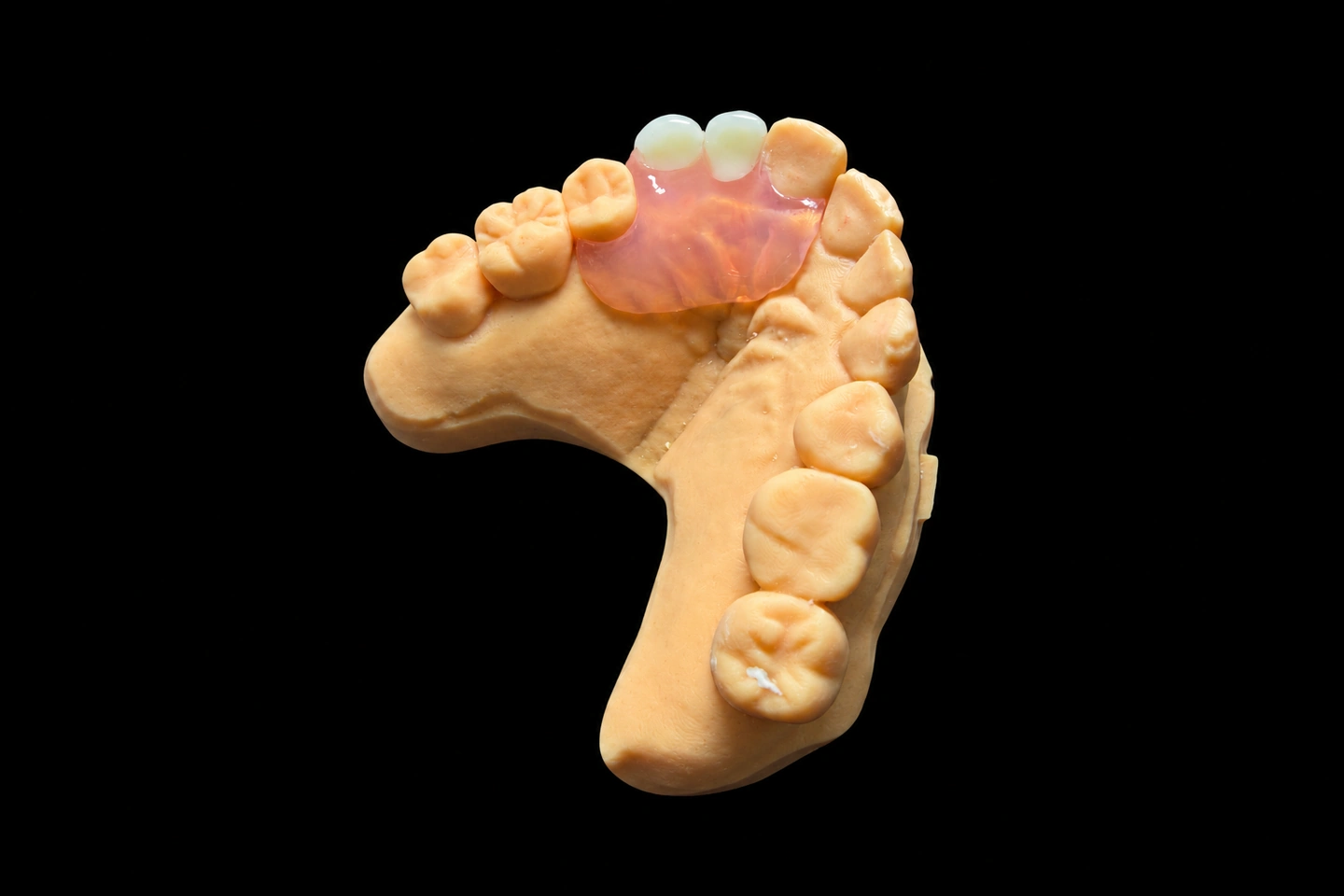
We designed the Valplast partial using a two-point flexible clasp system on the adjacent teeth (#7 and #9) rather than a single, heavily loaded contact point. This distribution of retention forces achieved several objectives:
Material Selection and Processing
Valplast thermoplastic nylon was selected for this case because:
Processing parameters:
Following established injection-molding protocols for flexible thermoplastics, we controlled:
These parameters were critical because insufficient cooling would have resulted in dimensional shrinkage, compromising the clasp fit and retention.
Tooth Positioning and Retention
The artificial tooth (#8 replacement) was positioned using mechanical retention only — not adhesive or chemical bonding. This meant:
Pre-Delivery Conditioning
Before final delivery, the denture underwent a critical conditioning step:
Design Considerations for Single-Tooth Cases
Why This Design Avoids Common Pitfalls
Single-tooth Valplast partials are frequently compromised by a structural weakness: the denture lacks cross-arch reciprocation. Without bracing from the opposite side of the palate, the appliance tends to rotate around its primary contact point during chewing.
Our two-point clasp design mitigated this by:
However, we were transparent with the patient about one documented limitation: a clinical study of 76 patients found that single-anterior-tooth Valplast restorations resulted in a mean gingival recession of 0.5 mm (range 0–1.2 mm) on the abutment teeth over 97–100 days, compared to 0.0 mm in control groups receiving conventional partial dentures. While modest, this finding underscores why single-tooth flexible partials are best reserved for interim restorations rather than long-term definitive treatment — a point the dentist had already discussed with the patient.
Material Longevity and Maintenance
We provided guidance on expected appliance lifespan and care:
Final Outcome
Delivery and fit:
The denture was delivered at the scheduled appointment. Initial insertion required a brief adjustment period:
Functional assessment
- Speech — Adapted within one week; the patient reported confidence speaking in professional settings by the second week.
- Mastication — She was advised to avoid hard foods (nuts, raw vegetables) to minimize clasp fatigue. With soft foods, mastication was effective and comfortable.
- Retention — The two-point clasp system achieved the design goal: the denture remained secure without movement during normal function, and the patient reported no need for denture adhesives.
Aesthetic satisfaction:
The patient confirmed that the restoration met her primary goal: no visible metal components, and the tooth blended with her natural dentition. She remained committed to exploring implant treatment as a long-term option once her schedule stabilized.
About Istar Dental Lab
This case was fabricated at Istar Dental Lab, a full-service dental laboratory founded in 2012 with manufacturing facilities in Shenzhen and Huizhou, China. Our removable denture department specializes in both conventional acrylic and thermoplastic partial dentures, including complex cases with spatial or aesthetic constraints.
For single-tooth Valplast restorations, our workflow includes:
Ready to discuss a case? Our team is available to consult on design strategy, material selection, or production timelines for Valplast or other removable denture projects.