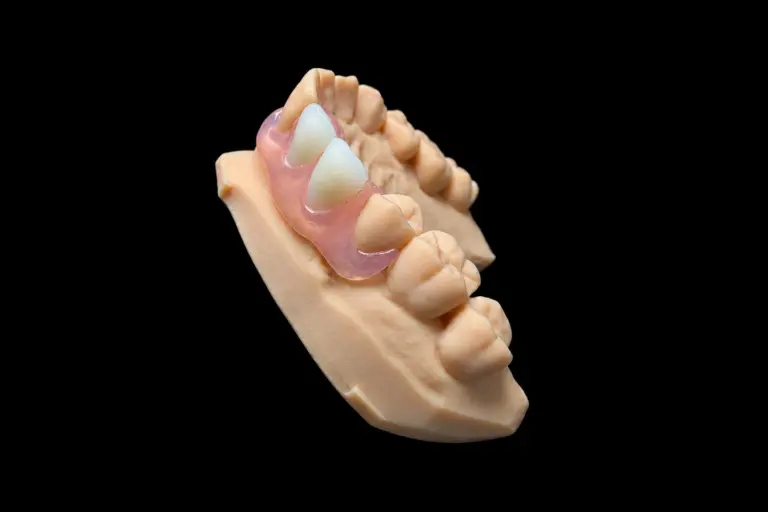
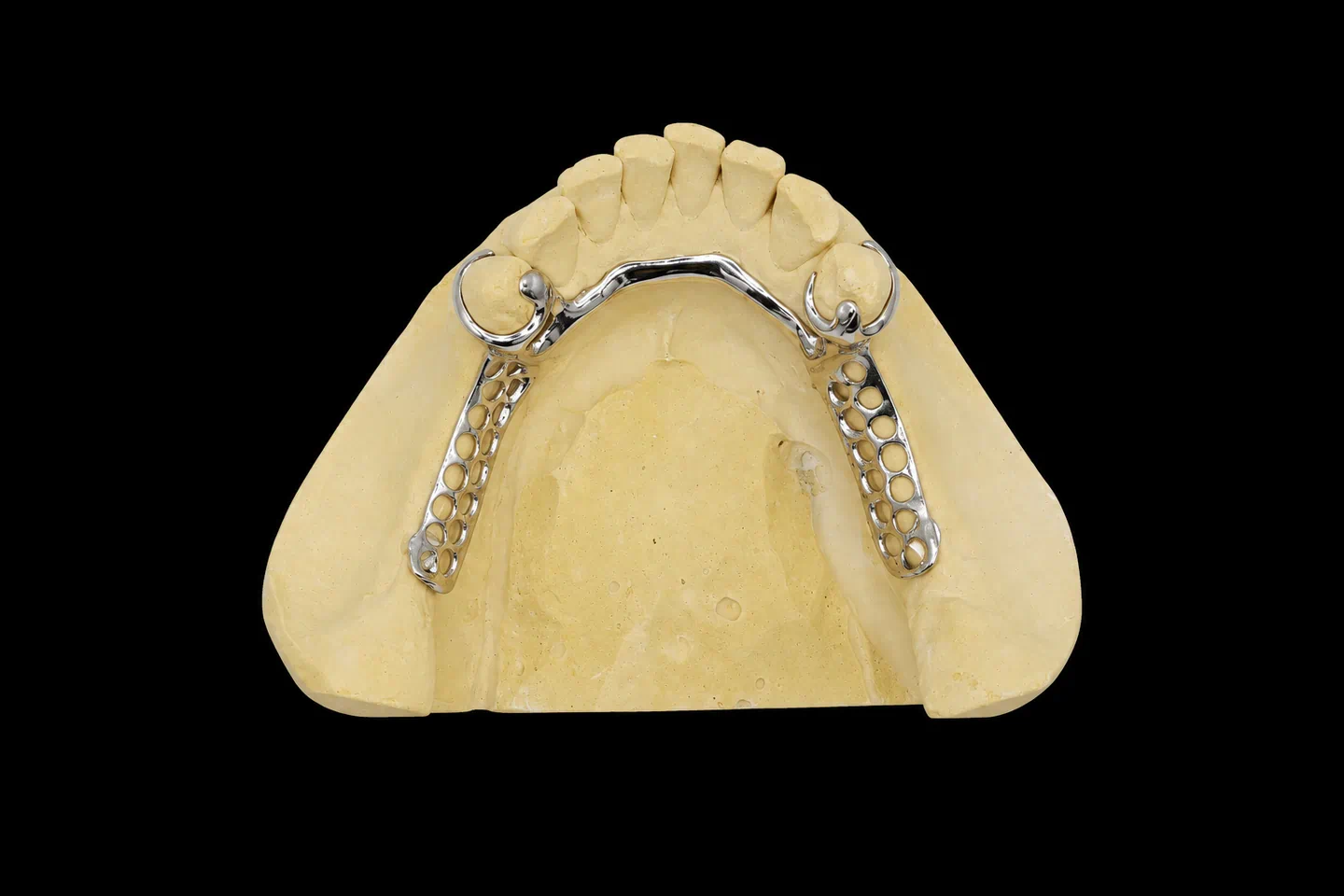
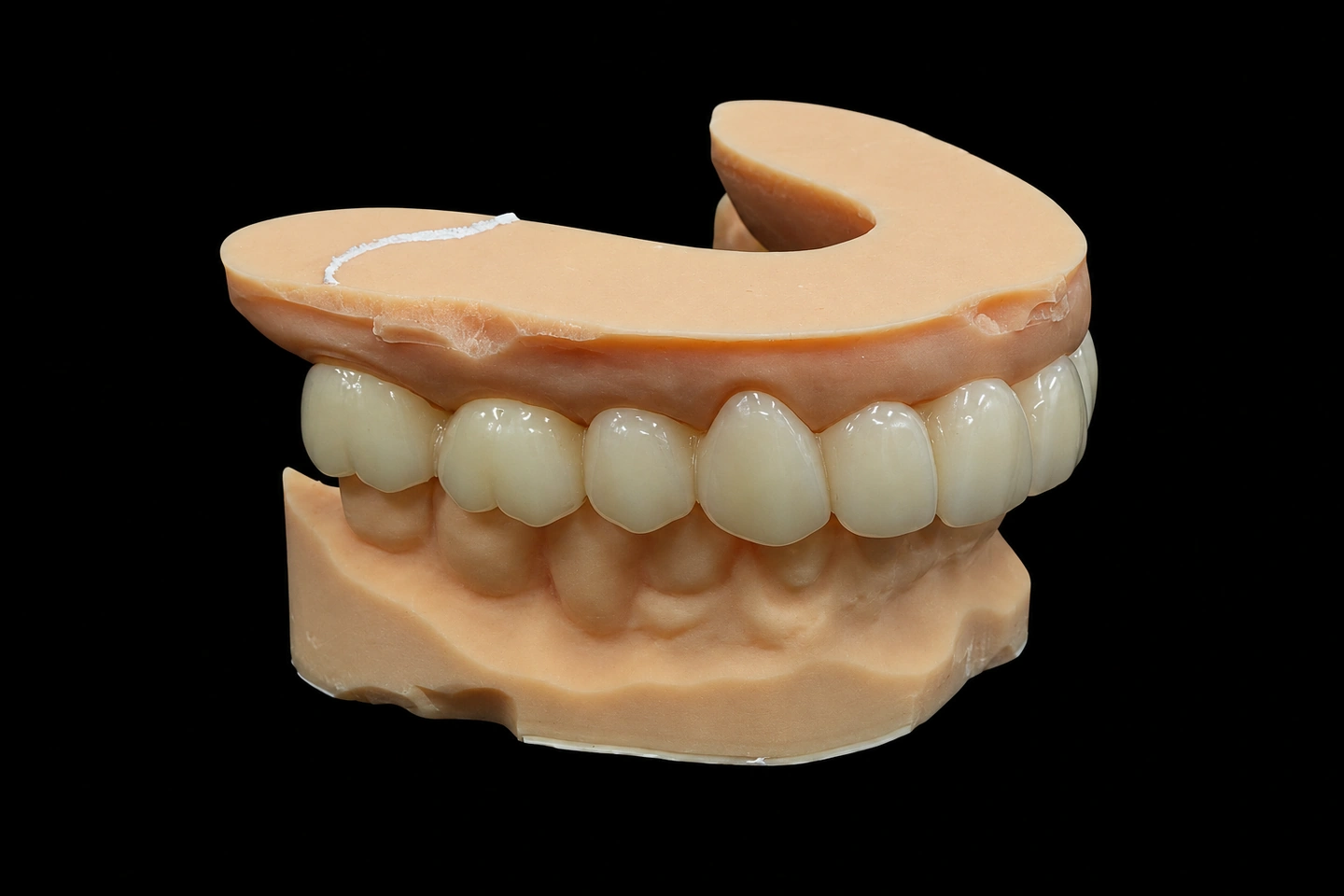
Patient Situation
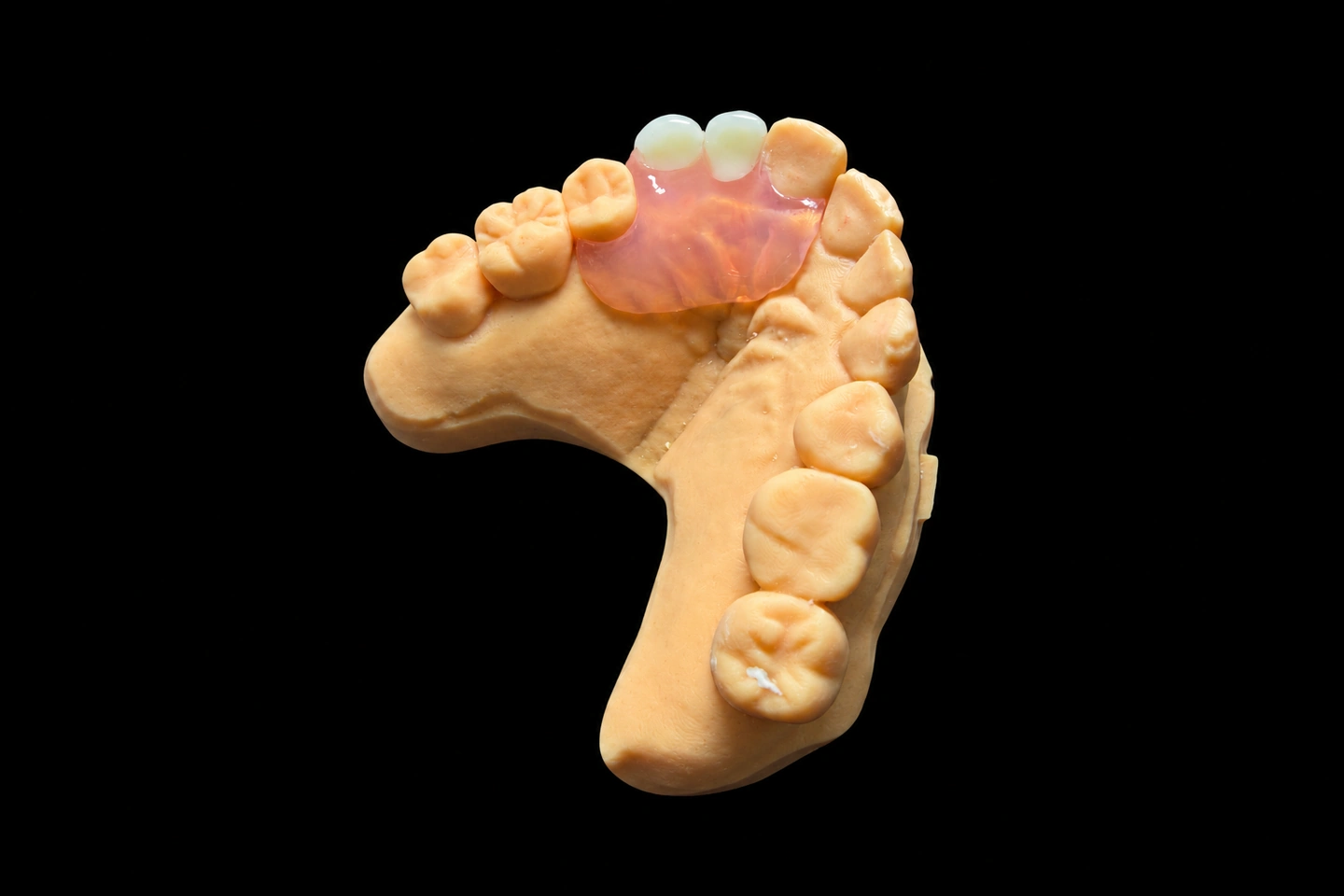
The patient is in their early 50s . #3 was lost to a cracked root about a year before, and #14 to a failed root canal about eight months before . Both ridges had settled by the time records were taken.
Here’s what the dentist’s records showed :
Implants were discussed and put off on cost . Bridges were turned down too, because the patient didn’t want healthy teeth cut down.
What the Dentist Asked For
The Rx, condensed :
The case came in with a full-arch VPS impression of the upper, a lower model, a VPS bite, and smile photos .
Can Flexible Partial Dentures for Back Teeth Handle Molar Chewing?
That was really the dentist’s question behind the Rx. The honest answer is: it depends on the gap.
A review of nonmetal clasp dentures recommends against metal-free flexible designs where there’s no tooth behind the gap (Kennedy Class I and II). An all-flexible design makes more sense in a short space bounded by stable teeth, with a modest bite load, enough room, and good home care. This patient checked every one of those boxes.
What a flexible base doesn’t have is a rigid connector or rests on the teeth. A Japan Prosthodontic Society position paper points out that those parts are what give a partial support and cross-arch stability, and it doesn’t recommend flexible partials without a metal framework as definitive dentures, outside limited cases. So the design work here was all about getting stability back some other way.
Why We Questioned the Two-Piece Plan
Two small partials sounded easy on the patient: nothing on the palate, and each piece tiny. The problem showed up when we thought about chewing.
When flexible partial dentures for back teeth come in two pieces, each saddle has just two clasps holding it, one in front and one behind. Chewing on the new molar pushes it sideways, toward the cheek or the tongue, and there’s nothing on the other side of the arch to push back. All of that load ends up on two flexible clasp arms and the ridge under one molar.
Join the two saddles across the palate, and chewing on one side is braced by the clasps and the base on the other. That’s the cross-arch stability the position paper is talking about. The trade-off is a strap the tongue can feel.
The Three Options We Sent Back
We held the case on day 1 and sent the dentist the survey findings, a photo of both outlines on the model, and three options:
| Option | What it means | The catch |
|---|---|---|
| A. Two one-sided Valplast pieces, as written | Nothing on the palate. Two very small appliances | No cross-arch bracing. Each side relies on two clasps and one small saddle |
| B. One Valplast piece with a narrow palatal strap | Both sides brace each other. One appliance to put in and take out | Something on the palate. Breaks Rx item 2 |
| C. Cast metal framework with rests | Rests put part of the load on the teeth; rigid connector | Metal clasps may show on #4 and #13, and rest seats need prep. Breaks Rx items 1 and 3, maybe 4 |
We said we’d lean toward B for a patient who wanted to chew hard on both sides. We’d make A if that’s what the dentist wanted. A metal framework partial would be the steadiest, but it went against most of the Rx.
The dentist showed the patient the photo with the strap outline . The patient picked B. They also liked having one piece to keep track of instead of two .
How We Met Each Requirement
Survey and path of insertion
All four clasp teeth had to share one path. We surveyed the model and tipped the path slightly toward the back , which put usable undercut low on the cheek side of each tooth:
| Tooth | Undercut used | Where |
|---|---|---|
| #2 | 0.75 mm | Distobuccal, out of sight |
| #4 | 0.5 mm | Distobuccal, in the gum third |
| #13 | 0.5 mm | Distobuccal, in the gum third |
| #15 | 0.75 mm | Distobuccal, out of sight |
Clasps that grip without showing
Rx item 4 meant the premolar clasps had to stay low. So the arms on #4 and #13 start at the saddle, run along the gum third, and stop before the part of the tooth that shows in a smile . We checked each one against the smile photos.
That left the second molars to carry most of the grip. #2 and #15 sit out of sight, have the deeper undercuts, and got the longer, wider arms . The premolar arms help hold, but they aren’t doing the heavy lifting.
A strap the tongue can live with
The strap runs straight across between the two molar saddles . It stays behind the rugae, away from where the tongue touches for many sounds, and it’s about 8 mm wide . We kept its edges away from the gum line on the palatal side of the teeth, so it doesn’t sit on the gum margins . It’s thin and smooth, with rounded edges, so it’s less of an edge for the tongue to find.
Molars that chew without rocking the base
On a flexible partial denture for molars, where the teeth sit matters as much as the clasps. We picked tooth molds to fill the 10 mm and 9.5 mm spaces and set them over the crest of each ridge. The bite was set for even contact on #3 and #14 when closing, against #30 and #19.
In side movements, the natural teeth guide, and the denture molars stay clear . There was plenty of room for the teeth and the resin around them, at 6.5 mm and 6 mm. A posterior flexible case report lists too little interarch space as a reason not to use its flexible design.
Keeping the molars in the base
Denture teeth don’t bond chemically to Valplast. They’re held by resin that flows into grooves cut in the tooth. In an 18-patient study of a flexible base material, teeth came loose in 4 cases at 10–11 months, put down to processing. A bond-strength study on Valplast found no bond at all without mechanical retention, and T-shaped grooves held best. So both molars got a T-shaped groove on the ridge side .
Finishing the base
Nylon doesn’t trim or polish like acrylic. Following Valplast’s clinical techniques, we used Valplast-specific burs and polishers on the outside and left the tissue side unpolished.
Making It, Day by Day
| Working day | Stage |
|---|---|
| 1 | Records checked, model poured, survey done. Options sent to the dentist |
| 2 | Option B approved. Teeth set, bite checked on the mounted models |
| 3 | Clasps, strap and saddles waxed. T-shaped grooves cut |
| 4 | Flasking and Valplast injection |
| 5 | Trimming, polishing, fit and bite checks |
| 6 | Final inspection, shipped with a Certificate of Authenticity |
The Finished Flexible Partial
Final inspection on these flexible partial dentures for back teeth :
| Check | Result |
|---|---|
| Seat on the model | Full seat on the planned path, no rocking at either saddle |
| Clasps vs smile photos | #4 and #13 arms below the visible part of the teeth |
| Strap | Clear of the rugae and the palatal gum margins |
| Molars, under finger pressure | No movement |
| Articulating film | Even marks on #3 and #14 when closing, none in side movements |
| Base | No bubbles or voids. Outside polished, tissue side left as processed |
Dentist and patient feedback
- It went in on the first try, with no clasp adjustments at the chair.
- Pressing on one molar didn’t lift the other saddle.
- Nothing showed on #4 or #13 at full smile.
- Seeing the two outlines side by side made it easy to talk the patient through the choice.
- The strap was noticeable for the first few days, then stopped bothering them.
- Speech felt normal by the end of the first week.
- At the two-week check, they were chewing on both sides again, with no sore spots.
Sending Us Flexible Dentures for Back Teeth
Got a patient missing back teeth who wants no metal? Send the records first, and we’ll do a feasibility review before we start. That’s when we’ll tell you whether all Valplast fits the case, or whether a one-piece design or a framework makes more sense. With flexible partial dentures for back teeth, that call mostly comes down to the gaps and the clasp teeth.
For flexible dentures for back teeth, we need:
Pack it per our how-to-send guide. A flexible partial generally ships in 5–7 working days, counted from the day we receive the case. On upper Valplast cases, a try-in is available and counts inside those days. You pay to send the case in, and we pay to ship it back. Flexible partials carry a 1-year warranty.
Who Made It
Our removable department made this partial: about 55 technicians inside Istar Dental Lab’s four labs in Shenzhen and Huizhou, China. Istar started in 2012 and has about 460 people. Design, production and inspection all happen in our own labs, with no outsourcing, and a separate 25-person QC group checks every case before it ships.
The removable department handles about 4,000 cases a month in the slow season and about 6,500 at peak. Istar is an FDA-registered establishment (Registration Number 3039441248), which you can check in the FDA database, and our labs run an ISO 13485 quality management system. For EU clinics, custom-made partials follow the MDR custom-made device procedure.
Flexible Partial Denture for Molars FAQ
If I still want two separate pieces, will you make them?
Yes. We’ll flag the risk, and if you keep the design, we make it to your Rx with no written sign-off. Problems that come from that design, remakes included, aren’t covered by us.
Can the partial be relined or have a tooth added later?
Yes, at the lab. Valplast doesn’t take a chairside reline the way acrylic does. Send the partial with a new impression taken in it, an opposing model, and a bite.
How can the patient check the resin is genuine Valplast?
Each Certificate of Authenticity has a serial number the patient can register with Valplast.
Can you rush a flexible partial?
Yes, free of charge, if you send us 10 or more cases a month. We guarantee the ship date, but not the arrival date, because customs times vary.
How is a flexible partial priced?
We don’t publish prices on the website. Quotes are itemized to your requirements, not one bundled price.
Do you make other kinds of partials?
Yes: flexible partials for front and back teeth, metal frameworks, and acrylic. The full range is on our partial dentures page.
Send Us Your Next Flexible Partial
Single trial cases are welcome, and ongoing partnerships suit clinics with a regular case flow. Send a test case, request the price list, or book a factory or video visit.