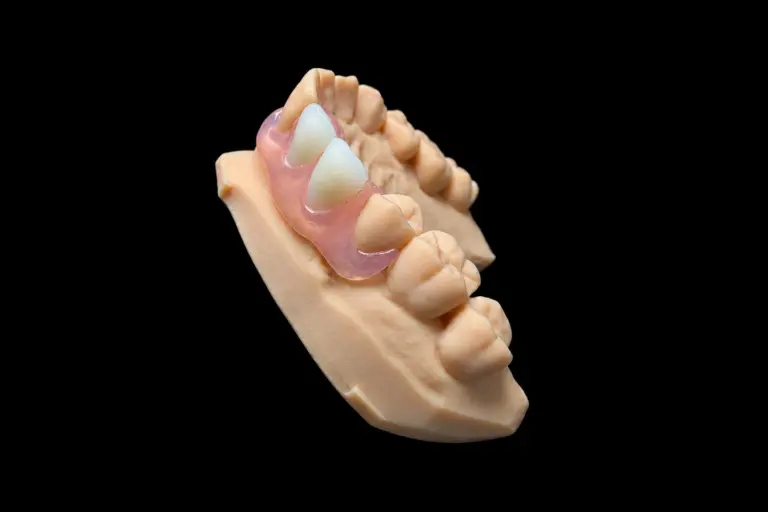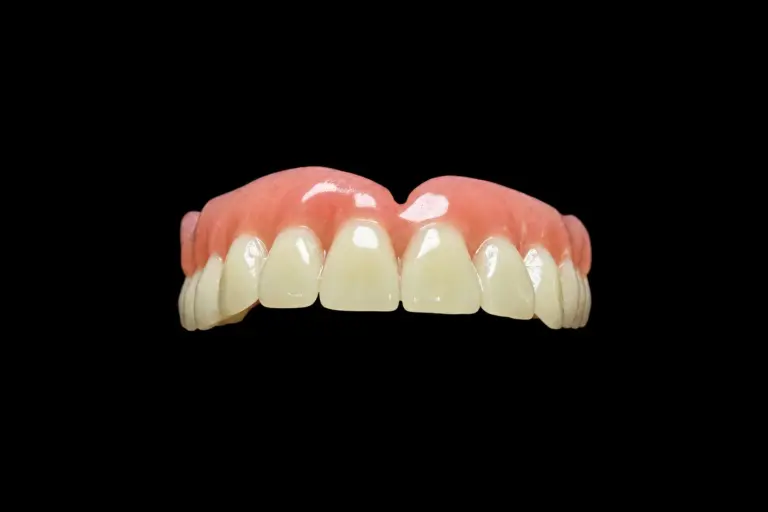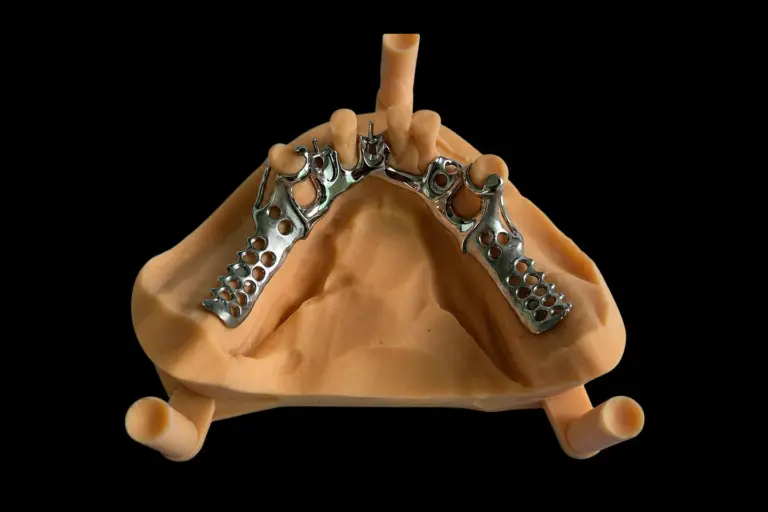
When patients ask for metal-free partial dentures, they don’t all mean the same thing. Some want no metal anywhere in the mouth. Many just don’t want a clasp to show when they smile, and some want to retire an acrylic partial held by wire clasps. Each request leads to a different design, and the difference shows up years later in the abutments and the ridge, not on delivery day.
The materials keep improving, but the long-term evidence hasn’t caught up. A 2025 systematic review of flexible and non-metal clasp dentures found abutment periodontal health similar to conventional partials for up to 12 months, more mucosal redness with flexible dentures, and weak evidence for comparable clinical performance overall. So the real decision is case selection: which metal-free design suits which mouth, and what each one will need later.
“No Metal” Can Mean Three Different Requests
No Metal at All
The whole denture is polymer: a flexible polyamide (nylon) base and clasps, or a rigid framework in PEEK or acetal. This is the truly metal-free option, and the one to reach for when a patient can’t have metal in the mouth.
Partial Dentures Without Metal Clasps
The patient wants nothing shiny in the smile, but metal can still do the work out of sight. A rigid framework with rests and connectors can carry tooth- or gum-colored clasps only where they would show. Attachment-retained partials on crowned abutments are another route.
Partial Dentures Without Wires
Usually a patient wearing an acrylic partial or flipper with wrought-wire clasps. Many of these cases are short spans or interim situations, so partial dentures without wires are often a simple step up: a flexible base or resin clasps replace the wire.
Find Out Why Before You Pick a Material
The reason behind the request decides the design more than the request itself:
- Visibility. The patient objects to seeing metal. This doesn’t require taking metal out of the support. A framework with esthetic clasps, or a smarter clasp design that hides metal , often solves it.
- Metal allergy. Here the denture has to be metal-free, or made from a metal the patient tolerates. We supply nickel-free and beryllium-free materials and work to other stated allergy requirements, and we make frameworks in pure titanium and PEEK.
- Interim use. After extractions or implant placement, a flexible partial is a reasonable temporary denture while the tissue heals, as the evidence review on nonmetal clasp dentures notes.
Support Comes First, Retention Second
Patients usually like these dentures. In a randomized crossover trial, 24 patients wore a thermoplastic-resin partial and a metal-clasp partial for three months each. Of those patients, 75% reported greater overall satisfaction with the thermoplastic denture and 83% preferred its appearance, while chewing, stability and ease of cleaning rated about the same. Three months of preference doesn’t tell you how the abutments and ridge will look in five years, though.
Taking the metal out of a clasp changes how the denture looks. Taking the metal out of the rests and connectors changes how it works. That difference sits behind every metal-free design decision.
In a conventional framework, rests carry vertical load onto the abutments and a rigid major connector spreads it across the arch. A fully flexible partial usually has neither. Under chewing load the base moves and presses on the mucosa, and the flexible clasps take load they weren’t designed to carry. The 2025 review above describes the consequences when rests and a rigid connector are missing: uneven force distribution, trauma to the supporting tissues, ridge resorption and increased abutment mobility.
The Japan Prosthodontic Society’s position paper on non-metal clasp dentures draws the same line. It splits them into flexible designs, which have no metal framework, and rigid designs built on one. It recommends the rigid type for patients who won’t accept metal clasps for esthetic reasons, and it doesn’t recommend flexible designs as definitive dentures, except in limited cases such as metal allergy. It also holds both types to the same design principles as a conventional clasp partial.
Rigid polymer frameworks in PEEK or acetal aim to give that support without metal. They’re newer, and the clinical record is short: only one of the 14 studies in the 2025 review evaluated PEEK.
That leads to a practical rule:
- A flexible partial is reasonable for a short, tooth-bounded span with healthy abutments and good posterior support, or as an interim denture.
- Keep rests and a rigid connector, in metal or a rigid polymer, for long spans, free-end saddles, few abutments, little posterior support, or any denture meant to be definitive. Use non-metal clasps only where they would show. For a definitive denture, that’s usually the best answer when a patient asks for partial dentures without metal clasps.
From the bench: A flexible clasp retains by flexing into an undercut, so the survey matters as much as it does for a cast clasp. Send the survey line and undercut measurements with the case, or send the survey information and we’ll propose a design.
Metal-Free Partial Dentures: Materials Compared
| Polyamide (nylon) | Acetal (polyoxymethylene) | PEEK | Rigid framework with resin clasps | Acrylic with wire clasps | |
|---|---|---|---|---|---|
| Stiffness | Low; flexes under load | Higher than nylon | Highest of the polymers, below CoCr | Rigid (CoCr, Vitallium or titanium) | Rigid base, flexible wire |
| Rests and rigid connector | Usually none; mostly tissue-borne | Possible in framework designs | Yes, as a milled framework | Yes | Limited |
| What shows | Gum-colored clasp arms over the cervical area | Tooth-colored clasps | A light, non-metallic framework | Resin clasps where they’d show; metal kept out of sight | Wire clasps |
| Repairs and relines | Lab work; bonds poorly to ordinary repair resins | Depends on the product | Depends on the product | Framework work as usual; the resin clasp is harder to adjust or repair | Simple, often chairside |
| Typical use | Short spans, interim dentures, metal allergy, tissue undercuts | Tooth-colored clasps and some frameworks | Metal-free definitive designs, metal allergy | Definitive cases where a clasp would show | Interim and transitional cases |
Thermoplastic Doesn’t Mean Flexible
Nylon, acetal, polyester and PEEK are all thermoplastics. The word describes how they’re processed, not how they behave in the mouth. Nylon is the flexible one. Acetal is much stiffer, and acetal resin has been used for tooth-colored partial denture frameworks as well as clasps. PEEK goes further and can be milled into a complete framework. Products within each family also vary, so check the manufacturer’s indications for the specific resin.
Clasp Retention Depends on the Material
In a 2025 meta-analysis of in vitro clasp studies, cobalt-chromium clasps gave the highest retention among identical designs, followed by PAEK-family polymers (which include PEEK) and then acetal. PEEK circumferential clasps in a 0.5 mm undercut started out with retention similar to CoCr, and the polymer clasps held their retention more steadily over time.
Those are bench results, but they make one point clearly: a polymer clasp has to be designed for its own material, not copied from a CoCr design.
For full frameworks, a systematic review comparing PEEK and cobalt-chromium found PEEK mechanically adequate for clasps and frameworks, with CoCr still the stronger material.
At Istar Digital Dental Lab, we make flexible partials and metal framework partials , with frameworks in cobalt-chromium, Vitallium, pure titanium and PEEK, cast, milled or laser-printed. Everything is made in our own labs with no outsourcing, so the material can follow the case. More on our digital design and milling .
Which Cases Suit Metal-Free Partial Dentures
Metal-free partial dentures do best when the case asks little of the denture’s rigidity. The more support the case needs, the stronger the argument for keeping rests and a rigid connector.
Good Candidates
- One or a few missing teeth in a short, tooth-bounded span, with healthy, well-distributed abutments
- Anterior spaces where a metal clasp would sit in the smile
- Patients with a metal allergy
- Interim dentures after extractions or implant placement
- Pronounced soft- or hard-tissue undercuts that a rigid base can’t seat past, and patients with limited mouth opening, two situations where the polyamide literature review considers polyamide justified
When to Steer Away From a Flexible Design
Heavy Bite Forces
A flexible base deforms under heavy load and loses its fit. Use a rigid framework, with esthetic clasps if the patient wants them.
Long Spans and Free-End Saddles
A base without rests sinks into the tissue and loads the ridge and the terminal abutment. Use a framework with rests designed for the extension.
Large Base Coverage
When the denture needs a broad base for support, a flexible material can’t hold its shape across it. A rigid framework does that job better.
Very Deep Undercuts on the Abutment Teeth
Tissue undercuts on the ridge can favor a flexible base, but very deep undercuts on the abutment teeth strain the clasp arms until they deform. Recontour the abutments or change the design.
Few Abutments, Short Crowns or a Poor Ridge
Short clinical crowns leave little room for a clasp to retain, and a severely resorbed or knife-edge ridge gets sore under a base that moves. Add support with rests, or consider implant assistance.
Poor Hygiene or No Recall
Flexible clasp arms cover the cervical part of the tooth and the gingival margin, which makes plaque control harder. Without good home care and regular recalls, choose a design with less tissue coverage.
After Delivery: Adjustments, Repairs and Relines
Plan the repair path while you’re planning the case, especially if the remaining teeth have a guarded prognosis.
In the chair. Most chairside work is limited to relieving pressure spots and polishing, using burs and polishers suited to the resin. Follow the resin manufacturer’s instructions for clasp adjustment. The evidence review cited above lists laboratory relining, grinding and polishing among the drawbacks of nonmetal clasp dentures, and the polyamide review describes poor bonding to ordinary repair resins. A quick chairside reline of the kind you’d do on acrylic isn’t a safe assumption.
At the lab. We can add teeth to, repair and reline flexible partials. It’s more involved than on an acrylic partial, so if the patient is likely to lose another tooth, factor that in when you choose the material. For a broken denture, send the denture with an impression and a bite record. For a reline, rebase or added tooth, send the denture, upper and lower models and a bite record.
Over time. Thermoplastic surfaces roughen and stain more readily than PMMA. Some laboratory studies summarized in the polyamide literature review have also found more Candida biofilm on polyamide than on PMMA. That’s a hygiene concern, not proof of more denture stomatitis, but it’s a good reason to keep these patients on regular recalls.
What to Tell the Patient at Delivery
Most of this applies to any partial, but the cleaning points matter more on metal-free partial dentures, because thermoplastic surfaces scratch and stain more easily.
- Seat and remove the denture with your fingers. Never bite it into place.
- Clean it every day with a soft denture brush and a non-abrasive denture cleanser. Ordinary toothpaste can scratch the surface.
- Don’t use bleach, abrasive household cleaners or hot water.
- When it’s out of your mouth, keep it in water or denture cleanser so it doesn’t dry out.
- Brush your natural teeth and gums separately, especially the teeth the clasps hold.
- Come in for recalls, and whenever the denture feels loose or sore. Don’t fix it with adhesive.
The ADA’s denture care guidance covers daily cleaning and storage in more detail.
Sending a Metal-Free Partial Case to Istar Digital
What to Send
An accurate model or scan, the survey line analysis, abutment undercut measurements and a bite record. On the Rx, say why the patient wants no metal (visibility, allergy or interim use) and mark where metal must not show. Send your own design, or send the survey information and we’ll propose one.
A Design You Approve
Clasp types, rest positions, connectors and the extent of any retention mesh are marked on the design. Nothing goes into production until you’ve approved it, and complex framework partials always go through design approval.
When the Material Doesn’t Fit the Case
If the material on the Rx looks risky for the span, the bite or the undercuts, we’ll raise it before production and suggest an alternative. We never change a material without your agreement, written or verbal.
Checked Before It Ships
Each partial is checked on the model before it leaves the lab: clasps fit the abutments with the right amount of retention, the denture seats without rocking, the base extension is correct and the clasps stay clear of the occlusion.
Covered After Delivery
Every removable denture carries a 1-year warranty. If the cause is on our side, we adjust or remake it free, including a denture that doesn’t seat, a lifted border, a badly placed clasp, esthetics or an occlusion that’s off, and a gingival shade you’re unhappy with. Report it within 24 hours of receiving the case, with photos, and we pay to ship the remake back. Full terms are in our remake and warranty policy .
Quotes are itemized. The base material, whether there’s a framework and what it’s made of, the number of clasps and the number of teeth each affect the price. For the price list, contact our sales manager. Single trial cases are welcome, and an ongoing partnership suits a regular flow of cases.
Istar Digital is an FDA-registered establishment, Registration Number 3039441248, which you can verify in the FDA database. Our labs run an ISO 13485 quality management system.
Send a metal-free partial case
Frequently Asked Questions
Can the metal clasps on an existing partial be swapped for tooth-colored ones?
Not as a chairside swap. A cast clasp is part of the framework, so the realistic route is usually a new partial designed with non-metal clasps where they would show. Send the denture and models, and we’ll tell you what’s realistic for that framework.
Is a flexible partial unbreakable?
No. Nylon resists snapping if it’s dropped, but resisting a sudden fracture isn’t the same as being rigid. Its lower stiffness means more movement and deformation under load than a rigid framework, and the 2025 systematic review reports loss of clasp retention in some polyamide designs.
Can a flexible interim partial become the patient’s long-term denture?
For most patients it shouldn’t, given the position paper’s view on flexible definitive dentures. If the patient likes how it looks, use the interim period to plan the definitive denture with rests and a rigid connector, and keep non-metal clasps where they show.
What does the research say overall?
A 2025 Canadian health technology review of flexible dentures found mixed results across short studies. Appearance and satisfaction sometimes favored flexible dentures, retention could be worse, and chewing results were inconsistent. That’s why case selection and support matter more than the material label.
How are flexible partials coded?
In the CDT, flexible-base partials have their own codes, D5225 for the maxilla and D5226 for the mandible, separate from resin-base and cast-framework partials. Coverage varies by plan, so check it before treatment.