Patient Situation
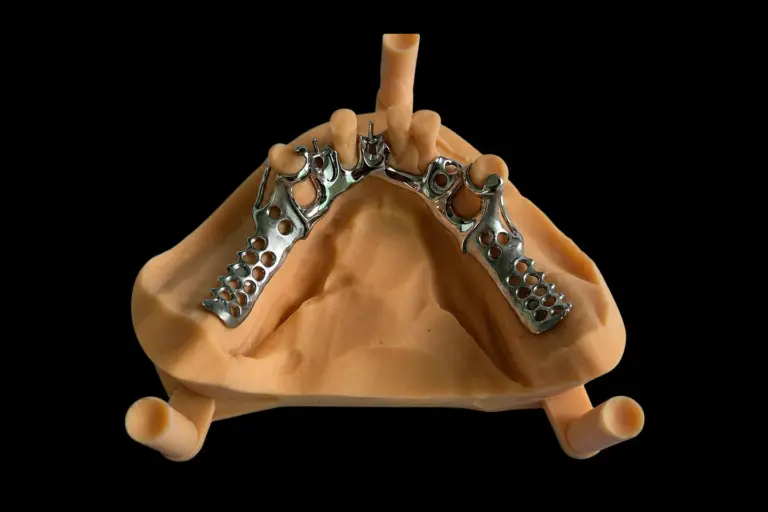
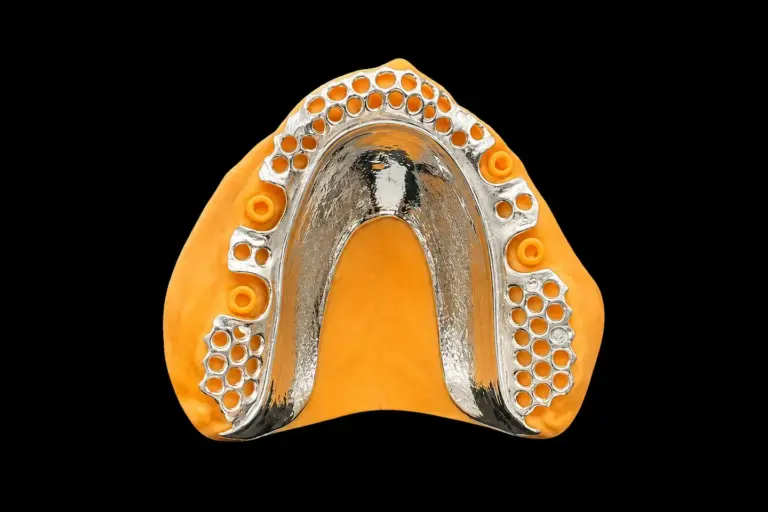
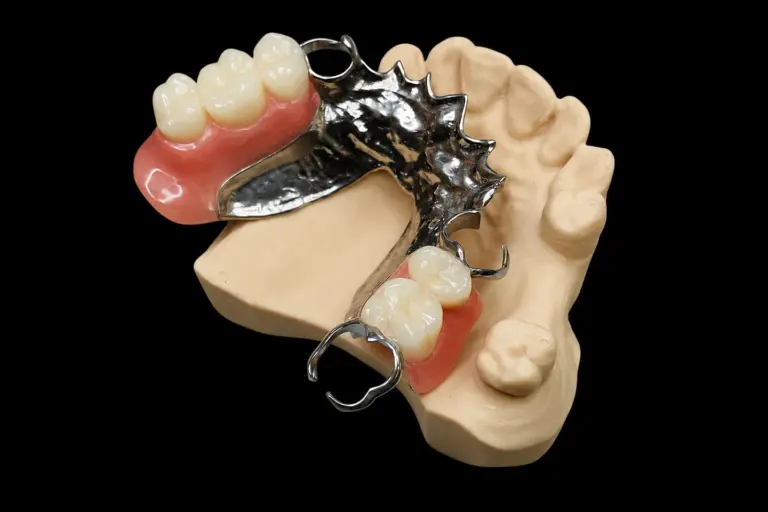
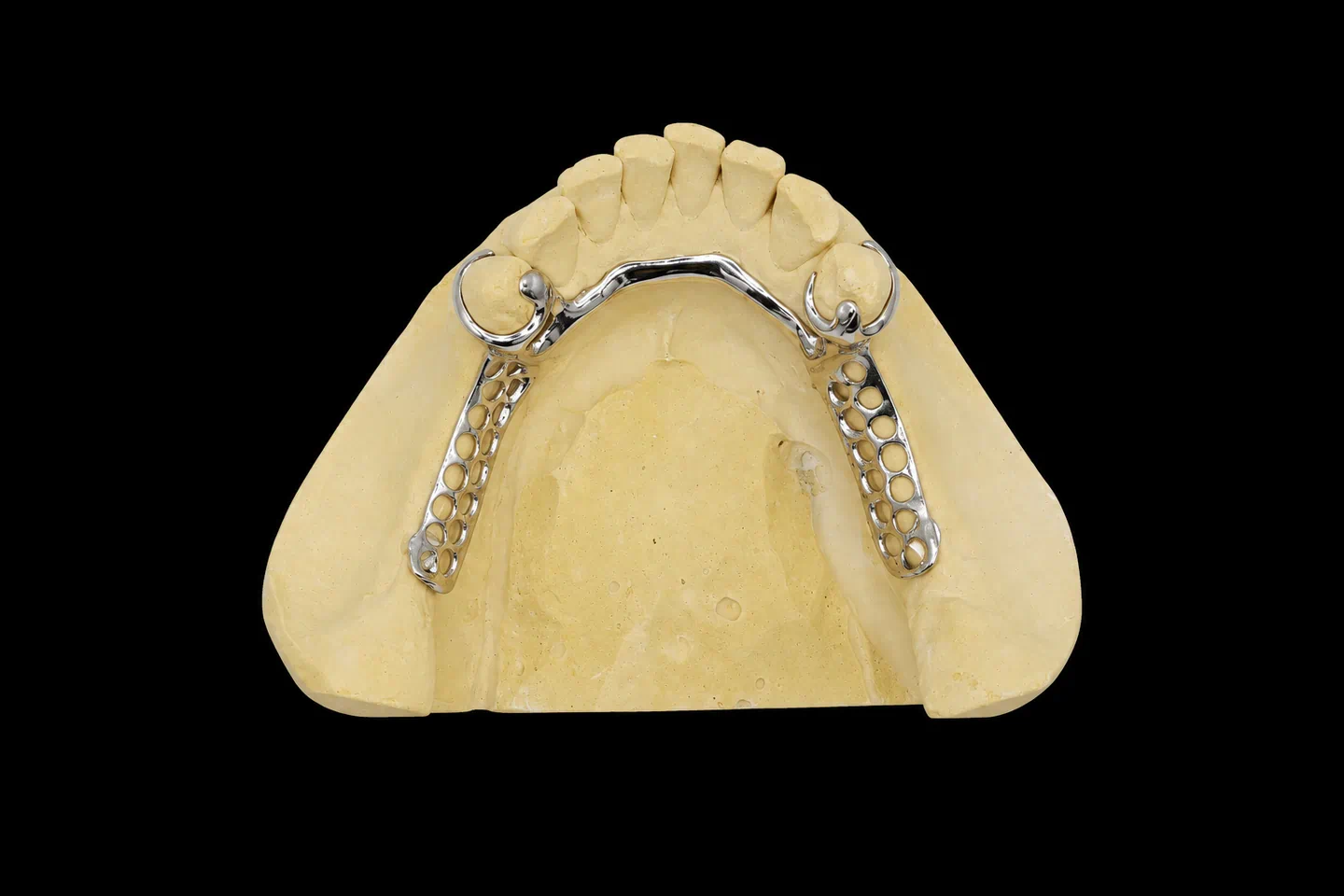
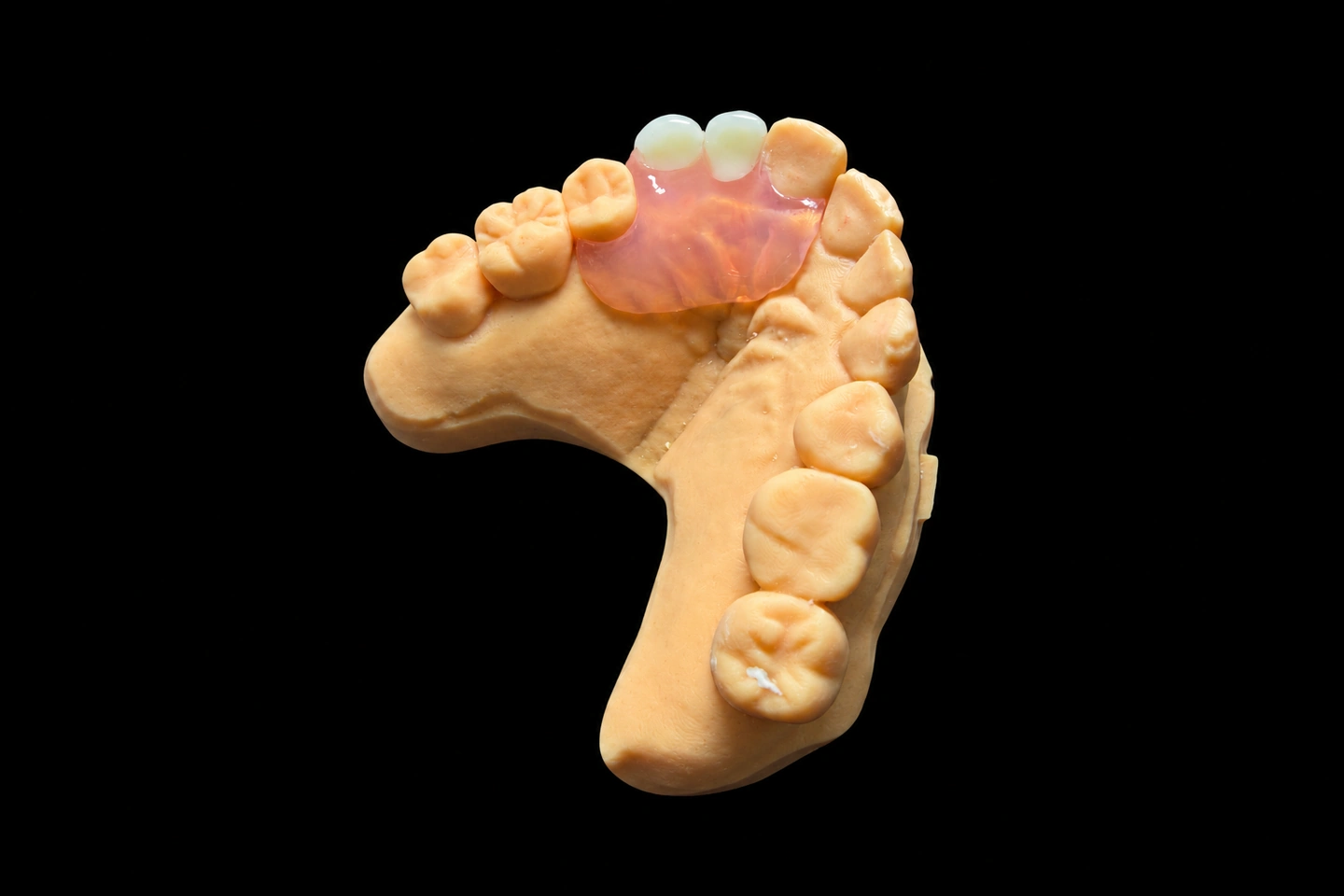
The patient had worn an acrylic partial for about four years and had it repaired twice . It covered most of the palate. This time the dentist and patient settled on upper metal dentures with a cobalt-chromium framework .
Two of the four teeth the new upper cast metal partial denture would hold on to weren’t ready for it:
A root-canal-treated tooth holding a partial is worth a second look. A 46-study meta-analysis in The Journal of Prosthetic Dentistry found cast-clasp partials had about 95% five-year survival, but abutment teeth and non-vital teeth carried a higher risk of extraction after five years. Keeping #5 as an abutment was the dentist’s call . Our job was to make sure the load on it went where it should.
The Rx for These Upper Metal Dentures
The dentist sent intraoral scans of both arches with the #5 and #12 preps, a bite scan, and smile photos . The Rx listed six points :
Why We Surveyed First on This Upper Cast Metal Partial Denture
Points 1 and 2 are the usual way to do it: crowns go in, then the partial is designed around whatever shape they have. We surveyed the whole arch with the preps before designing anything . The survey sets the path of placement, and every guide plane, rest, and clasp tip follows from it. If the crowns are made first without that path, the upper metal dentures have to live with whatever shape the crowns ended up with.
What natural-contour crowns would have meant
We mocked up natural-contour crowns on the preps and surveyed them along the path the molars allowed :
| On #5 and #12 | Natural-contour crown | What the framework would need |
|---|---|---|
| Rest seat | None | A seat ground into the finished crown chairside |
| Distal surface | Rounded, not parallel to the path | A gap under the minor connector, or a framework that binds |
| Usable undercut | About 0.5 mm, mid-buccal, middle third | A clasp tip high on the face, in the smile |
| Lingual surface | Bulging | A thick reciprocal arm sitting proud |
That undercut row is the real problem. A clasp tip that high has to cross the buccal face to get there, and point 4 rules that out.
The material question
The Rx asked for zirconia. The Ankara University RPD textbook doesn’t recommend all-ceramic crowns on teeth that will support a partial, and it puts guide planes and rest loads on metal, not porcelain. Grinding a rest seat into a zirconia crown after cementation wasn’t something we wanted to hand the dentist either.
Room for the rests
A rest seat in a crown needs extra reduction on the side where the rest goes. The rest itself should be at least 1 mm thick at its thinnest point. Add metal under the seat, and we wanted about 2.0 mm of reduction at the distal-occlusal of each premolar . #12 had 2.1 mm . #5 had 1.3 mm .
The Call With the Dentist
Picking the crowns isn’t our job. Laying out what each choice means is. We sent survey screenshots with the readings and three options, then talked it through :
| Natural-contour zirconia, as written | PFM crowns shaped for the framework | Full cast metal crowns shaped for the framework | |
|---|---|---|---|
| Rest seats | Ground chairside later | In metal, built into the crown | In metal, built into the crown |
| Guide planes | None | Distal and lingual, in metal | Distal and lingual, in metal |
| Clasp tip on #5, #12 | High, mid-buccal | Low, at the distobuccal line angle | Low, at the distobuccal line angle |
| Looks in the smile | Natural | Porcelain buccal, no metal at the margin | Metal shows |
| Extra prep | None | About 0.7 mm at #5’s distal-occlusal | About 0.7 mm at #5’s distal-occlusal |
The dentist went with PFM crowns shaped for the framework, with porcelain margins on the buccal . The patient’s smile ruled out full cast, and the dentist didn’t want to grind into finished crowns . Two more things came out of the call:
Rx point 1 changed, and we sent a revised crown design for sign-off .
How We Built the Crowns Around the Upper Metal Dentures
One path for all four abutments
We set the path so the distal surfaces of #5 and #12 and the mesial surfaces of #2 and #15 could all be parallel . The crowns were designed on that path, and the marks we sent for #2 and #15 used the same one. Guide planes have to be parallel to the insertion path and to each other, so this was the one setting the crowns and the upper cast metal partial denture both depended on.
What each crown carries
| Feature | #5 | #12 | Why |
|---|---|---|---|
| Distal-occlusal rest seat | Rounded triangle, about one-third of the tooth’s width, floor sloping toward the center | Same | Sends chewing load down the root, not sideways |
| Distal guide plane | 3 mm tall, in metal | 3 mm tall, in metal | Guides the partial in and out along one path |
| Lingual surface | Flat, parallel to the path, 2.5 mm tall, in metal | Same | Lets the reciprocal arm sit flush, not bulky |
| Placed undercut | 0.25 mm, distobuccal line angle, gingival third | Same | A short bar clasp from below reaches it without crossing the face |
| Buccal | Porcelain, collarless margin | Same | No metal collar at the crown margin |
The rest seat form follows the occlusal rest guidance: wide and fairly thin rather than narrow and thick, reaching at least to the center of the tooth. The 0.25 mm figure is the gauge the textbook uses when it places an undercut on a crown for a clasp.
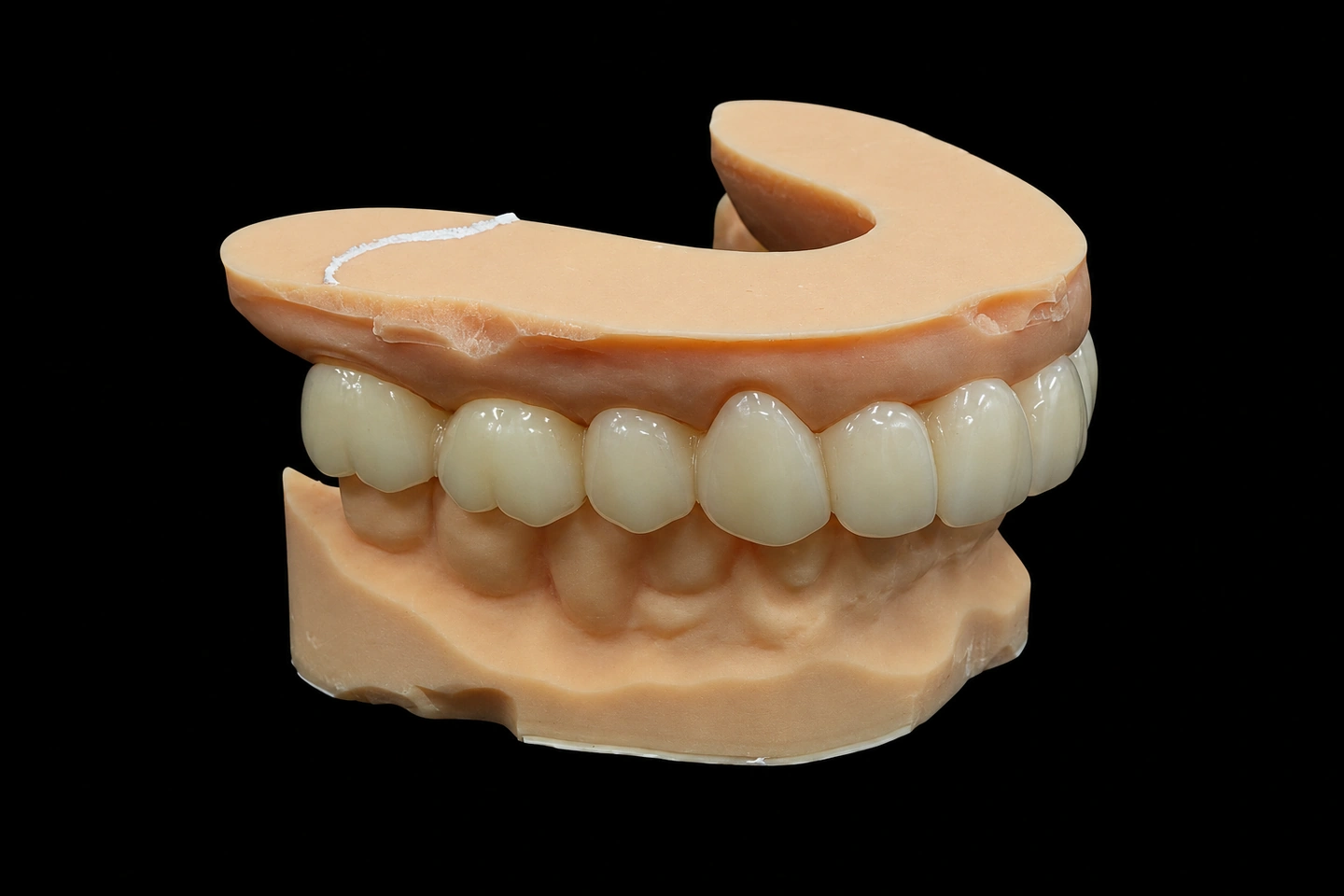
Making the crowns
The dentist cemented both crowns, and #2 and #15 were already done . Then came a new full-arch scan and bite scan .
How We Made the Upper Cast Metal Partial Denture
Survey check on the new scan
Before designing the framework for the upper metal dentures, we surveyed the scan of the arch with the crowns in place . The question was simple: did what’s in the mouth match the plan?
| Check | Result |
|---|---|
| Distal guide planes, #5 and #12 | Parallel to the path |
| Mesial guide planes, #2 and #15 | Parallel; #15 slightly short at 2 mm, still usable |
| Undercut, #5 and #12 distobuccal | 0.25 mm, where placed |
| Undercut, #2 and #15 mesiobuccal | 0.25 mm |
| Rest seats | All four clear of the opposing teeth in the bite scan |
The framework design
The design went to the dentist with clasp types, rest positions, connector size, and mesh coverage marked. Approved the next working day .
Framework check and try-in
On the model, under magnification, we checked clasp form and flex, rest fit, connector section, smooth seating with no rocking, and no bite interference. The framework shipped for try-in on working day 6 .
The try-in was the real test for these upper metal dentures. The framework went on without force. All four rests sat down fully, and nothing lifted when the dentist pressed on the strap . Nothing on the crowns needed adjusting . One note: the minor connector on #15 felt tight on the short guide plane . The dentist eased it about 0.1 mm on the inside of the connector and took a VPS bite on the framework .
Teeth, processing, and final inspection
The Finished Upper Metal Dentures
Dentist and patient feedback after delivery
The dentist
The upper metal dentures seated at the first appointment with no changes to the crowns or clasps . The only follow-up was easing one sore spot on the buccal flange at #3 at the one-week check . The dentist said planning the crowns around the partial took one extra prep tweak and saved a lot of chairside grinding .
The patient
At two weeks, the patient was wearing it all day and chewing on both sides . The strap felt odd for a few days, then less so . The patient’s first comment on the smile photo was that the clasps were hard to spot .
What the dentist went over about the upper cast metal partial denture
It’s root-canal treated and it’s holding a partial, so recall checks on it matter .
Biting it into place can bend the clasps.
The acrylic base can be relined. The framework and the crowns stay as they are.
Sending Us Upper Metal Dentures With New Crowns
Crowns shaped for a partial generally take 5–7 working days in the lab. Most upper metal dentures take 5–7 working days too, and simple ones 2–3. Stages that need your sign-off or a try-in wait for your reply before the next one starts.
Who Made It
Istar Dental Lab has been making dental restorations since 2012, with about 460 staff across four labs in Shenzhen and Huizhou, China. Crowns, the frameworks for upper metal dentures, and denture processing are all done in-house. Nothing is outsourced. About 55 people work in the removable department and about 25 in QC.
Istar Dental Lab is an FDA-registered establishment (Registration Number 3039441248), which you can look up in the FDA establishment registration database. Our labs run an ISO 13485 quality management system, and custom-made devices for EU clinics follow the MDR custom-made device procedure. You’re welcome to visit the factory or book a video tour.
Upper Metal Dentures FAQ
Which framework metals can we choose for upper metal dentures?
Cobalt-chromium is our standard (chromium cobalt dentures), and we also work in Vitallium alloy and pure titanium. We don’t swap materials without your okay, and proof of alloy composition and batch is available on request. The full range is on our metal dentures page.
Can we order just the framework for upper metal dentures?
Yes. We ship the finished framework, and your team sets and processes the teeth. A framework try-in stage is available too.
Can an upper cast metal partial denture use attachments instead of clasps?
Yes. We accept partials with precision attachments. Write the system, type, and size on the Rx, and we’ll order parts to that spec.
What do the warranties cover?
Crowns, PFM included, carry 3 years. The partial carries 1 year, framework included. Lab-caused problems, like a partial that won’t seat, lifted borders, an off bite, or a poorly placed clasp, get adjusted or remade free. You pay to send the case in, and we pay to ship finished work back, remakes included.
Can you rush a case?
Rush is free for clients who send us 10 or more cases a month, for any material or case type. We guarantee the ship date. We can’t guarantee arrival, because customs times vary.
How does pricing work?
We don’t publish prices on the website. Ask for our price list, and we’ll quote each item to your Rx. Single trial cases are welcome, and ongoing partnerships suit clinics with a regular case flow.
Planning Crowns Under an Upper Cast Metal Partial Denture?
Send the preps, both arches, and the smile photos before the crowns are made. Upper metal dentures fit best when the crowns under them are planned on the same path. We’ll survey it, show you where the rests, guide planes, and clasp tips will go, and agree the crowns with you before we build anything.