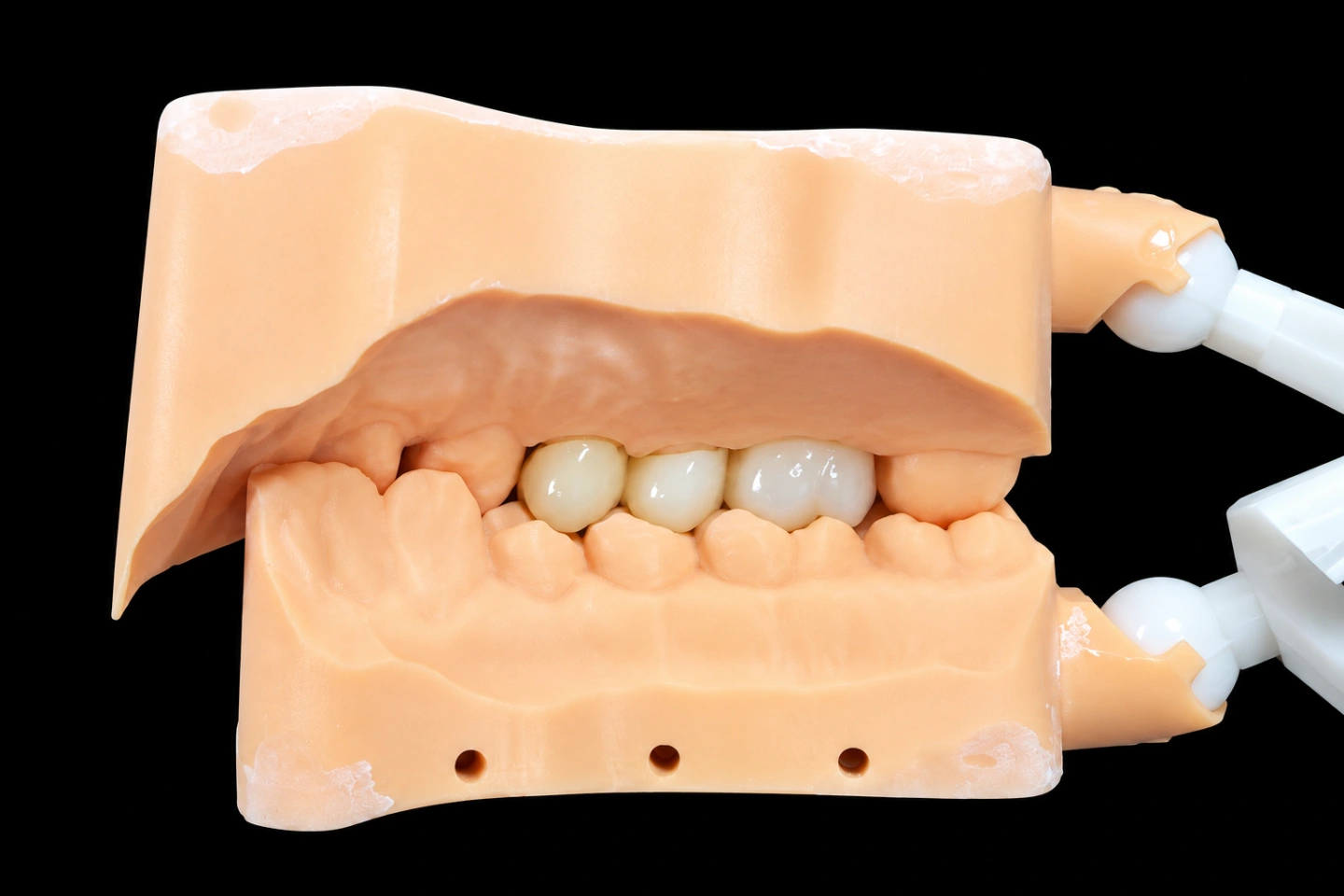
Patient Situation
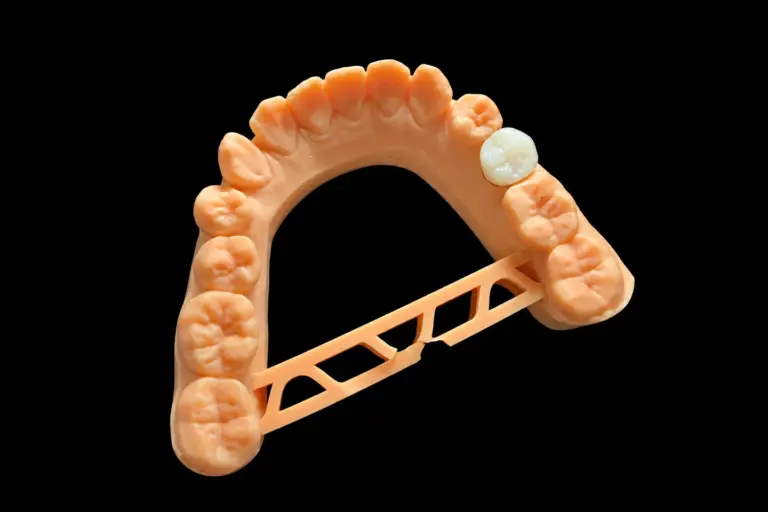
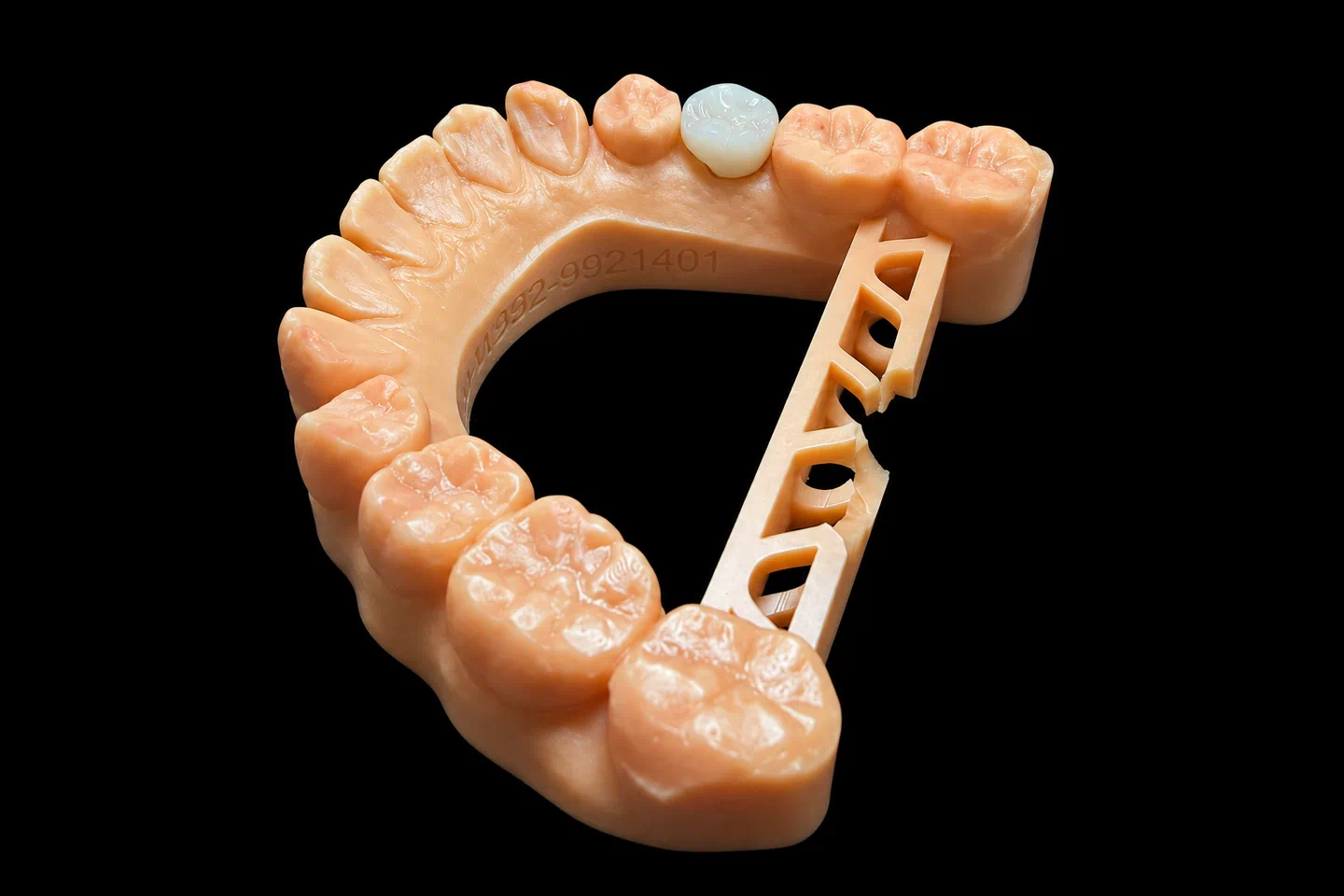
The patient lost #30 about two years ago . The site has settled, and the ridge is a little flatter than the teeth on either side . The dentist sent intraoral scans of both arches in STL, a bite scan, the Rx and a shade photo of #28 .
What the Dentist Asked For
The Rx, condensed :
Requests 1 and 4 run into each other at the #30/#31 joint.
The Technical Problem: One Connector Without Enough Height
Why height matters more than width
A zirconia crown bridge rarely breaks through the middle of a tooth. It breaks at a connector, where the pontic joins an abutment. Under a bite, the connector bends like a small beam.
A beam’s strength rises with the square of its height but only in step with its width. Make a connector 20% taller and you gain more than you would by making it 20% wider. Connectors sit between the gum and the bite, so on a short tooth, height is the thing that runs out.
What we measured
Our CAD technician measured both connector sites on the scan . Height counts from just above the gum, leaving the threader room the Rx asked for, up to where the marginal ridge has to sit under the upper teeth.
| Connector | Height available | Width available |
|---|---|---|
| #29/#30 | 4.6 mm | 3.9 mm |
| #30/#31 | 4.1 mm | 3.6 mm |
Why a layered zirconia bridge came up short here
In a layered zirconia bridge, the zirconia framework carries the load and porcelain covers it. The porcelain needs its own thickness over the connector, so the framework connector ends up shorter than the space.
At #30/#31, that left a framework connector about 2.9 mm high by 3.6 mm wide, roughly 8.2 mm² in cross-section . Our design range for back-tooth connectors is 9–16 mm², depending on the material. This one fell below it, on a molar.
Porcelain adds a second risk. A review of tooth-supported zirconia bridges found that porcelain-veneered ones chipped significantly more than monolithic ones over five years. Their rates of complete fracture, though, weren’t significantly different. So going monolithic cuts chipping, but it doesn’t make a thin connector safe.
The Options We Sent Before Milling
We sent the dentist the measurements, a design preview and three options :
| Option | #30/#31 connector | What you give up |
|---|---|---|
| A. Layered zirconia bridge, as written | 2.9 × 3.6 mm, about 8.2 mm² | Below our range on a molar connector |
| B. Layered, with the connector pushed down into the gum-side embrasure | 3.9 × 3.6 mm, about 11.0 mm² | The floss threader no longer fits under that connector. Height could also come from the gum side of #31, but that’s a clinical call, with another visit and a new scan |
| C. Monolithic zirconia bridge from a multilayer disc | 4.1 × 3.6 mm, about 11.6 mm² | #29’s face gets stain and glaze instead of hand-layered porcelain, so a little less depth |
We recommended C, the only option that keeps both the connector height and the cleaning space. The dentist approved it by email the same day , and the design was locked.
How We Built the Monolithic Zirconia Bridge
Design
Milling and sintering
The zirconia crown bridge was milled in one piece from a single multilayer zirconia disc . Zirconia shrinks a lot in the furnace, so the software scales the design up to make up for it. We set that factor from the material maker’s data and check it against a standard test block for every new batch of discs.
Sintering runs on a fixed program. Temperature, heating rate and hold time are locked, every firing’s curve is logged, and we check the furnace with test pieces regularly. This bridge sat on a heat-resistant support tray, held at more than one point so the span couldn’t sag.
Fit check before finishing
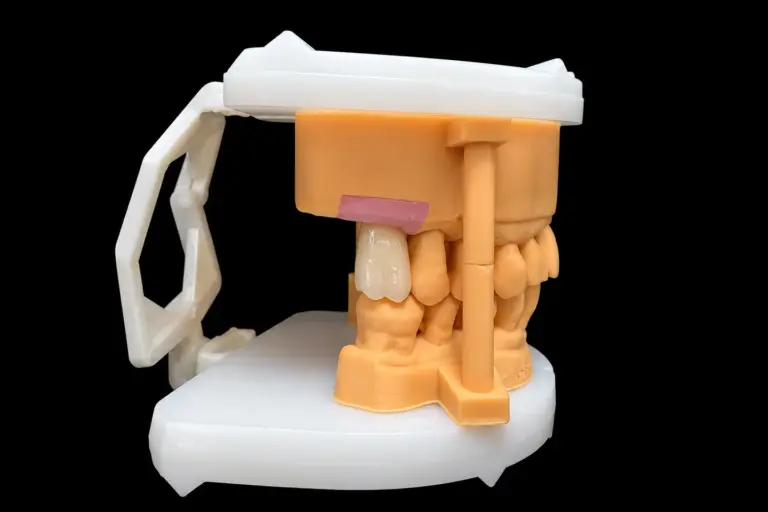
After cooling, the zirconia crown bridge went back on the printed model before any stain or glaze. If the furnace had moved anything, that’s the stage where it’s still easy to catch and fix.
Finishing
#29’s buccal face was stained and glazed to the shade photo of #28 . The chewing surfaces were polished . Anything we adjusted was polished back step by step with a zirconia polishing kit, so no rough spots are left to wear the upper teeth.
Finished Result
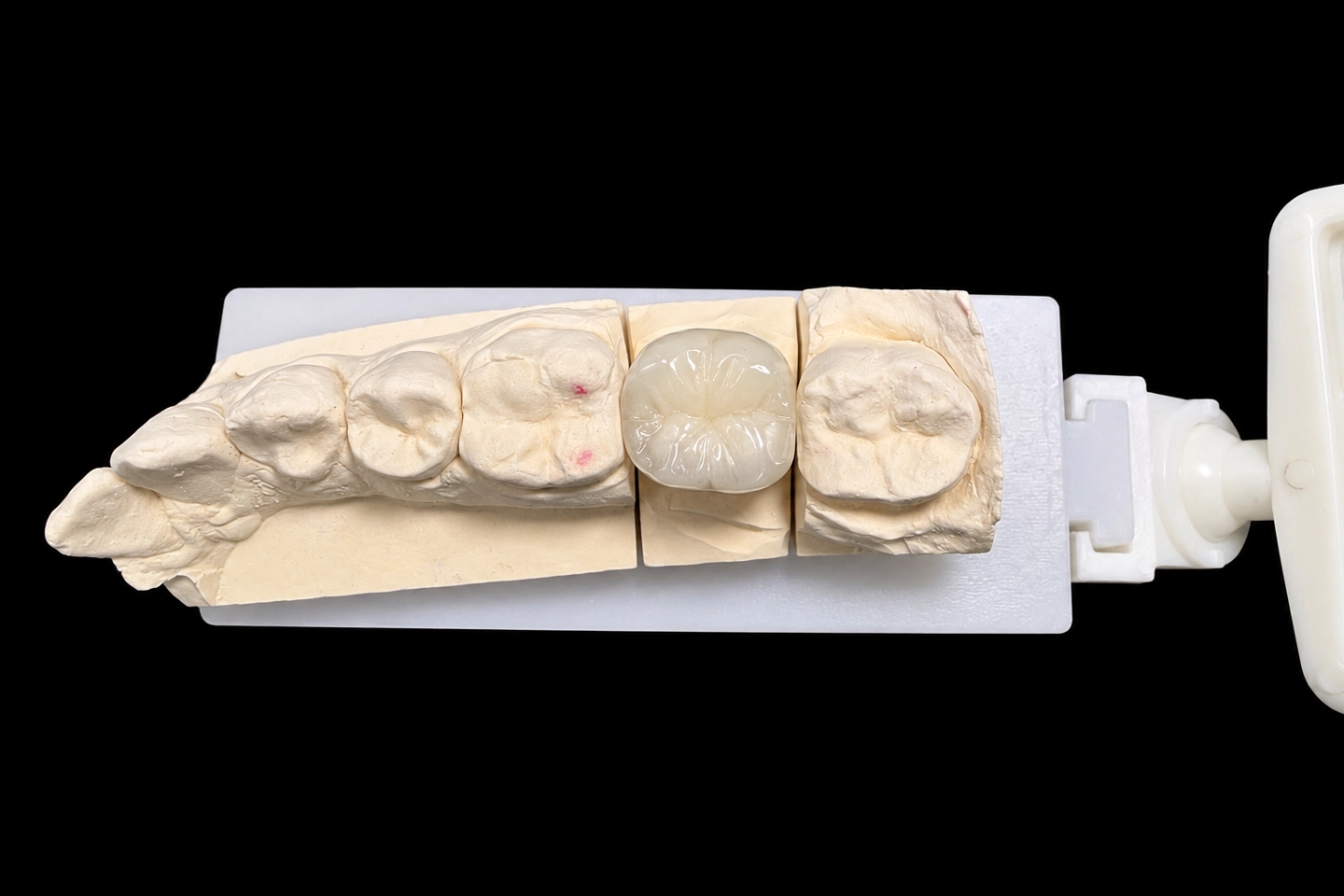
The finished zirconia crown bridge at final inspection :
| Check | Result |
|---|---|
| #30/#31 connector height | 4.1 mm |
| #29/#30 connector height | 4.6 mm |
| Floss threader under both connectors | Passes |
| Seat on the model | No rocking |
| Margins on #29 and #31 | Closed under magnification |
| Contact with #28 | Normal, per the Rx |
| Bite | Even centric stops, no side-move contacts |
| #29 shade | A2, matched to the #28 photo under standardized light |
| Turnaround | Shipped on working day 6 after approval |
Dentist and Patient Feedback
Summarized from the dentist’s notes at seating and at the two-week check . The patient’s comments came to us through the dentist.
- The monolithic zirconia bridge seated with no margin or contact changes. One light occlusal adjustment on #29, polished chairside.
- Seeing the connector numbers before milling made it easy to sign off on a different build from the one on the Rx.
- On their next bridge with a short abutment, they plan to ask for the connector measurements up front.
- The bite felt even from day one, and they chew on the right side again.
- At home, the floss threader goes under both connectors without catching.
- In their own photos, #29 doesn’t stand out next to #28.
Monolithic Zirconia Bridge or Layered Zirconia Bridge?
Monolithic isn’t the stronger pick by default. In a 2026 review of tooth-supported bridges covering 41 studies, five-year survival was 87.9% for monolithic zirconia and 92.9% for veneered zirconia. Those are pooled numbers from many patients, not a forecast for any one bridge.
A layered zirconia bridge still fits teeth in the smile when the connectors have room for both the framework and the porcelain. A monolithic zirconia bridge fits short abutments and back teeth where every tenth of a millimeter goes to the connector. See our monolithic zirconia crowns and bridges, layered zirconia crowns and bridges and zirconia crowns for posterior teeth.
Sending Us a Zirconia Crown Bridge
Every step, from your data to QC and packing, happens in our own labs: four of them in Shenzhen and Huizhou, China, with about 460 people. Istar Digital is an FDA-registered establishment, Registration Number 3039441248, which you can check in FDA’s establishment database. The lab runs under ISO 13485.
Got a bridge on a short abutment, or a connector you’re not sure about? Send us the scan and Rx, and we’ll measure the connectors before we mill anything. Send your first case or talk to us.
FAQ
How many units can a zirconia bridge span?
We treat five units as long span. How far a bridge can go depends on how many pontics each abutment carries (usually one at most), the bone around the abutments, and the bite, including grinding and side-move forces. Bridges of four units or more always get design approval before production.
Do I need a facebow or extra bite scans for a bridge?
For a routine three-unit bridge, one centric bite scan is enough. On longer bridges, extra local bite scans help us check the bite. For long-span bridges, raised bites and full-arch work, send facebow records so we can mount on a semi-adjustable articulator.
Can I send my own CAD design for milling?
Yes. If you ask us to mill your design as-is, we mill it as sent, so please double-check it first. If we spot a clear problem, like a thin connector, we’ll tell you before milling. If you still want it as designed, we make it to your file, and remakes caused by that design are on your side.
Do you take rush cases?
Yes, at no extra charge, for clients who send 10 or more cases a month. We guarantee the ship date. The arrival date depends on customs, so we can’t guarantee that.