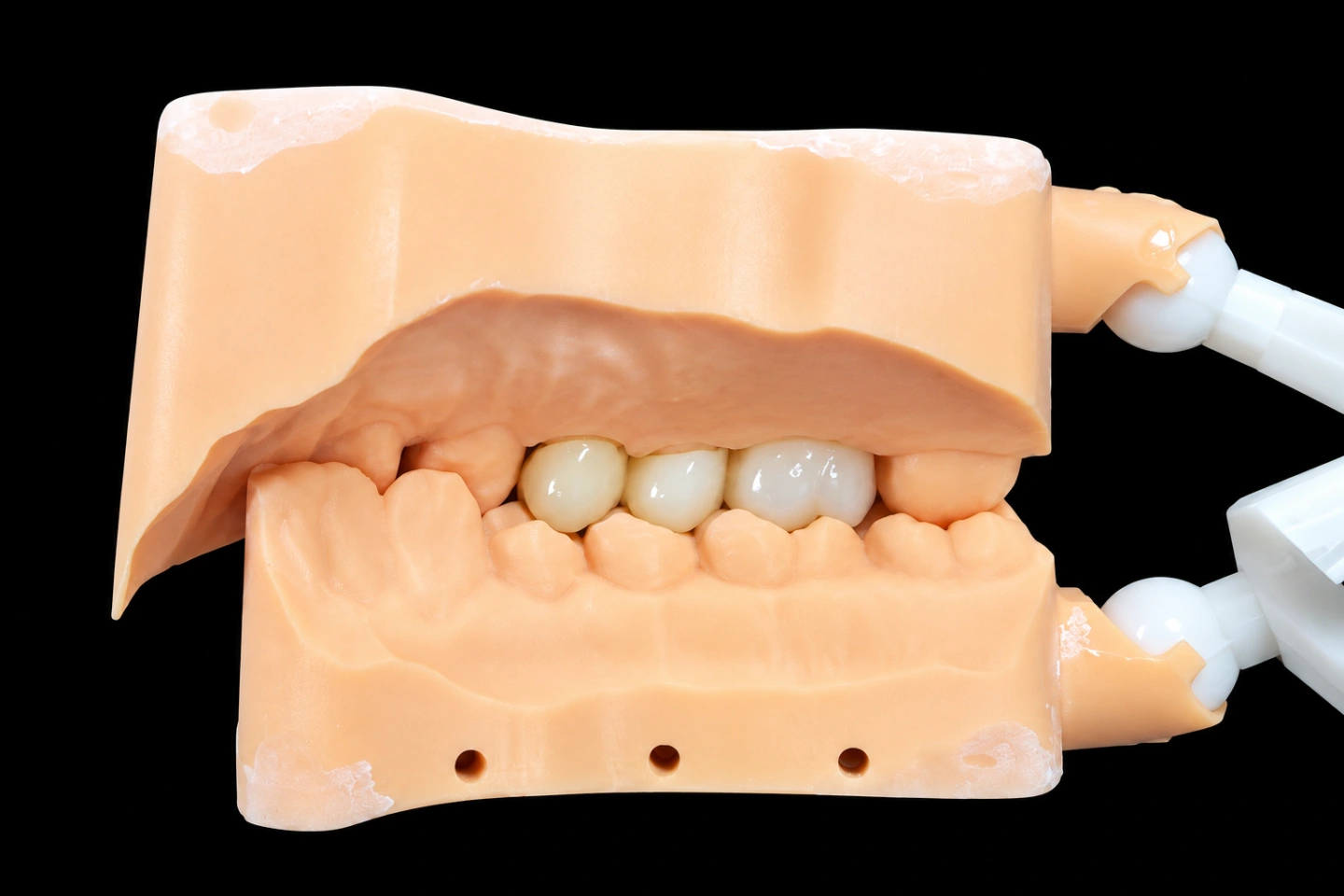
Patient Situation
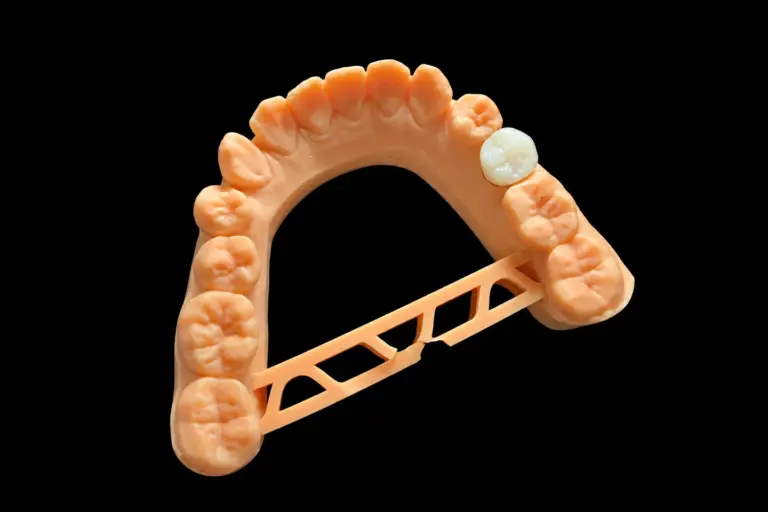
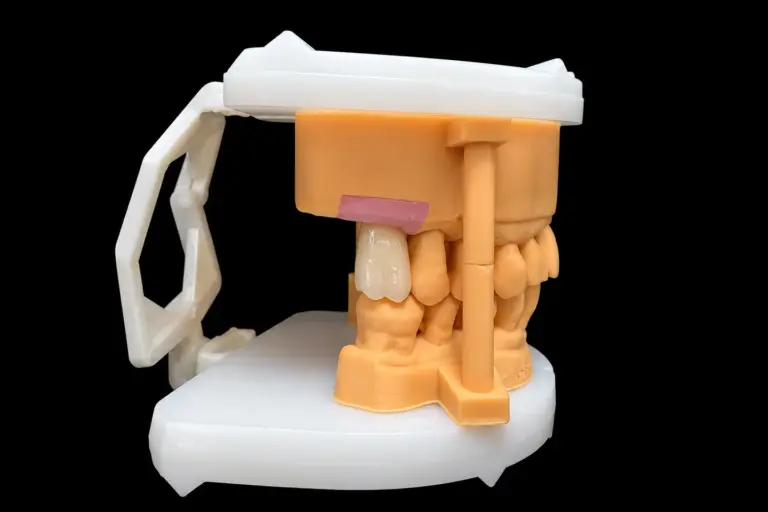
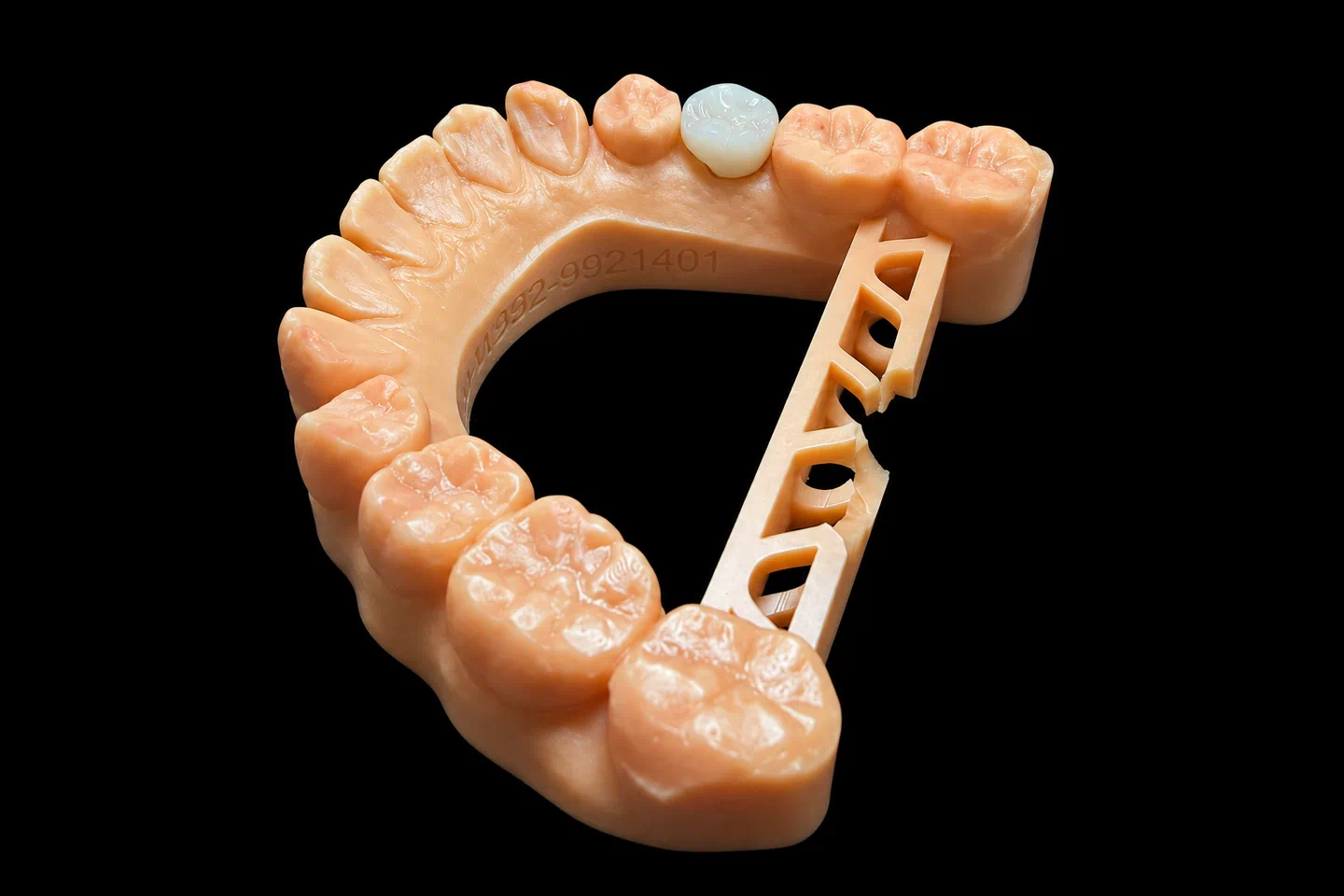
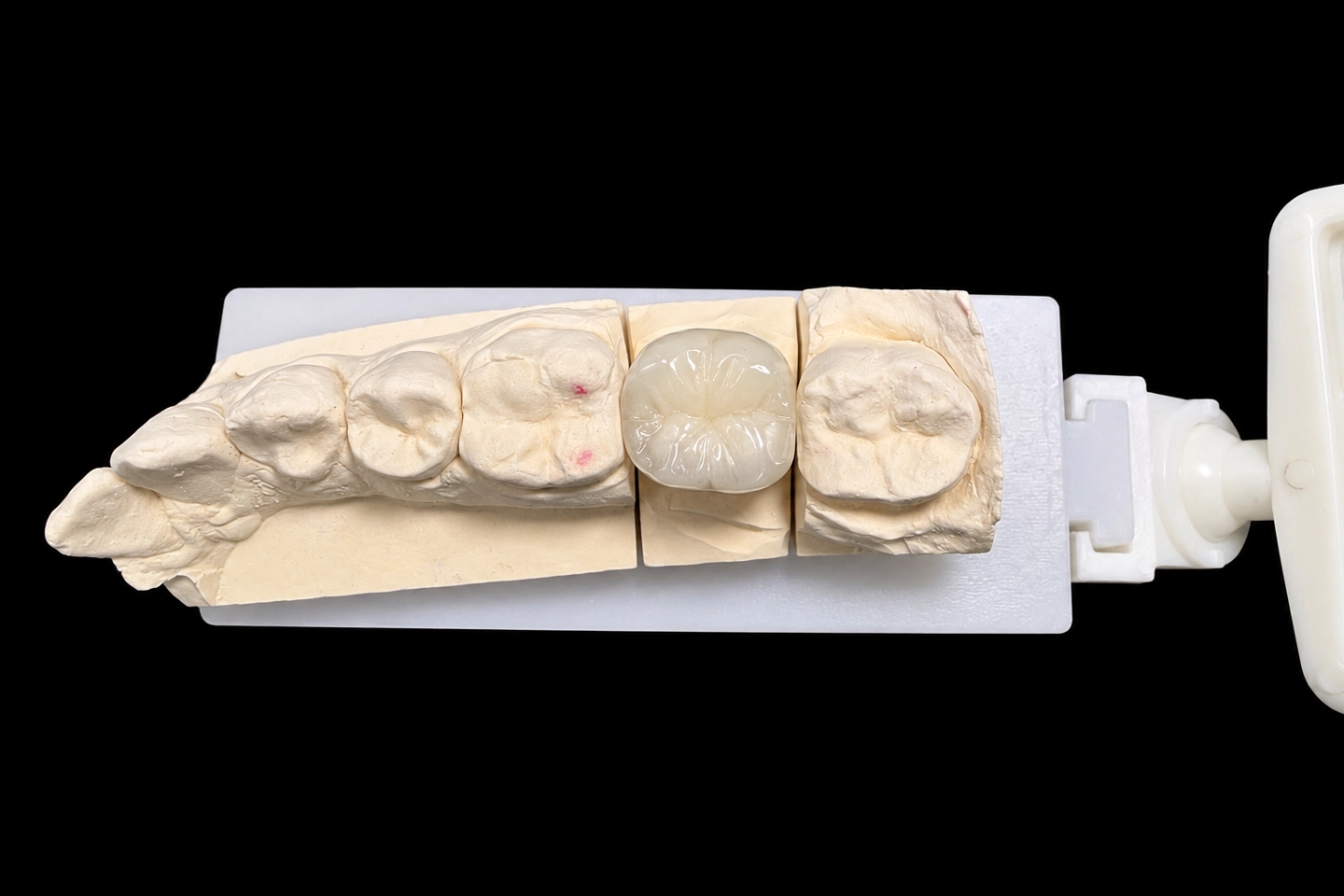
Here’s what we had to work with on this zirconia crown for posterior teeth, all from the scan, the photos and the dentist’s notes:
The patient had one clear request: a tooth-colored crown, with no metal on top .
What the Dentist Asked For
The Rx, condensed :
That last line shaped the whole case.
Why a posterior zirconia crown here
The material was the dentist’s call. For a clencher with little room, we’d point the same way. Single-layer zirconia is the strongest zirconia we make, it has no porcelain layer to chip, and it needs less room than a PFM.
An IPS e.max Press crown wasn’t a good fit. We’re careful with it on clenchers and back teeth, and it asks for more space. Spear Education’s prep guide shows 1.5–2 mm of occlusal reduction for a monolithic e.max molar, against 1–1.5 mm for full zirconia.
The Technical Problem: Not Enough Room Over One Spot
Our technicians read the clearance for this posterior zirconia crown off the first scan, with the bite closed :
| Area on #31 | First scan | Enough? |
|---|---|---|
| Central fossa, under the #2 mesiopalatal cusp | 0.6 mm | No |
| Mesiobuccal cusp | 1.1 mm | Yes |
| Distobuccal cusp | 1.0 mm | Yes |
| Mesiolingual cusp | 1.3 mm | Yes |
| Distolingual cusp | 1.2 mm | Yes |
| Distal marginal ridge | 1.0 mm | Yes |
| Buccal and lingual walls | 0.7 mm | Yes |
Six of those seven readings were fine. The whole problem came from one cusp on the opposing tooth.
Why we didn't just mill it at 0.6 mm
A zirconia crown on a back tooth can be strong when it’s thin. In an aged lab test of monolithic crowns, the authors saw high fracture resistance even at 0.5 mm. But the 1.0 mm crowns took more load than the 0.5 and 0.8 mm crowns, and the 1.5 mm crowns didn’t break at the 10 kN limit.
That’s a test rig, not a clencher’s mouth. So we set 0.8 mm as the occlusal floor for this crown , and 0.6 mm didn’t clear it.
Shape was the other worry. The same Spear guide says that under 1 mm of occlusal space, the crown tends to go saucer-shaped, and the technician ends up scratching anatomy into the surface. At 0.6 mm, that’s what this fossa would’ve looked like.
Why a more translucent zirconia was off the table
More translucent zirconia needs more room, not less. In a 2024 fracture study, 5Y crowns only matched 1.0 mm 3Y crowns at 1.2 mm thick and bonded with resin cement. This crown didn’t have 1.2 mm at the fossa, so we stayed with 3Y .
The Options We Sent Before Making Anything
We stopped the case and sent the dentist a screenshot in our WhatsApp group, with the readings and four ways forward :
| Option | What it means | The trade-off |
|---|---|---|
| A. Reduce the prep | The dentist takes 0.3 mm more off the #31 fossa and rescans | Keeps #2 untouched, but takes more from a vital tooth with a short prep |
| B. Recontour the #2 cusp | The dentist takes about 0.3 mm off the tip of the #2 mesiopalatal cusp, polishes it and rescans | Keeps the prep as it is, but changes natural enamel, so the patient has to agree |
| C. Mill it as is | No chairside work, with a flat fossa at 0.6 mm | Fast, but under our floor for this crown, with almost no anatomy |
| D. Metal occlusal | A PFM crown with metal occlusal in place of zirconia | Thin and strong, but it’s the one thing the patient said no to |
We don’t decide what happens in the mouth. We told the dentist what each option would do to the crown, and we left the clinical call to them.
They went with B. The patient agreed, the dentist recontoured the cusp tip, and the new upper scan and bite scan reached us the next day . The fossa read 0.9 mm . Nothing else on the list changed.
How We Met the Rx: Making This Zirconia Crown on a Back Tooth
Picking the zirconia
For this zirconia crown on a back tooth, we used single-layer zirconia . We also make multilayer zirconia, which goes from a denser neck to a more see-through top. See our posterior zirconia crown options for the full range.
CAD design
We sent a design preview with the thickness marked, and the dentist approved it in writing the same day . Here’s what went into it:
Milling and sintering
Our milling department cut the crown from the approved file . The software’s shrinkage setting follows the zirconia maker’s numbers, and we check it with test pieces on each batch.
The crown sintered on a locked program, on a heat-proof support so it wouldn’t warp. We keep the temperature log for every furnace run.
Hand finishing and polish
After sintering, the technician checked the seat on the printed model and fine-tuned the contacts . Then the occlusal surface went through a step-by-step zirconia polishing kit, with no glaze layer .
The dentist had a good reason to ask for that. In a lab wear study, polished zirconia wore enamel less than adjusted-only or glazed zirconia. In a 12-month clinical study on first molars, glazed crowns caused more enamel wear than polished ones at 12 months, though there was no real difference at 6 months.
Final checks
Our QC technician worked through the work order and the Rx: margins, inner surface, seat, contact with #30, bite in center and side movements, shape, polish, and any cracks, pits or chips. We also measured the thin spots with a crown caliper . The crown was cleaned and disinfected, then shipped in a foam-filled box.
Finished Result of the Posterior Zirconia Crown
Here’s how this zirconia crown for posterior teeth measured up:
| Area on #31 | Clearance on the second scan | Crown thickness at final inspection |
|---|---|---|
| Central fossa | 0.9 mm | 0.86 mm |
| Mesiobuccal cusp | 1.1 mm | 1.05 mm |
| Distobuccal cusp | 1.0 mm | 0.95 mm |
| Mesiolingual cusp | 1.3 mm | 1.25 mm |
| Distolingual cusp | 1.2 mm | 1.15 mm |
| Distal marginal ridge | 1.0 mm | 0.95 mm |
| Buccal and lingual walls | 0.7 mm | 0.65 mm |
The thinnest occlusal point came in at 0.86 mm, above the 0.8 mm floor .
Try-in feedback
The dentist: the crown seated with no margin or contact changes. It needed one light touch on the mesial marginal ridge, and they polished the spot again with a zirconia kit. They cemented it with an MDP resin cement .
The patient: happy that it’s tooth-colored with no metal on top, and the bite felt normal after that one adjustment .
What we gave up
the fossa is shallower than a textbook molar’s. That’s the cost of keeping 0.86 mm there .
single-layer zirconia looks a bit more opaque, and the crown reads slightly brighter than #30 . Spear’s guide explains why: more zirconia means more opacity and higher value.
the #2 cusp lost about 0.3 mm of natural tooth .
What this crown can't promise
Polishing doesn’t stop enamel wear. In a small 5-year study of six patients with polished 3Y bridges, enamel wear reached 77 μm against 54 μm on control teeth.
The tooth under the crown can still have problems too. In a chart review of 515 single crowns, tooth fracture caused half of the failures, across both metal-ceramic and zirconia crowns. We don’t have long-term follow-up on this crown yet .
Who Did What on This Posterior Zirconia Crown
| Step | Who |
|---|---|
| Prep, scans and shade | The dentist |
| Measuring clearance and flagging the thin spot | Istar |
| Choosing how to fix it, and recontouring #2 | The dentist, with the patient’s OK |
| Thickness, contacts, anatomy and polish | Istar, to the approved design |
| Chairside adjustment and cementation | The dentist |
Sending a Similar Zirconia Crown for Posterior Teeth
Planning a zirconia crown for posterior teeth with a tight bite? This is how it works with us.
Every step happens in our own labs: four of them in Shenzhen and Huizhou, China, with about 460 people, including about 100 in design, 70 in milling and 25 in QC. We make about 8,000 single zirconia crowns a month in the slow season and about 15,000 at peak, and we don’t outsource.
Istar is an FDA-registered establishment, Registration Number 3039441248, which you can look up in FDA’s establishment database. The lab runs under ISO 13485. You can also book a factory or video visit.
Need a zirconia crown on a back tooth that’s short on room? Send us the scan and Rx. We’ll read the clearance and tell you where it’s tight before we mill anything. Send your first case or talk to us.
FAQ
Can I send just one test case?
Yes, single trial cases are welcome. Ongoing partnerships suit a regular case flow best, since international shipping is the big cost on one-off cases.
What if I don't answer when you flag a problem?
The case stays on hold. We’ll remind you every other day until it’s sorted out, so nothing gets milled on a guess.
What can I adjust chairside, and when should I call you?
A slightly high bite is fine to adjust chairside. If the crown is cracked, won’t seat or has an open margin, stop and contact us.
If I've adjusted a crown and it still needs a remake, who covers it?
Usually we do. Send photos and tell us what you adjusted, and we’ll work out the cause with you.
What if a zirconia crown cracks later?
Send photos to your case group. If it seated well and only the crown cracked, we can often remake it from the original data. For a fit, margin or bite problem, we’ll want a new scan, model or impression.
Do you take rush cases?
Yes, at no extra charge, for clients who send 10 or more cases a month. We guarantee the ship date. The arrival date depends on customs, so we can’t guarantee that.