Patient Situation: Missing Upper Front Teeth and a Wire That Showed
The patient lost #8 and #9 in a fall years ago and had worn an acrylic flipper since . Five months before this case, #7 was taken out after a root fracture, and the dentist added a tooth to the old flipper to get through the wait . That flipper had wire clasps on both canines.
The patient works in sales and is on calls most of the day . The wire on #6 showed every time they smiled, and the thick acrylic behind the front teeth made “t” and “s” sounds lazy . Implants had been talked through. The patient said not now . A fixed bridge would have meant crowning both sound canines, and the dentist didn’t want that .
What the dentist’s notes and the records showed:
What the Dentist Asked For
The Rx, shortened :
Why the Grip Was Hard to Place on This Flexible Partial
On a flexible partial denture for upper front teeth, the “clasp” is really the base carried around a tooth as a pink arm. It hides metal. It doesn’t hide the fact that something wraps the tooth. So where those arms go decides both what shows and how well the partial stays put.
The best undercuts were exactly where the smile shows
We surveyed the printed model on a level path. Here’s what came up :
| Spot | Undercut | Shows at full smile? |
|---|---|---|
| #6 facial, near the gum | 0.6 mm | Yes |
| #11 facial, near the gum | 0.5 mm | Yes |
| #5 mesiobuccal | 0.5 mm | Only in the back corner |
| #12 mesiobuccal | 0.45 mm | Only in the back corner |
| #10 facial | 0.2 mm | Yes |
The canines had the most to give and were the most visible. The premolars had enough, and they’re farther back. #10 offered almost nothing, and an arm there would cover the gum margin on a short tooth.
No rests means the base carries the load
This design has no rests. When the patient bites on #8 and #9, the saddle presses up into the ridge, and the base can lift a little at the back edges. In a flexible partial there’s no rigid frame to stop that. Only the clasps and the base’s contact with tooth and tissue hold things in place.
A Japan Prosthodontic Society position paper on non-metal clasp dentures puts it plainly. It doesn’t recommend flexible dentures with no metal framework as definitive dentures, outside limited cases like metal allergy. It asks for conventional partial denture design rules to be applied to them. So we flagged this before anything else.
Every step back is a trade
Moving the arms back to the premolars hides them. But arms farther from the saddle hold the front less directly. To make up for that, the base needs more contact on the palatal surfaces of the teeth. That pushes against Rx item 3. Nothing here was free.
The Three Designs We Sent the Dentist
We held the case on lab day 1 and emailed the survey readings, screenshots, and this table. Sharing the survey with the design is something we do on request:
| Option | Where the grip comes from | Good | The catch |
|---|---|---|---|
| A. Canine arms | Low facial arms on #6 and #11 | Closest to the saddle. The strongest hold on the front teeth | Shows at full smile. Conflicts with Rx item 2 |
| B. Premolar arms plus palatal contact | Arms on #5 and #12 through the canine–premolar gaps, and a horseshoe base on the palatal of #5, #6, #10, #11, #12 | Nothing on the canine faces. Middle of the palate stays open | Less direct hold on the front. More base behind the teeth |
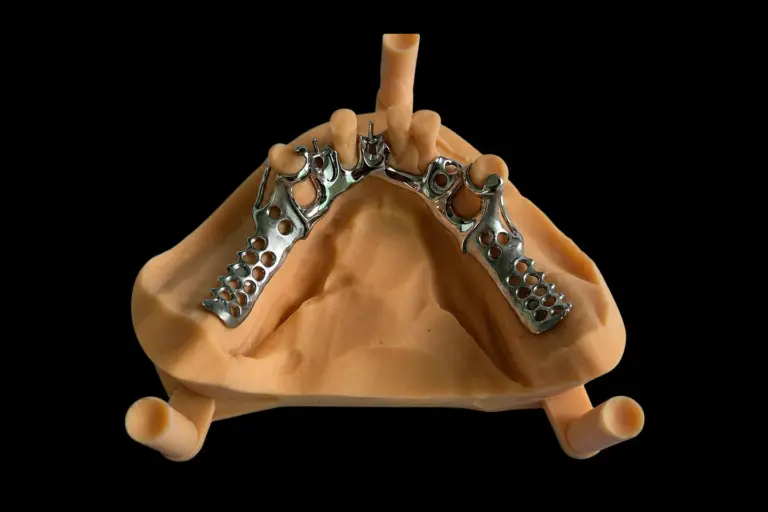
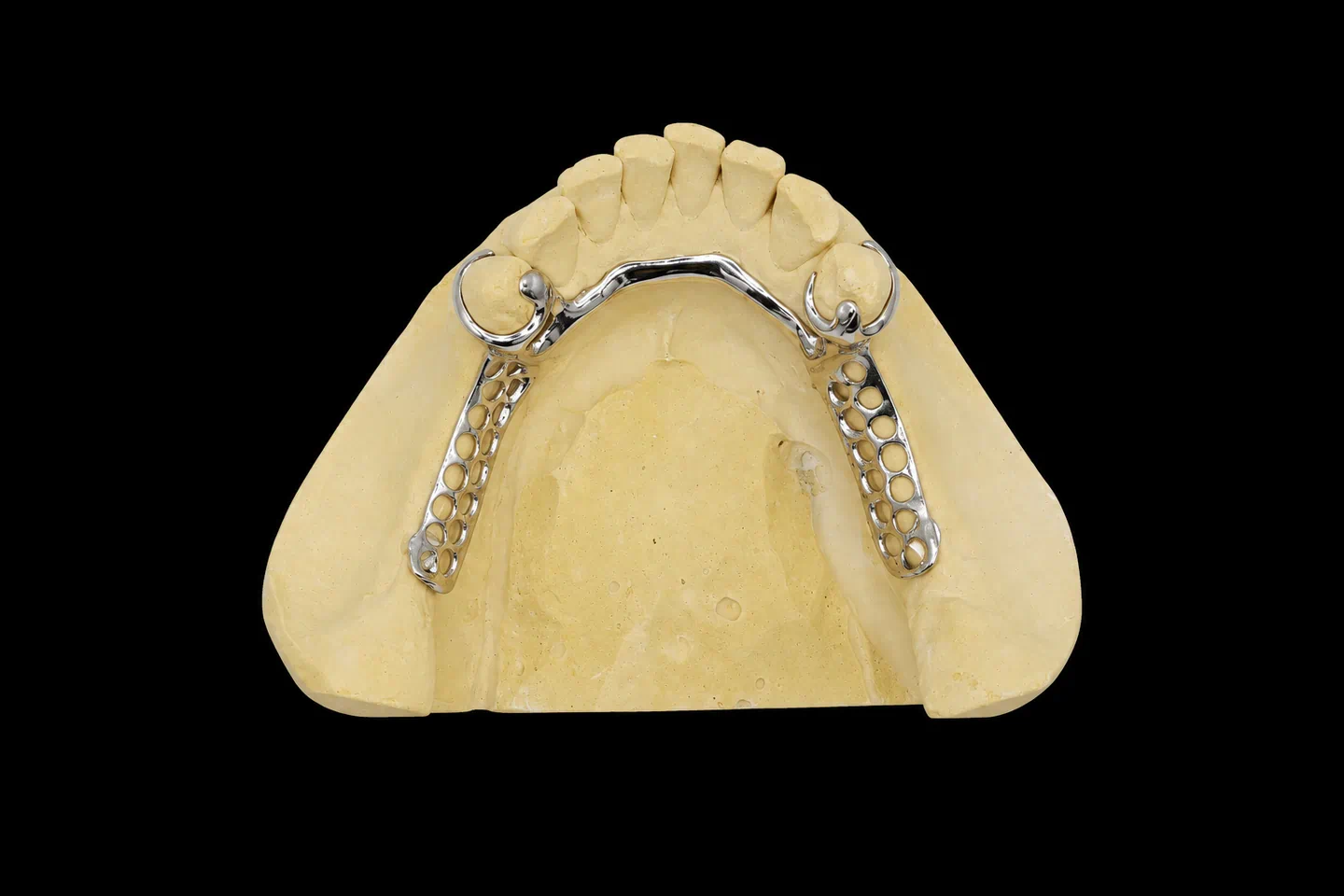
| C. Metal framework partial with rests | Rigid frame, rests, cast clasps | Steadiest. Teeth share the biting load | Conflicts with Rx item 1. Clasps would need redesigning to meet item 2 |
For #10 we suggested no arm in any option, only base contact on its palatal surface . A 0.2 mm undercut on a 7.5 mm crown wouldn’t add much grip, and the arm would sit on the gum in the middle of the smile.
We said Option C would be the steadiest. We also said Option B would be the least steady of the three on hard foods . The research gives B some room, though. A one-year study of 120 upper partials suggests polyamide for small edentulous areas and light chewing loads. It also found acrylic gave more bulk and speech trouble, which fit this patient’s history.
The dentist talked it over with the patient and chose Option B . That’s the dentist’s call. The risks were on the table, so we built it to the Rx.
How We Built This Flexible Partial Denture for Upper Front Teeth
Here’s how each Rx item became lab work:
| Rx item | What we did |
|---|---|
| 1 | Valplast resin only. Base and arms as one piece |
| 2 | Arms on #5 and #12, run low and checked against the full smile photo |
| 3 | Horseshoe base. The palate behind the rugae left open |
| 4 | No arm on #10. Palatal contact only |
| 5 | Used the existing undercuts. No rest seats, no prep |
| 6 | Set the teeth to the shade photo and to #10’s shape, and checked contacts on the articulated scans |
| 7 | Emailed survey readings and design screenshots, waited for sign-off, then sent the try-in |
| 8 | Recorded the resin details on the certificate |
Sizing the premolar arms
The arms on #5 and #12 do most of the holding, so they’re on the fuller side: 5 mm wide and 1.3 mm thick , going for the 0.5 and 0.45 mm undercuts. A lab study of thermoplastic clasps recommends 1.0–1.5 mm thickness for a 5 mm wide Valplast arm, and this sits inside that. Valplast’s clinical techniques note that thickness and clasp design drive retention, so we didn’t thin them for looks.
Shaping the horseshoe
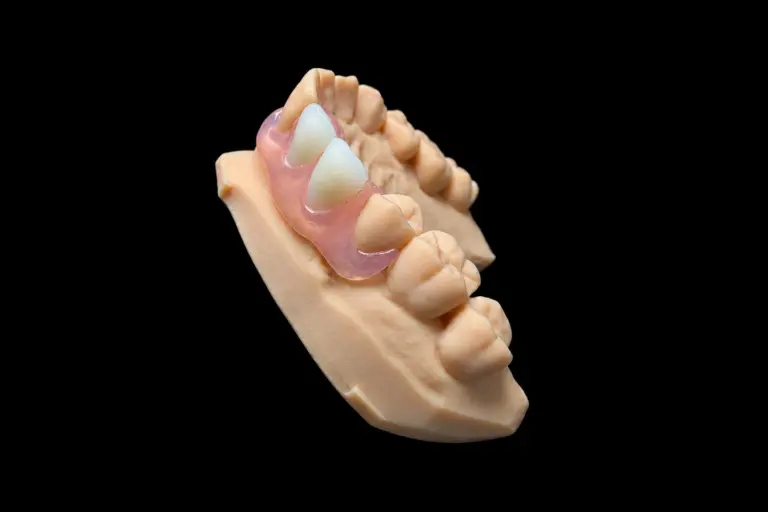
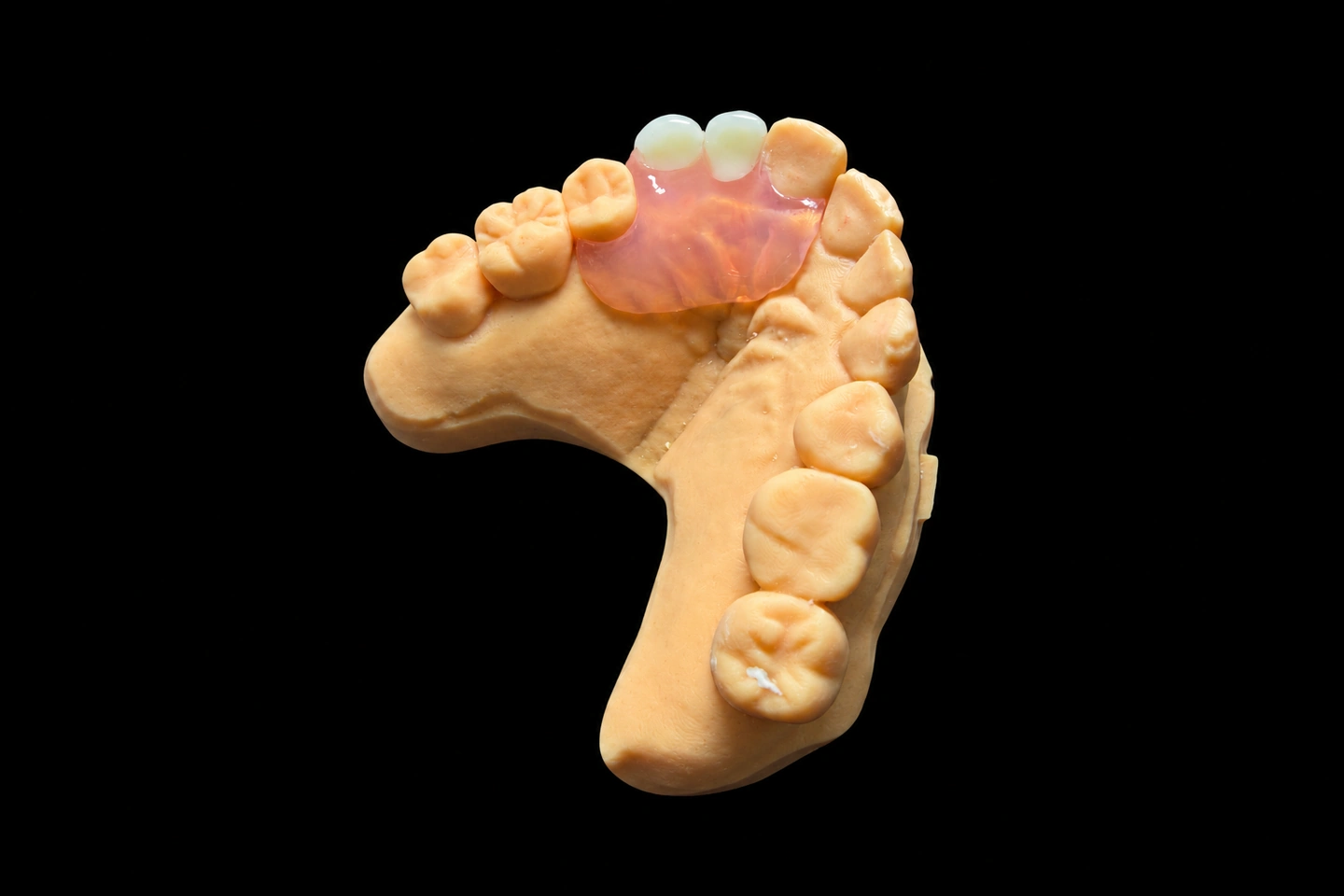
The base runs along the palatal of #5, #6, #10, #11, and #12, and behind the saddle . We kept its back edge in front of the deepest part of the vault and thinned it so the tongue doesn’t catch a ledge . On the palatal of the abutments, we kept the base clear of the gum margins , so the edge isn’t pressing on the gum where plaque gathers.
Keeping the denture teeth in
Valplast holds denture teeth mechanically, not with a chemical bond. Each tooth got retention holes, and we cleared them of wax before injection so resin could fill them . There’s room for that here: the 3 mm overbite left space behind #8 and #9 for teeth plus base . Canada’s Drug Agency reports significantly more denture tooth loss with flexible partials at one year in the same 120-patient study, so this step matters.
What the Try-In Changed
The dentist seated the wax try-in, took smile photos, and had the patient read a short sales script out loud . Notes and photos came back through our WhatsApp group for the case, and the try-in changes were photographed before we made them.
A wax base doesn’t flex like Valplast, so this round tested tooth position, bulk, and speech, not grip.
| Item | At try-in | What the dentist asked | Final |
|---|---|---|---|
| Base behind #8 and #9 | Tongue caught it on “t” and “d” | Thinner, smoother | 0.5 mm thinner, edge rounded |
| #8 and #9 length | Fine at rest | No change | No change |
| #7 | Looked wider than #10 | Narrower | 0.4 mm narrower |
| Arm path on #5 | Showed at a wide laugh | Lower | Moved 0.5 mm toward the gum, still clear of the margin |
| Bite | Light on all three teeth | No change | No change |
Speech changes are worth testing early. In a small study of trial palatal connectors, connectors could get in the way of speech, especially with high palates and narrow arches. Those people had all their natural teeth, so it isn’t a partial denture study, but it fit this patient’s complaint.
Lab days, start to finish
These are days the case was in our lab. The try-in’s courier days and the dentist’s appointment aren’t counted here .
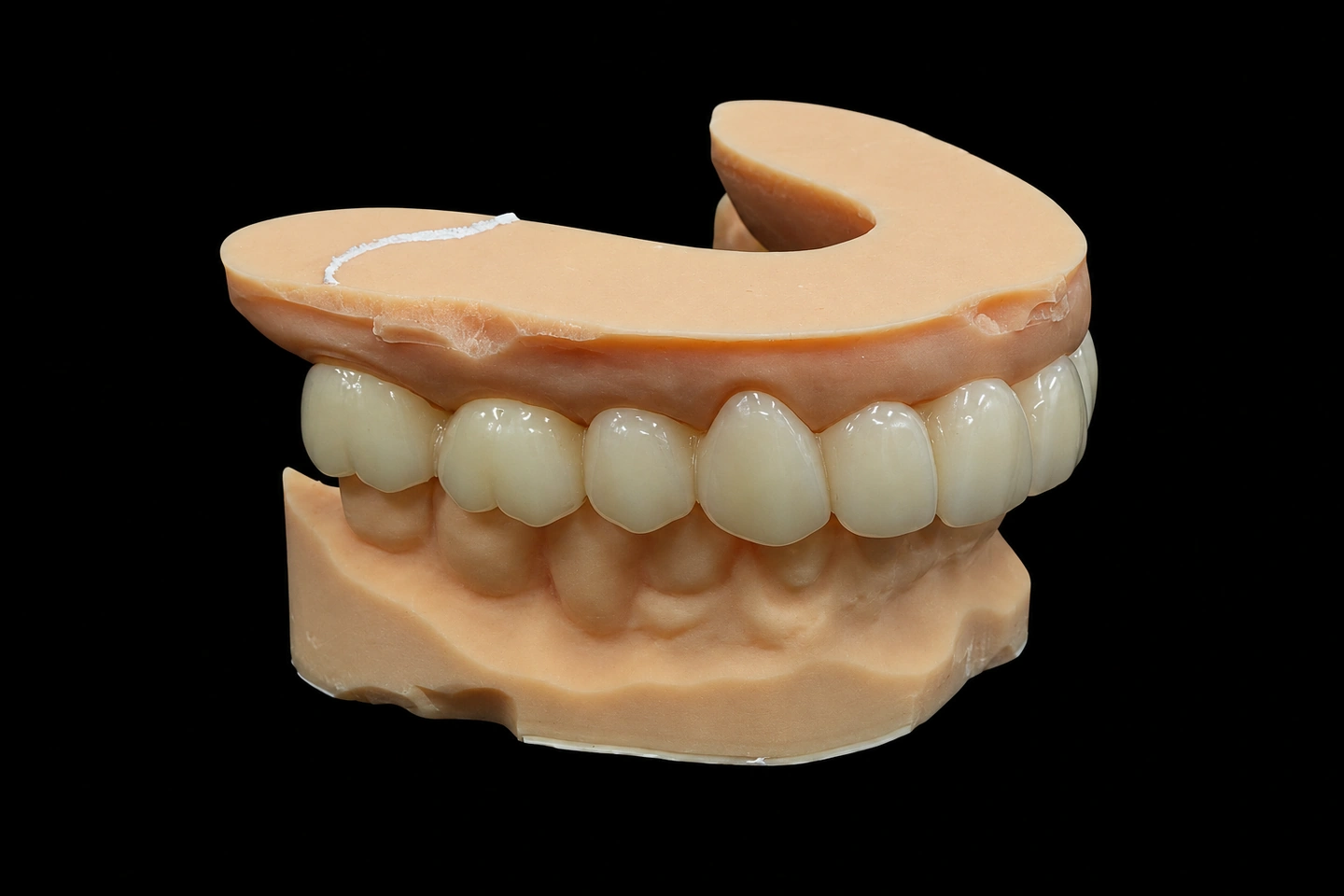
The Finished Flexible Partial Denture for Upper Front Teeth
The design goals were simple to list: no metal, nothing on the canine faces, an open palate, and a front that stays put in normal talking and eating. Final inspection:
| Check | Result |
|---|---|
| Seat on the model | Full seat, no rocking, no lifted edges |
| Thickness, by caliper | Horseshoe 1.8–2.2 mm, saddle 2.0–2.5 mm, no sudden changes |
| Base under strong light | No bubbles or cracks at the corners or thick spots |
| Teeth, under finger pressure | No movement on #7, #8, or #9 |
| Arms, by caliper | Within 0.1 mm of design |
| Gum margins | Base clear of the palatal margins on all five abutments |
| Articulating film | Light marks on #7–#9 when closing, none in protrusion |
| Smile photo overlay | No arm on any canine face. #5 and #12 arms sit in the back corners |
Dentist and patient feedback
The dentist: warmed it in hot tap water for 30–60 seconds, as Valplast’s clinical techniques describe, and it seated with firm retention on both premolars . One spot on the saddle over #7 needed easing .
The patient: “t” and “s” felt normal to the patient by day three . In the office, nobody has spotted it . Biting into an apple with the front teeth lifts the back edges a little, as the dentist warned, so the patient cuts hard foods instead .
That’s feedback from delivery and two weeks, not years , so we won’t promise how long it’ll last. Canada’s Drug Agency also says follow-up on flexible partials is too short to judge durability. The dentist set recall visits to check the abutments, the gum under the base, and the fit . A polyamide literature review recommends close follow-up too.
Sending a Flexible Partial for Missing Upper Front Teeth
Planning a flexible partial denture for front teeth and unsure where the clasps can go? Send the records first. We offer a pre-shipment feasibility review, and moving an arm is easy before anything’s made.
We need:
A flexible partial generally takes 5–7 working days, and a try-in round counts inside that. Design sign-off can add 1–2 days, and courier and customs time are separate.
Who Made It
Our 55-person removable department made this partial in Istar Digital Dental Lab’s own labs. Istar Digital has four labs in Shenzhen and Huizhou, China, about 460 people, and has been at it since 2012. Nothing gets outsourced. A separate 25-person QC group checks work before it ships. The removable department handles about 4,000 cases a month in the slow season and about 6,500 at peak.
Istar Digital is an FDA-registered establishment (Registration Number 3039441248), which you can look up in the FDA database, and our labs run an ISO 13485 quality management system. For EU clinics, custom-made partials follow the MDR custom-made device procedure.
Flexible Partial Denture for Front Teeth: FAQ
Can you reline, repair, or add a tooth later?
Yes, all three, and it’s lab work. Send the appliance, upper and lower models, and a bite record. Valplast’s FAQ warns the patient may go a few days without the partial while it’s out.
What if I keep a design you've flagged?
We make it to your Rx, and you don’t need to sign a risk form. Problems caused by that design, remakes included, aren’t on us. Change your mind before production, and we change the design.
What's the warranty?
1 year on the base. A base that won’t seat, lifted edges, badly placed clasps, an off bite, or the wrong gum color get adjusted or remade free. Changing the shade or material later isn’t covered, and neither is going ahead on a poor impression after we’ve warned you. You pay to send a case in, and we pay to ship finished work back, remakes included.
Valplast’s own limited lifetime warranty is separate. It covers breakage of the resin base, not the teeth.
Is the resin genuine Valplast?
Yes. We can ship a Valplast Certificate of Authenticity with the case, and each certificate has a serial number you can register with Valplast.
What other partials do you make?
Acrylic, cast frameworks, and other flexible partials. The full range is on our partial dentures page.
Can you rush it?
Yes, free, if you send us 10 or more cases a month. We guarantee the ship date, not the arrival date, because customs times vary.
How does pricing work?
Prices aren’t on the website. Quotes are itemized to your requirements, not one bundled price. Ask for the price list.
Send Us Your Next Front-Teeth Partial
Got a patient who wants a flexible partial denture for upper front teeth with nothing showing in the smile? Single trial cases are welcome, and ongoing partnerships suit clinics with a regular case flow. Send a test case, request the price list, or book a factory or video visit.