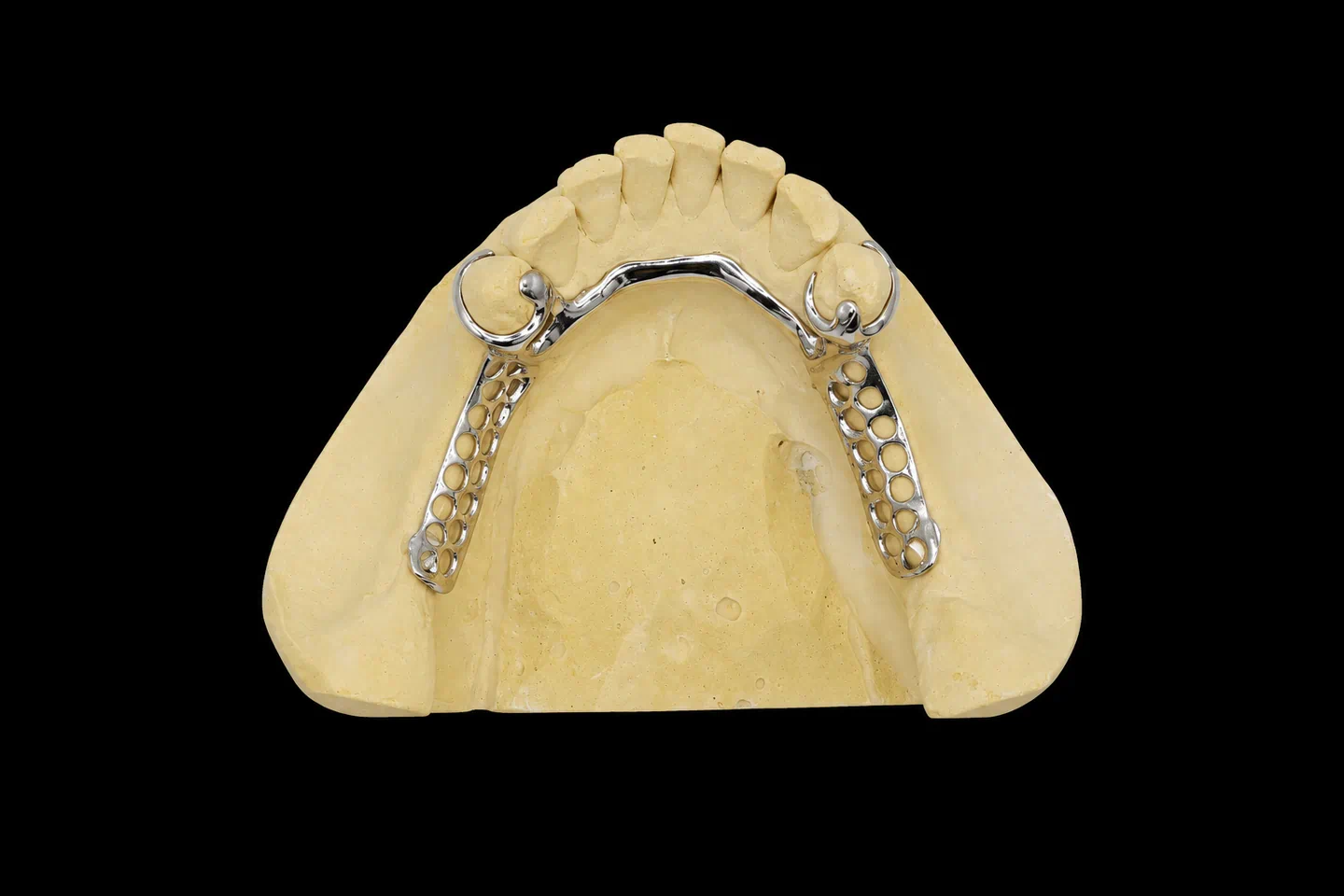
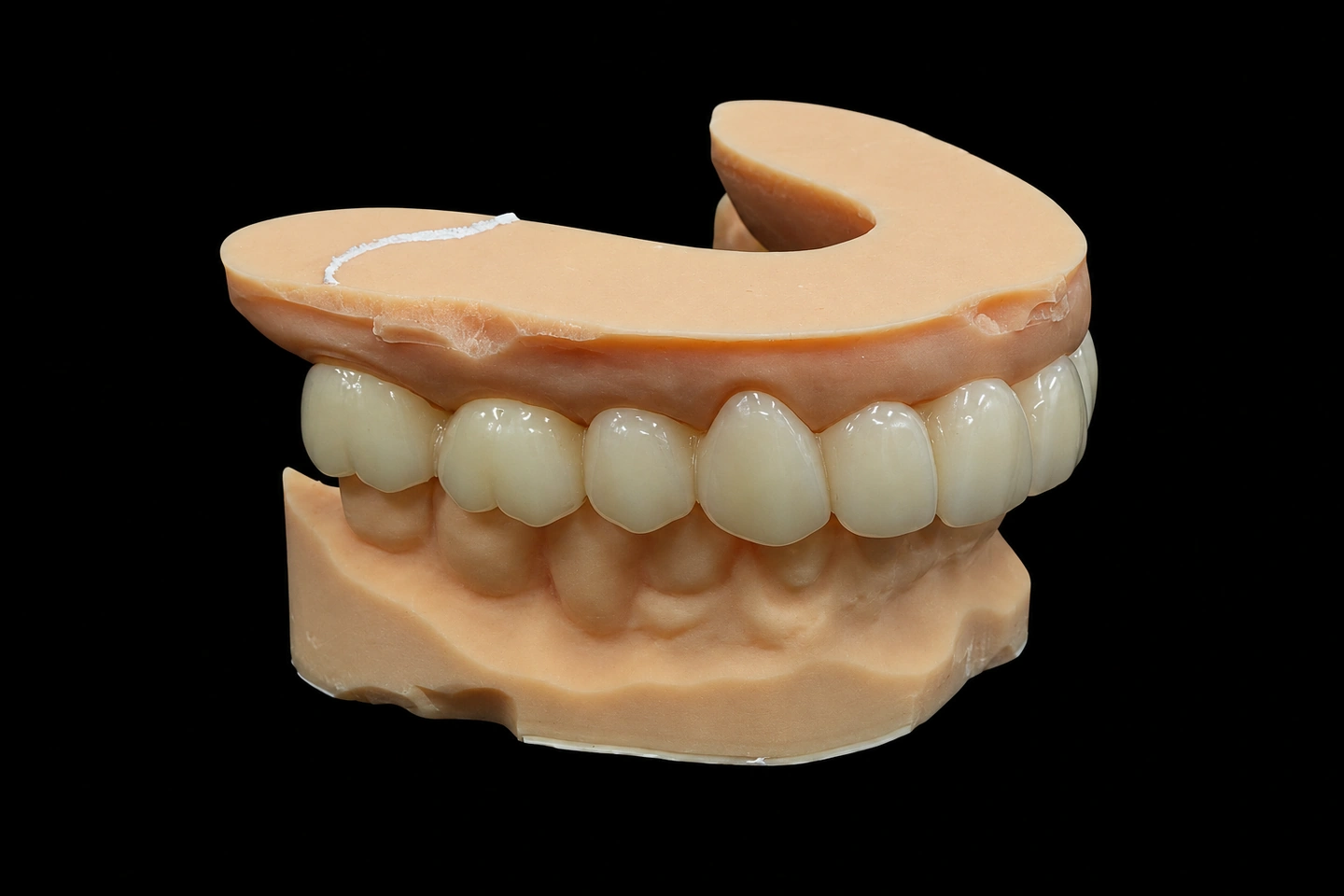
Patient Situation
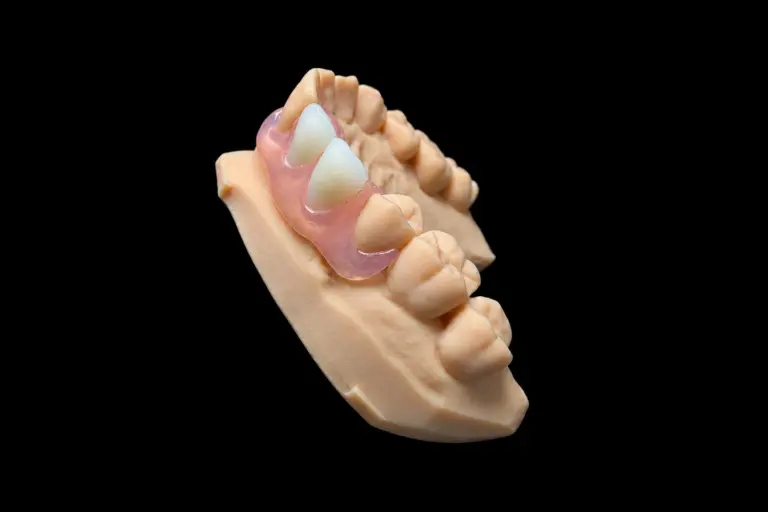
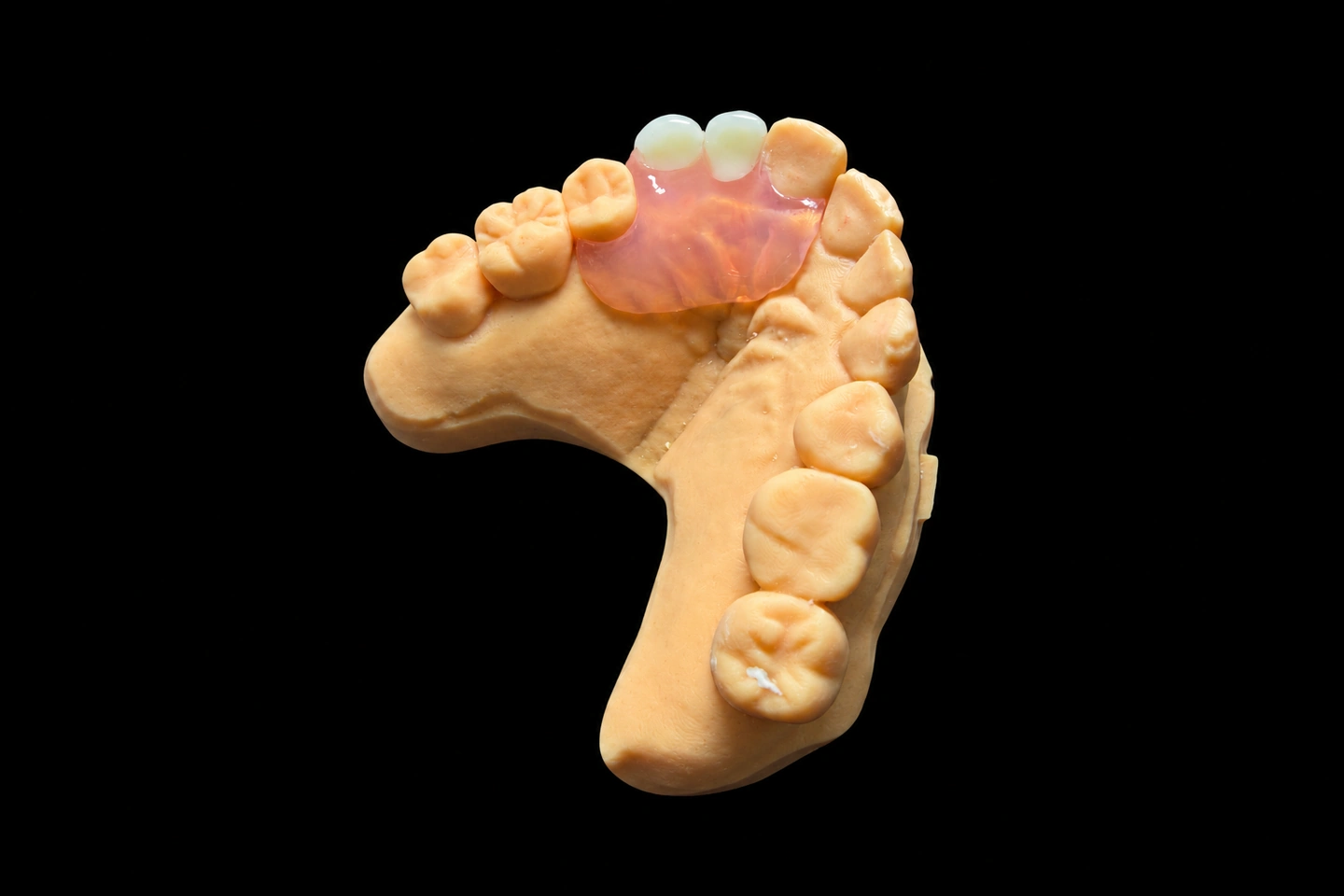
The patient is in their 60s . They’d lost #19 and #20 years ago and turned down implants back then on cost . They also didn’t want metal showing or any drilling on healthy teeth . So the dentist went with a unilateral Valplast partial, and the patient wore it every day .
Two years in, #21 split vertically and had to come out . The dentist waited about 12 weeks before taking records. Here’s what the records showed:
What the Dentist Asked For
The Rx, condensed :
What We Found on the Old Unilateral Valplast
We checked the appliance before we touched anything. A tooth add only makes sense if the old unilateral flexible partial is worth keeping.
The old base was still in good shape
| Check | Finding |
|---|---|
| #19 and #20 teeth, under finger pressure | No movement |
| Base, under strong light | No cracks, no bubbles |
| #18 clasp | Seated on the pickup model, no gap at the tip |
| Surface | Light staining along the necks of #19 and #20, and a dull patch on the buccal flange |
| Saddle fit at #19 and #20 | Checked chairside by the dentist with a fit checker before the pickup impression: no rocking |
The staining wasn’t a surprise. A two-year report on flexible denture bases described yellow staining on both patients’ appliances, put down to care at home. A review of polyamide denture bases also notes the surface scratches more easily than acrylic.
The path of insertion was already decided
This is the catch with any tooth add on a unilateral Valplast. The old base and the #18 clasp go in and out on one path. Whatever we add has to follow the same path, or the appliance won’t seat. So we couldn’t pick a new path for #22. We had to survey #22 on the path the old base already had.
On that path, #22 gave us two choices :
So the grip was where everyone would see it, and the hidden spot barely held.
Three teeth on one side is a bigger job than two
In a unilateral flexible denture made all in Valplast, the base sits on the ridge. There are no rests on the teeth, so the base is tissue-borne, and the polyamide review lists lower stiffness than PMMA as a known drawback. Going from two teeth to three makes the saddle longer, and a longer flexible saddle can move more under chewing.
The Options We Sent Back
We held the case on day 1 and emailed the dentist the survey, the smile photo with the lip line drawn on it, and three options:
| Option | What it means | The catch |
|---|---|---|
| A. Add #21, clasp in the 0.5 mm mesiofacial undercut | Best grip at the front | The clasp edge shows at full smile. Breaks Rx item 5 |
| B. Add #21, low clasp in the 0.25 mm distofacial undercut | Clasp stays behind the lip. #18 carries most of the hold | Weaker grip at the front end |
| C. Make a new unilateral Valplast on a new path | A tilted path gave #22 0.5 mm low on the tooth, plus a fresh base | Breaks Rx item 1. New impression, a longer trip, and the patient gives up an appliance they like |
We also flagged the bigger risk. A unilateral flexible partial has no cross-arch connection to hold it if it comes loose. A clinical report describes a patient who swallowed a removable partial, and a review of unilateral partials treats case selection and retention as part of the design. A cross-arch design or a metal framework partial would be steadier. Adding a third tooth makes the appliance longer, which helps a little, but it doesn’t take the risk away.
The dentist picked B and would check retention at delivery. That’s the dentist’s call to make, since they’ve got the patient in the chair.
How We Met Each Requirement
We kept the old base, the #19 and #20 teeth, and the #18 clasp. Nothing crosses the arch, there’s no metal anywhere, and #22 wasn’t touched.
Joining new resin to the old base
Valplast says on its FAQ that teeth can be added through a lab. That’s why the unilateral Valplast had to come to us. You can’t add to a Valplast base chairside the way you’d add to acrylic, because, as the polyamide review explains, polyamide bonds poorly to ordinary repair resins.
On this case, we prepared the joint area at the front of the old base , set #21 with retention holes cut in its ridge side, and injected new Valplast to form the #21 saddle and the #22 clasp in one piece with the old base . Denture teeth don’t bond to Valplast chemically. The resin flows through the holes and locks them in, so the #21 tooth got the same treatment #19 and #20 had two years ago.
Getting enough hold from a shallow undercut
With only 0.25 mm on #22, we didn’t try to make that clasp do the heavy lifting on this unilateral Valplast. We made the arm a little wider and longer around the distofacial , so it touches more of the tooth, and kept it at the same thickness as the #18 arm . The #18 clasp stayed as it was.
We didn’t push the arm higher to find more undercut. That would’ve traded the dentist’s hidden clasp for grip they’d already said no to.
Planning for a ridge that may still change
At 12 weeks, the #21 ridge could keep shrinking. We fitted the new saddle to the pickup model, kept its edges smooth, and told the dentist up front that a reline under that saddle might be needed later . A unilateral flexible denture in Valplast can be relined at the lab, so that’s a planned trip, not a remake.
Shade and bite on the new tooth
The #21 tooth came from the same tooth line and shade as #19 and #20 . We set it against the opposing model for light contact when closing and nothing in side movements.
The base was the harder match. New Valplast next to a two-year-old base can look a touch lighter , and we told the dentist that before we started. Polishing the old outer surfaces with Valplast-specific polishers lifted the staining and brought the two closer.
Making It, Day by Day
| Working day | Stage |
|---|---|
| 1 | Pickup impression poured with the appliance in it, old base checked, #22 surveyed |
| 2 | Clasp outline approved from screenshots, skipping a wax try-in round to save the patient days without the partial |
| 3 | Setup and wax-up of the new saddle and clasp |
| 4 | Flasking and injection |
| 5 | Trimming and finishing. The tissue side stays protected |
| 6 | Final inspection, then shipped with a Certificate of Authenticity |
The Finished Unilateral Flexible Denture
Final inspection on this unilateral flexible denture:
| Check | Result |
|---|---|
| Seating on the new model | Full seat on the old path, no rocking at either end |
| #21 tooth, under finger pressure | No movement |
| Joint between old and new resin | Continuous under strong light, no gaps or bubbles |
| #22 clasp, by caliper | Within 0.1 mm of the approved design |
| #22 clasp vs smile photo | Below the lip line |
| Articulating film | Light marks on #21 when closed, none in side movements |
Dentist and Patient Feedback on the Unilateral Valplast
The dentist sent us a short summary after delivery and again after a follow-up visit a few weeks later . In brief:
- It went in on the first try, with no clasp adjustment at the chair.
- With the patient chewing on a cotton roll on the left, the front end stayed down.
- Seeing the clasp choice laid out before production made it easy to explain to the patient.
- They went over Valplast’s care instructions with the patient again, since the old base had picked up stain once.
- It feels like the old partial with one more tooth, not a new appliance to get used to.
- They can’t see the new clasp in the mirror when they smile.
- The edge of the new saddle was noticeable for the first few days, then stopped bothering them.
- At the follow-up, they were wearing it all day with no sore spots, and the color change at the joint only showed up close.
Sending a Unilateral Flexible Partial for a Tooth Add
Got a patient who’s lost a tooth next to their unilateral flexible partial? Send us the records before you send the appliance, and we’ll do a feasibility review first. That’s when we can tell you whether the old path works for the new clasp tooth.
For a tooth add, we need:
A tooth add generally ships in 5–7 working days, counted from the day we receive the case. You pay to send the case in, and we pay to ship it back.
Who Made It
Our removable department made this unilateral Valplast: 55 technicians inside Istar Digital Dental Lab’s four labs in Shenzhen and Huizhou, China. Istar Digital started in 2012 and has about 460 people. Design, production, and inspection all happen in our own labs, with no outsourcing, and a separate 25-person QC group checks every case before it ships.
The removable department handles about 4,000 cases a month in the slow season and about 6,500 at peak. Istar Digital is an FDA-registered establishment (Registration Number 3039441248), which you can check in the FDA database, and our labs run an ISO 13485 quality management system. For EU clinics, custom-made partials follow the MDR custom-made device procedure.
Unilateral Valplast FAQ
Can a unilateral Valplast be repaired if the base breaks?
Yes, we repair flexible partials here at the lab. Separately, Valplast’s own limited lifetime warranty covers breakage of the resin base, not the teeth, and it runs through the dentist and Valplast.
Is the resin in a unilateral Valplast genuine?
Yes. Each Certificate of Authenticity has a serial number the patient can register with Valplast to check the material.
Do you make new unilateral flexible partials, or just add teeth?
Both. We also make cross-arch flexible partials, metal frameworks, and acrylic. The full range is on our partial dentures page.
Do I have to sign a risk form to keep a design you've flagged?
No. We make it to your Rx without a written sign-off. Problems that come from that design, remakes included, aren’t covered by us.
Can you rush a unilateral Valplast?
Yes, free of charge, if you send us 10 or more cases a month. We guarantee the ship date, but not the arrival date, because customs times vary.
How is a unilateral flexible partial priced?
We don’t publish prices on the website. Quotes are itemized to your requirements, not one bundled price.
Send Us Your Next Unilateral Valplast Case
Single trial cases are welcome, and ongoing partnerships suit clinics with a regular case flow. Send a test case, request the price list, or book a factory or video visit.