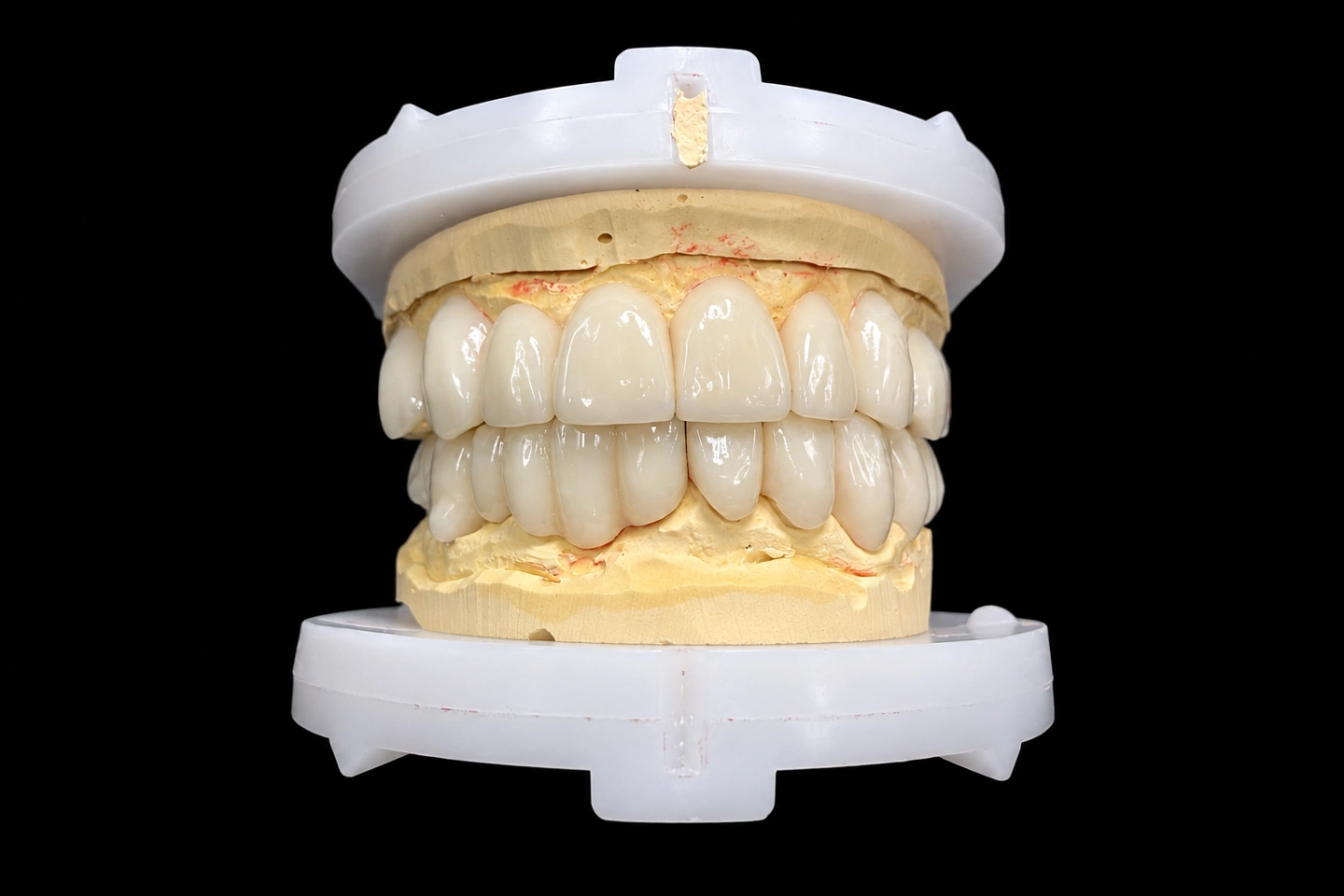
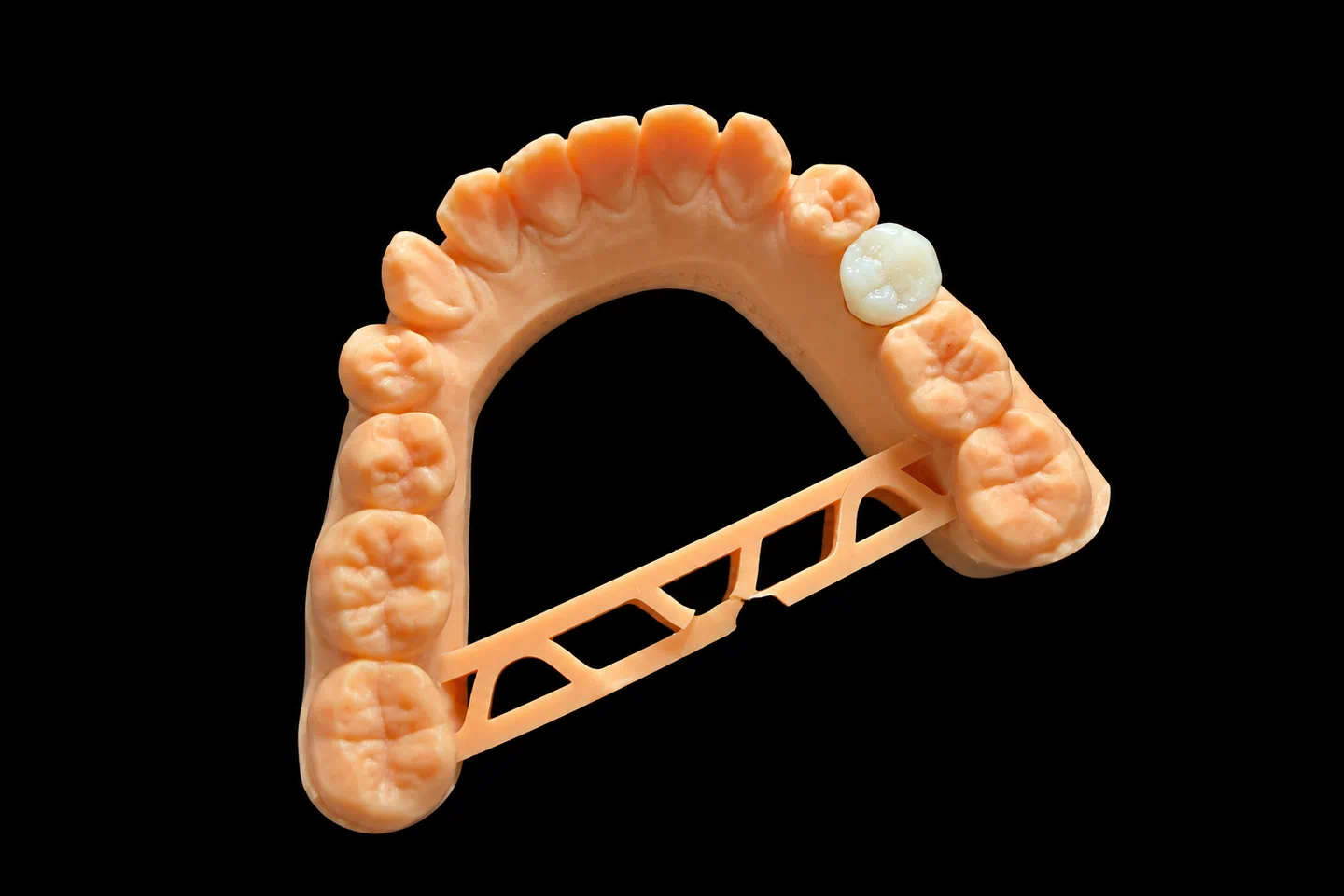
Patient Situation
The patient, in their 50s, had worn two PFM crowns on #8 and #9 for about 15 years . The porcelain had worn down at the edges, #9 had a small chip, and a gray line showed at both facial margins where the gum had pulled back .
The dentist’s notes, photos and scans showed this :
That last point is why these front teeth temporary crowns had a job beyond holding the space. Nobody knew yet whether the speech would hold up with longer teeth.
What the Dentist Asked For
The Rx, condensed :
The dentist set the length from the smile photos.
The Technical Problems in These Temporary Crowns on Front Teeth
The 1.5 mm had to go somewhere
You can add length straight down, or you can tip the new edge forward. Tipping it forward changes where the edge meets the lower lip, and it changes lip support. A 2023 review of speech in prosthodontics groups F and V as labiodental sounds, made with the lips and teeth, so edge position isn’t just a looks question.
Longer teeth mean more overlap
Straight down, the extra length lands right in front of #24 and #25. More vertical overlap makes protrusion steeper, and the lower incisors meet the palatal surface sooner. A study of the /s/ speaking space found that in people with natural teeth, incisal overlap was linked to the space they used for /s/.
A long PMMA edge needs thickness
A longer edge sticks out further past the prep, and in PMMA a thin edge is the first thing to chip. We wanted 1.0 mm at the edge . The easy place to find that thickness is the palatal side, which Rx line 3 said had to stay where it was.
These three pull against each other.
How We Built Version 1
Design
Our designer built the form from three sources, each for one job :
| Source | What we took from it |
|---|---|
| Pre-op scan with the old crowns on | Facial shape, neck width, the palatal profile to stay inside |
| Smile photos and the Rx | The length target, the incisal line against #7 and #10 |
| Bite and protrusive scans | Where #24 and #25 touch, and the path they travel |
Then the numbers went in :
Here’s the catch. Holding 1.0 mm at the new edge filled in part of the palatal concavity. In the incisal and middle thirds, version 1 sat 0.4 mm fuller than the old crowns . That breaks Rx line 3, a little.
We flagged it in the preview with a cross-section, and offered to thin it in the design. The dentist chose to test version 1 as it was and see if the patient noticed, and approved it on working day 2 .
Material, milling and shade
Both crowns came from an A2 PMMA disc , and we stock PMMA from Ivoclar and Aidite. A systematic review of provisional materials didn’t find one material that wins on every property, so the PMMA on the Rx stood.
The dentist sent shade photos taken with a 5500K ring flash, with #7, #10, the stumps and the shade tab in the same frame . The stumps were close to dentin color, so no opaque layer was needed . The facial got stained to match the laterals’ warmer necks, then polished to a high shine.
Checks before shipping
QC checked both crowns against the Rx and the approved design: margins, the inside surface, the seat, contacts, the bite in closed position and protrusion, form, polish, and no cracks or voids. They shipped on working day 6 in a foam-filled box, with the tracking number sent that day .
Week 1: What the Dentist Reported
The dentist seated version 1 of the front teeth temporary crowns with temporary cement . The look got a yes right away: the length worked in the smile, and the patient liked it .
At the 9-day check, the dentist reported :
Along with that came a scan of version 1 in the mouth and a short video of the patient counting from 60 to 70 .
Four Ways Forward, and the Dentist's Pick
We posted these four options in the case’s WhatsApp group :
| Option | What it means | The trade-off |
|---|---|---|
| A. Keep version 1, wait it out | Give the patient time to adapt | If it doesn’t settle, the final copies the bulk |
| B. Shorten both by 0.5 mm | Less overlap, less palatal needed | Gives up a third of the length the patient wanted |
| C. Version 2: put the palatal concavity back | Same length, facial and edge thickness | The protrusive path changes and has to be checked again |
| D. Version 2: tip the edge forward 0.3 mm more | More room behind the edge | Changes the F and V position and the look, which already worked |
We recommended C, because it changed the part that failed and left the parts that passed. The dentist went with C .
Version 2: A New Palatal Side
We started version 2 of the temporary crowns on front teeth from the scan of version 1 in the mouth, so we knew exactly how much the dentist had polished off. Here’s what changed on the palatal side :
| Area | Version 2 |
|---|---|
| Palatal, middle third | Matched to the old crowns |
| Palatal, incisal third | 0.1 mm fuller than the old crowns, the minimum for a 1.0 mm edge |
| Closed-bite contacts | Same spots on both centrals. The thinning stayed incisal to them |
| Protrusion | Rechecked: still shared by #8 and #9, slightly smoother |
It shipped on working day 5 .
The Finished Temporary Crowns on Front Teeth: Results
Version 2 stayed in for 3 weeks. Here’s how it did in the mouth :
Feedback After the Try-In
Once the patient had worn both versions, the dentist summed it up for us .
- The cross-section in the design preview made testing version 1 a real choice, not a gamble. The extra palatal bulk was known before seating, so the S problem didn’t come as a surprise.
- Version 2 went in without any palatal adjustment at the chair.
- Sending a scan of the worn temporaries, instead of a new impression, kept the second round quick on their side. They plan to do the same on their next length change.
- Living with the longer teeth for a month took the worry out of the final crowns.
- Version 2 felt different behind the teeth but looked no different in the mirror. In their words, the teeth “just feel like teeth.”
- A second round wasn’t what they’d hoped for, but they’d rather find the problem in plastic than in ceramic.
From the Temporaries to the Final e.max Crowns
At the end of the three weeks, the dentist sent a scan of the temporaries in the mouth, then a prep scan with them off . We laid one over the other.
| Final crown | |
|---|---|
| Material | IPS e.max Press, pressed |
| Outside: length, edge, palatal side, facial | Copied from the scan of version 2 |
| Margins | Covering the old gray-line area at the facial |
| Inside | Rebuilt from the prep scan, thickness checked for e.max |
The dentist approved the overlay, and the finals shipped on working day 6 . At the 2-week check, the patient’s speech was the same as with version 2 .
Sending Similar Temporary Crowns on Front Teeth
Changing the length or shape of upper incisors and want the patient to test it first ? Here’s how it works with us:
Every step happens in our own labs, with no outsourcing: four of them in Shenzhen and Huizhou, China, running since 2012, with about 460 people, including 100 in design, 70 in milling and 25 in QC. You can book a factory visit or a video visit with sales.
Istar Digital is an FDA-registered establishment, Registration Number 3039441248, which you can check in FDA’s establishment database. The lab runs under ISO 13485, and everything is made to the dentist’s Rx. For EU clients, custom-made devices follow the MDR custom-made device procedure.
Planning a length or shape change on upper incisors? Send us the scans and the Rx as a trial case. Single trial cases are welcome. Send your first case or talk to us.
FAQ
What's the warranty on front teeth temporary crowns?
1 year. They’re made for short-term wear, so they don’t get the 3 years we give final crowns. Lab-side problems like open margins, open contacts, a high bite, a crown that won’t seat or the wrong shade get remade free. Changing the shade or material later isn’t free, and neither is a remake after you asked us to go ahead on an unclear impression.
Can you 3D print them instead of milling?
Yes, we can 3D print temporaries, and we make them in composite resin too. We won’t swap a material without your OK.
Can you make a wax-up or mock-up before the temporary crowns on front teeth?
Yes. We can make a diagnostic wax-up or a mock-up first, so the patient sees the change before any prep.
Do you make temporaries on implants?
Yes. We can also supply temporary cylinders, screws and tools, at extra cost.
Can I use a wax bite with physical impressions?
Please don’t. Wax softens and distorts in transit. Use a VPS bite registration, and VPS is our first choice for the impression too.
Do you take rush cases?
Yes, at no extra charge, for clients who send 10 or more cases a month. We guarantee the ship date. The arrival date depends on customs, so we can’t promise that.
How do you price temporary crowns on front teeth?
Quotes are itemized to your Rx, not one bundled price. Ask us for the price list.