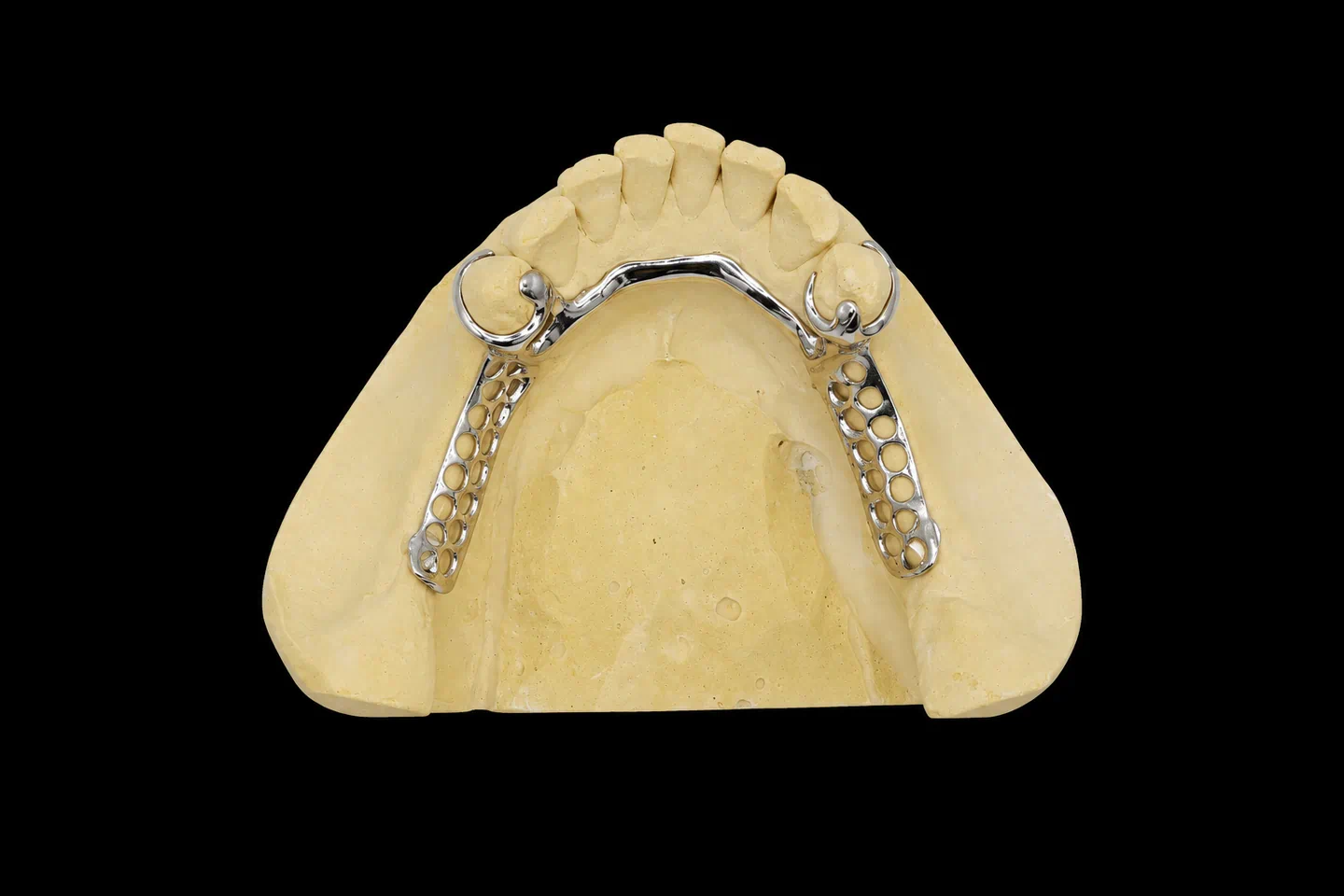
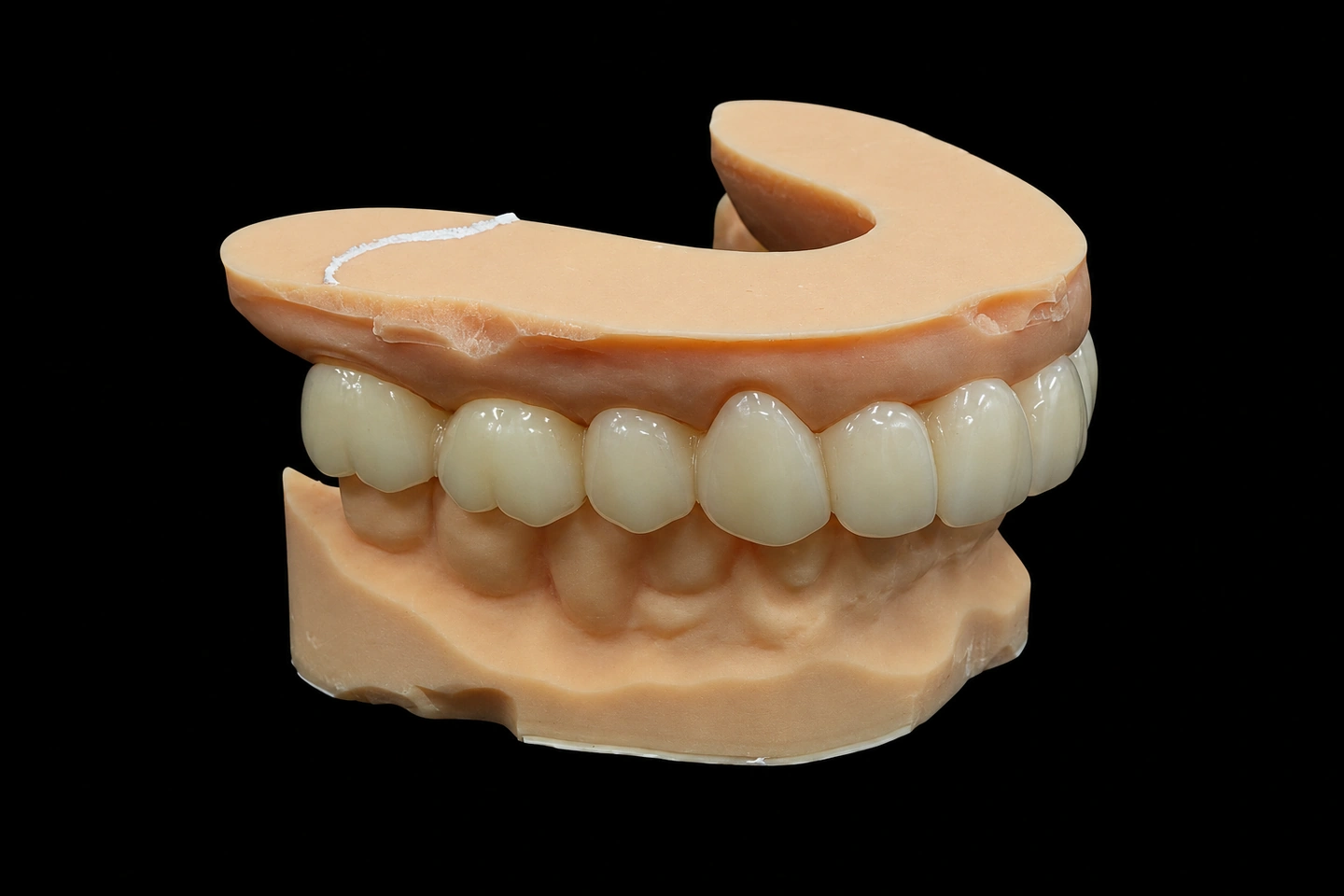
Patient Situation
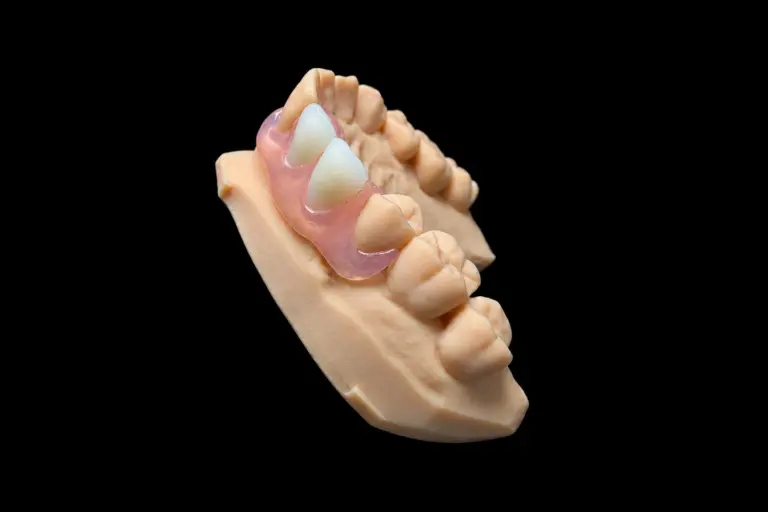
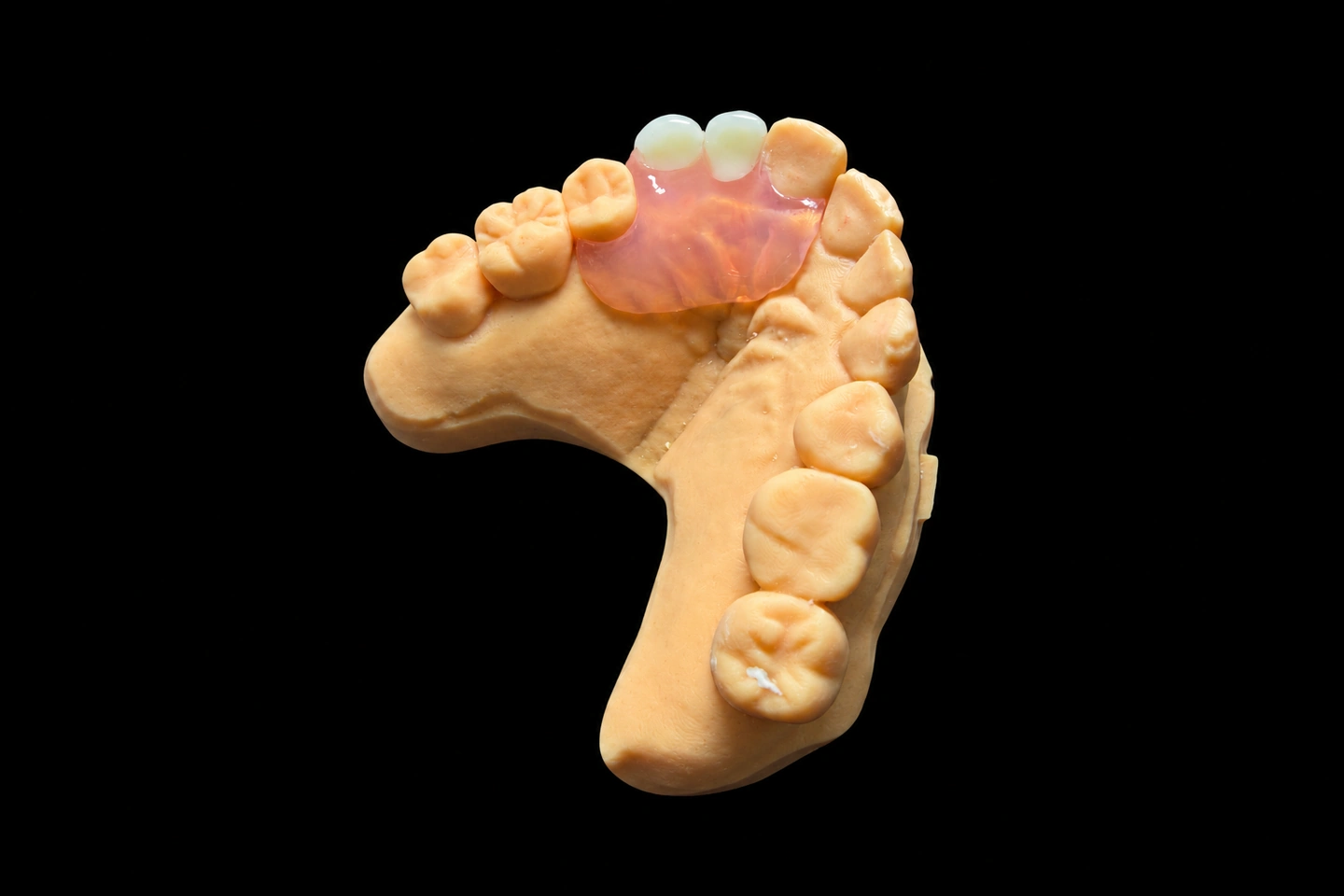
#12 split vertically and came out about 5 months before the case reached us. An implant was the long-term idea, but the patient wanted to wait about a year . A bridge would’ve meant cutting down #11 and #13, and the patient said no to that . So the dentist planned a flexible denture for one tooth to fill the gap for now .
The dentist’s notes and the models showed:
Records we received: stone models poured from alginate impressions of both arches, a VPS bite, a shade-tab photo, a full-smile photo, and the Rx form .
What the Dentist Asked For
The Rx for this flexible partial denture single tooth, condensed :
Items 3, 4, and 5 pull against each other. No cross-arch connection means the grip all comes from the teeth next to the gap. And the teeth next to the gap are the ones that show.
Where a Flexible Denture for One Tooth Gets Its Grip
The level-path survey came up short
We surveyed the models with the occlusal plane level first :
| Spot | Crown height | Undercut, level path | Shows at full smile? |
|---|---|---|---|
| #11 distofacial | 10 mm | 0.3 mm | Yes |
| #13 distofacial | 5 mm | 0.4 mm | Yes |
| #14 mesiofacial | 6.5 mm | 0.6 mm | Only from the side |
All values in this table are sample data .
A lab study on thermoplastic clasps says Valplast needs more than 0.5 mm of undercut with a clasp 1.0 mm thick, and recommends 1.0–1.5 mm of thickness on a 5 mm wide arm. It’s bench data, but it gave us a line to check against. #11 and #13 both fell short.
Thinning the arms wasn’t the fix. Valplast warns that changing clasp thickness or gingival reach can alter flexibility.
#13 doesn't have much room
With 5 mm of crown, a 5 mm arm would cover the whole facial surface of #13. A review of nonmetal clasp dentures says short clinical crowns restrict where these designs fit, and this one sits right in the smile. A narrower arm helps the looks, but the same lab study ties retention to arm width too.
No rests, and a small piece
No prep means no rest seats, so a flexi denture single tooth like this one puts its load on the ridge. That same review points out that flexible designs lack occlusal rests and says they aren’t a prudent pick as definitive work. It also advises against them for Kennedy Class I and II. This one is Class III, and an interim.
Size is the other worry. The ACP position statement on posterior single-tooth replacement calls Nesbit-type removable prostheses generally contraindicated because of aspiration risk, and a premolar is a posterior tooth. A clinical report on unilateral partials warns they can come loose and be swallowed or aspirated.
What We Sent the Dentist Before Making It
We paused this flexi denture single tooth on lab day 1 and emailed the survey with a short note. Three things in it:
The risk
We passed along the ACP position and said a metal framework partial with rests or a cross-arch design would be steadier. The dentist kept the one-sided Valplast . The patient had turned down metal and anything on the palate, it’s an interim, and the dentist would cover the risk chairside . Only the dentist has the patient in the chair, so that’s the dentist’s call.
A tilted path
Tip the model about 4° , so the appliance comes in from the palate side and rolls toward the cheek. Coming out, the arms have to move against the facial surfaces instead of sliding off them. Nothing on the other side of the arch gets in the way, because there’s nothing over there. The catch is that the patient has to learn the path.
A longer piece
Run the #13 arm on to #14, which adds a grip that mostly stays out of sight:
| Stop at #13 | Carry on to #14 | |
|---|---|---|
| Base length | About 13 mm | About 20 mm |
| Grip points | #11, #13 | #11, #13, #14 |
| What’s good | Smallest piece | Extra grip behind the smile line, and more to handle |
| The catch | All the grip sits in the smile on two shallow spots | More material for the tongue and cheek to notice |
The dentist said yes to both and asked to see it at try-in . A bigger piece isn’t swallow-proof, and nobody pretended otherwise.
How We Met Each Requirement
| Rx item | What we did | How we checked |
|---|---|---|
| 1. All Valplast | Base and arms injected as one piece | Resin as written on the Rx |
| 2. No prep | Used existing undercuts only | Survey on the tilted path |
| 3. One side only | Base runs #11 to #14 and stops about 6 mm from the palatal gum line | Design sent to the dentist |
| 4. Low, far back | Arms sit low on the teeth and #14 carries the rest of the grip | Full-smile photo, then try-in |
| 5. Firm grip | Three grip points on the tilted path, arms 1.2 mm thick | Seated and removed by hand on the model |
| 6. Match #5 | VITA tooth reshaped to the #5 outline, shade A2 | Shade photo, model, try-in |
| 7. Light bite | Light contact with #21 on closing, none in side moves | Articulating film on mounted models |
| 8. Try-in | Wax setup sent before processing | Dentist’s marked-up photos |
What the tilt did to the numbers
| Spot | Level path | 4° tilt |
|---|---|---|
| #11 distofacial | 0.3 mm | 0.6 mm |
| #13 distofacial | 0.4 mm | 0.6 mm |
| #14 mesiofacial | 0.6 mm | 0.9 mm |
All values in this table are sample data . Each spot got past the 0.5 mm line, and we didn’t have to go looking for anything deeper. We marked the path on the model and wrote the direction on the delivery note , so the dentist could show the patient.
How the arms run
On this flexible denture for one tooth, the #11 arm starts at the gap and wraps the distofacial corner, low on the tooth, 5 mm wide in the first design . The second arm crosses #13 about 4 mm wide, with roughly half of that on the gum . It carries on past the #13/#14 embrasure and ends in the #14 mesiofacial undercut, where it widens to 5 mm . On the palatal side, the base hugs #13 and #14 for bracing . It’s flexible resin, so that helps, but it won’t act like a rigid frame.
Keeping one tooth in the base
Valplast holds a denture tooth mechanically, so we cut a T-shaped groove in the ridge lap , the shape with the best bond in one lab study on Valplast. Wax matters too. A small 18-patient case series of larger dentures saw teeth come loose in four cases, and the authors blamed wax left in the retention areas. Those weren’t single-tooth cases, but on a flexi denture single tooth, one loose tooth is the whole job. We checked the groove after boil-out .
What the Wax Try-In Changed
Valplast suggests a wax try-in before finishing, and the Rx asked for one. The dentist seated the wax setup of this flexible denture for one tooth, took full-smile photos, and sent back notes .
| Checked | What it showed | What we changed |
|---|---|---|
| #11 arm | Top edge showed at full smile | Lowered the edge and narrowed the arm from 5 mm to 4 mm |
| #12 length | 0.5 mm longer than #5 | Shortened it |
| Side moves | Contact on #12 going left | Took it out of the move |
| Palatal base | Fine for speech | Nothing |
| Shade | A2 read right next to #11 and #13 | Nothing |
A narrower #11 arm gives up some grip. That’s where saying yes to #14 paid off.
Wax can’t test clasps, so the grip had to wait for the final. We sent photos of the changes, and the dentist gave the go-ahead .
Making This Flexible Denture for One Tooth
These are lab days for this flexi denture single tooth. The try-in round sits between days 3 and 4 .
The Finished Flexible Partial Denture Single Tooth Build
The design goal for this flexible partial denture single tooth: steady on one side of the arch, no metal, no prep, and as little pink as the grip would allow. Final inspection found:
| Check | Result |
|---|---|
| Seating along the marked path | Full seat, no rocking, no lifted edges |
| Arm tips | In the surveyed undercuts on all three teeth |
| Grip by hand on the model | Firm, no binding on the way in |
| Arm thickness, by caliper | 1.1–1.3 mm |
| Base thickness, by caliper | 2.0–2.5 mm , no sudden changes |
| Base under strong light | No bubbles (internal bubbles mean a remake) |
| #12 under finger pressure | No movement |
| Articulating film | Light mark on closing, none in side moves |
| Size and shade | Within 0.3 mm of #5, A2 against the shade photo |
Feedback at delivery
The dentist: warmed it in hot water for 30–60 seconds the way Valplast describes, and it went in on the second try once the path clicked . Retention was firm with no adhesive . One spot on the palatal edge by #13 needed easing .
The patient: got the in-and-out path after a few tries in the chair, and noticed the base for the first few days . The dentist went over taking it out at night and calling right away if it ever felt loose .
Sending Us a Flexi Denture Single Tooth Case
Not sure a flexible partial denture single tooth will hold on your patient’s teeth? Send the records first. We offer a pre-shipment feasibility review for flexible cases, and a design is a lot easier to change before anything’s made.
Models and impressions travel best packed the way our how-to-send guide shows.
A flexi denture single tooth generally takes 5–7 working days from the day we receive it, and that includes a try-in. Simple cases can take 2–3. Courier and customs time are separate.
Who Made It
Our 55-person removable department made this flexible denture for one tooth in Istar Digital Dental Lab’s own labs. Istar Digital has four labs in Shenzhen and Huizhou, China, about 460 people, and has been at it since 2012. Nothing gets outsourced. A separate 25-person QC group checks work before it ships, and the removable department handles about 4,000 cases a month in the slow season and about 6,500 at peak.
Istar Digital is an FDA-registered establishment (Registration Number 3039441248), which you can look up in the FDA database, and our labs run an ISO 13485 quality management system. For EU clinics, custom-made partials follow the MDR custom-made device procedure.
Flexi Denture Single Tooth FAQ
Can a flexi denture single tooth be relined, repaired, or added to later?
Yes, all three. Thermoplastic resin doesn’t bond well to reline resins, so it’s lab work, not chairside work. Send the appliance, upper and lower models, and a bite record. The patient goes without it while it’s away.
A clasp feels too tight or too loose. Can I adjust it chairside?
Yes. Valplast’s clinical techniques page describes heating the clasp in hot water for 60 seconds, bending it, and letting it cool. Go easy, and check with us before you remove any material from a clasp.
What cleaning instructions should the patient get?
Follow Valplast’s care page. It covers a denture brush, a daily soak, and keeping the appliance wet when it’s out. Toothpaste can scratch the surface.
What's the warranty?
Istar Digital’s warranty on a flexi denture single tooth is 1 year. A base that won’t seat, lifted edges, badly placed clasps, an off bite, or a gum color you’re not happy with get adjusted or remade free. Changing the shade or material later isn’t covered, and neither is going ahead on a poor impression after we’ve warned you. You pay to send a case in, and we pay to ship finished work back, remakes included.
Valplast’s own limited lifetime warranty is separate. It covers breakage of the resin base, not the teeth.
Is the resin genuine Valplast?
Yes. We can ship a Valplast Certificate of Authenticity with the case when you need one.
What if I keep a design you've flagged?
We make it to your Rx, and you don’t need to sign a risk form. Problems caused by that design, remakes included, aren’t on us. If you’d rather change it, we change it.
Can you rush it?
Yes, free of charge, if you send us 10 or more cases a month. We guarantee the ship date, not the arrival date, because customs times vary.
How does pricing work?
Prices for a flexible denture for one tooth aren’t on the website. Quotes are itemized to your requirements, not one bundled price.
What else do you make for missing teeth?
Other flexible partials, acrylic, and cast frameworks. The full range is on our partial dentures page.
Send Us Your Next Flexible Partial Denture Single Tooth Case
Got a flexible denture for one tooth coming up, with shallow undercuts or a short neighbor? Single trial cases are welcome, and ongoing partnerships suit clinics with a regular case flow. Ship us a test case, request the price list, or book a factory or video visit.