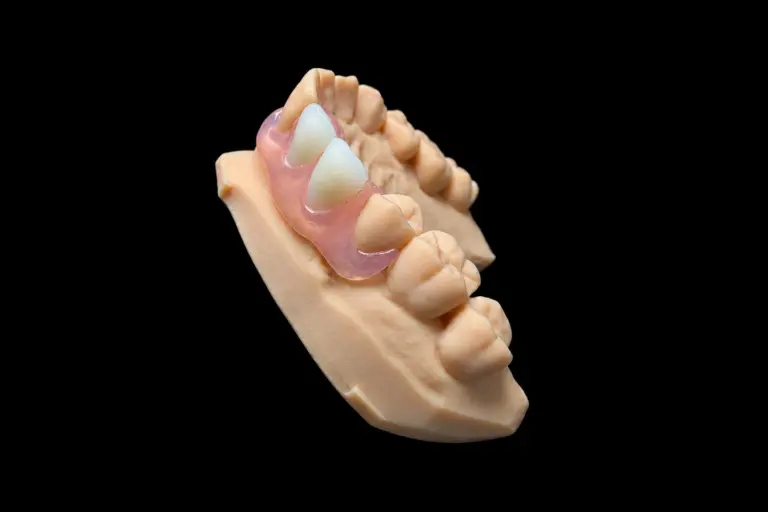
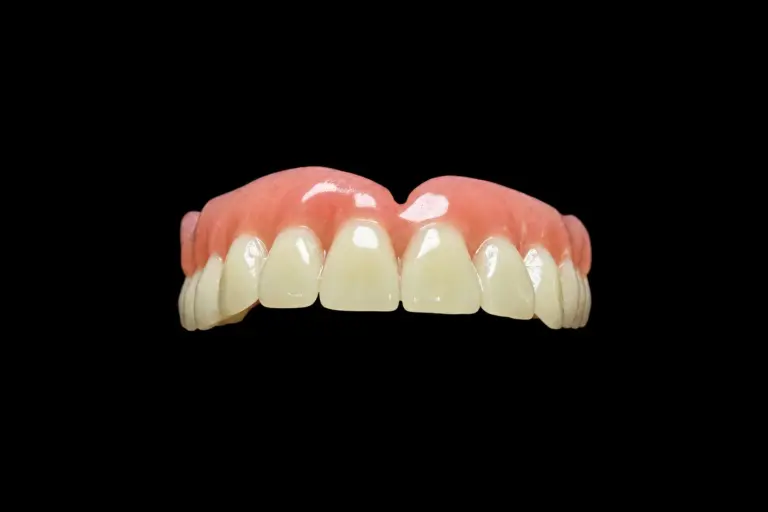
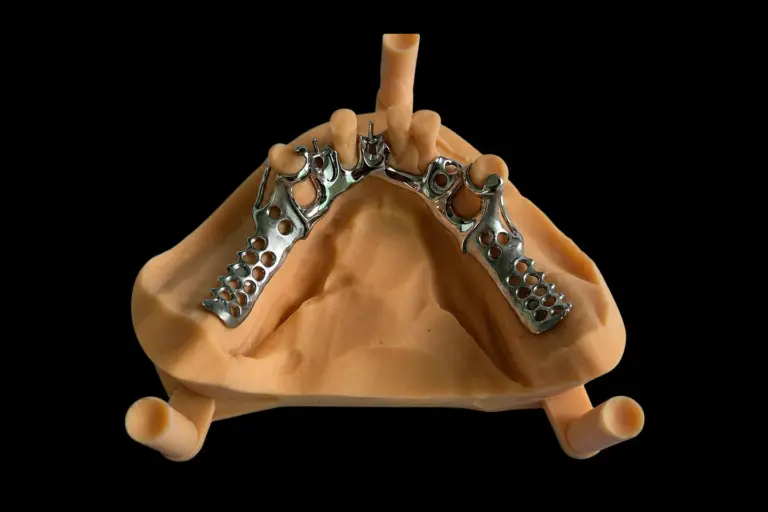
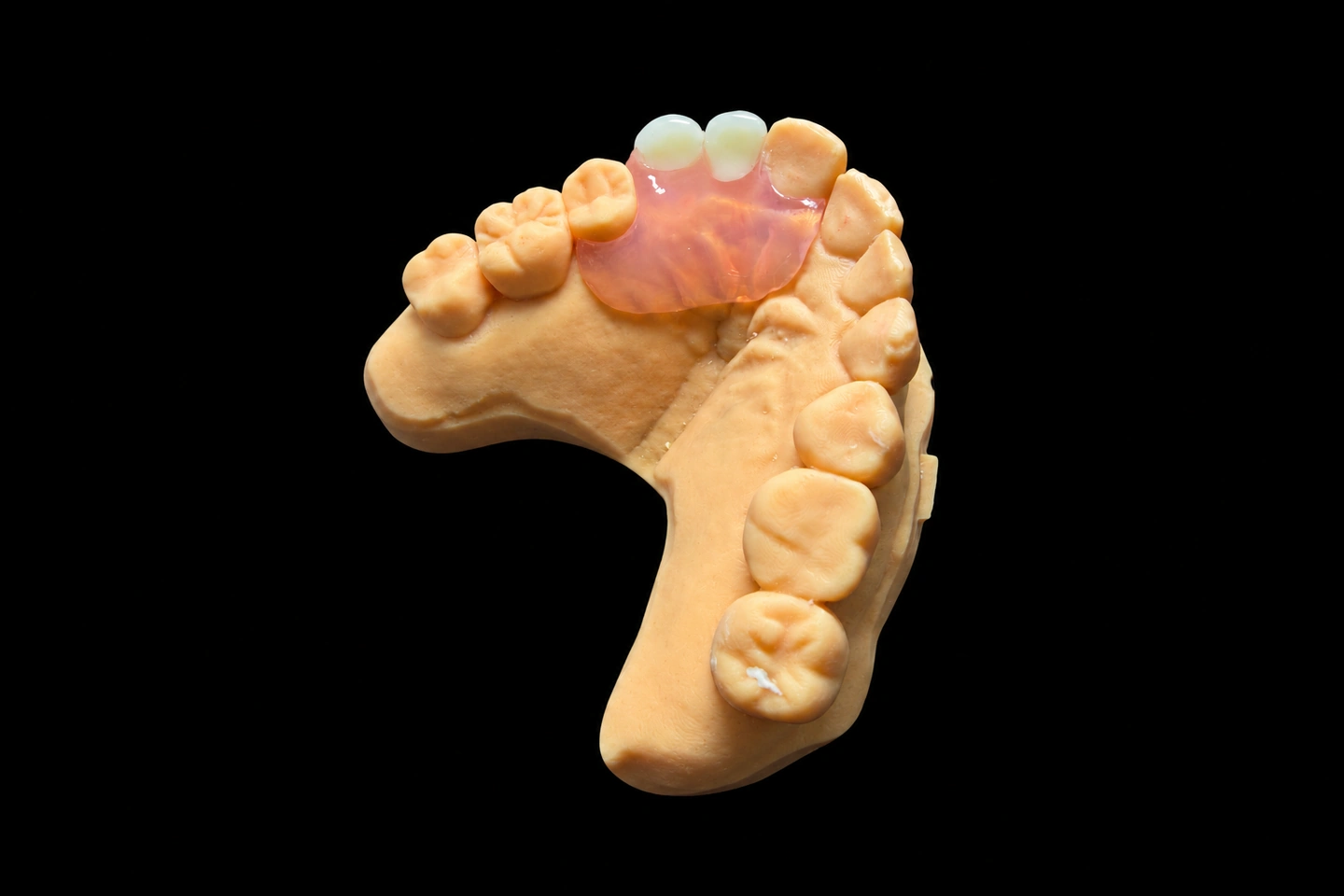
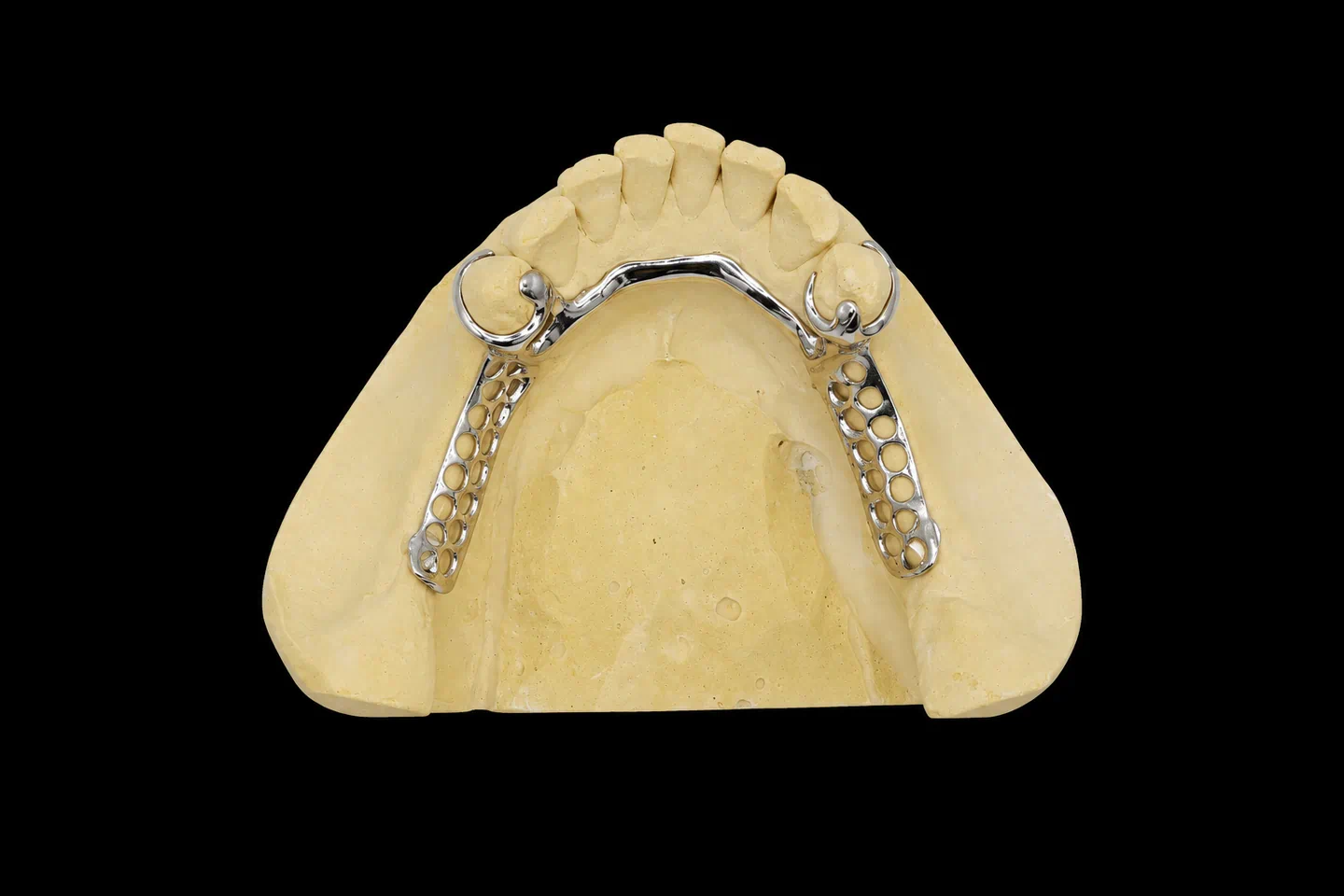
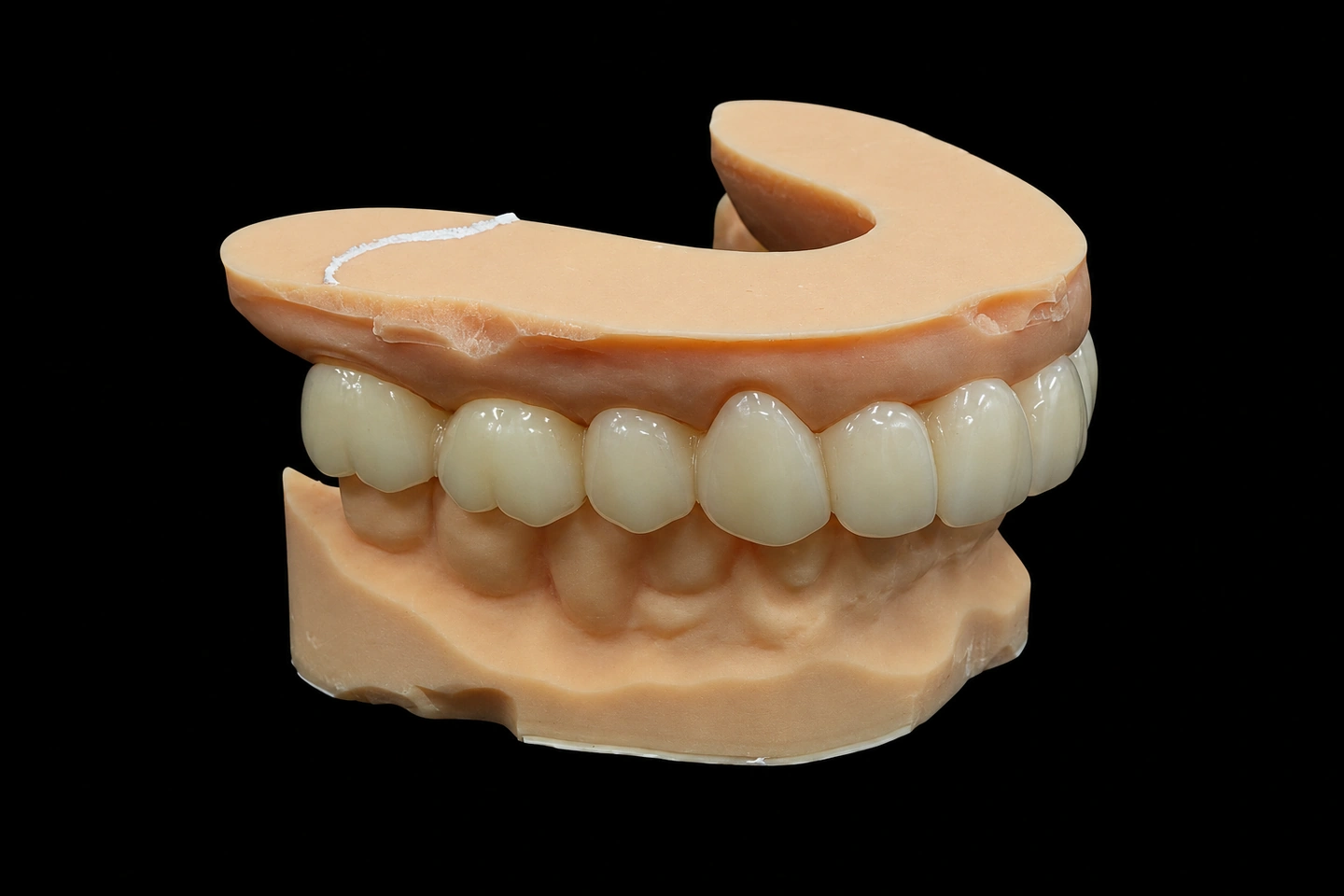
Patient Situation
The patient lost #19 and #20 about nine months before the case reached us, so the ridge had already settled. The dentist’s chart noted a metal allergy . The records showed:
What the Dentist Asked For
The Rx for this Valplast denture, condensed :
The Technical Problems in This Valplast Partial Denture
Not enough height for the #19 tooth
Valplast holds denture teeth mechanically, not chemically. Resin flows through holes in each tooth, usually T-shaped ones, which is why interarch space under 4 mm is a contraindication. Too little room, and a tooth can come loose. A common rule of thumb calls for about 5 mm of posterior clearance.
We measured 4.3 mm at #19 in the closed position, and 5.6 mm at #20. So #20 was fine. #19 sat above the floor but under the rule of thumb.
A shallow undercut on a tooth in the smile
Retention in a flexible clasp comes from undercut, thickness, and width. One lab study of thermoplastic clasps found Valplast needed more than 0.5 mm of undercut with a 1.0 mm thick clasp, and it suggested 1.0–1.5 mm of thickness for a 5 mm wide arm. That’s test-bench data, not a recipe, but it’s a useful check.
On our first path of insertion, #21 gave us 0.4 mm and #18 gave us 0.7 mm . The easy fix for #21 is running the clasp higher up the tooth, which is exactly where nobody wants to see it.
No rests, so the ridge takes the load
This Valplast partial denture is tissue-borne. Bite force goes through the base into the ridge, not down the abutments. A span this short is about as forgiving as it gets, but the base fit and the occlusion on #19 had to account for it.
What We Sent Back to the Dentist
Tight space is on our list of cases that need design sign-off before production, so we paused this Valplast denture on day 1 . If we’re waiting on a dentist, we follow up every other day until it’s settled. Here, we emailed the measurements and three options:
| Option | What it means | The catch |
|---|---|---|
| A. Keep the bite as is | We shorten the #19 tooth to fit the space | Less tooth to hold the resin |
| B. Reshape #14 | Dentist removes about 0.6 mm from #14 and sends a new bite scan | One short chair visit, and it touches a natural tooth |
| C. Titanium framework partial | Rigid support, with rests and clasps | Conflicts with Rx items 1 and 4 |
We don’t make that call, and we never change a material without consent anyway. The dentist picked B, saw the patient the next day, and sent a new bite scan on day 2 . We remounted it and measured again: 4.9 mm at #19, enough room to place the retention properly.
Why a Valplast Partial Denture Fit This Case
Not every flexible case makes a good Valplast partial denture. The Japan Prosthodontic Society’s position paper on non-metal clasp dentures doesn’t recommend flexible designs without a metal framework as definitive dentures, except in limited cases such as metal allergy. This patient’s chart put the case in that exception .
Valplast’s FAQ describes the resin as free of acrylic monomer, with a metal-free coloring agent. The dentist weighed that against the patient’s allergy history . Had there been a free-end saddle, loose abutments, or a heavy bite, we’d have flagged those on the same email.
How We Met Each Requirement
| Rx item | What we did |
|---|---|
| 1 and 2 | Used Valplast resin only and recorded the resin details on the certificate |
| 3 | Kept the base on the left side, around #18 and #21 |
| 4 | Worked with the teeth as scanned and adjusted the path of insertion instead |
| 5 | Tilted the path about 3° , which raised #21’s undercut to 0.6 mm and let the clasp stay low |
| 6 | Compared the teeth and base with the shade photos before and after finishing |
| 7 | Set #19 and #20 on the mounted models and narrowed the #19 chewing surface by about 1 mm |
Fitting the retention into the space
Inside this Valplast denture, the #19 space broke down like this: at least 1 mm of Valplast under the tooth, which left about 3.9 mm for the tooth itself. We ground the tooth from the ridge side so its chewing surface stayed intact, then cut the retention holes from that same side. #20 had more room, so it needed less grinding.
Sizing the clasps
The tilted path also took #18’s undercut to 0.8 mm . That’s still moderate, and very deep undercuts are where flexible clasps become a problem. On this Valplast partial denture, we set the #21 arm at 1.2 mm thick and 5 mm wide , and the #18 arm at 1.4 mm thick , since that one stays out of sight and can carry more of the retention.
Making It, Day by Day
The Finished Valplast Denture
Final inspection on this Valplast partial denture:
| Check | Result |
|---|---|
| Teeth, under finger pressure | No movement on #19 or #20 |
| Base under #19, by caliper | 1.1 mm |
| Saddle, by caliper | 2.0–2.5 mm |
| Base, under strong light | No bubbles (internal bubbles mean a remake) |
| Clasps, by caliper | Within 0.1 mm of the design on both arms |
| Seating on the model | Full seat, no rocking or lifting edges |
| Articulating film | Marks on #19 and #20 when closed; none in side or forward movement |
| Smile photo | #21 clasp edge stays below the lip line |
At delivery, the dentist told us the Valplast denture seated at the first try. It needed one small tweak: the #21 clasp felt snug, so they loosened it with the hot-water method in Valplast’s clinical techniques .
Ridge changes will affect this Valplast denture over time. With no cross-arch connector, the dentist checked stability at delivery and set the wear instructions, including taking it out at night . Nylon has its downsides too: a literature review on polyamide denture bases reports lower stiffness than PMMA, plus surfaces that scratch more easily and can pick up color.
Sending Valplast Flexible Dentures Cases to Istar Digital
Planning Valplast flexible dentures and not sure the space or undercuts will work? Send the records before you ship anything, and we’ll review feasibility first. Better to catch a problem while it’s still a file, before a model crosses an ocean.
For Valplast flexible dentures, we need:
Flexible partials generally ship in 5–7 working days, counted from the day we receive the case. Design sign-off can add 1–2 working days.
Who Made It
Our removable department made this Valplast denture: 55 technicians working inside Istar Digital Dental Lab’s four labs in Shenzhen and Huizhou, China. Istar Digital has been at this since 2012 and has about 460 people. Everything from design to inspection happens in our own labs. We don’t outsource. A separate 25-person QC group checks cases before they ship.
The removable department handles about 4,000 cases a month in the slow season and about 6,500 at peak. Istar Digital is an FDA-registered establishment (Registration Number 3039441248), which you can check in the FDA database, and our labs run an ISO 13485 quality management system. For EU clinics, custom-made partials follow the MDR custom-made device procedure.
Valplast Denture FAQ
Is the resin genuine Valplast?
Yes. Ask for the certificate on any case. Each one carries a unique serial number the patient can register with Valplast to check the material and activate the manufacturer’s warranty.
What warranty comes with a Valplast partial denture?
Two separate things. Istar Digital’s warranty on the base is 1 year. If a problem is on our side, like a base that won’t seat, a badly placed clasp, an off bite, or the wrong gum color, we adjust or remake it free. Changing the shade or material later, or asking us to proceed on a poor impression after we’ve flagged it, isn’t covered. You pay to send a case in, and we pay to ship finished work back, remakes included.
Valplast’s own limited lifetime warranty covers breakage of the resin base, not the teeth, and it runs through the dentist and Valplast.
Can it be relined, repaired, or have a tooth added later?
Yes, a Valplast partial denture can get all three, here at the lab. Not chairside, the way you’d reline acrylic. Send the appliance, upper and lower models, and a bite record. Valplast’s impression steps cover the pickup impression for adding a tooth and the closed-mouth impression for a rebase. Plan ahead for the time the patient goes without the partial, because it has to travel to us and back.
What should I tell the patient about cleaning?
Valplast has a care page you can pass along: a denture brush instead of a regular toothbrush, no toothpaste on the appliance, a regular soak in Val-Clean, and keep it in solution or water when it’s out of the mouth.
What other partials do you make?
Cast metal frameworks, acrylic, and other flexible partials. The full range is on our partial dentures page.
Can you rush a Valplast denture?
Yes, free of charge, if you send us 10 or more cases a month. You can ask before or after we receive the case. We guarantee the ship date, but not the arrival date, because customs times vary.
Send Us Your Next Valplast Denture Case
Single trial cases are welcome, and ongoing partnerships suit clinics with a regular case flow. Ship us a test case, request the price list, or book a factory or video visit.