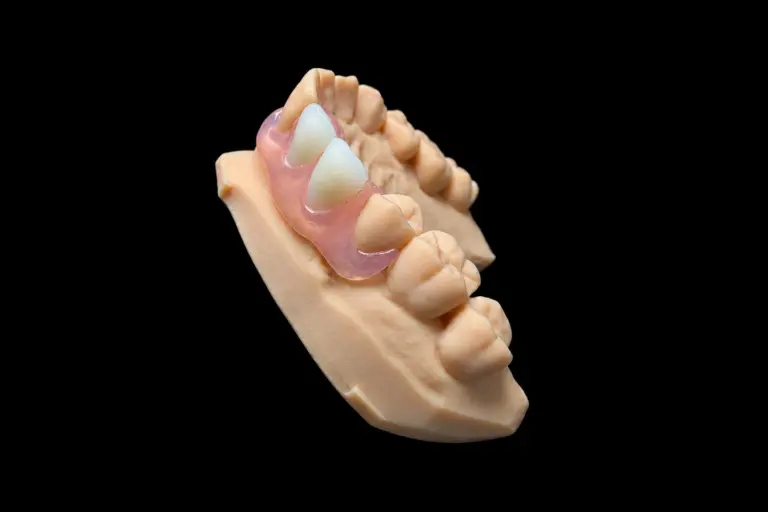
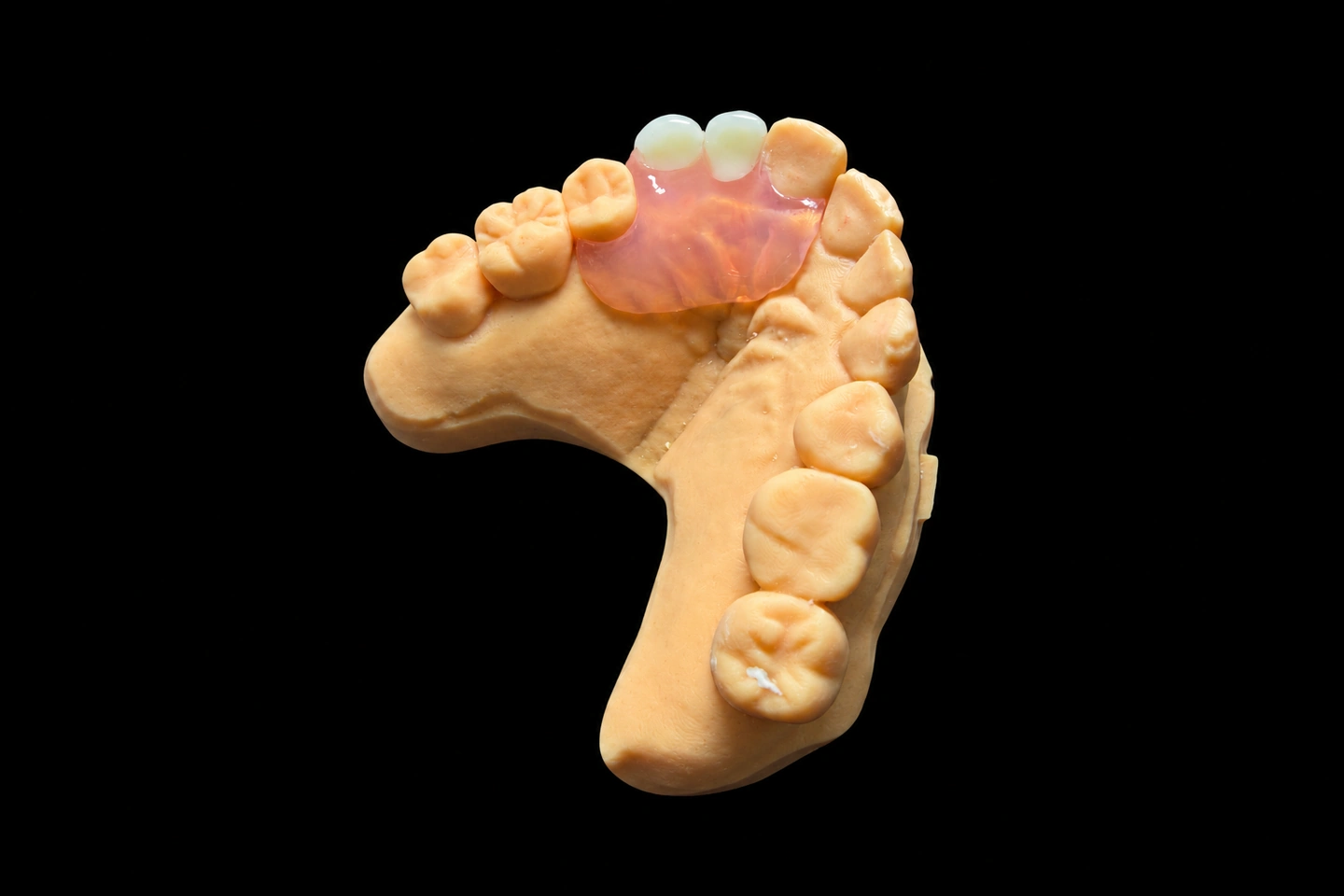
Patient Situation
The patient had an old root canal on #8, and the root split vertically. The dentist extracted the tooth and planned a single implant once the site was ready, with a one tooth denture to fill the gap in the meantime. When an interim appliance can go in after surgery varies from one set of instructions to the next, as these post-op instructions for immediate dentures and flippers. That timing was the dentist’s call, not ours.
The records reached us eight weeks after the extraction, so we worked from a ridge that had already taken shape rather than guessing at one. Here’s what the scans and photos showed before we planned the single tooth denture:
What the Dentist Asked For
The Rx for this one tooth denture was short and clear. In the dentist’s words, condensed :
Requirements 4 and 5 sound simple. In this bite, they were the whole case.
The Technical Problems in This One Tooth Denture
The lower incisors land where the appliance usually sits
In a typical one tooth denture, a band of resin runs behind the upper front teeth to carry the replacement tooth and link it to the clasps. In this patient, the lower incisors close right onto that zone. Any resin there gets hit every time the patient bites down, and that’s how a patient ends up unable to eat with it in.
The palatal surface of the replacement tooth sits in the same path. If it copied #9’s palatal contour exactly, the lower incisors would hit it too.
A narrow gap next to a wide tooth
A tooth sized to the 8.2 mm gap looks narrow next to #9. A tooth sized to #9 doesn’t fit the gap. On top of that, the facial dip in the ridge would make a standard tooth look long and show a dark line at the gum.
Retention, the smile line, and the palate
Flexible clasps need an undercut to grip, and the best undercuts here were on the canines. Clasps on the canines only stay out of sight if the lip covers them. Joining #6 and #11 means crossing the palate, which the dentist wanted kept small, and the connector couldn’t sit in the incisor contact zone from the first problem.
There was also the material question. Flexible resin isn’t the right choice for heavy bite force or very deep undercuts, because the material flexes and deforms. We checked both before accepting the Rx as written. The undercuts were moderate, and the replacement tooth would carry almost no bite load once it was kept out of contact, so a flexible single tooth denture was a sound choice.
How We Met Each Requirement
| Dentist’s requirement | What we did | How we checked it |
|---|---|---|
| Flexible, metal-free | Flexible resin base and clasps, injection-molded. No metal rests, wires, or mesh. | Material as written on the Rx. Any change would have needed the dentist’s OK first. |
| Match #9 in shade and shape | Chose the composite denture tooth mold and shade closest to #9 (A2 ), then shaped the outline, line angles, and surface texture to the photos. | Compared with the PLY color scan and the shade-tab photo. |
| Gum line level with #9 | A thin gum-colored facial flange fills the ridge dip. The gingival margin is set level with #9, in a gum shade picked from the photos. | Checked on the working model and against the full-smile photo. |
| No contact when closing | Palatal surface of the replacement tooth shaped to clear the lower incisors by 0.5 mm in the closed position. The tooth stays out of forward and side movements. | Mounted models, articulating film in closed, forward, and side positions. |
| Minimal palate | A narrow palatal strap runs about 6 mm behind the palatal gum line of the incisors, past the lower incisor contact zone, linking both clasp sides. | Dentist approved the design screenshots before production. |
| Light ridge contact | Modified ridge-lap pontic, touching the ridge without pressure. | Checked seated on the working model. |
| Ship within 7 working days | Design sent for approval on day 1 ; production started the day it was approved. | Shipped on working day 6 . |
Making the width read right
We couldn’t widen the gap, so we changed how the tooth reads. We matched #9’s length and incisal edge position, then moved the line angles slightly toward the center of the facial surface. Light reflects off the flat area between the line angles, so the eye reads that as the tooth’s width. The replacement tooth is 0.4 mm narrower than #9, but at speaking distance the two read as a pair.
Why flexible resin suited this single tooth denture
Flexible resin let us make the clasps gum-colored and skip metal altogether, which is what the Rx asked for. The trade-offs are well documented in this literature review of flexible denture materials: good esthetics and comfort, but less rigidity than acrylic or a metal framework. Those limits didn’t hurt this case, because the replacement tooth is kept out of the bite.
Making It, Step by Step
Every one tooth denture we make runs through the same stages. Here’s how they ran on this case.
The Finished One Tooth Denture
At final inspection, every requirement on the Rx had a check behind it:
At delivery, the dentist reported that the one tooth denture seated at the first appointment and needed only a light clasp adjustment chairside .
Here’s what it won’t do. A single tooth denture like this is an interim appliance. It doesn’t replace the root, and the ridge keeps changing until the implant goes in, so the fit will shift over time. The dentist plans the follow-up visits for that.
Sending a Single Tooth Denture Case Like This
If your patient has a similar bite or smile line, these records let us make the same checks before production:
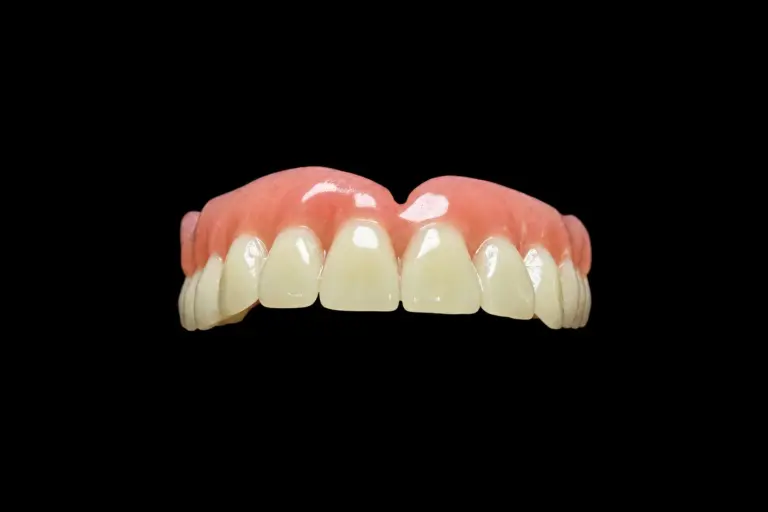
Most one tooth denture cases ship in 5–7 working days, and simple ones in 2–3, counted from the day we receive the case. For other designs, see our single-tooth flexible denture and the full range of partial dentures.
Who Made It
This one tooth denture was made in our removable department, a team of 55 technicians inside Istar Digital Dental Lab’s four labs in Shenzhen and Huizhou, China. Istar Digital has been running since 2012 and has about 460 staff. Every step, from scan intake to design, injection, finishing, and inspection, happens in our own labs, and we don’t outsource. A separate QC group of 25 inspects work before it ships.
The removable department handles about 4,000 cases a month in the slow season and about 6,500 in peak season. Istar Digital Dental Lab is an FDA-registered establishment (Registration Number 3039441248), which you can check in the FDA establishment registration database. Our labs run an ISO 13485 quality management system. You’re welcome to visit the factory or book a video tour through our sales team.
One Tooth Denture FAQ
Is a one tooth denture the same as a flipper?
Not always. Many dentists use “flipper” for a quick acrylic interim, while a one tooth denture or single tooth partial can also mean a flexible design like this one. Write the material and clasp type on the Rx, and we’ll make exactly that.
Can you make it in acrylic instead?
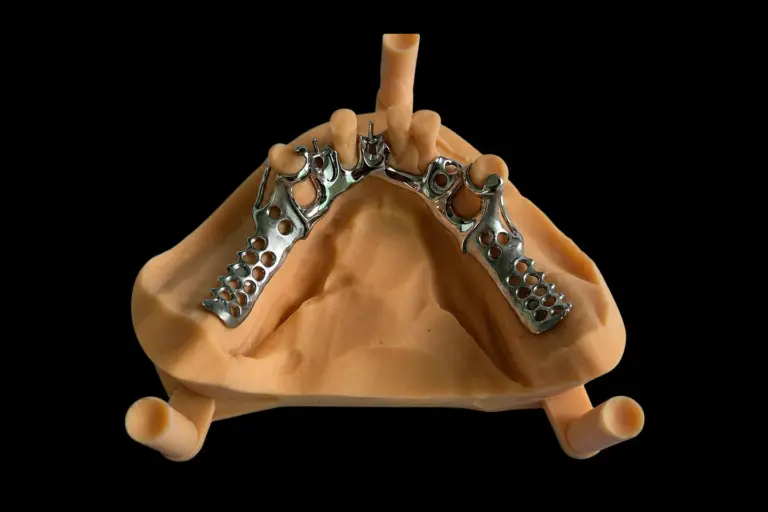
Yes. We make acrylic partials with heat-cured, injection-molded, or 3D-printed bases. For a definitive partial with rests and a rigid connector, see our metal dentures. If we ever think a different material suits the case better, we ask first and only switch with your written or verbal OK.
Can it be relined, repaired, or have a tooth added later?
Yes. Our flexible partials can be relined, repaired, and have teeth added. Send upper and lower models, the appliance itself, and a bite record.
Can you rush a one tooth denture?
Rush service is free for clients who send us 10 or more cases a month, for any material or case type. We guarantee the ship date. We can’t guarantee the arrival date, because customs times vary.
What does the warranty cover on a single tooth denture?
Our dentures come with a 1-year warranty. If a problem is on our side, such as the appliance not seating, edges lifting, a badly placed clasp, an off bite, or the wrong gum color, we adjust or remake it free. You pay to send the case in, and we pay to ship finished work back, remakes included.
Send Us Your Next One Tooth Denture Case
Send a test case with your scans, photos, and Rx, and we’ll review the bite and smile line before we make anything. You can also request our price list or book a factory or video visit.