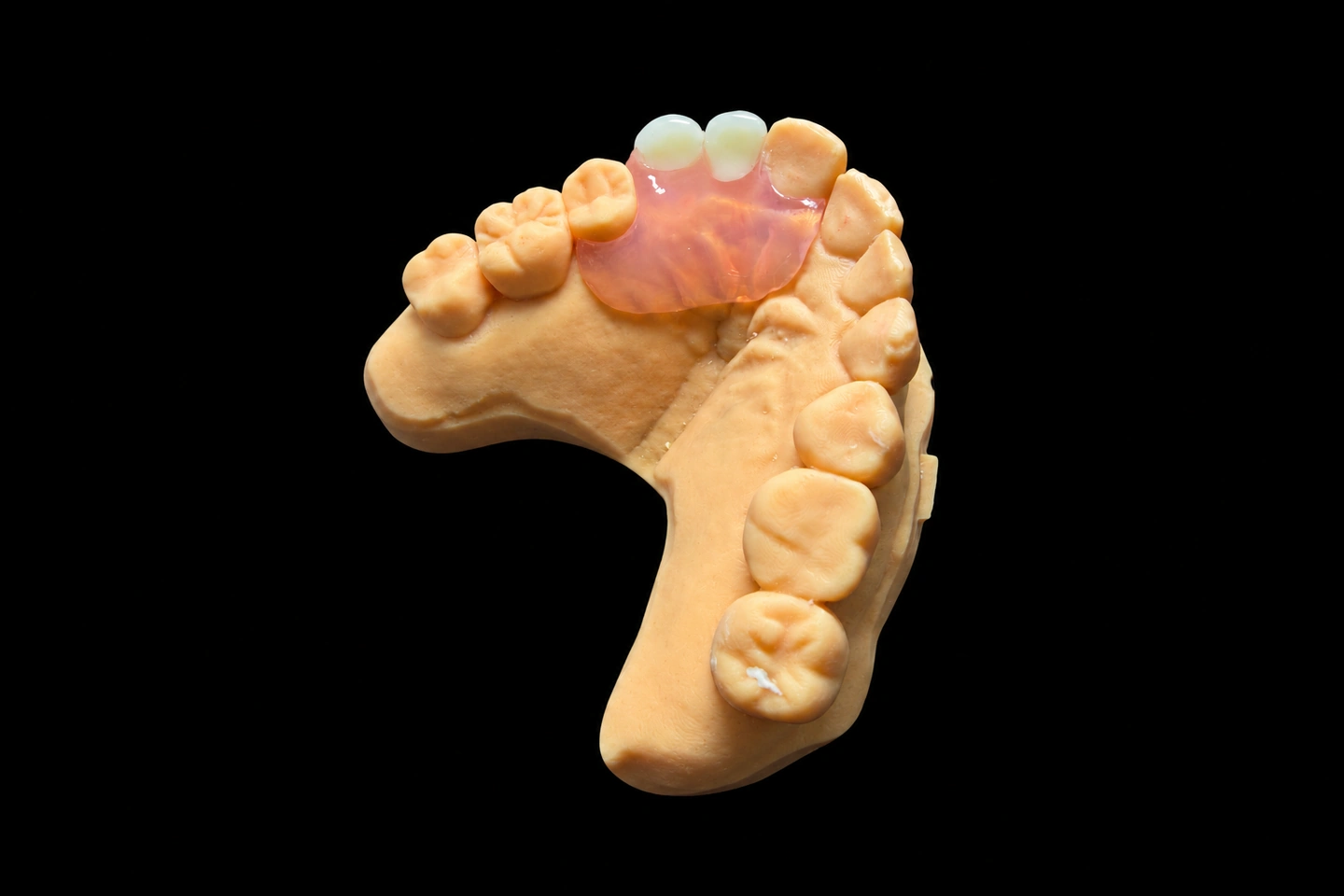
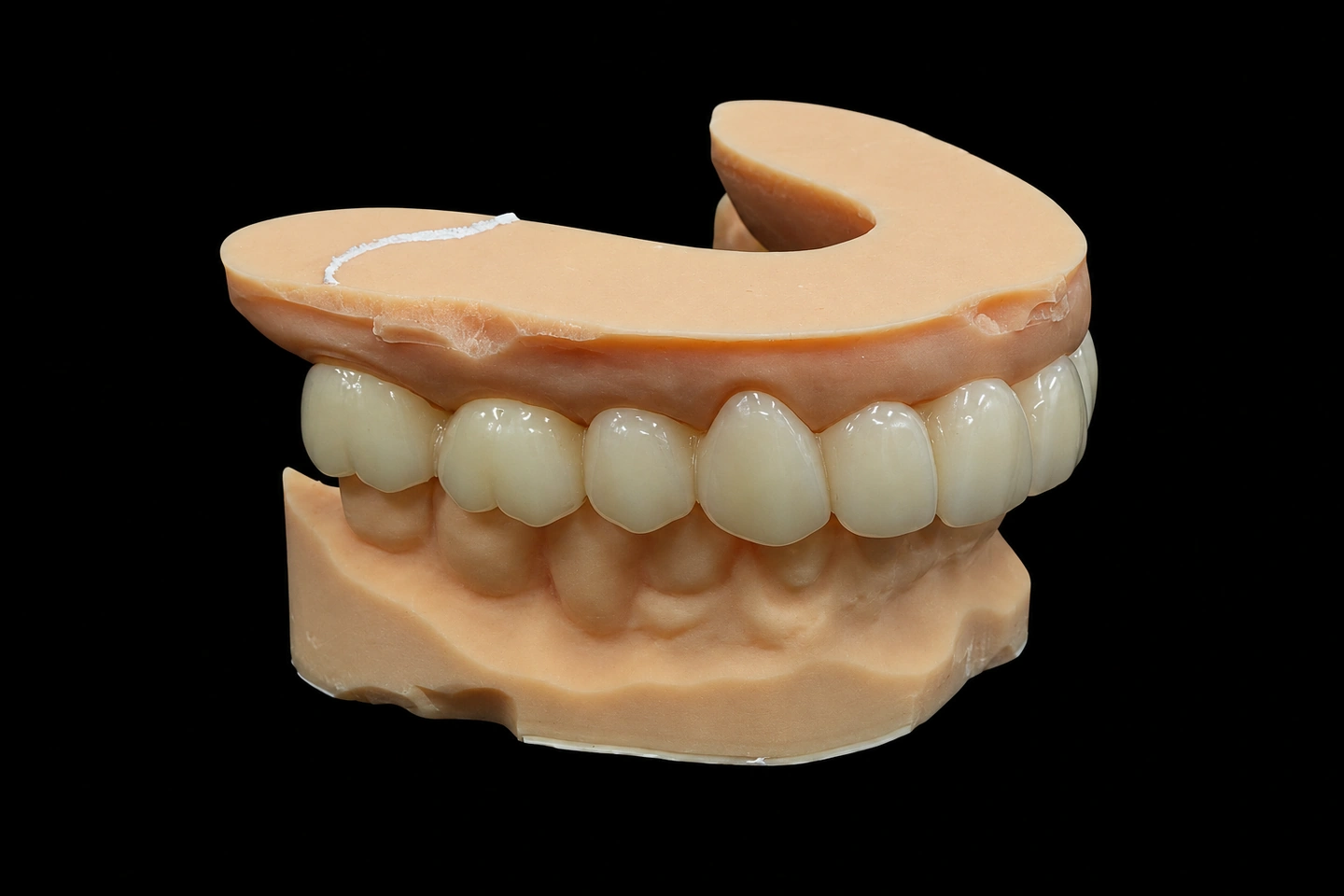
Patient Situation
The patient had worn a lower acrylic partial with wire clasps on both canines for about six years . It had no rests. Three complaints came with it: the back lifted off with sticky food, the bases sank and pressed on the ridge during chewing, and the wire on #27 showed when the patient talked .
The dentist chose a cobalt chrome lower denture on a new framework. That was the dentist’s call, made with the patient. Our part started when the records came in, and this is what the records showed:
What the Dentist Asked For
The Rx boiled down to six points :
Leaving out the second molars was a deliberate move by the dentist. With no teeth that far back, less chewing force lands at the far end of the bases, well behind the canines. We kept that in mind for everything that followed.
Where This Cobalt Chrome Lower Denture Got Tricky
Points 2 and 3 pulled against each other. So did point 2 and the shape #27 was in. We surveyed the diagnostic scan before anything was designed, and three problems showed up.
Two teeth, one long lever
With free ends on both sides, the bases rest on soft ridge while the canines don’t move. Every bite on the back teeth pushes the bases down, and the partial wants to rotate around a line running through the two rests.
Put the rests on the distal of the canines, as the Rx asked, and that rotation point sits right next to the free end. As the base sinks, a rigid clasp tips the canine toward the gap. On a lower partial with only two abutments, both canines take all of that, every chew.
The root-filled canine was the weak link
We didn’t have to guess how much this matters. In a retrospective study of 128 lower partials with free ends on both sides, losing abutment teeth was the main reason dentures had to be replaced. Fewer abutments and a history of root canal work both raised the risk.
This cobalt chrome lower denture had both. So protecting #27 mattered more than squeezing out the last bit of grip.
A circumferential arm would show
A circumferential arm crosses the face of the canine around the middle of the crown. The patient’s lip covers only the gum half . So the clasp the Rx asked for would sit in plain view every time the patient talked, which is the exact thing the patient didn’t like about the old wire clasp.
Clasp Options for This Lower Cobalt Chrome Partial Denture
The survey showed a usable 0.25 mm undercut low on the mesiofacial of both canines . On #22, the gum below the tooth was flat enough for an I-bar to approach from underneath. On #27, there was a soft tissue undercut below the gum line , so an I-bar arm would have bridged a gap that traps food.
Here’s how the options lined up:
| Option | What it offers | The catch in this mouth |
|---|---|---|
| As written: circumferential clasps, distal rests on both canines | Strong hold on paper, simple to make | Twists both canines as the bases sink, #27 included. Arms cross the visible half of the teeth. |
| RPI on both canines | Rests move to the cingulum, clasps ease off as the base sinks, I-bars sit low | The I-bar on #27 would cross the tissue undercut and catch food |
| RPI on #22, RPA on #27 | Same stress release on both teeth, each clasp suited to its tooth’s survey, both arms stay in the lip-covered zone | The RPA arm tip on #27 may show in a big laugh |
| Overdenture on the canines, or crowns with attachments | Different ways to spread the load | Clinical changes to the teeth. The patient wanted to keep both canines as they are . |
We didn’t change the design ourselves. The Rx said circumferential clasps with distal rests, so we sent the dentist the survey, this table in short form and a marked-up proposal. If the dentist had wanted to stay with the original design, we’d have made it to the Rx. The dentist picked the third option, RPI on #22 and RPA on #27, and explained the change to the patient .
How We Met Each Requirement
| Dentist’s requirement | What we did | How we checked it |
|---|---|---|
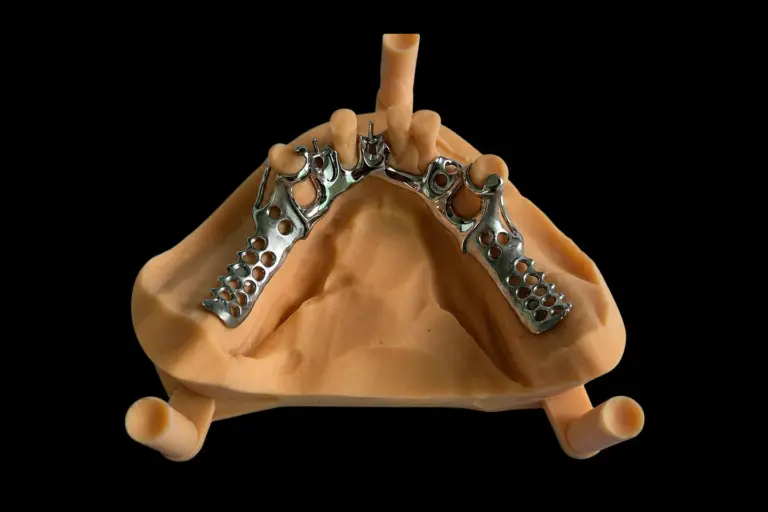
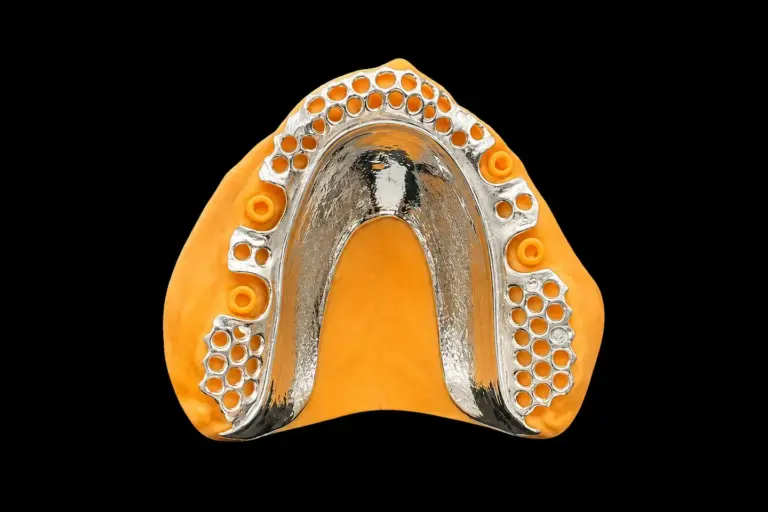
| Co-Cr framework, teeth to the first molars | Bases carried back to cover both retromolar pads, teeth set only to #19 and #30 | Base outline on the approved design, then at framework try-in |
| Stays down when the patient eats | Cingulum rests, clasps that ease off under load, full bases and a seated front saddle | Finger pressure on the bases at try-in, watching the rests |
| No metal showing | I-bar on #22 and RPA arm on #27, both kept in the lip-covered half of the tooth | Design screenshot checked against the talking and smiling photos |
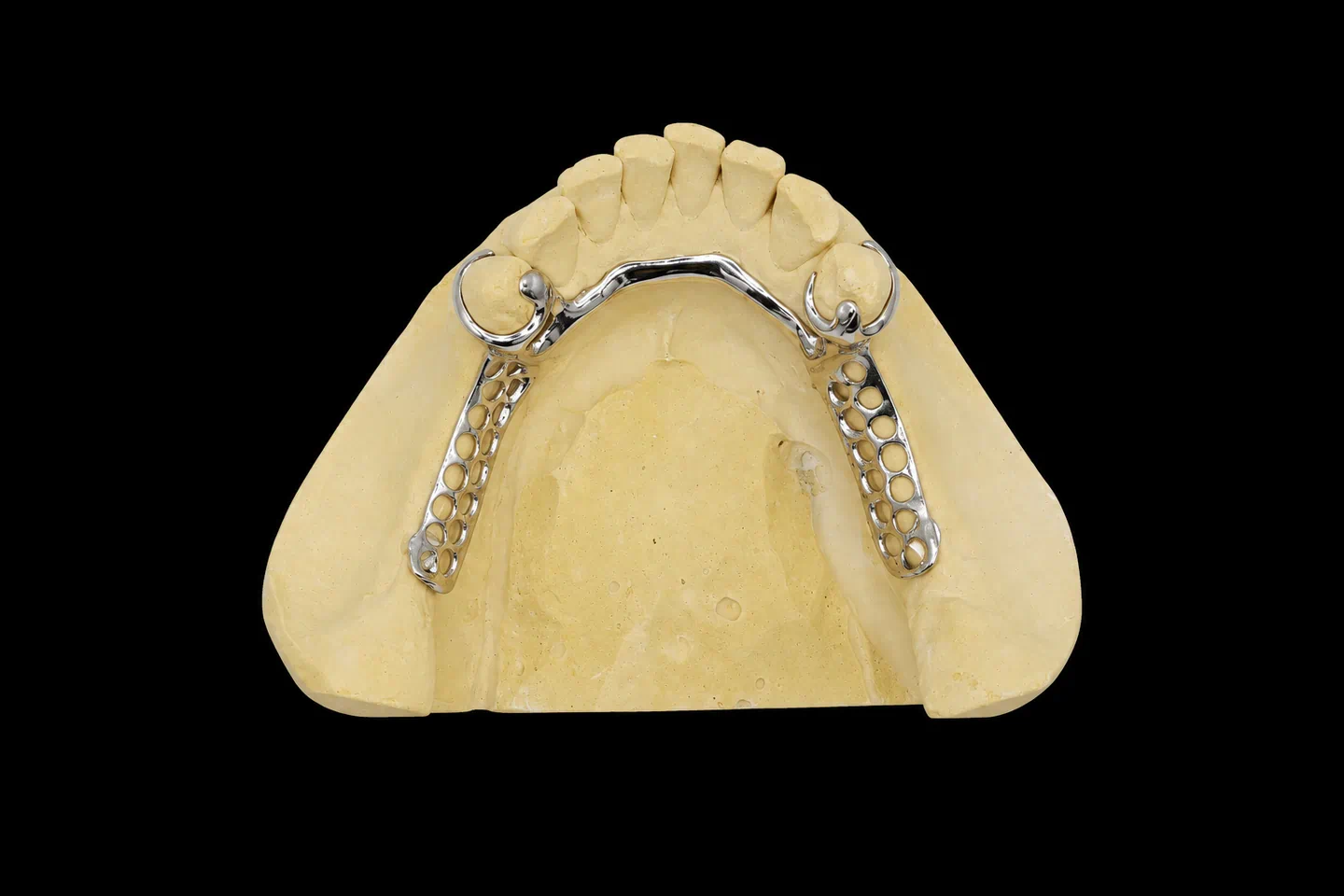
| Lingual bar | Bar placed with its top edge 3 mm below the canine gum margins, inside the 10 mm the dentist measured | Framework checked on the model, then at try-in with the tongue raised |
| Two try-ins | Framework try-in and wax try-in, shipped as separate stages | Dentist sign-off at each stage |
| Upper teeth untouched | Lower teeth set to the existing upper teeth | Bite checked on the articulator and at wax try-in |
Keeping the metal clean around the canines
With only two teeth left, plaque around them costs a lot. A survey of 87 Co-Cr partial wearers five to six years after delivery found plaque, gingivitis and recession were common on tooth surfaces within 3 mm of the denture, and root caries was linked to denture contact. So we kept the bar 3 mm clear of the canine gum margins , kept the minor connectors narrow, and kept metal off the gum where it didn’t need to be.
How We Improved Retention and Stability
Dropping the tight clasps from the Rx meant the hold had to come from somewhere else. On this cobalt chrome lower denture, the rests, the clasps and the bases share that work.
Moving the rests forward
The rests went onto the cingulum of each canine instead of the distal. That moves the rotation line forward, away from the free ends. Now a sinking base pushes the canine down along its long axis instead of tipping it back, and on a root-filled #27, that matters most.
Letting the clasps ease off
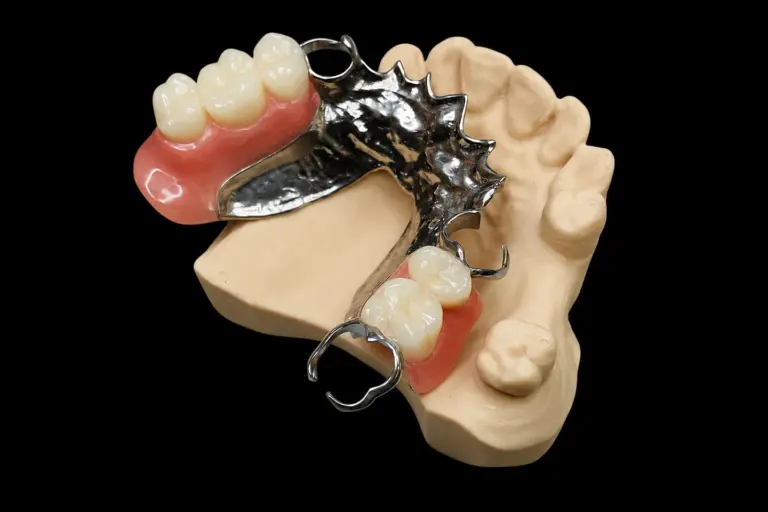
On #22, the I-bar comes up from the gum side and touches the tooth only at its tip, in the undercut. On #27, the RPA arm starts at the proximal plate and runs along the survey line . When the base sinks, both clasps move away from the tooth instead of levering it.
The proximal plates do the other half of the job. Snug contact with the guide planes gives the partial one set path in and out, so it can’t shift around. A case series on support and bracing in extension-base partials describes this proximal plate and guide-plane contact as one of the main ways to limit denture movement.
Making a Chrome Cobalt Lower Partial Stay Down Without a Tight Clasp
The old partial lifted at the back, and on a chrome cobalt lower partial with two abutments, clasp grip can’t stop that by itself. The bases had to help:
How We Made This Cobalt Chrome Lower Denture
Stage 1: Survey, design, and framework
The framework try-in
The framework seated on both rests at the first try . With finger pressure on the back of each base, the dentist saw the bases move toward the ridge while both rests stayed down, and the clasps didn’t lift .
One thing came back. In a wide laugh, the tip of the RPA arm on #27 showed by about 1 mm . The dentist and the patient decided to leave it, since it only showed in a full laugh. The dentist took a VPS bite on the framework and sent it back for the wax stage.
Stage 2: Wax try-in
We set the teeth in wax on the framework, matched to the existing upper teeth. The dentist checked looks, tooth position, bite, speech and stability. One change: the patient felt the new lower incisors looked longer than the old ones, so we brought #24 and #25 down by about 1 mm .
Stage 3: Processing and final inspection
The Finished Cobalt Chrome Lower Denture
At final inspection, this cobalt chrome lower denture matched the approved design. Both cingulum rests seated fully, the bases sat flat on the model without rocking, and both clasp arms stayed in the lip-covered half of the canines . The bar sat where it was planned, 3 mm below the gum margins .
Dentist and Patient Feedback After Fitting
The partial seated at the first appointment and stayed still under finger pressure. It needed one small adjustment, a sore spot on the lingual of the left ridge near #20 at the one-week check .
The back no longer lifts with sticky food, and nobody sees metal when the patient talks. Chewing felt normal after about two weeks .
A free-end base will always move a little under load, and the ridge under it will keep changing. The dentist set a recall schedule to watch #27 and the fit of both bases, and a reline may come up later .
Sending a Lower Cobalt Chrome Partial Denture With Few Abutments
When only two or three teeth are left, most of the work on a lower cobalt chrome partial denture happens before the metal is made. These records let us survey it properly and send you options while there’s still time to prep:
Most metal partials take 5–7 working days in the lab, and simple ones 2–3. Design approval on a complex framework adds 1–2 working days.
Who Made It
This cobalt chrome lower denture came through our removable department, about 55 technicians inside Istar Dental Lab’s four labs in Shenzhen and Huizhou, China. We’ve been making dental restorations since 2012 and have about 460 staff. Survey, design, framework, setup, processing and finishing all happen in our own labs, with nothing outsourced. A QC team of about 25 inspects work before it ships.
The removable line handles about 4,000 cases a month in a normal season and about 6,500 at peak. Istar Dental Lab is an FDA-registered establishment (Registration Number 3039441248), which you can look up in the FDA establishment registration database. Our labs run an ISO 13485 quality management system, and custom-made dentures for EU clinics follow the MDR custom-made device procedure. You’re welcome to visit the factory or book a video tour.
Cobalt Chrome Lower Denture FAQ
Why a metal framework instead of an acrylic partial?
It’s the dentist’s call for each patient. For context, a 10-year look at 1,893 partials found a median survival of 73 months for metal-based partials against 45 months for acrylic ones. It’s observational data, so case selection and maintenance play a part too. Our partial dentures page covers the acrylic and flexible options.
Can you add a tooth if an abutment is lost later?
Usually, yes. If the mesh runs under the area, we add the denture tooth to the acrylic using resin of the same type and strength-test the repair before it ships. If the framework itself is involved, send photos first and we’ll tell you whether a repair or a new framework makes more sense.
What other framework materials can you use?
Our cobalt-chromium partials are the standard. We also use Vitallium alloy and pure titanium. For a patient with a cobalt or chromium sensitivity, ask about titanium dentures. We never swap materials without your consent, and proof of the alloy’s composition and batch is available on request.
Do you make lower complete dentures with a metal base?
Yes. We make complete dentures with cobalt-chromium metal bases for arches with no teeth left. See our metal dentures range.
Can we order the framework only?
Yes. We ship the finished framework, and your team sets and processes the teeth. It suits clinics with an in-house lab and labs outsourcing the metal stage.
What does the warranty cover?
Metal partials carry a 1-year warranty covering the whole partial, framework included. Lab-side problems, like a partial that won’t seat, lifted borders, an off bite or a poorly placed clasp, are adjusted or remade free. If you change the basic requirements, or ask us to go ahead on an impression we’ve flagged as unclear, the remake is charged. You pay to send the case in, and we pay to ship finished work back, remakes included.
Can you rush a case like this?
Rush service is free for clients who send us 10 or more cases a month, for any material or case type. We guarantee the ship date. We can’t guarantee the arrival date, because customs times vary.
How is pricing handled?
We don’t publish prices on the website. Ask for our price list, and we’ll quote each case item by item, so a framework-only order and a fully staged case are priced for what they are. Single trial cases are welcome, and ongoing partnerships suit clinics with a regular case flow.
Send Us Your Next Few-Abutment Case
Got a cobalt chrome lower denture coming up with only a couple of teeth left, or an abutment you’re worried about? Send the diagnostic scans as a test case. We’ll survey it and send you the options before you prep a thing. You can also request our price list or book a factory or video visit.