Patient Situation
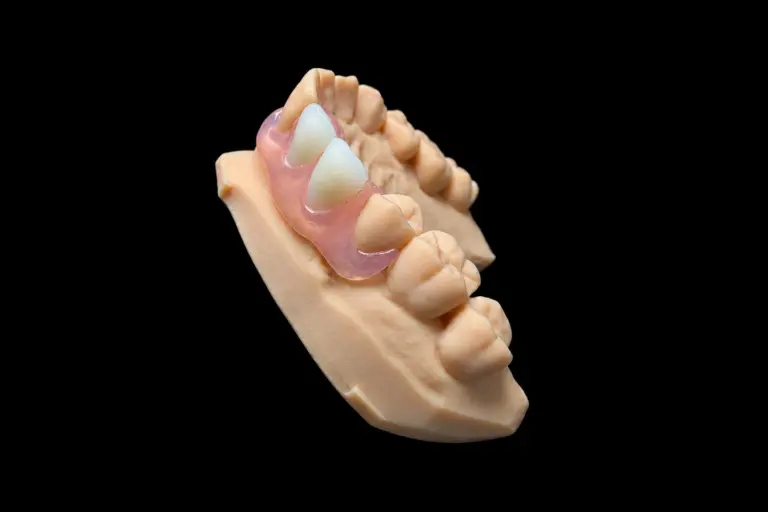
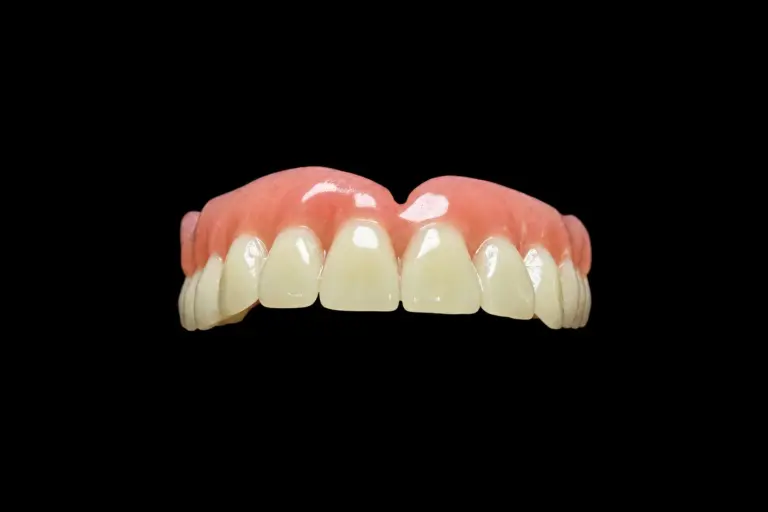
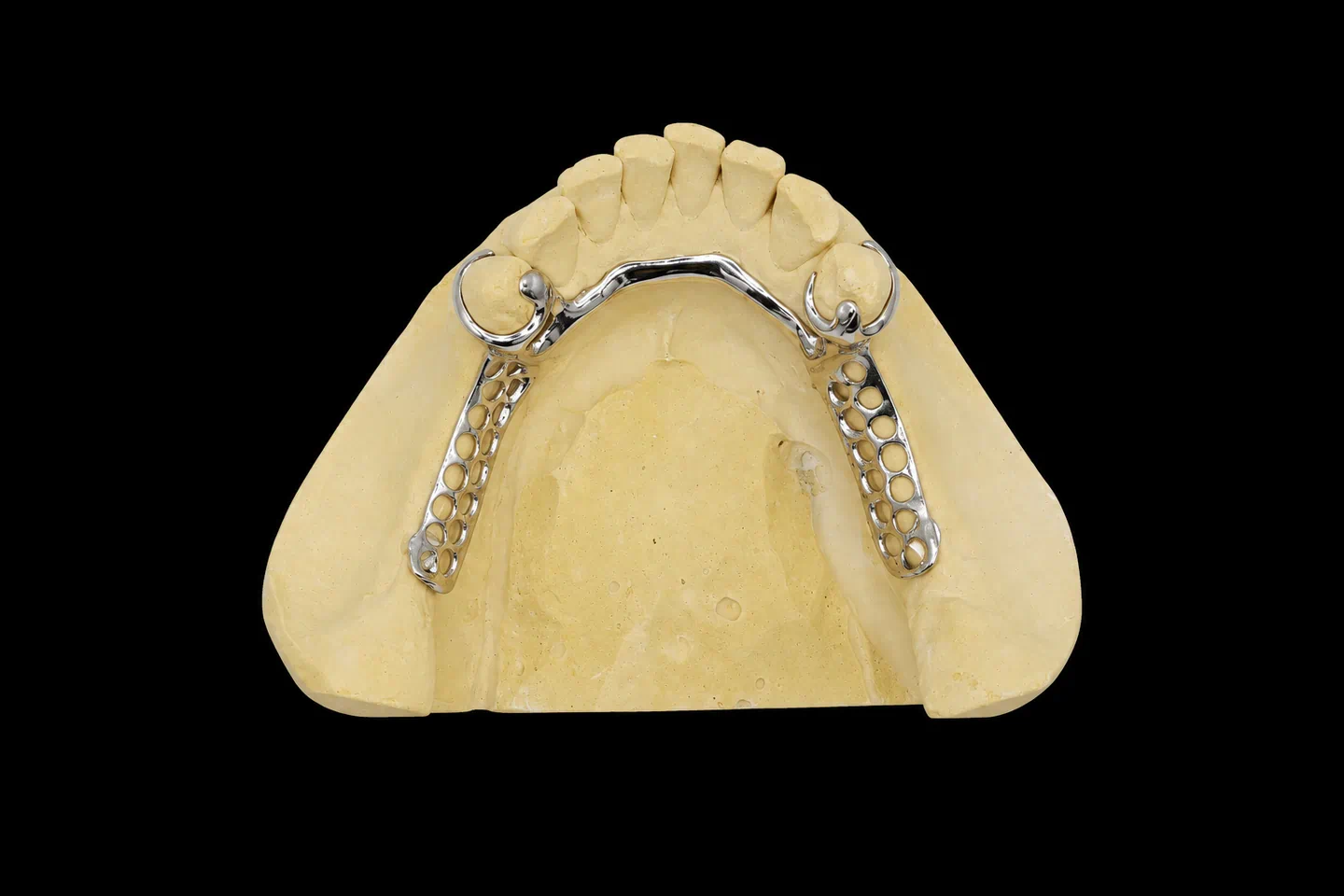
Old crowns on #8 and #9 failed, and both teeth came out about 6 months before the case reached us. The patient had been getting by on an acrylic flipper . It felt thick behind the front teeth, and its two wire clasps on #7 and #10 showed in every photo .
A bridge was on the table. A bridge leans on the teeth next to it, and the patient didn’t want #7 and #10 cut down . Implants were a “not yet” . So the dentist planned a flexible partial denture for 2 teeth as an interim, with no fixed end date .
The dentist’s notes and the records showed:
Records we received: stone models poured from alginate impressions of both arches, a VPS bite, the pre-extraction scan in PLY, shade-tab and full-smile photos, and the Rx form .
What the Dentist Asked For
The Rx for this flexible denture 2 teeth case, condensed :
The Technical Problems in This Flexible Denture 2 Teeth Case
Items 3 and 4 pull against each other
The ridge dropped 3 mm , but the teeth had to stay at the old length. So pink has to make up the difference, and pink has to stop somewhere. With 4 mm of gum showing at full smile, the spot where it stops could easily be on display. Run it higher and the line hides, but the patient gets more material under the lip.
The closest teeth had the worst undercuts
Here’s the survey on the level path :
| Spot | Undercut | Shows at full smile? |
|---|---|---|
| #7 distofacial | 0.2 mm | Yes |
| #10 distofacial | 0.3 mm | Yes |
| #6 distofacial | 0.7 mm | Only from the side |
| #11 distofacial | 0.8 mm | Only from the side |
Valplast cautions that changing clasp thickness or reach can alter flexibility, so thinning an arm to work a shallow undercut wasn’t the answer. The canines were the better bet, and that fit item 5.
A small piece with no rests
No prep means no rest seats, and the appliance only runs about 38 mm canine to canine. A flexible base without rests leans on the ridge. A small one also has no connector tying it to the back teeth, and a clinical report on unilateral partials warns that appliances like that can come loose and get swallowed or aspirated. Ours isn’t strictly one-sided, but it’s small, and we weren’t going to skip that conversation.
The quick checks came out fine
A continuing education course on non-metal clasp dentures lists the conditions that make these designs a bad bet. We ran the case against them:
| Condition to watch | This case |
|---|---|
| No occlusal stops | Stops on both sides |
| Not enough vertical room | Plenty, since the ridge loss left height for the teeth |
| Short crowns, shallow vestibule | Canines have good height, vestibule about 9 mm |
| Poor hygiene | Good, per the dentist |
| Overbite over 4 mm | 2.5 mm |
What We Sent Back Before Making Anything
We paused on lab day 1 , emailed the survey and a short note, and followed up every other day until we had an answer. It took one reply .
First, the risk. A Japan Prosthodontic Society position paper says flexible designs with no metal framework generally aren’t recommended as definitive dentures, outside limited cases like metal allergy, and points to a rigid framework when a patient turns down metal clasps for looks. The same paper says these dentures should follow the same design principles as metal-clasp partials. So we mentioned a metal framework partial with rests as the steadier build.
The dentist kept it flexible . It’s an interim, the patient had already turned down metal , and a British Dental Journal review presents one-sided partials as a fair option for patients who won’t tolerate anything bigger, given the right presentation and a skilled team. Same thinking here.
That’s the dentist’s decision, because only the dentist has the patient in the chair. The dentist also told the patient to take it out at night and to come in right away if it ever felt loose .
Second, the flange. We put three options in front of the dentist :
| Option | Flange edge above the tooth necks | What’s good | The catch |
|---|---|---|---|
| A. Full flange | About 9 mm, up to the fold | Edge stays out of sight, most lip support | Most bulk, close to moving tissue |
| B. Short flange | About 3 mm | Least bulk with some gum cover | Edge could show at full smile |
| C. No flange | None, teeth set on the ridge | Thinnest under the lip | Teeth read long, no gum cover, conflicts with item 4 |
The patient hated bulk after the flipper , so the dentist picked B and said, “show me at try-in” . Fair enough. Photos only tell you so much about a lip.
How We Met Each Requirement
| Rx item | What we did |
|---|---|
| 1 | Valplast base and clasps as one piece |
| 2 | Used existing undercuts only |
| 3 | Laid the pre-extraction scan over the new model to set length and width, then shaped the denture teeth to match |
| 4 | Built the flange to the try-in result, covered below |
| 5 | Put the clasps on #6 and #11, nothing on #7 or #10 |
| 6 | Checked contacts on an articulated model with film |
| 7 | Compared teeth and base against the shade photos before and after finishing |
| 8 | Sent a wax setup and waited for the dentist’s feedback |
Keeping clasps out of the front view
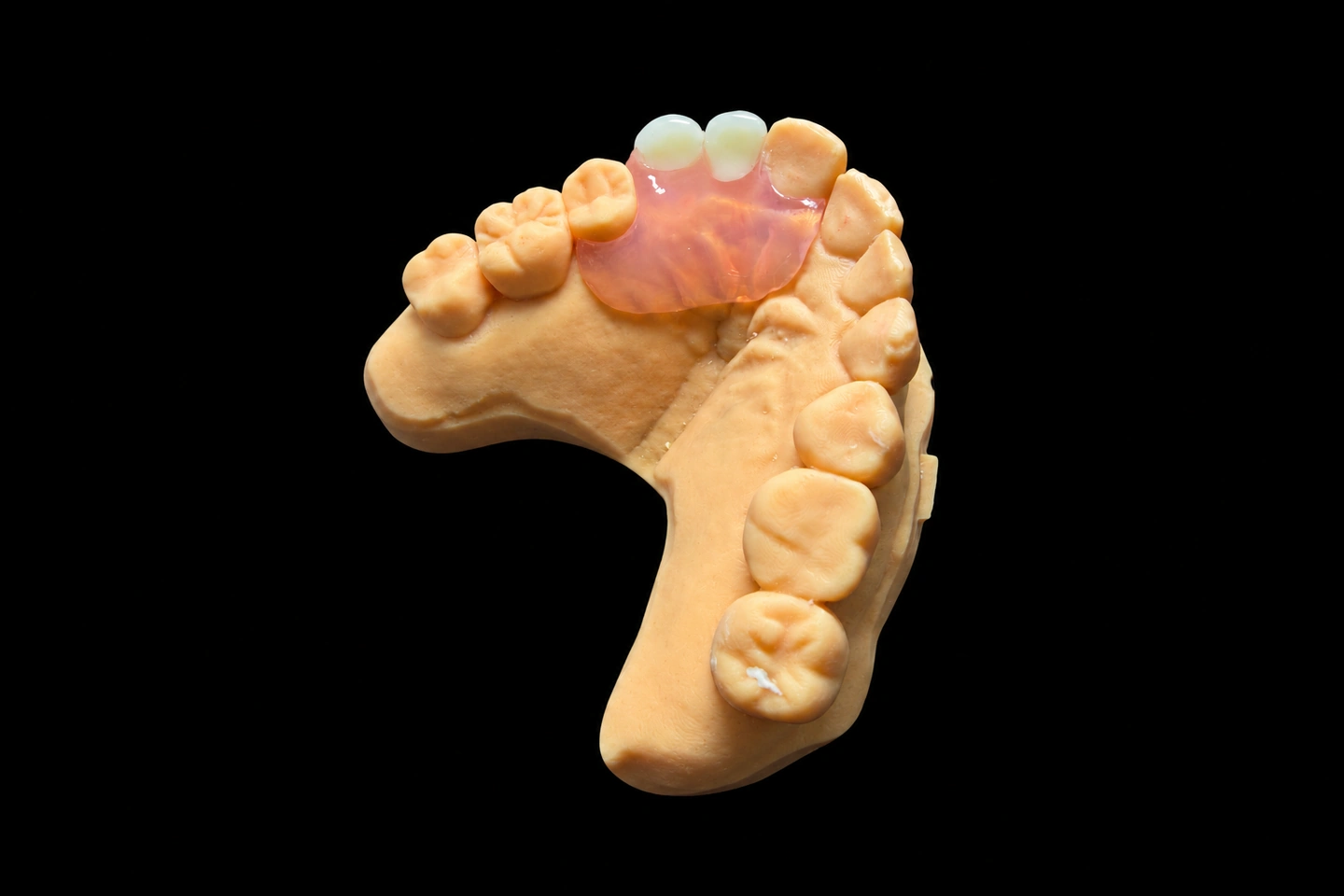
Each arm starts from the palatal base, goes through the open embrasure behind the canine, and comes forward into the distofacial undercut . From straight on, you don’t see it. From the side, you see a bit of pink at the back of the canine . The arms are 4 mm wide and 1.2 mm thick .
Bracing without a frame
On this flexible denture 2 teeth design, the base has to do the bracing. It hugs the palatal surfaces of #6 through #11 and stops about 8 mm behind the incisive papilla, leaving the rest of the palate open . A case series on support and bracing in extension-base partials ties stability to contact with the axial surfaces of the abutments, and we borrowed that idea. It’s flexible resin, though, so it helps. It isn’t a rigid frame.
Keeping the denture teeth in
Valplast doesn’t bond chemically to the denture teeth, so they stay in mechanically. One lab study on Valplast got the highest bond strength with a T-shaped groove on the ridge lap, so that’s what we cut . A literature review also found tooth retention better in PMMA unless the teeth got extra mechanical features. We kept at least 1 mm of resin around both teeth.
What the Wax Try-In Changed
The dentist seated the setup, took full-smile photos, marked it up, and couriered it back . Valplast suggests a wax try-in too. Without it, this flexible denture 2 teeth case would’ve shipped with the wrong flange.
| Checked | What it showed | What we changed |
|---|---|---|
| Flange edge | Clear line at full smile with the 3 mm edge | Raised it to about 6 mm and thinned the edge to about 1 mm |
| Midline | 0.5 mm right of the facial midline | Moved the setup left 0.5 mm |
| #9 length | 0.5 mm longer than the old crown | Shortened it |
| Lip | Natural, no puffiness with the short flange | Nothing |
| Speech | /f/ and /s/ clear | Nothing |
So the final flange landed between A and B . It’s more material than the patient first wanted, and the dentist cleared that with the patient before we went ahead .
One thing wax can’t do is test the clasps. Retention waits for the final.
Making It, Day by Day
These are lab days only for this flexible partial denture for 2 teeth. The try-in visit and courier time sit between days 3 and 4 .
The Finished Flexible Partial Denture for 2 Teeth
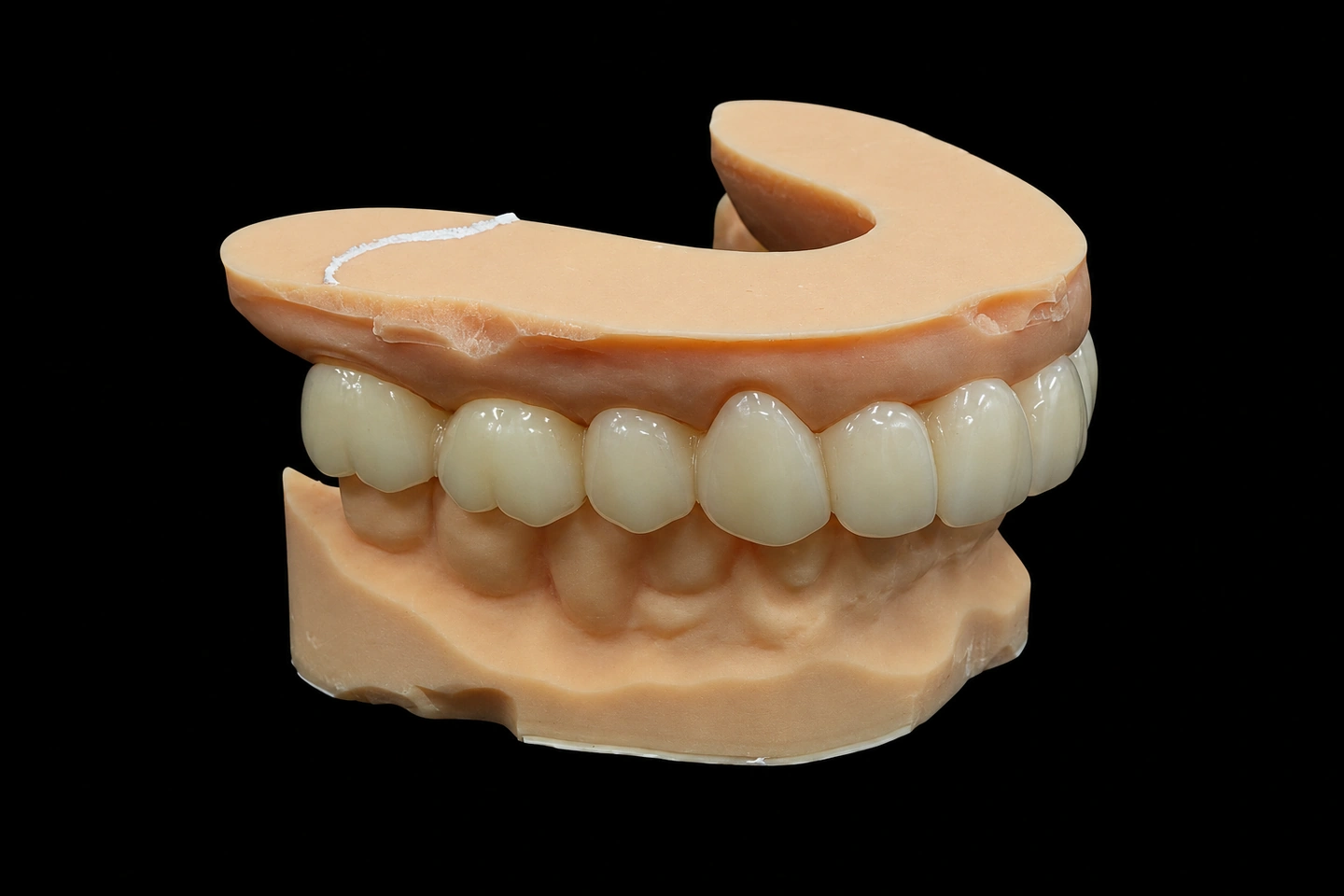
Design goal: bring back the old tooth length, hide the pink edge, and keep metal and clasps out of the front view. Final inspection on this flexible denture 2 teeth build:
| Check | Result |
|---|---|
| Seating on the model | Full seat, no rocking, no lifted edges |
| Tooth size vs. old crowns | Within 0.3 mm on length and width |
| Flange edge against the smile photo | About 2 mm above the lip line at full smile |
| Base thickness, by caliper | 2.0–2.5 mm behind the teeth, no sudden changes |
| Base under strong light | No bubbles (internal bubbles mean a remake) |
| Teeth, under finger pressure | No movement on #8 or #9 |
| Articulating film | Light marks when closing, none in protrusion |
| Shade photos | Teeth and base matched |
Feedback at delivery
The dentist: warmed it in hot water the way Valplast describes, and it went in with firm retention . One spot on the flange near the frenum needed easing . The clasps needed nothing .
The patient: happy that the wire was gone and the teeth looked like the old ones . They noticed the flange under the lip for the first few days .
What it didn't fix
That feedback comes from delivery, not years of wear , so we won’t promise how long it’ll last. The Japan Prosthodontic Society’s review of material properties notes lower color stability, higher fracture risk, and easier roughening than PMMA, and says the follow-up evidence is thin. The dentist set recall visits to check fit, the ridge, and the canines , and that makes sense, because the arms sit right at the gum line.
Sending Us a Flexible Denture 2 Teeth Case
Not sure a flexible denture 2 teeth design suits your patient? Send the records first. We offer a pre-shipment feasibility review, and it’s a lot easier to change a design before anything’s been made.
We need:
A flexible denture 2 teeth case generally takes 5–7 working days from the day we receive it. Design sign-off can add 1–2 days, and courier and customs time are separate.
Who Made It
Our 55-person removable department made this flexible partial denture for 2 teeth in Istar Dental Lab’s own labs. Istar has four labs in Shenzhen and Huizhou, China, about 460 people, and has been at it since 2012. Nothing gets outsourced. A separate 25-person QC group checks work before it ships, and the removable department handles about 4,000 cases a month in the slow season and about 6,500 at peak.
Istar is an FDA-registered establishment (Registration Number 3039441248), which you can look up in the FDA database, and our labs run an ISO 13485 quality management system. For EU clinics, custom-made partials follow the MDR custom-made device procedure.
Flexible Denture 2 Teeth FAQ
Can you reline, repair, or add a tooth later?
Yes, all three, on a flexible partial denture for 2 teeth or any other. Send the appliance, upper and lower models, and a bite record. The patient goes without it while it’s away, so plan for that. Valplast’s clinical techniques page covers the impression steps for rebasing and adding teeth.
Can a too-tight clasp be adjusted chairside?
Yes. Valplast describes soaking the clasp in hot water, bending it, and letting it cool. Changing clasp thickness can change how it flexes, so check with us before thinning one.
What's the warranty?
Istar’s warranty on the base is 1 year. A base that won’t seat, lifted edges, badly placed clasps, an off bite, or a gum color you’re not happy with get adjusted or remade free. Changing the shade or material later isn’t covered, and neither is going ahead on a poor impression after we’ve warned you. You pay to send a case in, and we pay to ship finished work back, remakes included.
Valplast’s own limited lifetime warranty is separate. It covers breakage of the resin base, not the teeth.
Is the resin genuine Valplast?
Yes. We can ship a Valplast Certificate of Authenticity with the case when you need one.
What if I keep a design you've flagged?
We make it to your Rx, and you don’t need to sign a risk form. Problems caused by that design, remakes included, aren’t on us. If you change your mind before production, we change the design.
What other partials do you make?
Acrylic, cast frameworks, and other flexible partials. The full range is on our partial dentures page.
Can you rush it?
Yes, free of charge, if you send us 10 or more cases a month. We guarantee the ship date, not the arrival date, because customs times vary.
How does pricing work?
Prices aren’t on the website. Quotes are itemized to your requirements, not one bundled price.
Send Us Your Next Flexible Denture 2 Teeth Case
Got a flexible partial denture for 2 teeth coming up, especially one in the smile? Single trial cases are welcome, and ongoing partnerships suit clinics with a regular case flow. Ship us a test case, request the price list, or book a factory or video visit.