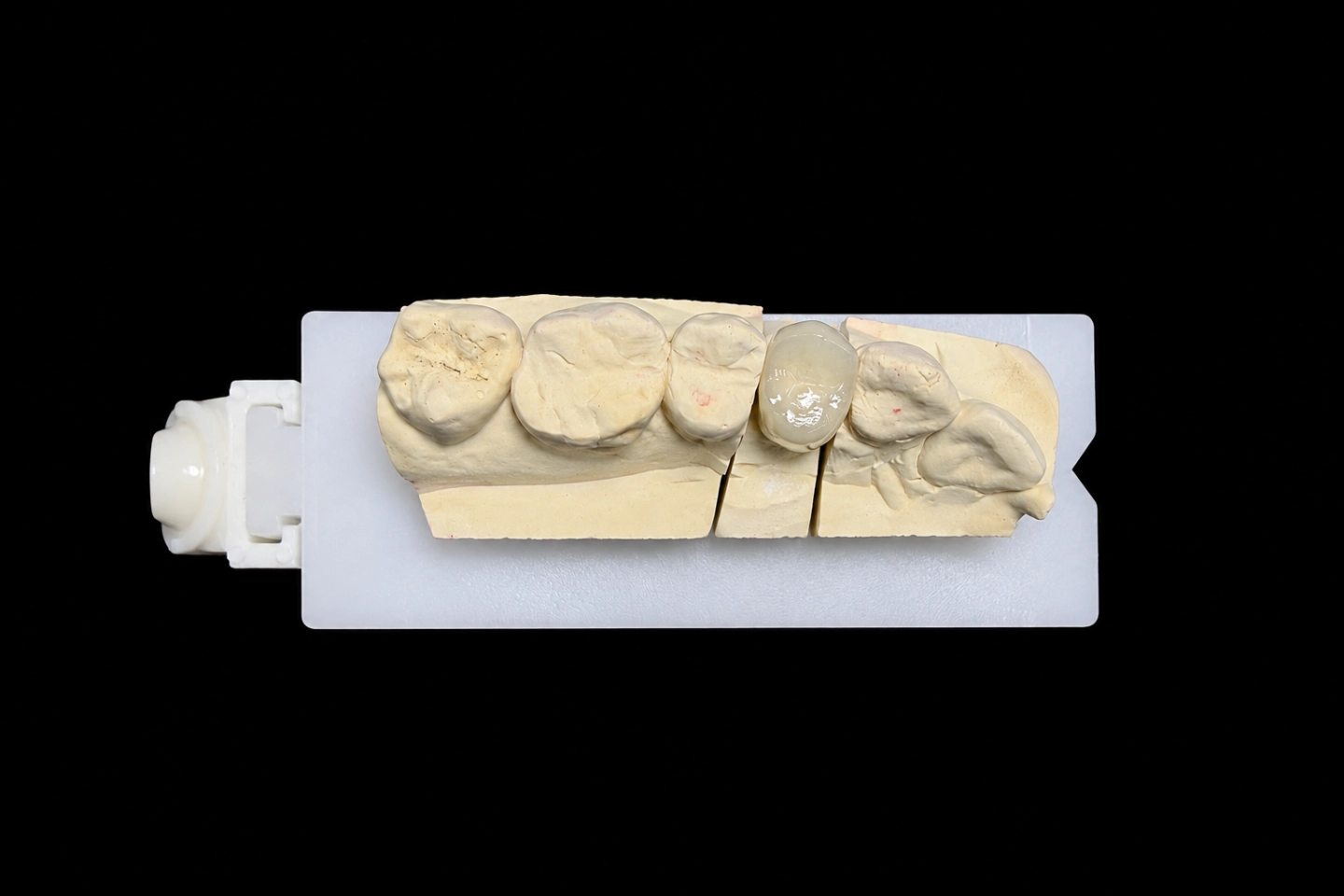
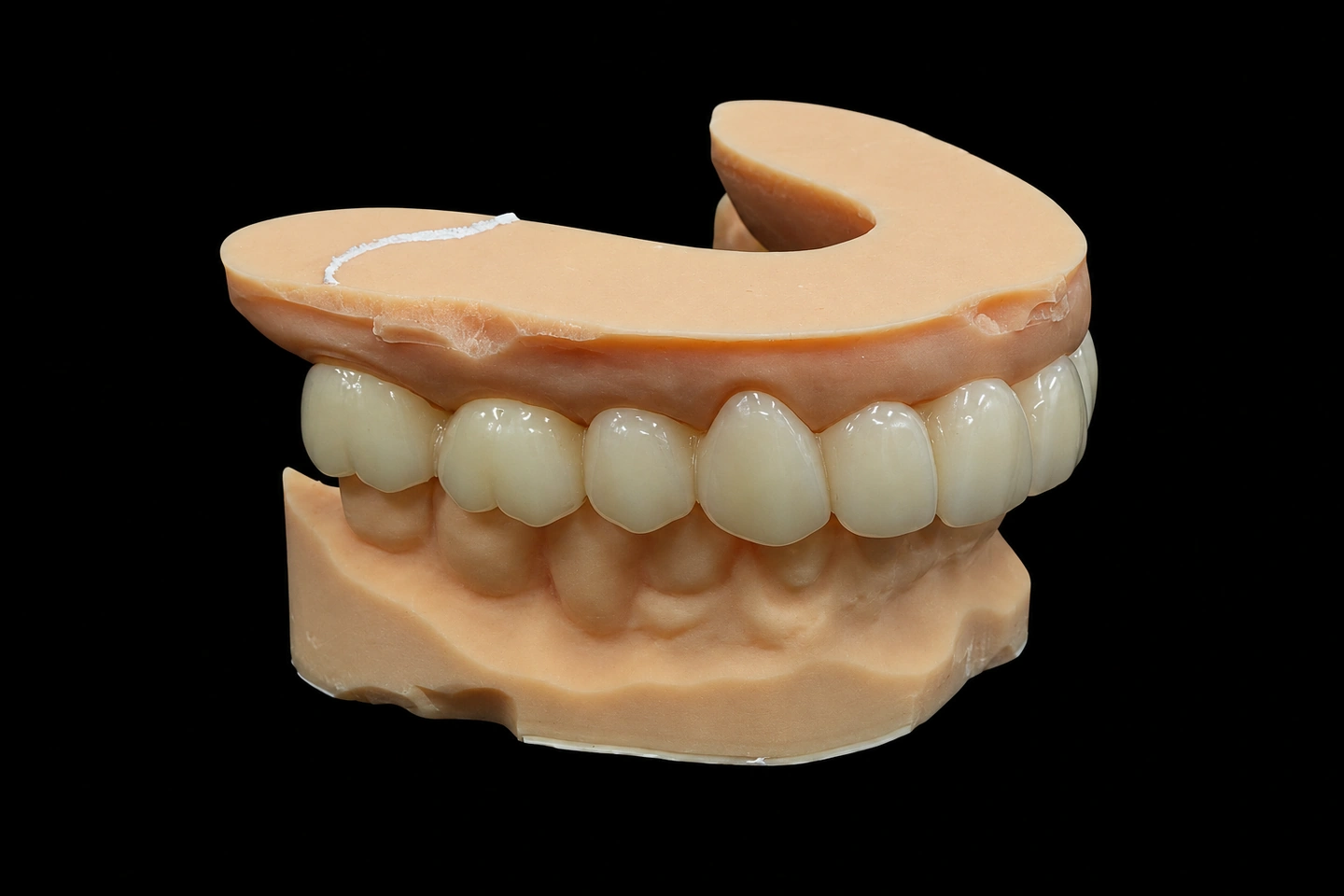
Patient Situation
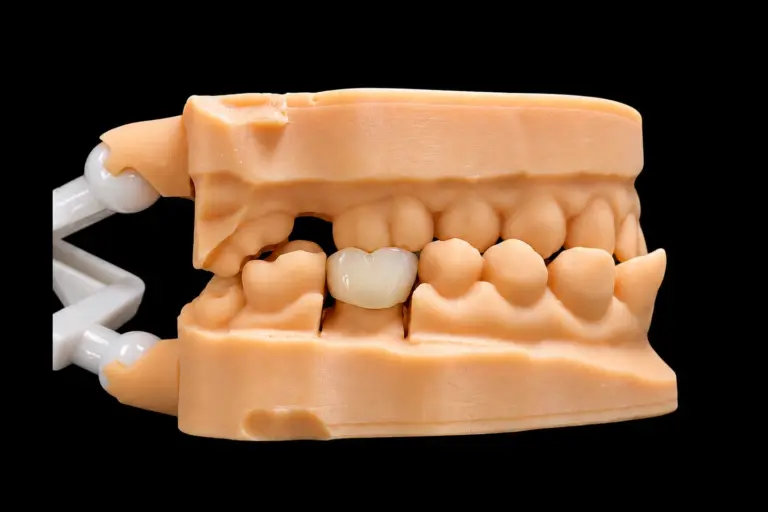
The patient lost #19 several years ago and never had it replaced . The scan and the dentist’s notes showed what that gap had done to the teeth around it:
The short walls on #18 matter most here. Every extra half millimeter taken off the top of #18 comes out of the retention that end of the bridge depends on. The dentist didn’t want to cut it shorter.
What the Dentist Asked For
The Rx, condensed :
Requests 2 and 7 can’t both happen on #18. That was the job.
The Technical Problem: Not Enough Room on #18
How much room porcelain needs
Under porcelain, the metal coping runs 0.3–0.5 mm thick. The porcelain on top of it needs 1.5–2.0 mm on a back tooth to stay strong. Put those together and a porcelain occlusal surface needs about 2 mm of room, at minimum.
Goodacre’s posterior metal-ceramic preparation guidance lands in the same place: around 2 mm or more where the occlusal surface is porcelain, and about 1.0–1.5 mm where it’s metal.
What we measured
Our technicians measured the clearance on the scan, in centric and in left lateral movement :
| Area | Clearance (lowest reading) | Enough for porcelain occlusal? |
|---|---|---|
| #18, distal cusps | 1.0 mm | No |
| #18, mesial cusps | 1.4 mm | No |
| #19 pontic | Full anatomy fits | Yes |
| #20 | 2.1 mm | Yes |
So the problem in this PFM bridge posterior case sat on one tooth: #18.
Why thinning the porcelain wasn't an option
Porcelain is the weak link in a posterior PFM bridge, not the metal. In a 15-year study of tooth-supported bridges, ceramic chipping and fracture were the most common technical problems. Metal-ceramic frameworks themselves rarely break: 0.6% at five years in a pooled review of 1,796 metal-ceramic bridges.
Squeezing a coping and porcelain into 1 mm of room on a second molar, against a clencher, is a bad bet. We weren’t going to build that and hope.
The Options We Sent Before Making Anything
We sent the dentist a design preview with the clearance readings and three options :
| Option | What changes on #18 | The trade-off |
|---|---|---|
| A. Reduce #18 for porcelain | The dentist takes about 1 mm more off the distal cusps. We marked exactly where on a reduction map. | Shorter walls on an already short tooth, a new scan, and another visit |
| B. Metal occlusal on #18 only | Metal chewing surface on #18, porcelain on its buccal face. Full porcelain on #19 and #20. | Some metal shows on #18 when the patient opens wide |
| C. Metal occlusal on all three units | Metal chewing surfaces across the bridge | Strongest under clenching, but metal shows on #20, which is in the smile |
We recommended B, a metal occlusal PFM bridge with porcelain wherever it shows, and said why. The call was the dentist’s, as it is on every case. They approved B by email the same day , and the design was locked before any metal was made.
How We Met the Rx: PFM Bridge Posterior Design and Production
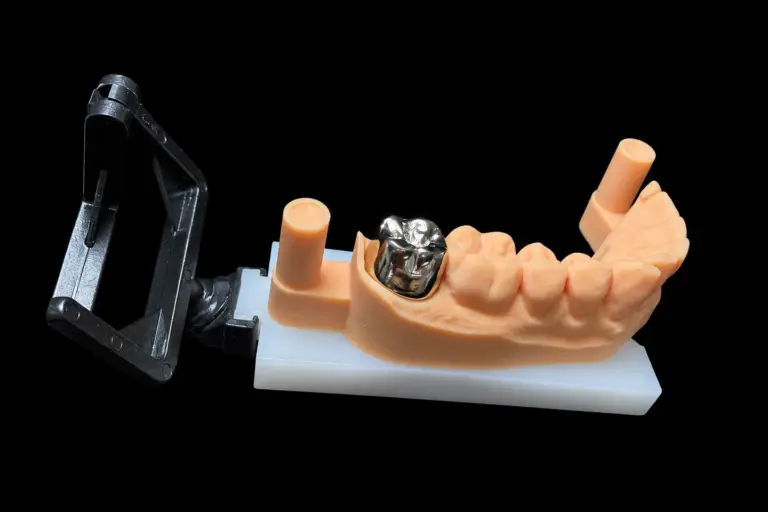
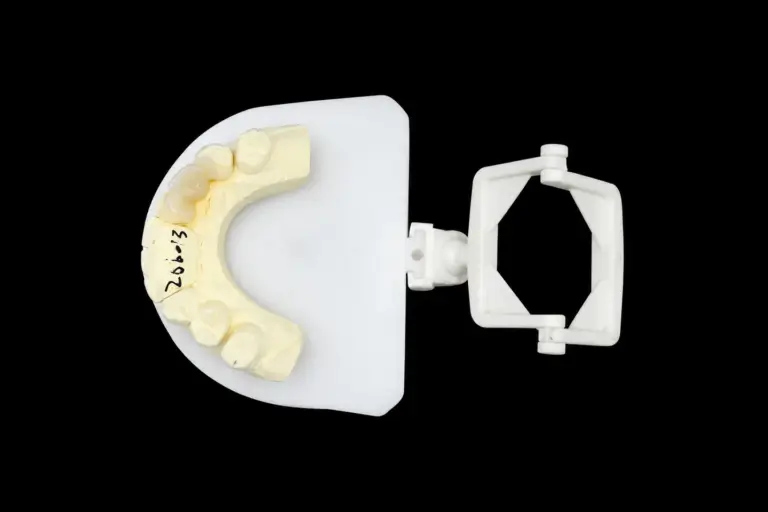
The metal occlusal PFM bridge design
Metal framework
Our metal department made the cobalt-chromium framework from the approved design. Before any porcelain went on, we checked:
Then the framework was blasted with aluminum oxide, cleaned ultrasonically and pre-oxidized, so the porcelain bonds properly.
Porcelain
The porcelain is matched to the alloy’s thermal expansion, a little lower than the metal’s, so the porcelain doesn’t end up in tension as it cools. That’s one of the main ways to prevent cracks.
The technician built the porcelain up in even layers: 1.5–2.0 mm on the occlusal of #19 and #20, and an even layer on #18’s buccal face. We cap a PFM at three or four firings to keep the shape and the color stable, and this one took three . The shade was checked against an A3 tab under standardized light before and after firing. #18’s metal occlusal was polished, not glazed.
Final checks
After glazing, we checked contacts, the bite in centric, protrusive and lateral moves, and the margins again. Glazing and firing can move things a little, so that check comes last on purpose.
Then the finished bridge was compared against the approved design, and our QC technician signed it off against the Rx. Fit, margins and occlusion get checked on every case, not on a sample. It shipped in a foam-filled box.
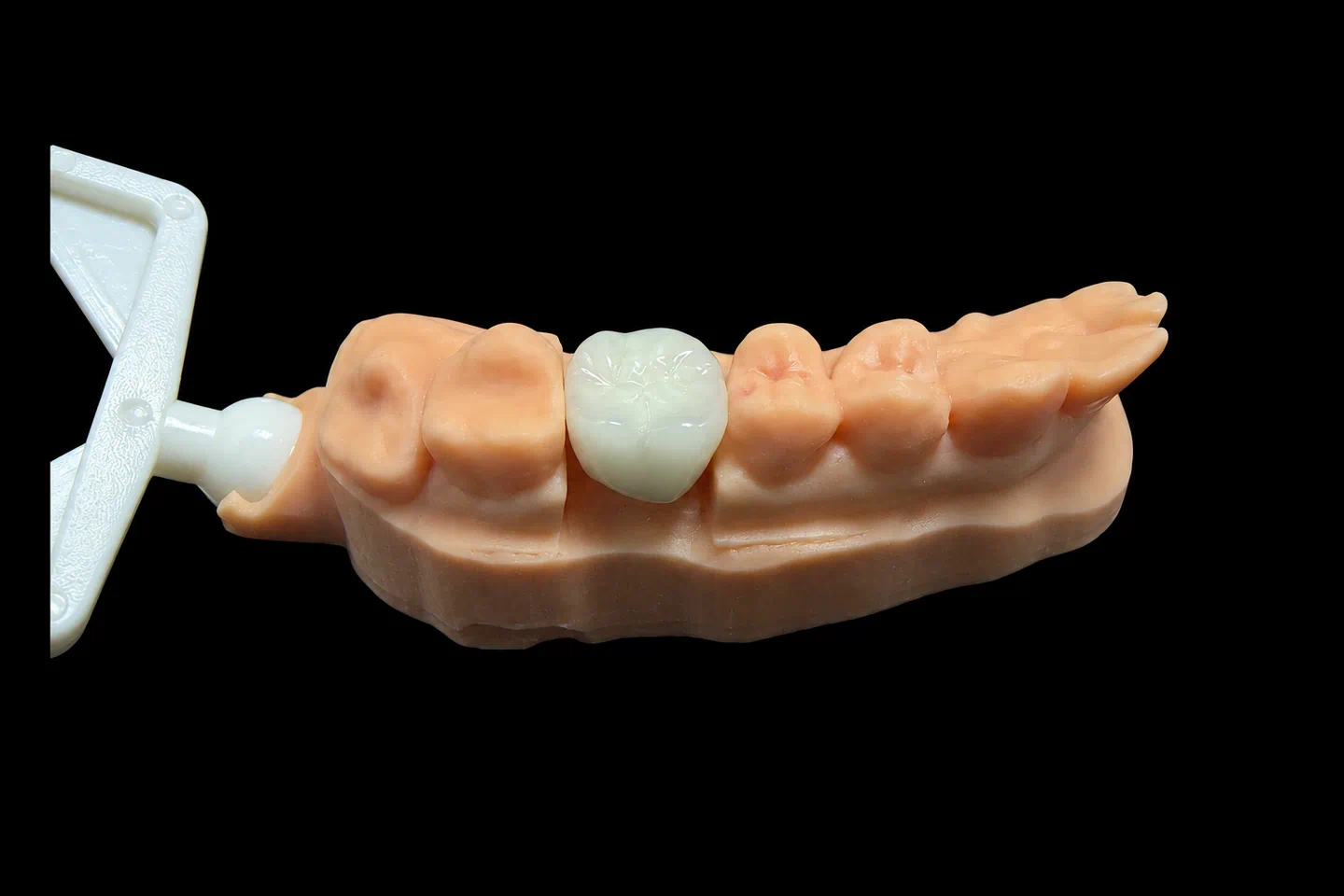
Finished Result of the Posterior PFM Bridge
Here’s how the finished bridge measured up to the design targets at final inspection :
The dentist reported that the bridge seated without any margin or contact changes, with one light occlusal adjustment on #20 at try-in .
In the end, this PFM bridge posterior case didn’t follow the original Rx to the letter. The bridge is built around the room #18 actually had, and the dentist signed off on that design before we made anything.
Sending a Similar Posterior PFM Bridge
If you have a posterior PFM bridge with a short or crowded abutment, this is how it works with us:
Every step happens in our own labs: four of them in Shenzhen and Huizhou, China, with about 460 people. CAD design, the metal department, porcelain and QC all run in-house, and metal and porcelain work are kept in separate departments. Istar is an FDA-registered establishment, Registration Number 3039441248, which you can check in FDA’s establishment database. The lab runs under ISO 13485.
Got a posterior bridge with a short abutment or a tight bite? Send us the scan and Rx. We’ll measure the room and send you options before we make anything. Send your first case or talk to us.
FAQ
Can you copy the shape of the provisional or an old bridge?
Yes. Send a scan of the provisional or the old bridge, and we copy its form onto the new one. We can carry over the function and guidance from a provisional the patient has already been wearing, too.
Can you save my default contacts and bite?
Yes. Tell us how you like contacts and occlusion once, and we save it to your account. If you’re a group practice, we keep each dentist’s preferences separate.
What do you need if I report a problem with a bridge?
Send the patient name, case number, what the problem is, and photos. Physical restorations come back to us. If it’s a fit, margin or bite problem, we’ll usually need a new scan or impression. If the bridge seats well but the porcelain chipped, we can often remake it from the original data. We find the cause before remaking anything, and we agree on it with you.
Do you take rush cases?
Yes, at no extra charge, for clients who send 10 or more cases a month. We guarantee the ship date. The arrival date depends on customs, so we can’t guarantee that.