Temporary Implant Crown: Milled PMMA Crowns, Bridges, and Full-Arch Provisionals
Fabricated interim restorations for implant cases. Four configurations, three material routes, screw-retained on titanium bases by default, with in-house milling and printing. Production starts the day a case opens with a confirmed implant platform and scan body.
- Configurations: Single interim crown · 2–4 unit interim bridge · Immediate full-arch provisional · Splint interim
- Materials: Milled PMMA (monolithic or multilayer) · Printed resin · Reinforced milled PMMA
- Fixation: Screw-retained on Ti-base · Cement-retained on custom abutment
- Production time: 2–4 working days single unit · 3–5 multi-unit · 5–7 full-arch
- Design review before milling: Optional, adds 1–2 working days
Product range
Four configurations in the current catalog. The configuration determines the material route, the fixation default, and the hardware included.
| Configuration | Units | Default material | Default fixation | Included hardware |
|---|---|---|---|---|
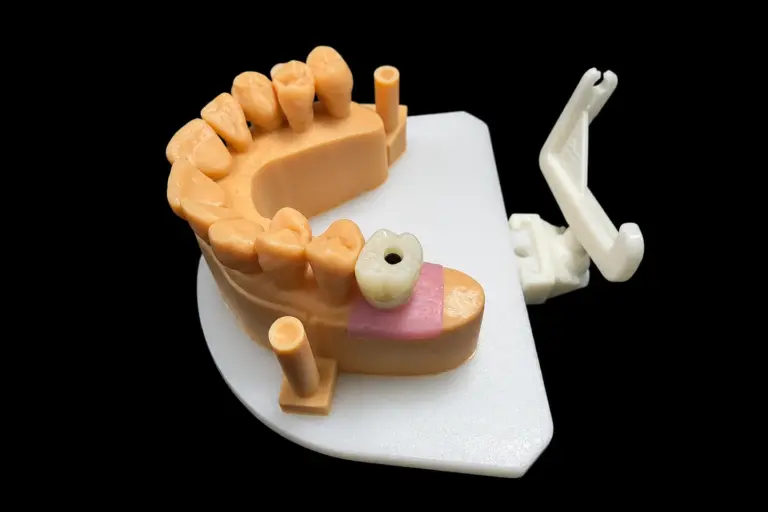
| Single interim implant crown | 1 | Milled PMMA, monolithic or multilayer | Screw to Ti-base | Ti-base; prosthetic screw |
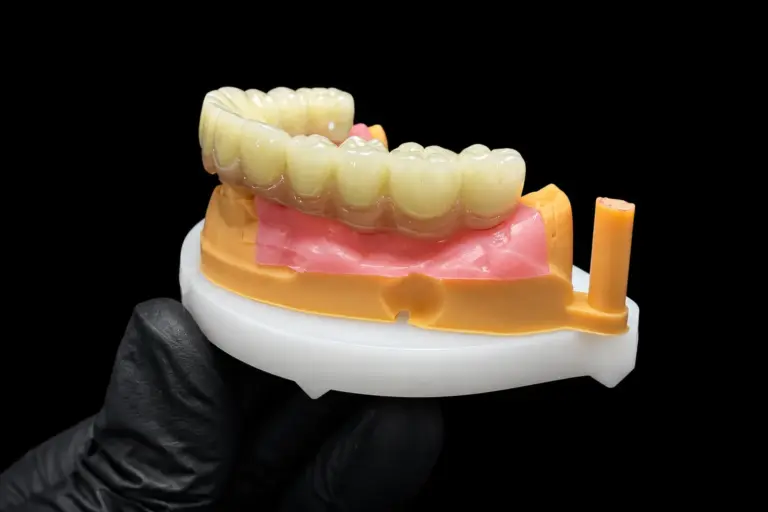
| Interim implant bridge | 2–4 | Milled PMMA | Screw-retained | Ti-bases; prosthetic screws |
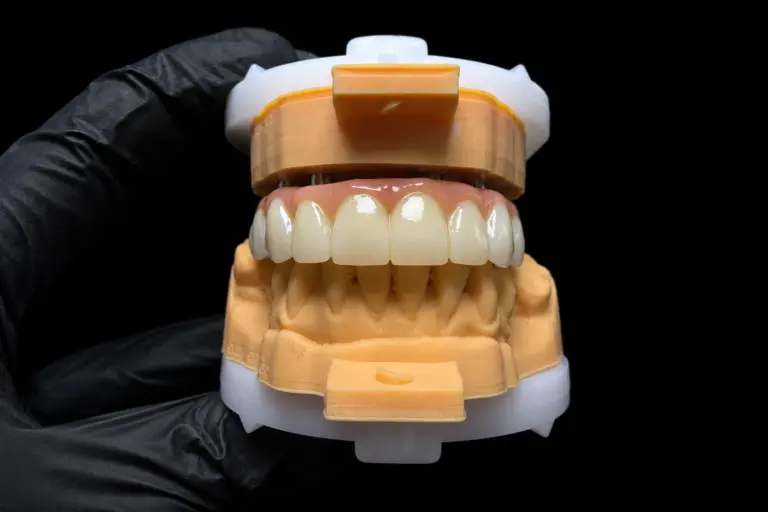
| Immediate full-arch provisional | Full arch | Reinforced milled PMMA | Multi-unit abutments, screw-retained | MUAs; temporary cylinders; prosthetic screws; optional titanium bar |
| Splint interim | 1–2 | Milled PMMA | Screw-retained | Ti-bases; prosthetic screws |
Single interim implant crown
The default product in the line. Delivered on a titanium base, screw-retained, in a PMMA shade matched from your submitted photographs. Where the screw channel would exit the labial surface of an anterior crown, the product ships as a cement-retained crown on a custom abutment, pre-cemented on the model so excess cement is controlled before delivery.
Interim implant bridge, 2–4 units
Two to four implant positions. Shipped as individual Ti-base-seated units joined into the bridge span, with connector cross-sections sized against the opposing dentition rather than to a single default. Screw-retained in all but exceptional cases.
Immediate full-arch provisional
The product supplied on surgery day for All-on-4 and All-on-6 cases. Reinforced milled PMMA on multi-unit abutments. A titanium reinforcement bar is included as a specified option on All-on-4 cases with a distal cantilever, and recommended whenever the cantilever geometry exceeds what unreinforced PMMA tolerates.
Splint interim
A variant for protected-loading cases where the restoration is designed to carry occlusal function at a defined reduced scheme, typically for cases with known parafunction. Same milling route as the single crown; the design difference is in the occlusal scheme and the material thickness.
Hardware ancillaries (titanium bars, additional MUAs, temporary cylinders, prosthetic screws) are available separately for cases where the clinic sources its own primary components.
Materials
Three material routes, selected by configuration and clinical need.
| Route | Base material | Supply form | Where it goes |
|---|---|---|---|
| Milled PMMA, monolithic | Industrial PMMA disc | 98 mm disc, qualified batch | Posterior single units, long-span bridges, functional testing |
| Milled PMMA, multilayer | Multi-shade PMMA disc with built-in translucency gradient | 98 mm disc | Anterior single units, esthetic zone cases |
| Printed resin | Qualified interim resin brand | Vat polymerization, controlled print orientation and post-cure | Cost-driven units, complex geometry, cases where printing wins on turnaround |
Milled PMMA is the default route for the single crown, bridge, and splint interim. Polishes to a surface that resists staining better than printed alternatives, machines predictably, and has the longest clinical track record as a provisional material.
Multilayer PMMA is a subtype of the milled route. The translucency gradient is built into the disc, so the restoration carries incisal translucency without surface painting. Specified on request for anterior cases where a single-shade monolithic reads as opaque against natural teeth.
Printed resin is a selectable route rather than a default. Mechanical performance across printed interim resins is not uniform. A systematic review of 3D-printed temporary resins found substantial spread in flexural strength and hardness across commercial materials. Istar Digital qualifies resins by batch before they enter production and controls print orientation, layer thickness, and post-cure protocol per qualified recipe.
Reinforced PMMA is the full-arch variant. The reinforcement bar runs through the milled arch where cantilever stress is highest. Available as a standard option on the full-arch product; recommended by Istar Digital on prescribed All-on-4 cases.
Specifications
| Parameter | Specification |
|---|---|
| Implant libraries | Major systems supported; platform and scan body model confirmation required at case open |
| Fixation | Screw-retained on Ti-base (default); cement-retained on custom abutment (where screw channel exit precludes screw retention) |
| Surface finish | Polished; characterization available on anterior units at request |
| Shade range | Standard dentin shades matched from submitted photographs; multilayer discs for esthetic zone |
| Design review option | Digital design file or 3D-printed model sent for approval before milling (adds 1–2 working days) |
| Production time, single unit | 2–4 working days in-facility |
| Production time, 2–4 unit bridge | 3–5 working days in-facility |
| Production time, full-arch | 5–7 working days in-facility |
| Shipping | Excluded from the production times above; international transit varies by destination |
| Hardware included per case | Per the Product range table |
| Ancillary hardware | Titanium bars, MUAs, temporary cylinders, prosthetic screws — available separately |
| Repair policy | Composite chairside repair for superficial chips; remake for structural fracture or Ti-base separation |
For a broader view of what governs turnaround on fixed work, see our breakdown of crown turnaround times.
What ships with each case
Every case includes the restoration itself and the hardware the restoration needs to seat. Istar Digital supplies these as part of the quoted price unless the clinic has indicated it will source its own.
- The restoration, finished and polished, in the configuration prescribed
- Titanium bases for each implant position in the restoration
- Prosthetic screws matched to the base and torque specification
- Case packaging with the printed design file reference and the implant system / platform recorded
Optional on the Rx:
- Multi-unit abutments (for full-arch cases where Istar Digital supplies the entire prosthetic stack)
- Titanium reinforcement bar (full-arch, prescribed or recommended by Istar Digital)
- Custom abutment (where cement-retained fixation is selected)
- 3D-printed design model (shipped for approval before milling, if the design-review option is selected)
Istar Digital’s standard restoration shipments to US clinics are produced under FDA establishment registration and product listing. The registration covers the custom restorations, not the implant fixtures themselves.
Alternatives you may be weighing
Where an implant provisional is not the right fit, because the implant is not yet placed or the case does not call for implant support, these are the alternatives Istar Digital produces in neighboring product lines.
| Alternative | Produced by Istar Digital | Use case | Primary limitation |
|---|---|---|---|
| Flipper (acrylic) | Custom dentures line | Rests on soft tissue; patient-removable | Rests on edentulous ridge during healing; a long-standing clinical concern |
| Flexible partial (Valplast-type) | Custom dentures line | Metal-sensitive patients; short gaps | Difficult to reline; unsuitable where load is heavy |
| Essix with pontic | Essix retainers line | Preserves the surgical site without loading it | No load capacity; patient-removable |
| Maryland / resin-bonded bridge | Crown & bridge line | Fixed, conservative; anterior short spans | Limited span; relies on adequate enamel |
On flippers specifically: the comparison between Essix and flipper in implant therapy sets out the trade-off most prosthodontists weigh. No prospective study quantifying bone response to flipper wear was found during our research for this page, so the bone-contact concern is treated as a clinical preference rather than a measured effect.
Clinical rationale (optional reading)
The next three subsections cover the clinical logic the product is designed around. They are not product specifications; they explain why the specifications are what they are. Prescribers who already know this layer can skip to the FAQ.
Why screw-retained is the default fixation
Wilson’s series on peri-implant disease found excess cement beneath the margin in 81% of the affected implants examined, with most sites improving after the cement was removed. Screw retention does not have this failure mode because there is no cement.
A 2023 systematic review and meta-analysis found comparable long-term peri-implant outcomes for cement- and screw-retained restorations when both are executed well. Cement is not inherently dangerous. Screw retention is simply less dependent on the cementation step being perfect every time, which during a provisional phase with a subgingival margin is worth something. The product defaults to screw retention and switches to cement only where the screw channel would exit a visible labial surface or an occlusal contact.
Why the full-arch product carries a reinforcement option
Full-arch provisionals carry cantilevers by design. On All-on-4 cases the distal extension past the last implant has no vertical support and sees the highest masticatory load. A retrospective series of 557 implants restored with immediate provisional prostheses reported fracture significantly associated with implant failure (OR approximately 7.0); a prospective cohort of immediate-load cases reported a 13.3% early mechanical complication rate with fracture and screw loosening leading. The reinforcement bar is a response to that risk. An unreinforced full-arch PMMA on an All-on-4 cantilever is a predictable fracture, and the bar is the cheapest insurance against it.
Why the emergence profile is designed on the Ti-base rather than built chairside
A randomized trial comparing profile designs found higher recession with convex subgingival contours than with flatter ones. The product’s subgingival portion is shaped on the Ti-base in CAD, transitioning from the implant platform to the finish line, so the contour that forms the tissue can be designed, approved, and later copied onto the final restoration. This is the process described in the digital emergence-profile workflow literature. The product is designed for this workflow; chairside buildups cannot easily reproduce or transfer the subgingival shape.
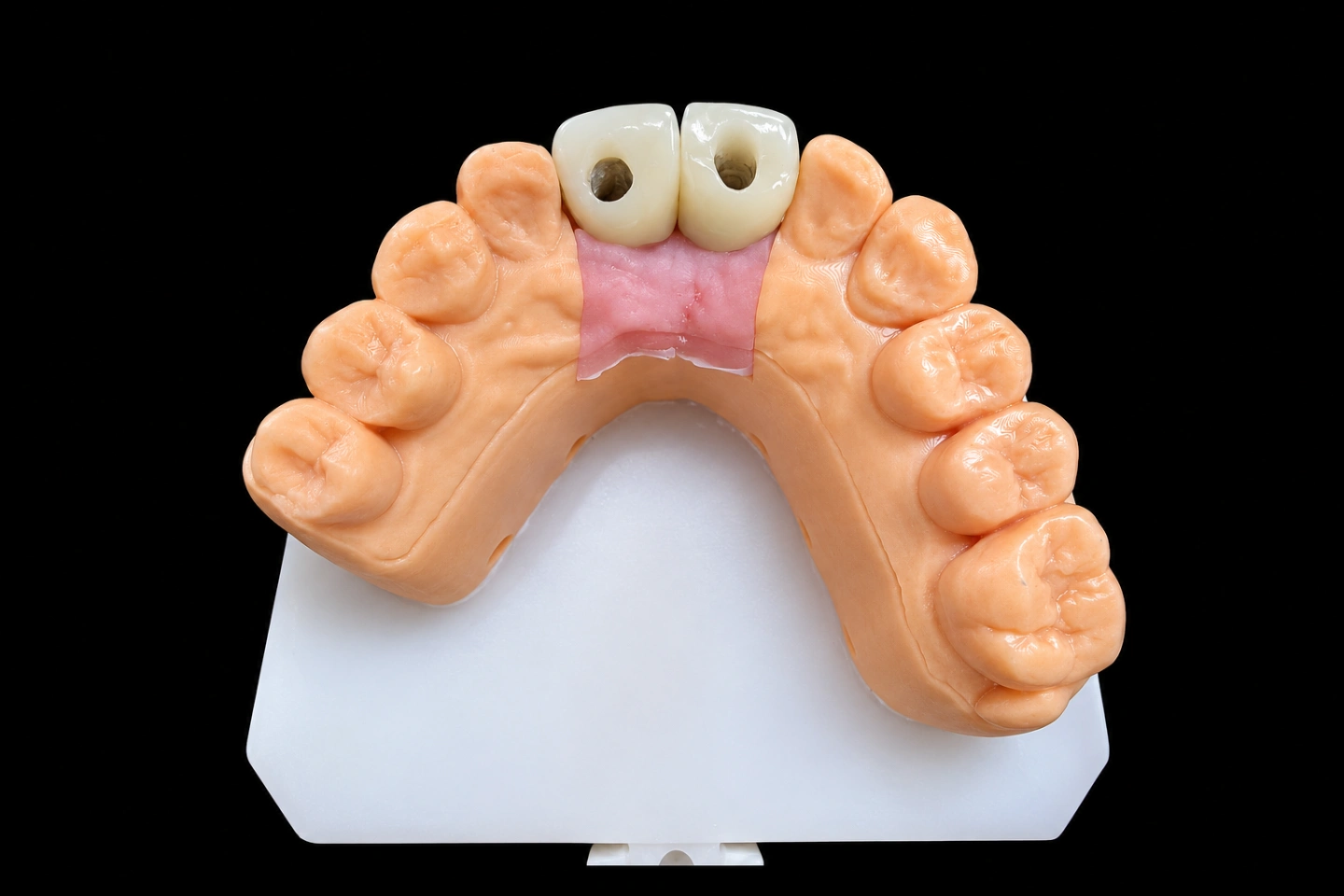
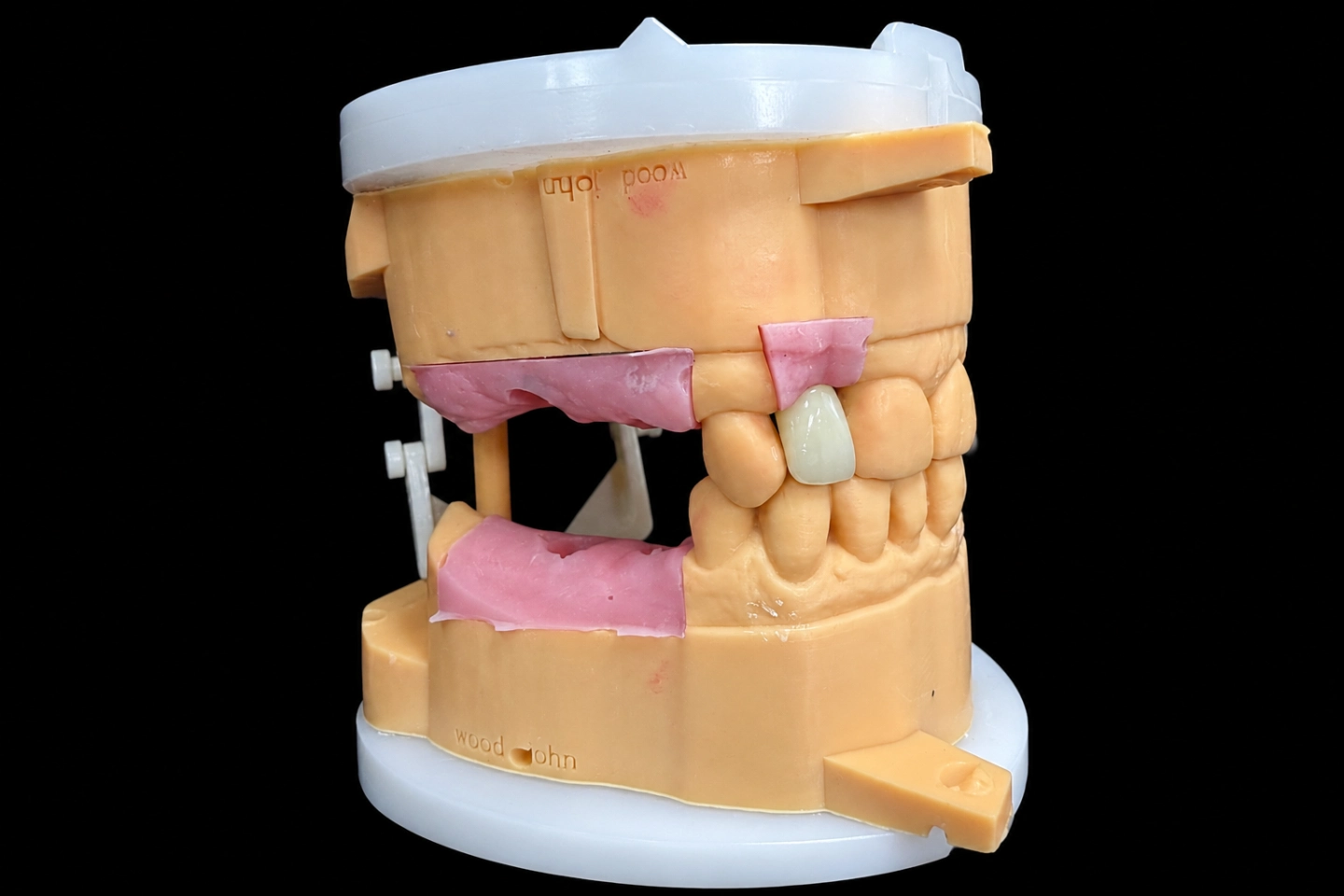
Cases from our lab
FAQ
How long is the product designed to serve?
Three to six months is the usual window, bounded by osseointegration and soft tissue maturation. Beyond six months the product is being asked to do a definitive restoration’s job, and delivering the final is the better answer than extending the interim.
Does the surface discolor over that window?
Milled PMMA takes on surface staining from coffee, red wine, and tobacco over time; abrasive toothpaste wears the polish that resists it. Replacement for esthetic reasons is not recommended inside the first three months of healing, because every change in that window disturbs the forming tissue.
When does a fracture call for a remake rather than a chairside repair?
A superficial chip on an incisal edge or a buccal surface can be composite-repaired at the chair. Any failure through load-bearing structure, and any separation between the crown and its Ti-base, is a remake. An in-vitro study of PMMA crowns on titanium bases found complete debonding of this interface when crowns were removed for scanning, which is also why intraoral scanning of the final setup is preferred over off-mouth scans of an interim still in service.
What case information is required before production starts?
Implant system and platform, scan body model (for digital cases) or impression type (for analog), bite registration, shade and photographs for anterior cases, and the loading protocol the restoration is being built for. The digital library attaches to the scan body, not the implant brand, so the scan body SKU is required rather than optional.
Does the final restoration inherit shade from the provisional?
No. The provisional defines position and shape; shade is matched independently at the definitive stage from fresh photographs and a tab against the natural dentition. The provisional does hand off form — incisal edge position, buccal corridor, and the subgingival contour — which is why clinics are asked to send the previous provisional back with the final impression.
Is production ever paused after a case is opened?
Yes, when a required field is missing on the Rx. The clock pauses, your coordinator contacts the clinic the same day, and production resumes once the gap is closed. Starting without a confirmed scan body SKU or platform specification is the main avoidable cause of a remake.
Ordering
Istar Digital Dental Lab has fabricated implant and prosthetic restorations since 2012 from facilities in Shenzhen and Huizhou. Custom restorations shipped to the US are produced under FDA establishment registration and product listing, which covers the restorations and not the implant fixtures.
Send a case for quotation, or ask a technical question about a specific configuration first.
For related products, see our implant restoration line, crown and bridge laboratory, zirconia restorations, digital workflow, and All-on-X sequencing notes.