Full Arch Dental Lab: All-on-X Arches Designed to Seat Passively
When a full arch doesn’t seat, the remake is the smaller cost. The bigger one is another appointment, more chair time, and a patient left waiting in a provisional. Istar Digital is a full arch dental lab set up to keep that from happening. A dedicated full-arch team in our implant department of about 80 people takes your case from scan to shipping, in our own labs in Shenzhen and Huizhou.
You approve every design before milling, and you can try the arch in PMMA first. The final arch reaches you only after it has seated on the model under its own weight, with the screws loose.
Full Arch Restoration Options
We design, make and inspect every full arch restoration below in our own labs, and nothing is sent out to another lab. We choose the structure with you, based on the restorative space and the strength the case needs. If the space or the load looks tight, the design preview tells you before anything is milled.
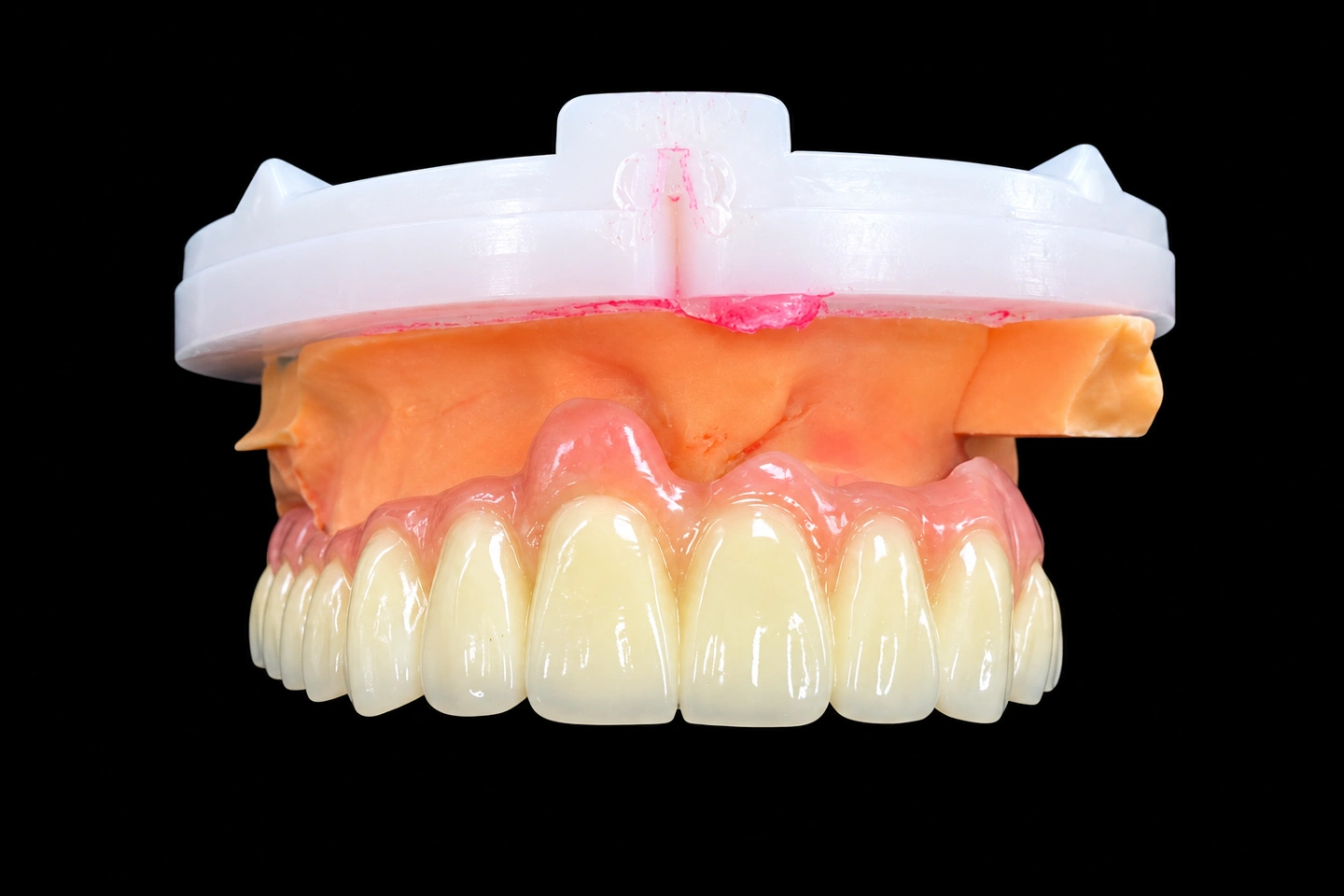
Monolithic Zirconia Arches
One piece of zirconia from the fitting surface to the occlusal table, with no veneering porcelain on the teeth to chip. In a 2026 umbrella review of complete-arch implant prostheses, veneer chipping was one of the most common technical problems, and monolithic zirconia showed fewer technical complications. Best for: heavy bites, bruxism, and patients who want an all-ceramic arch. → Zirconia brands and grades: Zirconia Dental Lab
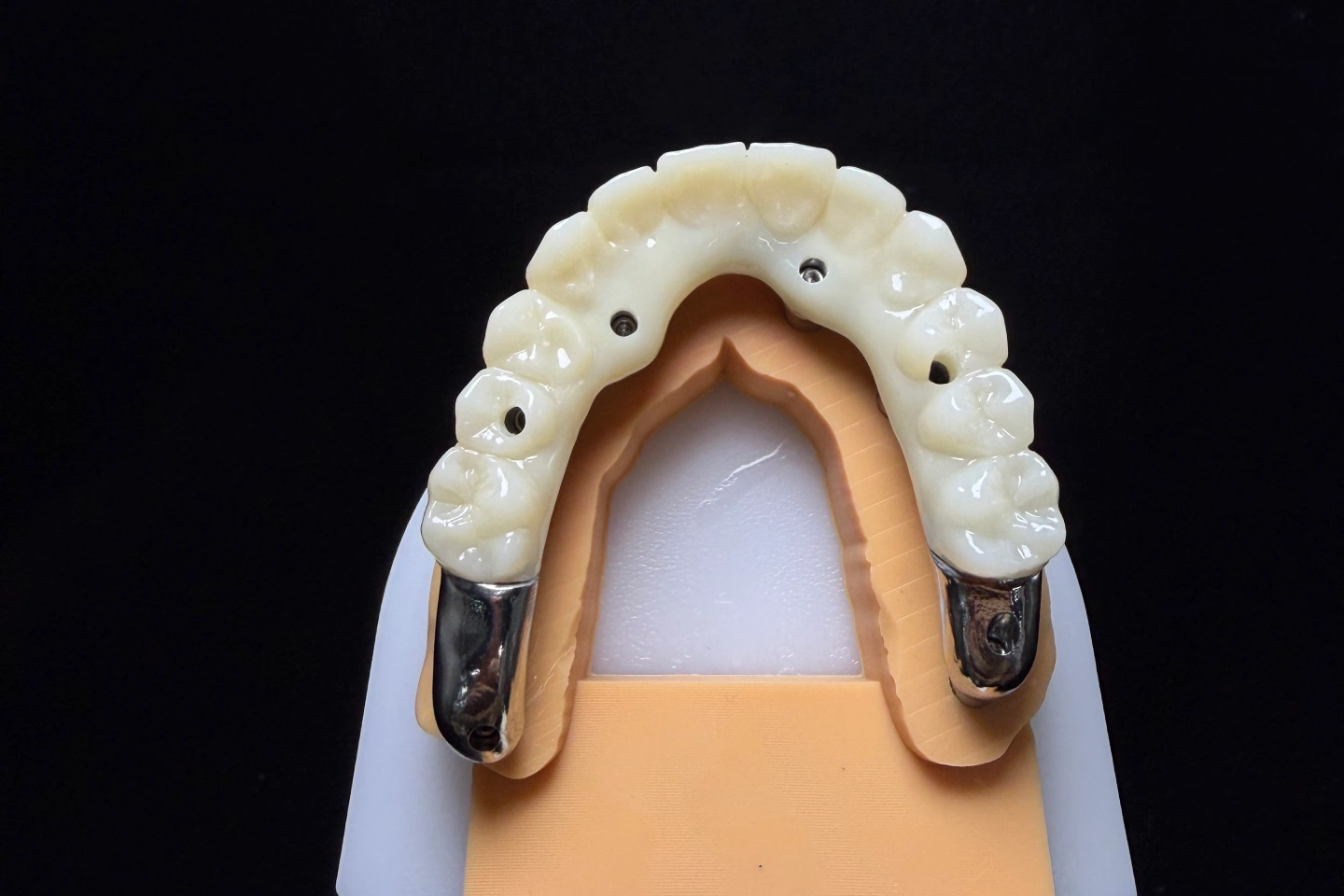
Titanium Bar Hybrids
Zirconia, resin or PMMA teeth on a titanium bar designed for passive fit. The bar leaves cleaning clearance above the mucosa and enough bonding area for the teeth. We can supply the titanium bar and the multi-unit abutments with the case, at extra cost. Best for: cases where you want a metal framework under the teeth.
PFM Full Arches
Porcelain fused to a metal framework, for cases that need strength and durability under heavy occlusal load and where cost matters more than top-tier esthetics. Best for: heavy load, long spans, and budget-conscious treatment plans.
Immediate-Load Provisionals and Prototypes
PMMA provisional bridges for loading on the day of surgery, and PMMA prototypes for testing the bite, vertical dimension, midline and lip support before the final arch. A prototype takes 2–4 working days in our lab. Best for: day-of-surgery loading, and any arch you want to try in first. → Implant Provisionals
For a removable option, our denture team makes implant overdentures on Locator, bar and other attachments → Denture Lab. Surgical guides are 3D printed in 2–3 working days. Single implant crowns, custom abutments and implant bridges → Implant Dental Laboratory.
How Our Full Arch Dental Lab Gets an Arch to Seat
Many fit problems start before milling: a scan that drifted across the arch, a bite taken too low, or a prototype adjusted chairside and then copied. So each of those points gets a check here, and the case moves on only when you say so.
1. We Check Your Scan Across the Whole Arch
Usable data confirmed within one working day.
- If anything is wrong, such as noise, holes, a wrong bite or a stitching step, you hear about it right away.
- We check the scan against reference markers or a model, comparing arch width and the bite on both sides.
- If the scan is clearly off, we ask for a rescan instead of designing on it.
Your part: with many implants, wide spacing or a long span, confirm the implant positions with a verification jig in the mouth before you send the scan.
Why full-arch scans drift: with no teeth to anchor the stitching, small errors between scan segments add up across the arch. A 2025 systematic review in Clinical Implant Dentistry and Related Research found that, in laboratory studies, complete-arch intraoral scans showed angular deviations beyond the threshold usually accepted for passive fit.
2. You Approve the Design
Nothing is milled until you say yes.
- Vertical dimension, midline and lip support come from the old denture or wax rim, the face-bow record and the patient photos.
- Contacts are even with no lateral load on the implants, lighter on cantilevers, and broad and flat for bruxers.
- Screw access comes through the occlusal surface wherever the implant axis allows. Angled channels stay within the manufacturer’s limit and need your OK.
- The fitting surface is smooth and convex, with at least 2 mm of cleaning space for floss and interdental brushes.
Your part: review the occlusal, buccal and lingual views, connector cross-sections, screw-hole positions and contact map. Anything that worries us is flagged on the preview, and two rounds of revisions are included.
3. You Try It In First, If You Like
Test the arch in PMMA before it’s final, in 2–4 working days.
- What you approve on the prototype carries into the final arch: occlusion, vertical dimension, contours and screw channels.
- The fitting surface isn’t copied, because it may have been adjusted chairside. We rebuild it from the implant library.
- The final arch keeps the shape you approved and still seats passively.
Your part: check the bite, vertical dimension, midline, lip support, esthetics and seating, then post your notes in the case chat.
The 2025 review above still recommends a rigid prototype try-in, even with the more accurate capture method it studied.
4. It Seats Before It Ships
Screws loose, no pressure, no rocking.
- Zirconia distortion is controlled from design to furnace, with even thickness and supported sintering, and the seat is rechecked after sintering.
- Zirconia is bonded to titanium bars in-house, with no cement left at the implant interface.
- The arch has to settle onto the analogs under its own weight; the screws never pull it down. Midline, arch width and occlusal height are checked on both sides.
- Two people sign off every arch. One that fails is adjusted or remade, never shipped.
- Screws and small parts are counted, labeled, marked non-sterile and double-checked before packing.
When a Full Arch Doesn't Seat
Start with the data, not the framework. Check the scan and implant-position records first, then the model or verification jig, and only then the framework. Send us photos, and we’ll work through it with you.
We find the cause before we remake anything, because a remake built on the same faulty record will fail the same way. For a fit or bite problem, we’ll usually need a new scan, model or impression. A fracture on an arch that seated well can often be remade from the original data. Failed cases also go through a root-cause review across our departments, and the fix goes into our checklists. → Remake and Warranty Policy
Restoring Full Arch Dental Implants With an Overseas Lab
Distance only matters when something has to travel. When you restore full arch dental implants with us digitally, most of the case moves as data.
Lab Time, Stage by Stage
Lab time counts in working days from the day a complete case arrives: 2–3 for a surgical guide, 2–4 for a PMMA prototype and 5–7 for the final arch. Your try-in and transit time come on top. If you send 10 or more cases a month, rush service is free for every case type. We guarantee a rush case’s ship date, but arrival depends on transit and customs.
What Ships, and Who Pays
Scans, design previews and approvals go back and forth online. Only the prototype and the final arch have to ship, and we pay to send finished work to you, remakes included. You pay shipping only when you send us something physical, such as an impression, a model or a verification jig. We’ll ship to any address you name, such as your clinic or a partner lab.
One Contact, No Surprises
Every full-arch case gets its own case chat with a dedicated contact, so your notes reach the people designing your arch. If a production issue could affect your date, we tell you as soon as it happens, with the cause, the expected delay and your options. We never use a damaged or mismatched component; we tell you instead.
Components on Your Terms
You decide whether we use original or compatible components, and nothing is substituted without your consent. We can supply titanium bars, multi-unit abutments, temporary cylinders, screws and tools with the case. Original parts cost the manufacturer’s price plus our fabrication fee; compatible parts cost less. Every component’s batch number and supplier is on record.
Itemized Quotes
The number of units sets the base, and the structure and material set the unit price. Components and design complexity are added on top. Every quote is itemized to your prescription, not bundled into one figure. Your sales manager sends the current price list on request.
Warranty and Credentials
Full arch restorations carry a 3-year warranty; implant components aren’t included in a free remake. Istar Digital is an FDA-registered establishment, Registration Number 3039441248, listed in the FDA establishment registration database for custom restorations, including implant superstructures but not implant bodies. Our labs run an ISO 13485 quality management system, and restorations for the EU follow the MDR custom-made device procedure.
Full-Arch Design and Milling for Dental Labs
Short on full-arch capacity? Send us the whole case or just part of it: full-arch CAD design only, milling and sintering of your designs, or full production. We work in editable exocad and 3Shape files, using your implant libraries and design parameters. If you send your own design for production, we mill it as designed and tell you if we spot an obvious problem.
Work goes out under your name, and we never contact your dentists.
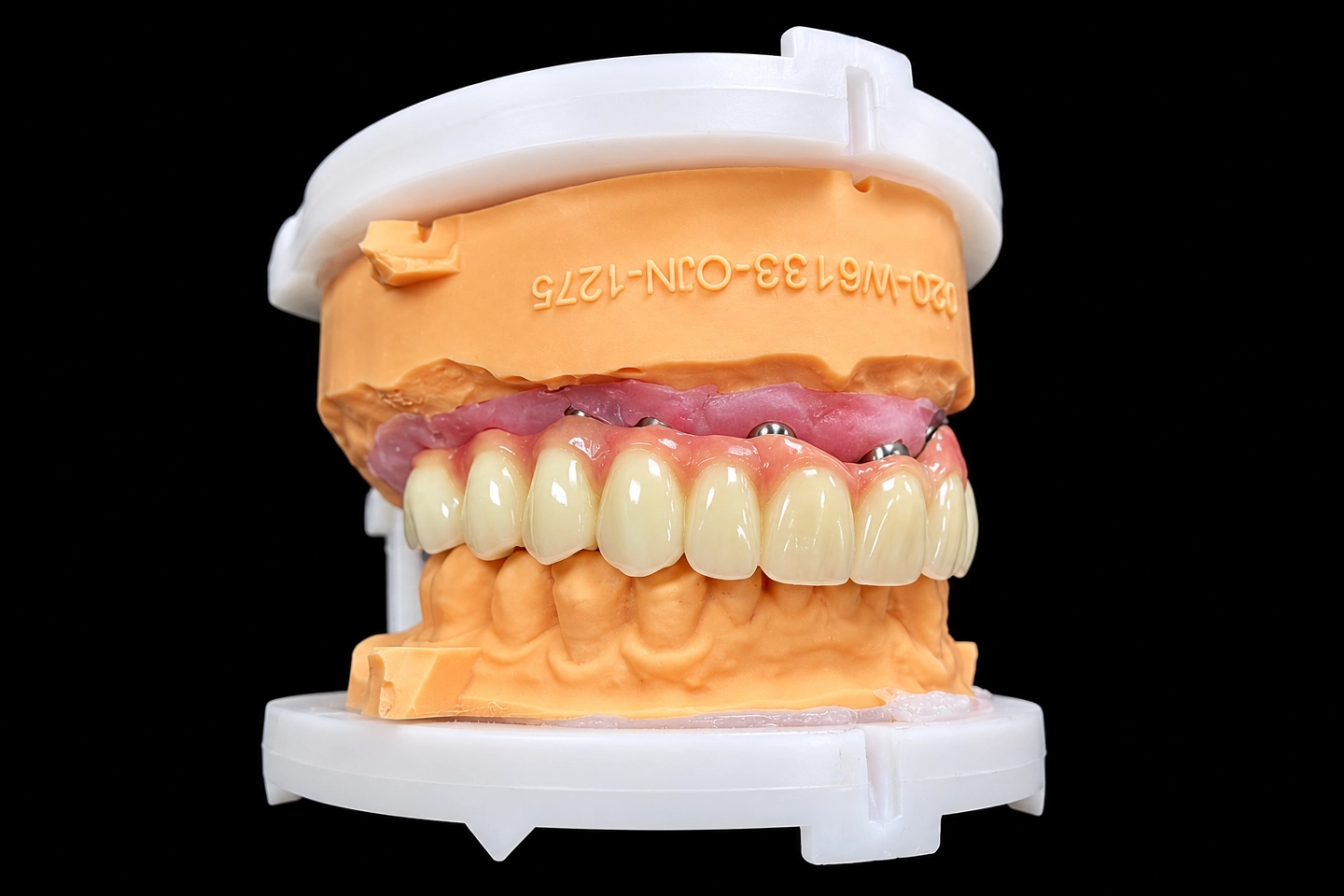
Cases from our lab
Frequently Asked Questions
How should we check passive fit in the mouth?
We seat every arch on the model before it ships, but the mouth has the final say. One protocol published in The Journal of Prosthetic Dentistry combines three checks: tactile feedback while the screws are tightened, a one-screw (Sheffield) test read visually or on a radiograph, and torque-time graphs from a torque-controlled motor.
How do we keep stitching error down on a full-arch scan?
Scan continuously in one direction with at least 30% overlap, and use stable anatomy as stitching references. Keep the patient’s head still and control moisture. Capture the centric bite in one complete pass, and check the stitched model for steps before you send it. If you see a misalignment, rescan right away.
Can we choose the zirconia or PMMA brand?
Yes. We work with imported zirconia from Zirkonzahn, 3M (Lava) and Ivoclar (Wieland), with zirconia made in China, and with PMMA from Ivoclar and a Chinese manufacturer. If you prescribe a specific brand, we produce in that brand. We never change a material without your consent.
What isn't covered by a free remake?
A change of shade or material at your request, and a case you asked us to make as best we can from an impression we’d flagged as poor.
The bite is right on the model but high in the mouth. What should we send?
Mark where the high spots are in centric, protrusive and lateral movements, check the scan or impression for distortion, and send a new intraoral scan or bite record. We’ll recheck the bite on our side and find the cause before anything is changed.
What torque should we use on the prosthetic screws for full arch dental implants?
Use the torque in the implant system’s instructions for use. We can give a reference value, but the manufacturer’s figure is the one that counts.
Can we start with a single full-arch case?
Yes, and many new clients do. The quickest way to judge a full arch dental lab is to seat its work. Single trial cases are welcome, and an ongoing partnership works best with a regular flow of cases.
Send Your Next Case to Our Full Arch Dental Lab
What to Send
- A full-arch scan with scan bodies, exported as PLY, plus the opposing arch
- A bite in PVS or polyether, not wax, which softens in transit and leaves the bite low
- A face-bow transfer or esthetic photos, and CBCT data
- Photos of the implant labels showing brand, platform, connection and scan-body model
- The old denture or a wax rim, so we can see the starting vertical dimension
- If the arch replaces lost tissue, gingiva photos with a shade tab in the frame. We layer the gingiva against color-calibrated photos, not screen colors.
→ File formats and scanners: Send a Case guide
For Your Quote
Tell us which implant systems you restore, whether the case is upper, lower or both, and the structure you have in mind. Let us know if you’d like a prototype stage, and whether we should supply the titanium bar or the multi-unit abutments. Include your approximate monthly full-arch volume. Your sales manager will reply with the price list and confirm we have the libraries for your systems.