Patient Situation
This patient’s full mouth dental implants for seniors started from a familiar place. They were 74 and had worn complete dentures on both arches for about 22 years . The current upper denture was nine years old . Its back teeth were worn flat .
The surgeon worked on each arch differently :
| Lower arch | Upper arch | |
|---|---|---|
| Implants | Four: #20, #22, #27, #29 | Six: #4, #6, #7, #10, #11, #13 |
| Abutments | Multi-unit; 30° at #20 and #29, straight at #22 and #27 | Placed later, at the final stage |
| Bone work | None | Sinus floor lift on both sides, done when the implants went in |
| Loading | Immediate: the clinic converted the old lower denture into a fixed acrylic bridge chairside | Not loaded; the patient kept wearing the old upper denture over the implants, relined soft by the clinic |
| Ready for the final | About four months after surgery | About five months after that |
That split is common in full mouth implants for seniors. The ITI consensus on loading protocols for edentulous jaws lists sinus floor lifts done with implant placement as a relative contraindication for immediate loading. So the upper waited, and the lower didn’t.
Two more things mattered for planning. The patient lived 90 minutes from the clinic, and their spouse did the driving . Fewer visits counted. And there was no grinding or clenching on record .
We didn’t place the implants. For full mouth dental implants for seniors, our part is everything that goes on top.
What the Dentist Asked For
The Rx for these full mouth dental implants for seniors listed five points :
The fifth point fits full mouth implants for seniors well. A 2025 meta-analysis of implant patients over 65 found five-year implant survival of 96.8% in patients over 75 and 92.1% in the 65 to 75 group. The over-75 group also had more plaque and more bleeding on probing. So age wasn’t a barrier in those studies, but cleaning access counts for more as patients get older.
Records came in one box and one upload : a facebow record, photos at rest and in a full smile, a scan of the old upper denture, a scan of the lower immediate bridge on and off the mouth, scan bodies on the four lower abutments, a VPS bite, and the post-op CBCT with the planned upper implant positions.
What the Full Mouth Setup Showed
Every full arch case gets a design review before production. With full mouth dental implants for seniors done in stages, we go one step further: we set up both arches as one, even when only one is on the order.
We used the facebow, the photos, and the old denture to place both arches. The upper implant positions from the CBCT went in as reference only, not as production data. Then we laid the old upper denture over that setup.
Three readings didn’t agree with the Rx’s plan to copy the old upper :
| Check | Old upper denture | Full mouth setup |
|---|---|---|
| Plane at the first molars, against the facebow reference | Left side 1.5 mm lower than the right | Level side to side |
| Back teeth | Worn flat, no cusp height left | Shallow cusps on both arches |
| Upper midline vs facial midline | 1.0 mm to the left | On the facial midline |
Why a tilt matters more in zirconia
A denture tooth can be ground and reset. A monolithic zirconia bridge can take small contact adjustments, but not a 1.5 mm change in plane.
If we’d built the lower to the old upper, the tilt would have gone into the zirconia. Then, five months later, the upper bridge would have had two choices. Follow the tilt, so the upper left teeth sit 1.5 mm lower and the smile line slants. Or level the upper and leave the left side short of contact. Neither suits full mouth dental implants for seniors that are meant to last.
Options We Sent the Dentist
It wasn’t our call which plane these full mouth dental implants for seniors would follow. We sent the overlay, the numbers, and three options through the case’s WhatsApp group :
| Option | What it involves | The catch |
|---|---|---|
| 1. Build to the old upper | Lower zirconia set to the current denture, as written | Fastest, but the tilt gets locked into the lower, and the upper has to match it later |
| 2. Build to the full mouth setup | Lower zirconia set to the leveled plan. We also make a new upper interim denture with its teeth set to the same plan | One try-in visit for both arches first, plus the cost of the interim denture |
| 3. Wait and do both together | Lower stays in a PMMA bridge made from the setup. Both finals are made once the upper is ready | No interim denture, but the lower final waits about five more months |
The dentist and patient picked option 2 . It meant one extra visit, not several. And for the five months of waiting, the patient would wear an upper denture set to the new plane, not the old tilt.
Trying In Both Arches at One Visit
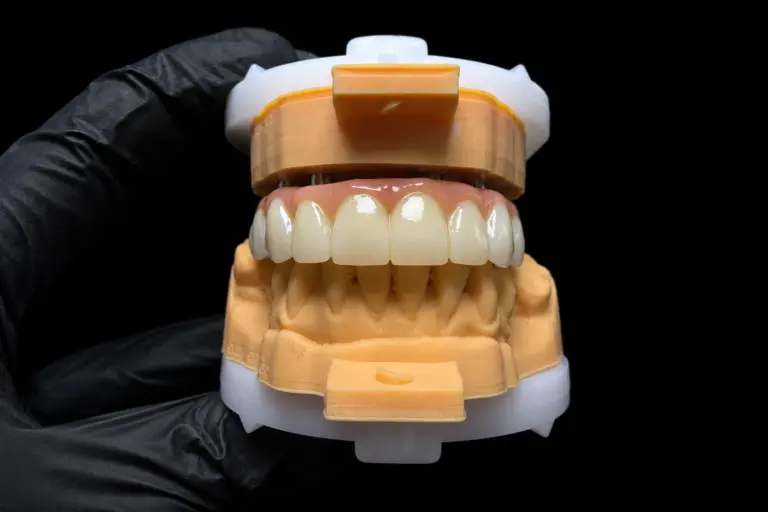
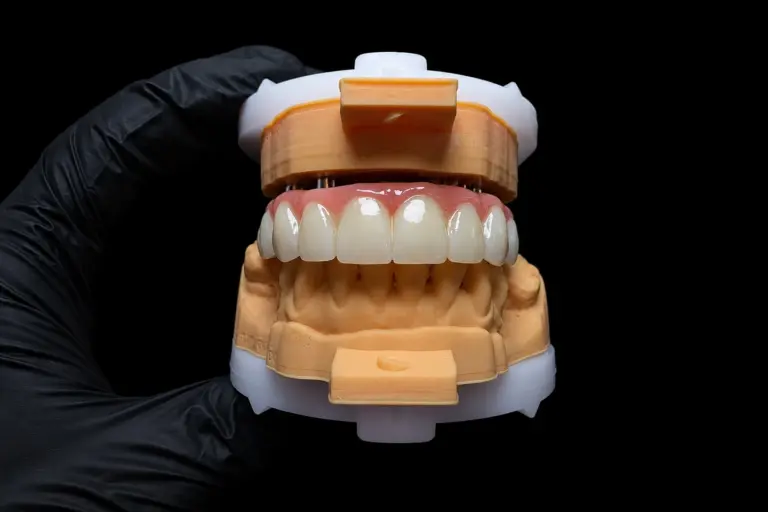
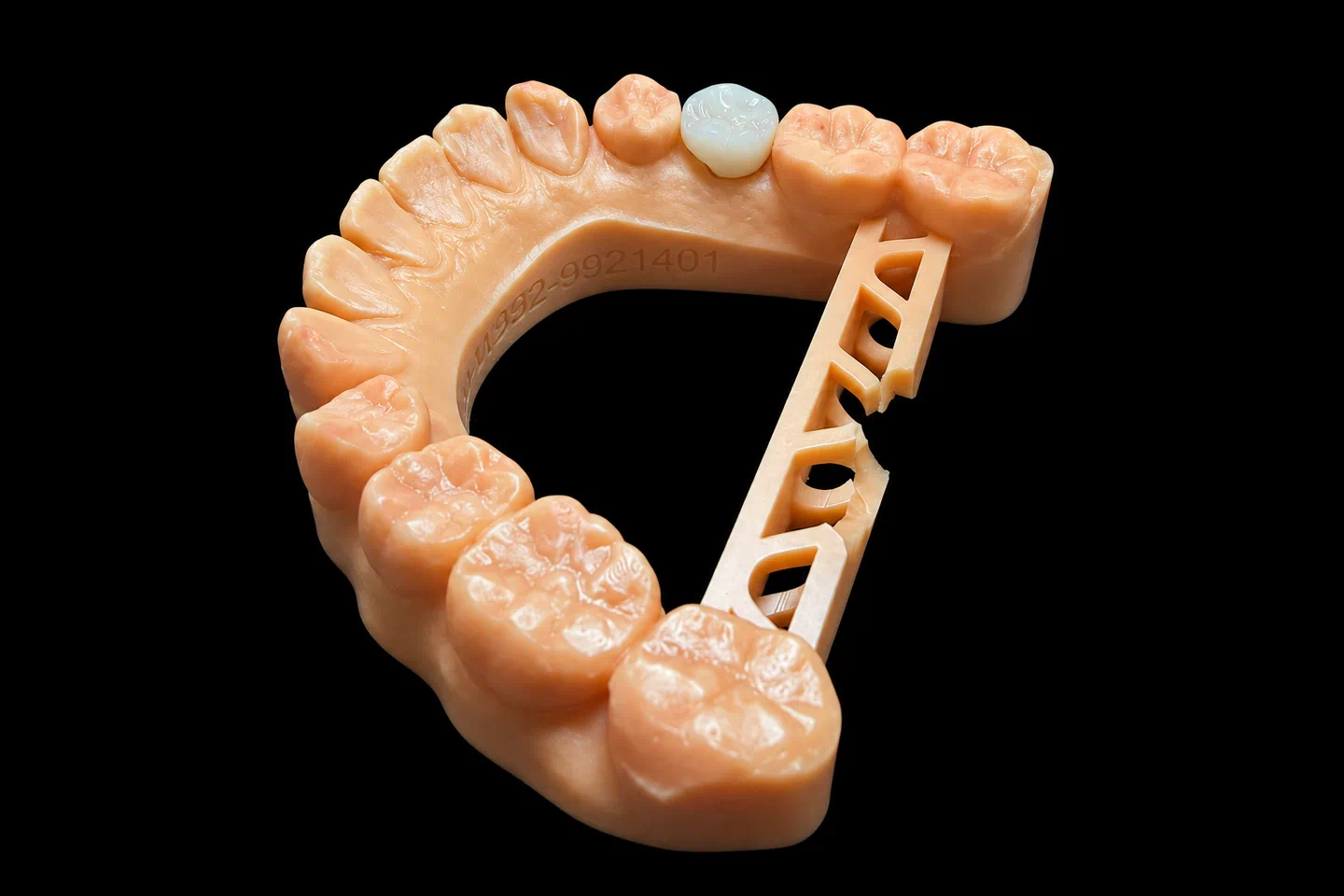
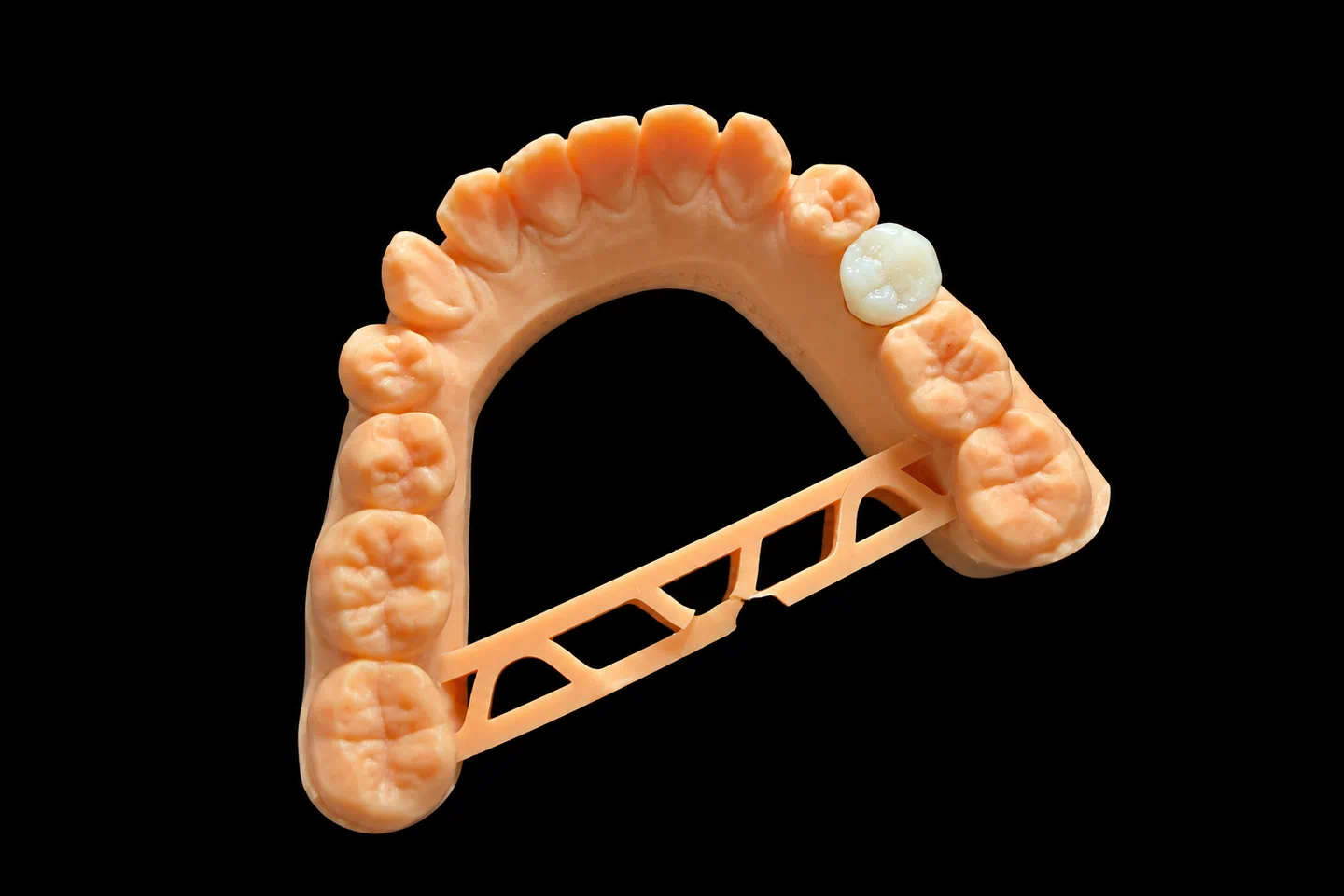
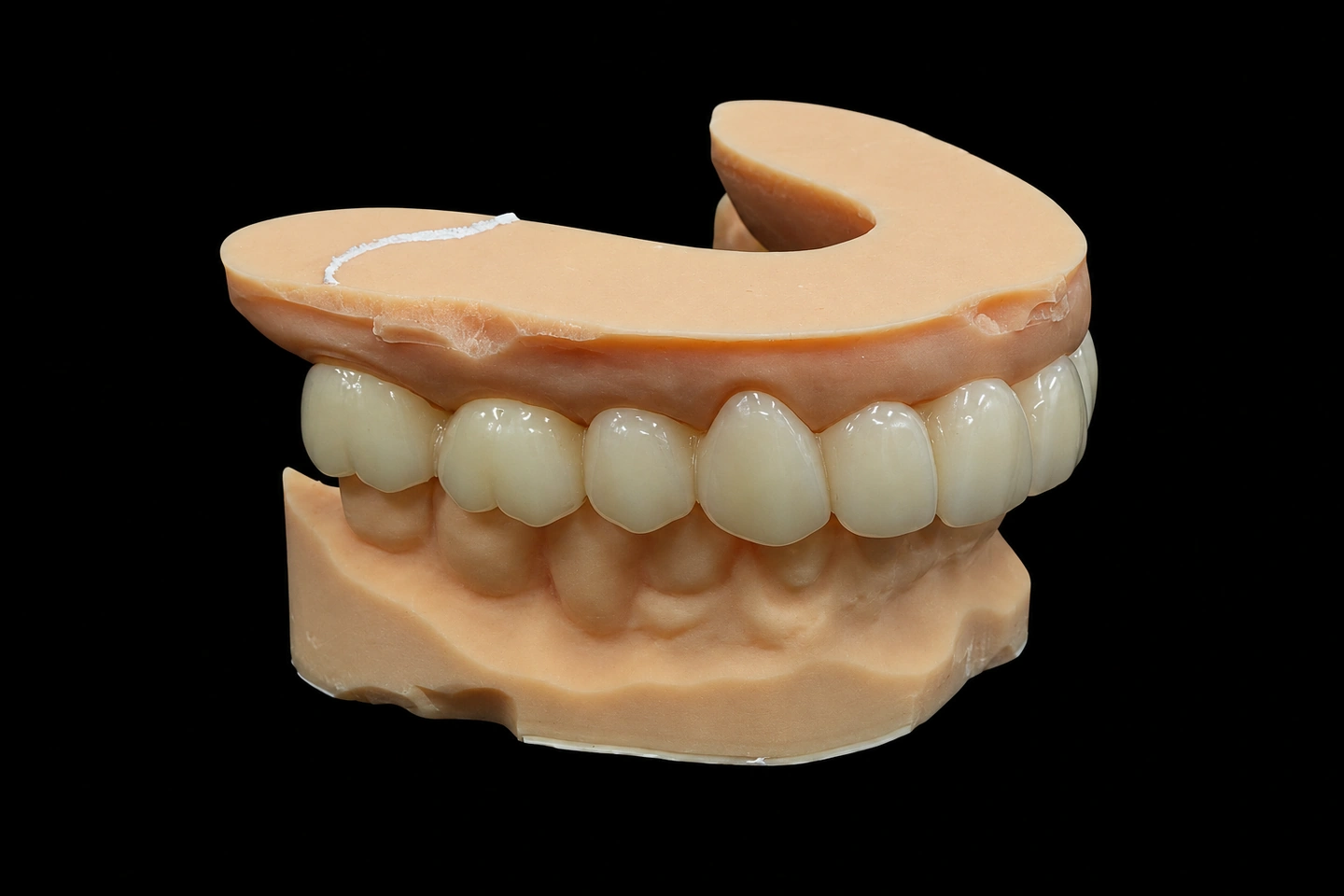
For the try-in, we shipped two pieces in one box :
That way the dentist checked the new plane with both arches in the mouth at once: bite, vertical, midline, lip, smile, speech, and fit of the lower prototype. For full mouth implants for seniors who travel far, one visit for both arches is worth planning for.
Here’s what came back :
Two changes. Nothing else moved.
Making the Lower Zirconia Bridge
From prototype to final design
On full mouth implants for seniors, the prototype is the reference, not the old denture. We lined up the approved prototype scan with the implant connections. Bite, tooth position, outer shape, and screw channels came across from the prototype. The tissue side didn’t. We rebuilt all four connections from the implant library and shaped the underside smooth and convex, with at least 2 mm of space for a water flosser and interdental brushes.
Then the dentist approved the final design: occlusal, facial, and lingual views, connector cross-sections, screw channel positions, and contact points .
Passive fit, sintering, and sign-off
The upper interim denture was made in heat-processed acrylic with the two try-in changes. Both shipped together, so the dentist could deliver them at one visit .
How does monolithic zirconia hold up in a full arch? A 2018 retrospective study of 2,039 complete-arch zirconia prostheses, all from one commercial lab, reported a five-year cumulative survival of 99.3%, with six fractures. Porcelain was used only in the gum area. It’s practice-based data with short follow-up, not a study of full mouth dental implants for seniors in particular, but it supports the material choice.
The Upper Arch, Five Months Later
When the surgeon cleared the upper implants , the clinic sent scan bodies on six multi-unit abutments and a scan of the interim denture, in and out of the mouth .
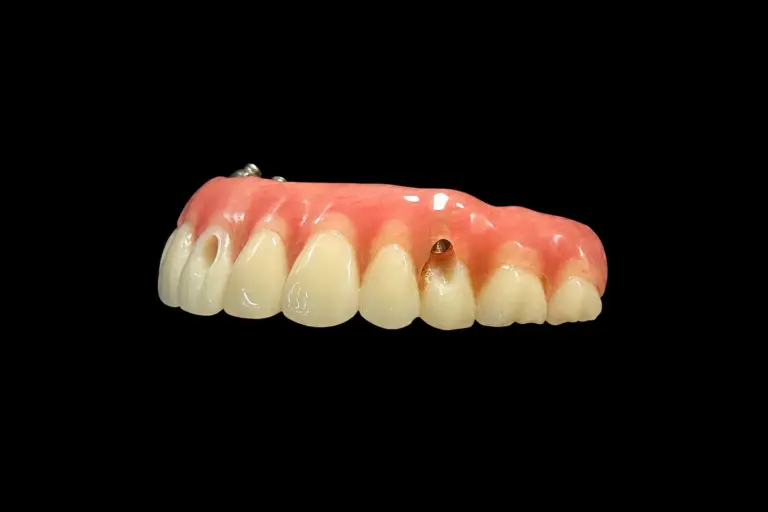
This is where option 2 paid off for these full mouth dental implants for seniors. The interim denture already held the plane, midline, and tooth lengths both arches had been tested with. We copied it into the upper bridge design, checked the six screw channels against it, and made an upper PMMA prototype .
At the upper try-in :
The final upper bridge for these full mouth dental implants for seniors, monolithic zirconia with pink only in the gum area , went through the same fit, sintering, cross-arch, and sign-off steps as the lower.
The Finished Full Mouth Dental Implants for Seniors
Feedback after delivery
Both bridges seated at their first appointment. One-screw test passed on all ten abutments, and X-rays showed no gaps . Screws were torqued to the implant maker’s values. No adjustments needed on the upper; a light polish on the lower right .
Liked that the new teeth looked the same from the try-in to the end, and found the water flosser easy to use under both bridges . Six clinic visits from the lower records to the upper final, counting deliveries .
What this case still needs
Two fixed zirconia arches don’t look after themselves, and the plaque finding in older implant patients is one more reason to keep full mouth implants for seniors on a recall list. The dentist booked regular checks with the bridges off, to look at the screws and the tissue underneath .
Full Mouth Dental Implants for Seniors Timeline
| Stage | Time |
|---|---|
| Lower records in, full mouth setup, dentist told | Working days 1–2 |
| Setup approved; lower PMMA prototype and upper wax try-in shipped | Working day 4 after approval |
| Two-arch try-in visit, feedback sent | 1 clinic visit |
| Lower zirconia bridge and upper interim denture | 6 working days after design approval |
| Upper records in, upper PMMA prototype shipped | 4 working days |
| Upper try-in visit | 1 clinic visit |
| Upper zirconia bridge | 7 working days after design approval |
Sending Us Full Mouth Implants for Seniors
Finishing one arch before the other? Note it on the Rx form and send:
Who Made It
These full mouth dental implants for seniors went through our implant dental laboratory. Full arch cases there go to a dedicated team inside an implant department of about 80 technicians. A separate QC team of about 25 inspected both bridges before they shipped.
Istar Dental Lab runs four labs in Shenzhen and Huizhou, China. We started in 2012, we have about 460 people, and nothing gets outsourced. We’re an FDA-registered establishment (Registration Number 3039441248), and you can look us up in the FDA establishment registration database. Our labs run an ISO 13485 quality management system, and custom-made work for EU clinics follows the MDR custom-made device procedure. Want to see the full arch line? Visit the factory or book a video tour.
Full Mouth Dental Implants for Seniors FAQ
Do you work with my implant system?
Most likely. We restore most systems on the market. Send the label photos and your scan library name, and we’ll confirm before you ship.
Can you supply the parts?
Yes: titanium bars, multi-unit abutments, temporary cylinders, screws, and tools. They’re charged separately.
Does it have to be monolithic zirconia?
No. For full mouth dental implants for seniors, we also make titanium bar with zirconia, titanium bar with PMMA, and PFM. Space and strength usually decide it. Our All-on-X page covers the options.
What if I'd rather build to the old denture anyway?
We’ll explain why it worries us. If you want to change the plan, we change it. If you’d rather go ahead, we build to your Rx, with no sign-off form needed. Remakes caused by that choice aren’t on us.
How long does each final take?
For full mouth implants for seniors, each arch’s final takes 5–7 working days after you approve the design. Try-ins, clinic visits, and shipping come on top of that.
What does the warranty cover?
A full arch implant bridge carries a 3-year warranty. Problems on our side, like a bridge that won’t seat or a high bite, get adjusted or remade free. You pay to send records in, and we pay to ship finished work back, remakes included.
How does pricing work?
We don’t publish prices on the website. Ask for our price list, and we’ll quote each case item by item, so you can see what the setup, try-ins, and interim denture add. Single trial cases are welcome, and ongoing partnerships suit clinics with a regular case flow.
Send Us Your Next Two-Arch Case
Planning full mouth dental implants for seniors in your practice? Start with one case and see how we work.