Patient Situation
The patient was 15 . Both upper laterals had never formed, so there was no extraction and no socket. Each space had a narrow ridge that had never held a tooth .
The orthodontist had opened the spaces with braces instead of closing them . Whether to open or close is a clinical choice, and AAPD’s guidance on the developing dentition leaves it to the individual case.
Implants in a growing jaw can end up sitting short as the teeth around them keep erupting, so they’re usually put off until growth is complete or nearly complete. For this patient, the orthodontist expected at least three more years .
Case details
- Spaces: 6.4 mm at #7 and 6.0 mm at #10, measured at the contact level. Not the same width.
- Bite: about 3 mm of overbite, with the lower incisors resting on the palatal of #8 and #9.
- Neighbors: #6, #8, #9 and #11 healthy and unrestored. Canines in their own positions.
- Habits: no grinding reported. The patient plays school sports.
What the Orthodontist Asked For
From the Rx :
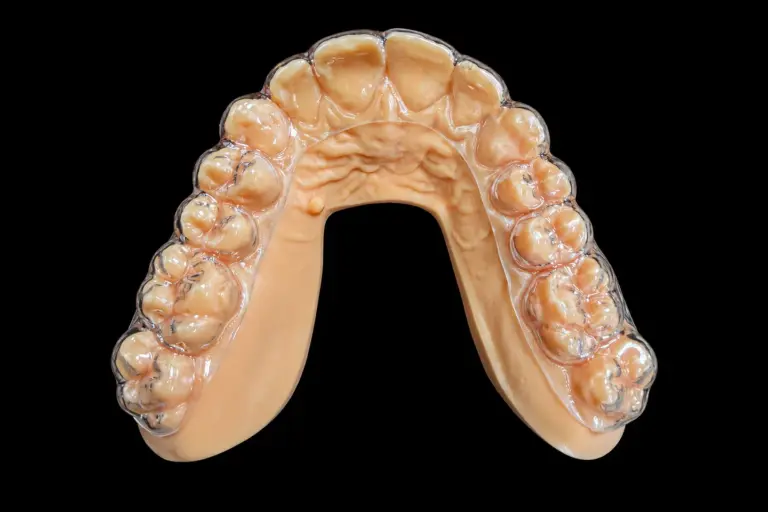
What We Found Before Building the Essix Pontic Retainer
A clear sheet was being asked to last years
A clear tray is the look most teens want. But thermoformed sheets wear, thin out and crack with daily use, and a 2024 study of Essix-type retainers looked at their wear, stiffness and service life. Those were plain retainers, not ones carrying teeth.
In an Essix retainer with pontic teeth, the sheet holds the space
In an Essix pontic retainer, the pontic is held by the sheet around it. If the pontic comes loose or the sheet splits along it, nothing stops #6 and #8 (or #9 and #11) drifting into the gap. On this case, a lost millimeter could mean an implant space that no longer fits. Picking that up at a 3-month check would already be late.
The lower incisors sit right where the sheet is thinnest
With 3 mm of overbite, the lower incisors bite on the palatal of #8 and #9. A full-coverage tray puts sheet between them on every closure, right next to the pontics. That’s added wear on the part of the tray we were most worried about.
Two spaces, two widths, one matched pair
The spaces differ by 0.4 mm . Two identical pontics would leave one too tight and one with a gap. Two pontics cut to the width would read as two different teeth in the smile, which is exactly what item 3 ruled out.
Three Ways to Build a Retainer With Pontic Tooth Replacements
We paused before design, posted the measurements in the case’s WhatsApp group, and laid out three options :
| Option | What it means | The trade-off |
|---|---|---|
| A. Essix retainer with pontic teeth, as written | Clear tray, both pontics locked into the sheet | Best look. The space depends on the sheet staying whole, and the sheet takes the lower incisor contacts |
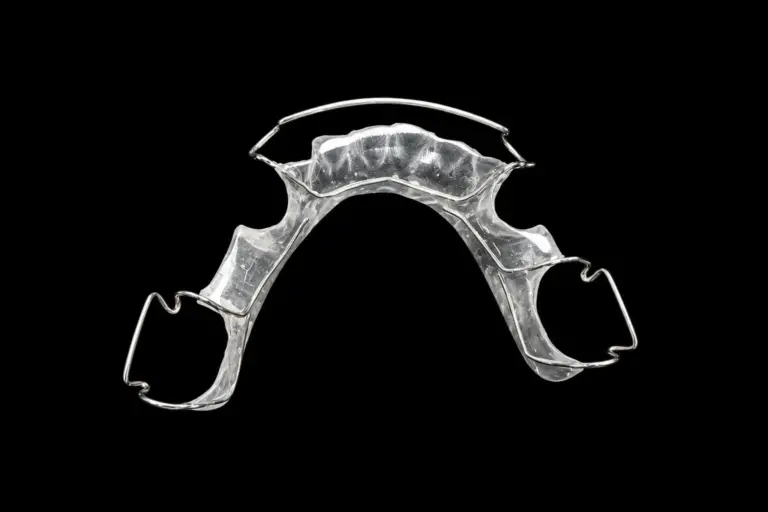
| B. Hawley retainer with pontic teeth | Acrylic palate, labial bow, clasps, pontics set in acrylic, wire stops at each space | Built to last and the orthodontist can adjust it. The wire shows and the palate is covered |
| C. Option A, plus a spare tray | Same as A, with a second tray made from the same model | Looks like A, with a backup when one cracks. Same weak spot, just twice |
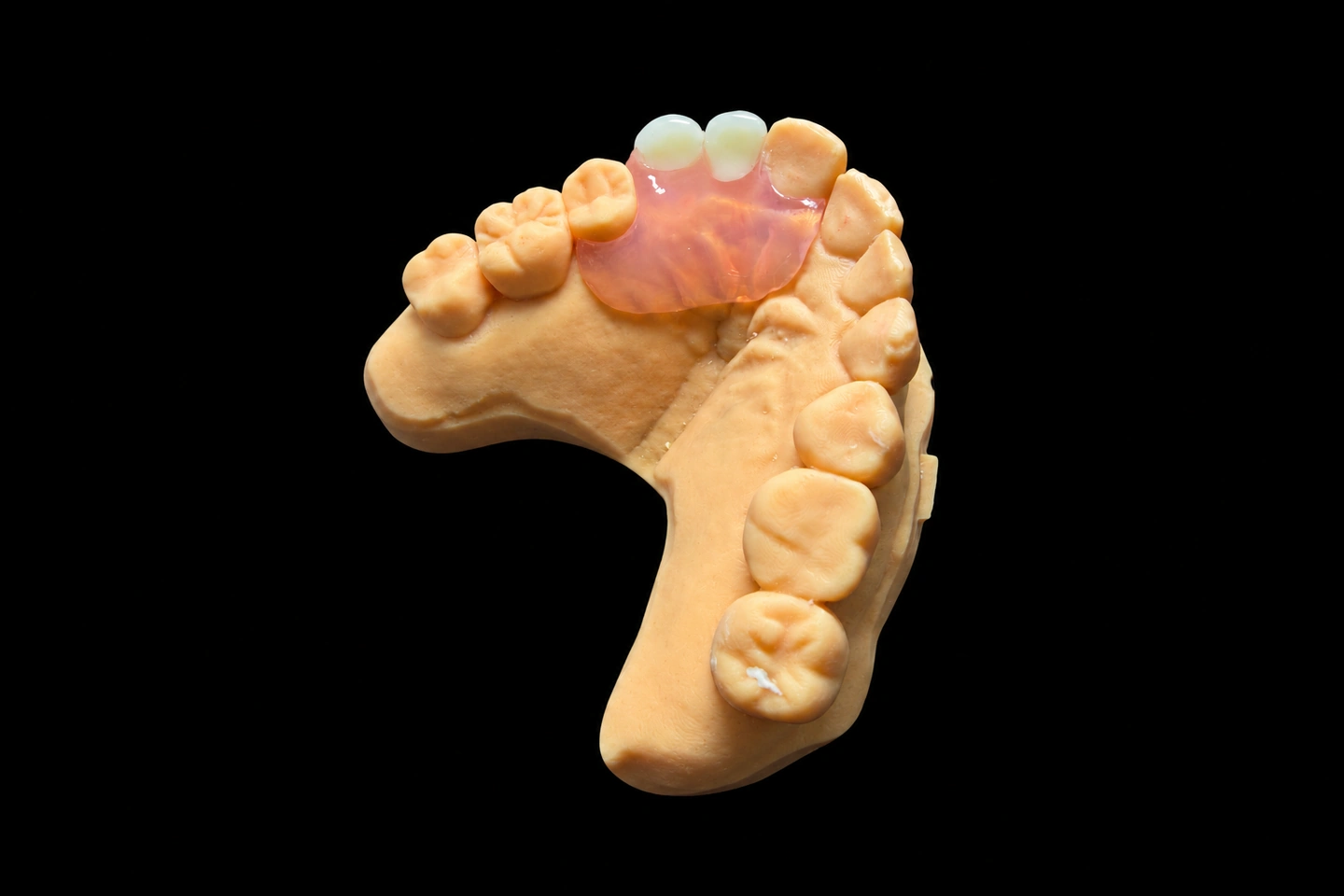
Which retainer suits the patient isn’t our call. The orthodontist went with B: a Hawley retainer with pontic tooth replacements on both sides .
The orthodontist weighed two published findings . In a randomized trial of 86 orthodontic patients, clear vacuum-formed retainers scored better for speech, looks and comfort, and Hawley retainers scored better for durability. And a comparison of periodontal health found higher plaque and gum index scores with Essix wearers than with Hawley wearers. Neither study used pontics, but for a retainer worn this long, both count.
How We Built the Hawley Retainer With Pontic Tooth Pair
Records
The orthodontist scanned both arches and the bite the day the braces came off, sent shade photos with a shade tab in view, and fitted a plain clear retainer chairside to cover the wait . We printed the upper model from the scan .
Shaping a matched pair for two different spaces
We set the two acrylic teeth as mirror images: same length, same incisal edge, same facial outline . The 0.4 mm went into the proximal surfaces at #7, with the line angles kept in the same place as on #10 . From the front, the reflections match. Only the contact areas differ.
Each pontic touches its neighbors at the contact point, snug but not wedged . That contact is part of what holds the space.
On the tissue side, each pontic is convex and just meets the ridge . No hollow ridge-lap shape for food to sit in.
Locking the pontics in and stopping drift
Each pontic got a groove cut into its palatal surface so the acrylic locks around it, not just against it .
We also added a short wire stop on each side of each space, sitting against the proximal surfaces of #6, #8, #9 and #11 behind the pontics . Metal stops help hold the space even if a pontic breaks away. Here they’re the backup to the backup.
Wirework
Acrylic and the bite
The palatal acrylic is cut back behind #8 and #9, so the lower incisors close against tooth and not plastic . We checked the scans and bite record against each other, then on an articulator, in closed bite and in protrusion.
Finishing and QC
Timeline
| Working day | What happened |
|---|---|
| 0 | Complete records received |
| 1 | Files checked, no rescan needed |
| 2 | Measurements and three options sent |
| 3 | Orthodontist picked option B |
| 8 | Shipped, tracking number sent that day |
| 13 | Arrived at the clinic |
The Finished Retainer With Pontic: Results
| Check | Result |
|---|---|
| Seating | Went in without adjustment. The orthodontist tightened one Adams clasp slightly |
| Spaces at the 6-week check | 6.4 mm and 6.0 mm, unchanged on the orthodontist’s calipers |
| Lower incisors | Clear of the palatal acrylic in closed bite. No contacts on the pontics in protrusion |
| Ridge | No blanching under either pontic at delivery or at 6 weeks |
| Speech | A slight lisp in the first days, gone by the 2-week check |
| Appearance | Pontics read as a pair in the smile photos. The bow is visible, as expected |
Feedback From the Orthodontist and the Patient
Summed up from the orthodontist’s messages after the 6-week check :
the measurements and the option table made the talk with the patient and parents short. Everyone saw the trade-off on paper before anything was made, so nobody felt the clear tray had been taken away. They plan to write “hold space for implants” and the expected implant date on the next missing-lateral Rx from the start.
was let down at first that it wasn’t clear. A few weeks in, no friend had picked out which teeth were fake. Putting it in and taking it out felt easier than with the plain tray worn during the wait, and there’s no worry about it cracking in a backpack.
What this pontic retainer can't do
It’s not an implant and it’s not a chewing tooth. The patient takes it out to eat and for sports, as the orthodontist explained at delivery . A Hawley won’t last forever either. The orthodontist checks it every few months and will order a new one if the fit or the pontics change . AAO’s patient guidance on retainers leaves the wear schedule to the orthodontist, and so does this appliance.
Sending a Similar Retainer With Pontic Case
Everything’s made in our own labs, with no outsourcing: four of them in Shenzhen and Huizhou, China, running since 2012, with about 460 people. Our retainer line makes Hawley retainers and clear retainers, with or without pontics. You can book a factory visit or a video visit with sales.
Istar Digital is an FDA-registered establishment, Registration Number 3039441248, which you can check in FDA’s establishment database. The lab runs under ISO 13485, and every appliance is made to the dentist’s Rx.
Holding a space open until the final tooth? Send us the scans and the Rx as a trial case. We’ll measure the spaces and the bite and send you the options before anything is built. Single trial cases are welcome, and regular case flow is where a partnership really pays off. Send your first case or talk to us.
FAQ
What's the warranty on a retainer with pontic?
1 year, for the Hawley and the clear version. Lab-side problems like an appliance that won’t seat, lifting edges or an inaccurate bite get adjusted or remade free. Changing the material or shade later isn’t free, and neither is a remake after you asked us to go ahead on an unclear impression.
What bite record should I send with impressions?
VPS, not wax. Wax softens and distorts in transit. VPS is our first choice for the impression too.
Do you take rush cases?
Yes, at no extra charge, for clients who send 10 or more cases a month. We guarantee the ship date. The arrival date depends on customs, so we can’t promise that.
How is it priced?
Quotes are itemized to your Rx, not one bundled price. Ask us for the price list.