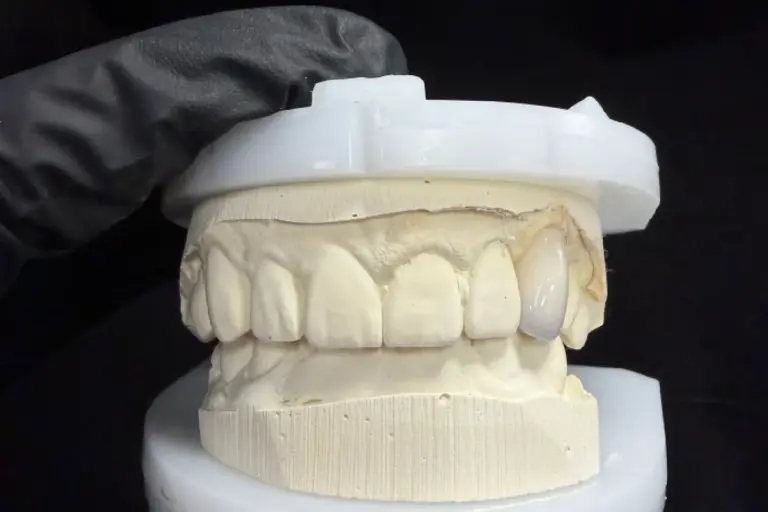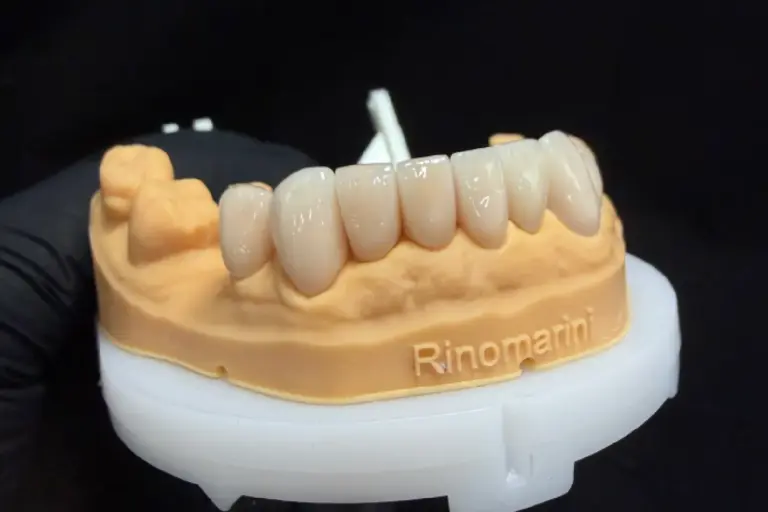
Temporary veneers cover the preps while the permanent veneers are made. They’re also the one stage where you and the patient can test the planned shape in the mouth before it’s committed to ceramic.
At Istar Digital Dental Lab, our four labs in Shenzhen and Huizhou make the diagnostic wax-ups and lab-made provisionals for veneer cases, as well as the final veneers.
Start With the Wax-Up, Not the Prep
Temporary veneers are only as good as the plan they’re copied from. For anything beyond one or two teeth, start with a diagnostic wax-up:
- Send us: a pre-op scan or impression, the bite, full-face and smile photos, and notes on length, midline and what the patient wants changed. Sketches, old photos and DSD plans help too.
- We send back: a digital wax-up for your approval, printed as a model if you want one, in 2–3 working days.
- You make: a putty matrix from the model, for the mock-up and later for the provisionals.
A mock-up on the unprepared teeth lets the patient see the plan, and say yes or no, before any enamel is touched. It also guides the prep. Reducing through the mock-up toward the planned final contour, rather than to a uniform depth off the existing tooth, makes it easier to stay in enamel.
Enamel matters for the final result. A systematic review of ceramic veneers bonded to different substrates found about 99% survival for veneers bonded to enamel, against 91% survival and 74% success where dentin exposure was severe.
When You Can Skip Temporary Veneers
A minimal prep that stays in enamel, with no exposed dentin and no visible step, often doesn’t need temporary dental veneers at all. Temporize when dentin is exposed, when the patient would otherwise leave with a visible change, or when a multi-unit case needs a trial run before the shape is committed. → Provisionals for crowns, bridges and implants: Temporary Teeth guide
How Temporary Dental Veneers Are Made
There’s no single right technique. The number of teeth and the depth of the prep usually decide it.
One or Two Teeth
Direct composite, shaped and spot-bonded on the tooth, is quick and gives you full control of the shape.
Three to Six Teeth
Fill a putty matrix from the wax-up with bis-acryl, seat it, then take the shell out to trim and polish it before you lute it. As this direct-indirect technique article in Dental Economics explains, bis-acryl has become the material of choice for veneer provisionals for its mechanical and optical properties, marginal adaptation, polishability and easy add-ons.
Six or More, or a New Smile
When you’d rather have the provisionals made to the exact approved design, order lab-made provisional veneers. We make them in PMMA or composite, 3D printed where that suits the case. A PMMA provisional stage takes 2–4 working days in our lab.
Some clinicians prefer shrink-wrap provisionals, formed on the preps and left in place. It works, but the flash has to be cleaned off the margins in the mouth without nicking the preparations you’ve just recorded.
Why Temporary Veneers Come Off, and How to Keep Them On
Three things work against temporary veneers. A veneer prep has almost no retention form. The provisional can’t be fully bonded, because it has to come off later without changing the prep. And it’s thin, so it can crack when it’s trimmed or removed.
Splint Them
Joining the provisionals into one piece spreads the load, and a matrix-formed set that follows the embrasures picks up some mechanical retention. The trade-off is that splinted units are harder for the patient to clean.
Spot-Etch, Then Clean Up Properly
A small etched spot in enamel gives the luting material something to grip; keep it clear of the margins so the provisional comes off cleanly. In a lab study on bovine enamel, spot-etching before bis-acryl significantly raised shear bond strength compared with no pretreatment. Every adhesive approach also left the enamel rougher, so clean the surface thoroughly before the final bond.
Keep the Gingiva Ready for Bonding Day
Bulky margins and closed embrasures trap plaque. Inflamed, bleeding tissue then makes the final impression and isolation harder on the day you bond the permanent veneers. Keep the margins smooth and flush and leave room for the papillae. Lab-made provisionals go through the same margin, contact, occlusion and polish checks as our crowns.
How Long Patients Wear Temporary Veneers
Temporary veneers have no set lifespan. They stay in for as long as the permanent veneers take to make and ship, plus your try-in schedule, which is usually a matter of weeks. When the permanent veneers come from Istar Digital, plan the provisional phase around:
- Design approval. It adds 1–2 working days. Time spent waiting for your reply isn’t counted in lab time.
- Lab time. Confirmed when the case is quoted, and counted from the day a complete case arrives.
- Transit. International shipping and customs come on top.
- Rush. Free for every material and case type if you send 10 or more cases a month. We guarantee a rush case’s ship date; the arrival date depends on transit and customs.
If the schedule could slip, choose a provisional built to last longer: splinted, lab-made, or both.
What to Judge in Temporary Veneers, and What Changes in the Permanent Ones
From temporary to permanent veneers, the shape should stay the same while almost everything it’s made of changes. Settle the shape now, and don’t read the rest off the provisionals.
Settle These in the Provisionals
- Incisal length and edge position
- Midline, proportions and smile line
- Facial contour and lip support
- Speech
- Occlusion and anterior guidance
- What the patient thinks after living with them for a few days
If the patient says they’re too long or too full, adjust them chairside and give it a few days. We copy what’s approved, so a shape nobody likes will come back in ceramic unless it’s changed now.
Don’t Judge These Yet
- Shade and translucency. Provisional resin doesn’t match ceramic’s shade options or the way it transmits light.
- Surface texture and luster. Ceramic veneers are stained, characterized and glazed by hand.
- Strength. Provisional resin is far weaker than ceramic.
The final shade comes from your prescription, your shade photos and the color of the prepared tooth. → Veneers
Turning Approved Provisionals Into Permanent Veneers
1. Record the Approved Provisionals
Record them after the last adjustment, the way the patient approved them.
- An intraoral scan of the provisionals in place, with the preps, opposing arch and bite. For anterior esthetic cases, send PLY so color and gingival detail come through.
- Or an impression of the same.
Your part: Add photos of the patient smiling and talking with the provisionals in.
2. We Copy What Works
Shape and function carry over; the material plan is checked against the space.
- Shape, incisal edges and anterior guidance copied from the provisionals, or mirrored from a contralateral tooth that’s already right
- Space measured on the model; if it won’t support the material you prescribed, we tell you before production. We never switch materials without your consent.
Your part: Tell us anywhere the final should differ from the provisionals.
3. Approve the Design
Every anterior veneer case is previewed before production; other veneer cases on request.
- A design preview by email or in your case chat; circle what you want changed on the image
- One design and two free revisions; ask for changes to shape, shade, occlusion, contacts or material
- The final decision is yours
Your part: Approve or comment.
From there, the case is made and checked like every veneer case we take on.
Choosing the Permanent Veneers
Pressed E.max
Lithium disilicate, pressed in IPS e.max Press, with the best translucency of the three and adhesive bonding with resin cement.
Best for: most veneer cases, including discolored teeth, enamel defects, diastemas under 3 mm, minor malposition and undersized teeth. Think twice: bruxism and heavy load, or not enough room for the thickness it needs.
Zirconia
Stronger and more wear-resistant than glass-ceramic. It can’t be etched, so it’s bonded with an MDP-containing resin cement, and clinical follow-up on zirconia veneers is still short.
Best for: heavier bites where e.max would be at risk. Think twice: cases where translucency matters most.
Composite
Lab-made composite veneers remove the least tooth structure and look natural. A systematic review of resin composite laminate veneers put pooled survival at 88% over mean follow-ups of 24 to 97 months, with direct veneers doing better than indirect ones. Surface roughness, color mismatch and marginal discoloration were the most reported complications.
Best for: conservative or transitional esthetics. Think twice: patients expecting ceramic-level stain and wear resistance.
How Long Permanent Veneers Last
Patients hear “permanent” as “forever.” It means the veneers are bonded in place and the prep can’t be undone. The ADA’s patient guide to veneers notes that treatment isn’t reversible because enamel is removed, and that a veneer can chip, crack, wear or loosen and need to be re-bonded, repaired or replaced.
A 2021 systematic review of 25 studies and 6,500 porcelain laminate veneers estimated 95.5% cumulative survival at 10 years. Fracture was the most common complication, followed by debonding, and both were more common in the first years after cementation. Veneers with incisal coverage, and non-feldspathic veneers, failed less often.
Survival isn’t the same as trouble-free. A 2025 meta-analysis of ceramic laminate veneers found similar survival at about 10 years for feldspathic, leucite-reinforced and lithium disilicate veneers. Their technical complication rates were 41.5%, 29.9% and 6.1%.
Load is the other variable you can plan for. The same ADA guide says veneers may not be a good choice for patients who clench or grind, or who have a deep overbite. When you do go ahead, we can make a night guard to protect the veneers. → Night Guard Dental Lab
Our ceramic veneers carry a three-year warranty, and composite veneers carry one year. It covers our work; it isn’t a prediction of how long veneers last.
What to Tell Patients While They Wear Temporary Veneers
- Bite with the back teeth, and keep hard or sticky food away from the front.
- Coffee, tea and red wine stain the provisional resin faster than they’ll stain ceramic.
- If the provisionals are splinted, thread floss through rather than pulling it up between the teeth.
- Mild sensitivity to hot or cold can happen. Severe, lasting or worsening pain is a reason to call.
- If one comes off, call the practice rather than gluing it back at home. The prep underneath is now exposed.
Frequently Asked Questions
A patient asked about snap-on veneers. Are those temporary veneers?
Not in the clinical sense. Snap-ons are removable appliances worn over unprepared teeth, not a stage of veneer treatment. ADA News has relayed expert warnings that they can trap food against the teeth, raising the risk of decay and gum disease. The ADA has also cautioned the public about “veneer technicians” working without a dentist, citing risks such as veneers placed over untreated cavities.
Which impression materials and models do you accept?
VPS is our preferred impression material; polyether and condensation silicone also work, as do stone, sectioned and 3D printed models. You pay to ship impressions and models to us, and we pay to ship the finished work back, remakes included. → Send a Case guide
If the shade isn’t right after delivery, is the remake free?
If the shade doesn’t match what you prescribed, yes, we remake it at no charge. If you choose a new target shade or a different material after delivery, it’s handled as a new case. → Remake and Warranty Policy