Patient Situation
The patient lost #5 about five years ago, after a crack ran below the gum . The site has settled, and the ridge is a little flat on the cheek side .
The dentist sent intraoral scans of both arches in STL, a scan from before the prep, a bite scan and shade photos with a tab in frame .
What the Dentist Asked For
The Rx, in short :
Requests 2 and 3 pull against each other. Request 2 also runs into a hard limit on pontic width.
The Technical Problem: A 9.6 mm Gap and a 9 mm Limit
The span qualifies
Ivoclar lists IPS e.max Press three-unit bridges for the front and premolar region, up to the second premolar as the back abutment. Here that’s #4, so the design sits inside the indication.
The width doesn't
Ivoclar’s processing instructions for IPS e.max Press list a premolar pontic wider than 9 mm as a contraindication. Built to fill the whole gap, this emax dental bridge would carry a 9.6 mm pontic.
Width isn’t just a number on a chart. The pontic hangs between two connectors like a small beam. Make it longer and the bending at each connector goes up, and the connectors are where glass-ceramic bridges tend to break.
Looks were a problem too. A 9.6 mm pontic next to a 7.4 mm #12 reads as a wide, odd tooth, even with no gaps.
The connectors had room
Our CAD technician measured both connector sites on the scan . Height runs from just above the gum to where the marginal ridge has to meet the lower teeth.
| Connector | Height | Width | Cross-section |
|---|---|---|---|
| #4/#5 | 5.0 mm | 4.1 mm | about 16.1 mm² |
| #5/#6 | 5.2 mm | 4.0 mm | about 16.3 mm² |
Our connector range for back teeth is 9–16 mm², depending on the material. Glass-ceramic sits at the top of that range, so we design e.max premolar connectors to 16 mm², with the height at least equal to the width . Both sites cleared it. On this case, the connectors were fine. The pontic width was the problem.
Three Ways to Build It, Sent Before Pressing
We sent the dentist the measurements, a design preview with the pontic width and connector sizes on it, and three options :
| Option | Pontic width | What you give up |
|---|---|---|
| A. Emax bridge, pontic narrowed, extra width split onto the abutment crowns | 9.0 mm; 0.3 mm added to #4’s front side and to #6’s back side | #4 and #6 come out 0.3 mm wider than their old shape, and both contacts move |
| B. Emax bridge as written, pontic fills the gap | 9.6 mm | Outside Ivoclar’s width limit. If you pick it, we make it to the Rx, and remakes caused by that design aren’t on our side |
| C. Monolithic zirconia bridge, full width | 9.6 mm | Less translucency next to natural #3 and #7 in a wide smile, and the pontic still looks 9.6 mm wide |
We recommended A, the only option that stays inside the limit and keeps e.max. The dentist showed the patient the preview, picked A, and approved it by email the next day . The design was locked.
How We Built the Emax Bridge
Design
Pressing
The emax dental bridge was pressed in one piece in IPS e.max Press, shade A2 . We keep the approved design and contours on file, so a remake comes out the same shape.
Fit check and finishing
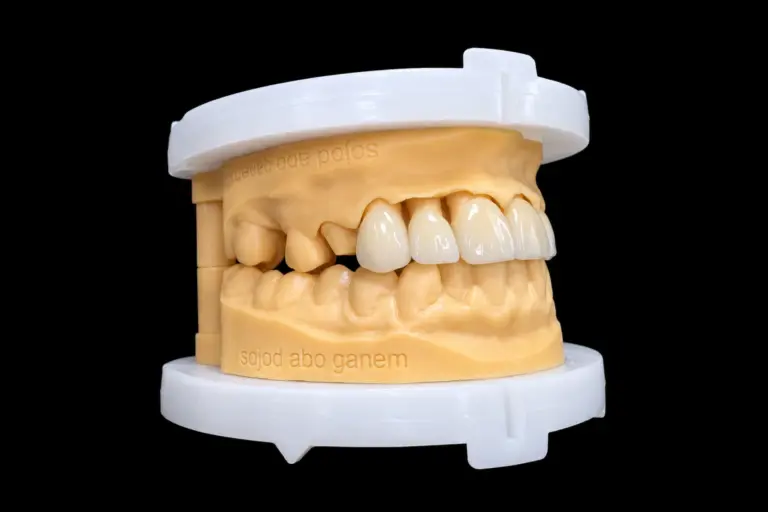
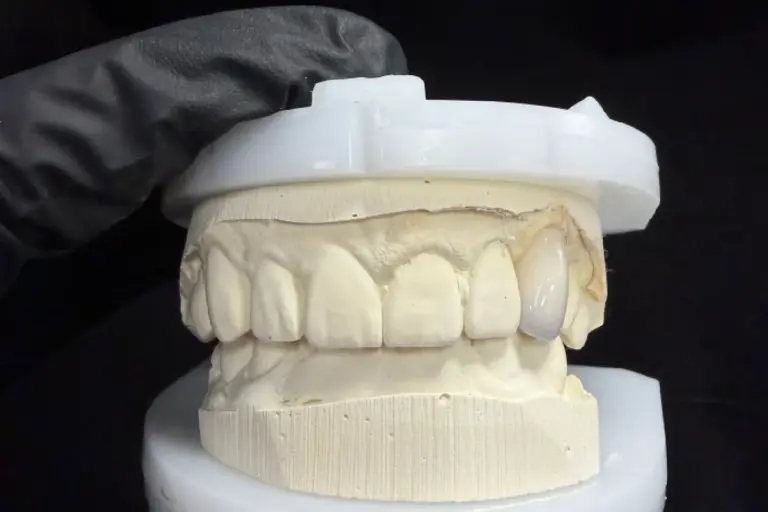
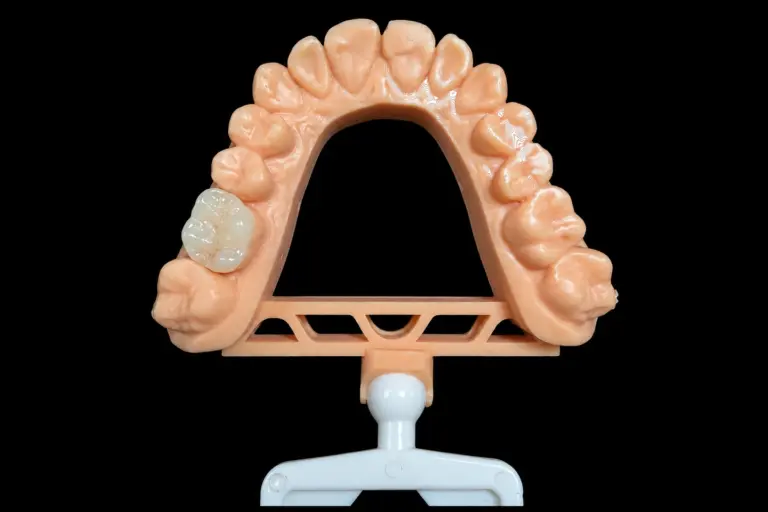
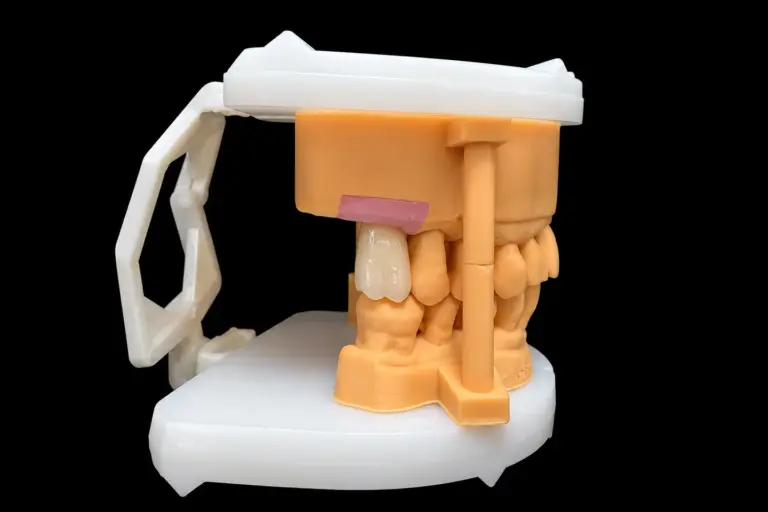
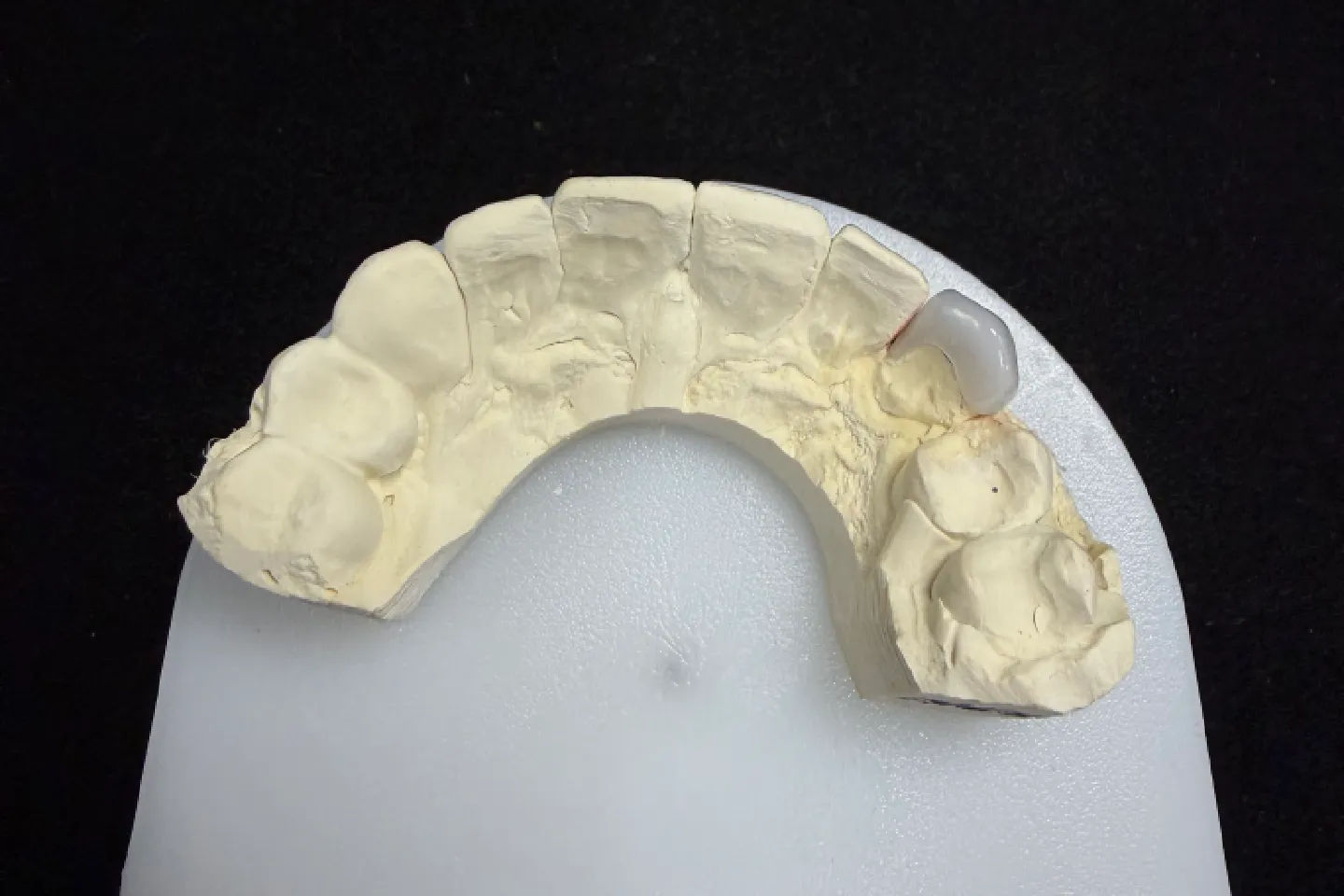
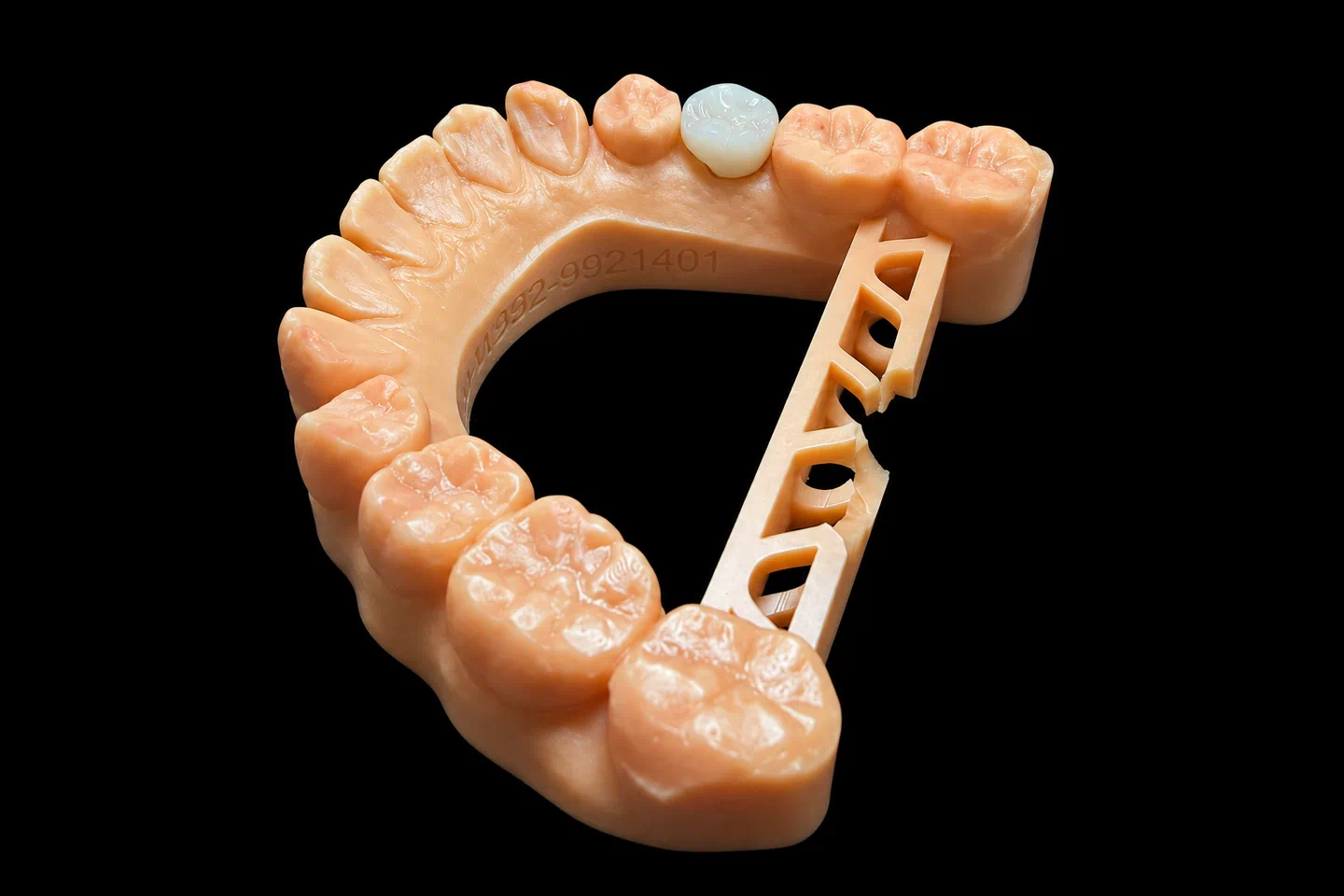
The pressed emax bridge went on the printed model first. We checked the seat, margins, contacts and both connectors before any stain went on. Then it was stained and glazed to the shade photos .
Finished Result
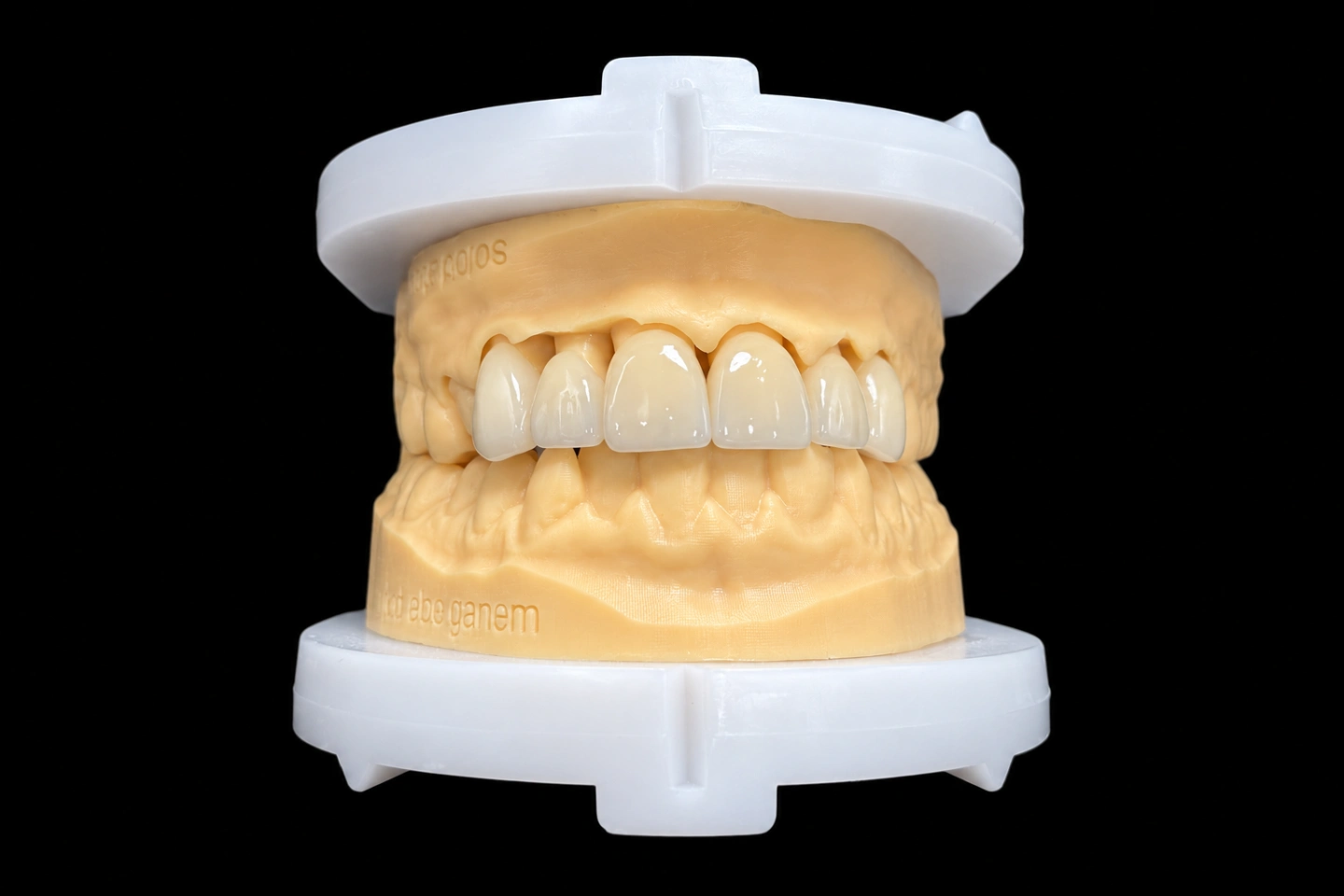
The emax dental bridge at final inspection :
| Check | Result |
|---|---|
| Pontic width | 9.0 mm |
| Pontic face from the front | About 7.8 mm |
| Connector #4/#5 | 5.0 × 4.1 mm |
| Connector #5/#6 | 5.2 × 4.0 mm |
| Seat on the model | No rocking |
| Margins on #4 and #6 | Closed under magnification |
| Contacts with #3 and #7 | Normal, per the Rx |
| Bite | Canine guidance on #6 matches the pre-prep scan |
| Shade | A2, checked against the photos with the tab |
| Turnaround | Shipped on working day 6 after approval |
Dentist and Patient Feedback
Summarized from the dentist’s notes at seating and at the two-week check . The patient’s comments came to us through the dentist.
- The emax bridge seated without changes to margins or contacts. One light touch on the pontic’s chewing surface, polished chairside.
- Seeing the pontic width next to Ivoclar’s limit before pressing made it easy to explain the change to the patient.
- Next time they have a wide premolar gap, they’ll ask for the widths before the prep appointment.
- No dark gaps in the smile.
- From the front, #5 looks about the same size as the tooth on the other side.
- The bite felt normal from the first day.
What Long-Term Data Says About Pressed Emax Bridges
In a ten-year study of three-unit IPS e.max Press bridges, 36 bridges in 28 patients had 100% survival at five years and 87.9% at ten. Success, meaning no complications at all, fell to 69.8% at ten years.
A 2026 review of tooth-supported multi-unit bridges puts five-year survival for lithium disilicate bridges at 82.5%. That’s significantly lower than metal-ceramic, with framework fractures above 10% at five years. Both are pooled numbers, not a forecast for one bridge. They’re why we hold the span, width and connector limits instead of stretching them.
For the full range of options, see our emax crowns and bridges and the rest of our e.max lab work.
Sending Us an Emax Dental Bridge
Every step, from your data to QC and packing, happens in our own labs: four of them in Shenzhen and Huizhou, China, with about 460 people. Istar is an FDA-registered establishment, Registration Number 3039441248, which you can check in FDA’s establishment database. The lab runs under ISO 13485.
Got a premolar gap that’s wider or narrower than it should be? Send us the scan and Rx for your emax dental bridge, and we’ll measure the pontic and connectors before we press anything. Send your first case or talk to us.
FAQ
Bridge emax or zirconia: how do you choose?
Pick a bridge emax design for a visible three-unit span when the patient doesn’t grind and the connectors have room. For grinding, short abutments with little connector height, or longer spans, high-strength zirconia or PFM is the safer pick.
What cement do you suggest for an emax bridge?
Resin cement, such as Variolink or RelyX Ultimate. E.max can be bonded or cemented. In the ten-year Press study above, the cementing method didn’t change the outcome.
Can I send my own CAD design?
Yes. If you ask us to make your design as-is, we make it as sent, so please double-check it first. If we spot a clear problem, like a thin connector, we’ll tell you before we start. If you still want it as designed, we make it to your file.
Do you take rush cases?
Yes, at no extra charge, for clients who send 10 or more cases a month. We guarantee the ship date. The arrival date depends on customs, so we can’t guarantee that.