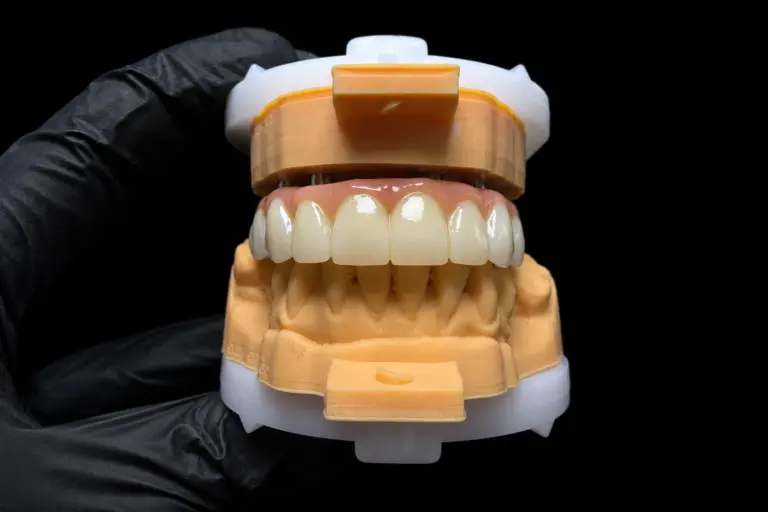
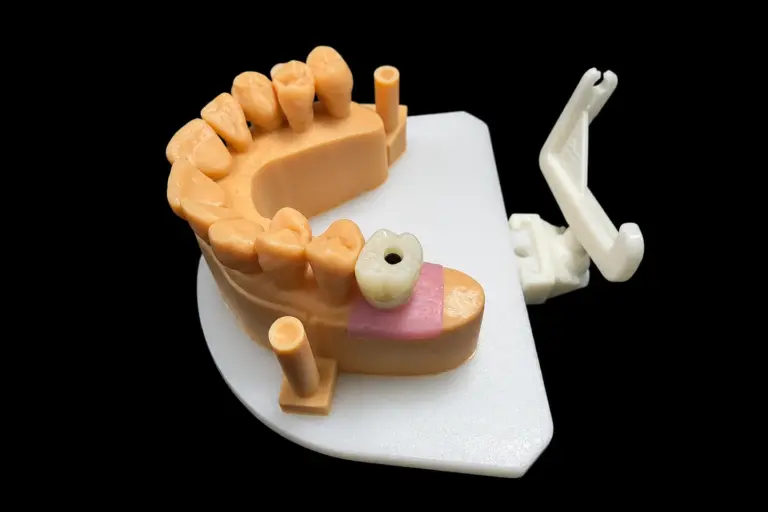
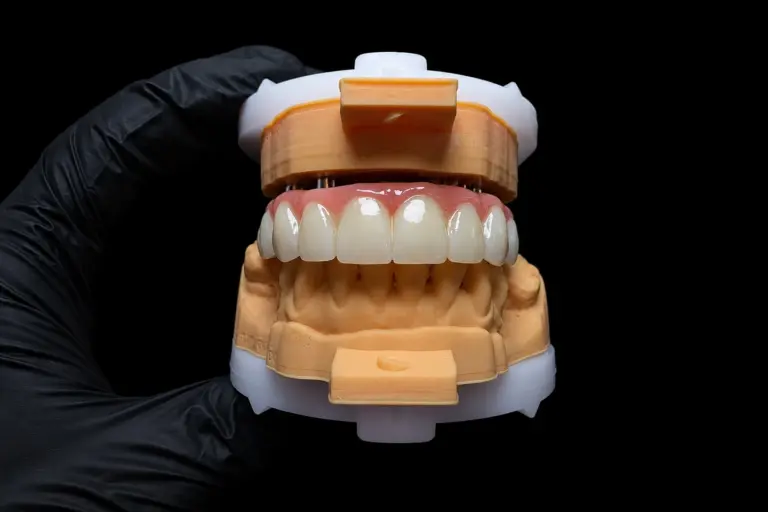
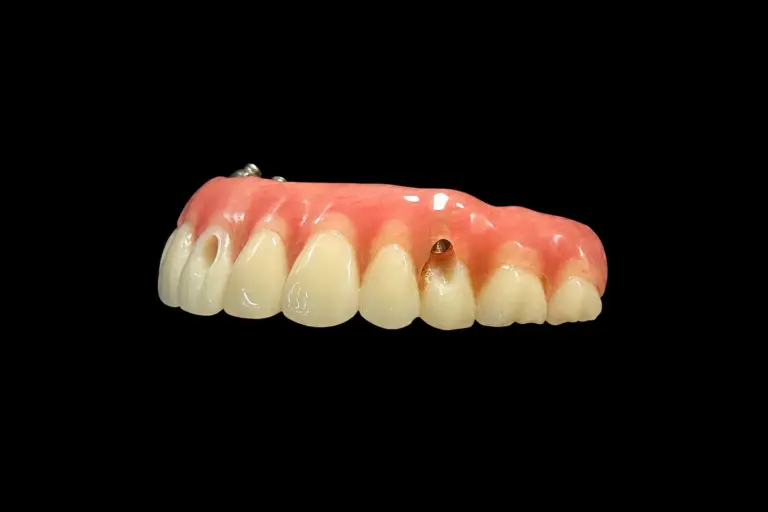
Patient Situation
The patient lost #9 to a root fracture about eight months before the case reached us.
What the Dentist Asked For
The Rx for this dental implant for one tooth :
The Technical Problems in This Single Implant Restoration
The straight channel came out in the wrong place
On this dental implant for one tooth, we matched the scan body to the Straumann library, then ran the implant axis through the proposed crown. It came out on the facial, 1.6 mm below the incisal edge.
Retrievable still mattered
In Jung’s systematic review of implant single crowns, screw loosening hit a 5-year cumulative rate of 8.8%, the most common technical problem it reported. With a dental implant for one tooth, that one screw holds the whole crown. If it ever needs a look, you want a way in.
Screws and cement both have trade-offs. Sailer’s review put 5-year technical complications on single crowns at 24.4% for screw-retained and 11.9% for cemented, with more bone loss over 2 mm around cemented crowns. Wilson’s endoscopic study tied excess cement to peri-implant disease in 81% of the cases it looked at. That’s an association, not proof of cause, and it comes from implants already showing signs of disease. Still, it’s why a deep cement line worried the dentist .
An angled channel eats into the crown
Tilt the channel and it swings closer to the palatal wall. Thin zirconia there is a risk for a single tooth implant crown. A lab study of monolithic zirconia implant crowns with screw holes recommended at least 1.2 mm of axial thickness. It’s bench data on monolithic crowns, not a rule for every design, so we used it as a check. The access opening also had to stay clear of the forward-movement contact.
One central next to a natural one
A single implant restoration on a lone central incisor has nowhere to hide. On top of that, a titanium base sits under this crown, and it can gray the neck through translucent material.
What We Sent Back to the Dentist
Before design work on this dental implant for one tooth went any further, we emailed the axis screenshot and three routes on day 1 :
| Route | What you get | The catch |
|---|---|---|
| A. Straight channel | Simplest build, easy to retrieve | Fails Rx item 2 |
| B. Angled channel on a Ti-base | Access moves to the palatal, still retrievable | Needs its own driver |
| C. Custom abutment, cemented crown | No access hole on the crown | Facial margin about 2 mm below the tissue, and no simple way to retrieve the crown |
We don’t pick the route for a single implant restoration. That’s the dentist’s call. We did share what the evidence can and can’t say about B: a systematic review of angled screw channel prostheses found lab fracture resistance comparable to straight channels and promising short-term clinical results, with limited long-term data. A meta-analysis of nonmolar crowns found short-term results close to cemented crowns, and didn’t show B to be better.
The dentist picked B on day 2 , with C as the fallback if the walls came up short, and confirmed the driver was in the operatory .
How We Met Each Requirement
Rx items 1, 2, and 8: two tries at the channel
Straumann lists up to 25° of channel angulation for this Ti-base, so the limit wasn’t the issue. The wall was.
Version 1 used 22° and put the opening mid-cingulum. It looked great from the palatal, but the thinnest axial wall came in at 0.9 mm . We told the dentist rather than just shipping a pretty screenshot.
Version 2 dropped to 18° and moved the opening 0.9 mm toward the incisal. That brought the wall to 1.2 mm and left the opening’s edge 1.2 mm from the forward-movement contact. The dentist signed off on day 4 .
Rx item 4: keeping the provisional's shape
On a single implant restoration, facial contour is where a copy goes wrong fastest. A bulky transition presses on tissue and makes cleaning harder. We overlaid the provisional and cuff scans, copied the contour below the tissue line, and kept the emergence angle at 26° facial, 28° mesial, and 27° distal . Katafuchi’s study linked angles over 30° to more peri-implantitis around bone-level implants (31.3% vs. 15.1%). Later studies don’t all agree, so we use 30° as a flag to discuss, not a hard line.
Rx item 5: shade and the gray neck
We kept 1.0 mm of zirconia around the top of the Ti-base. The rest is a layered zirconia build : porcelain on the facial carries the translucency and white band, and full zirconia on the palatal keeps porcelain away from the channel.
Rx items 3, 6, and 7: parts, contacts, and bite
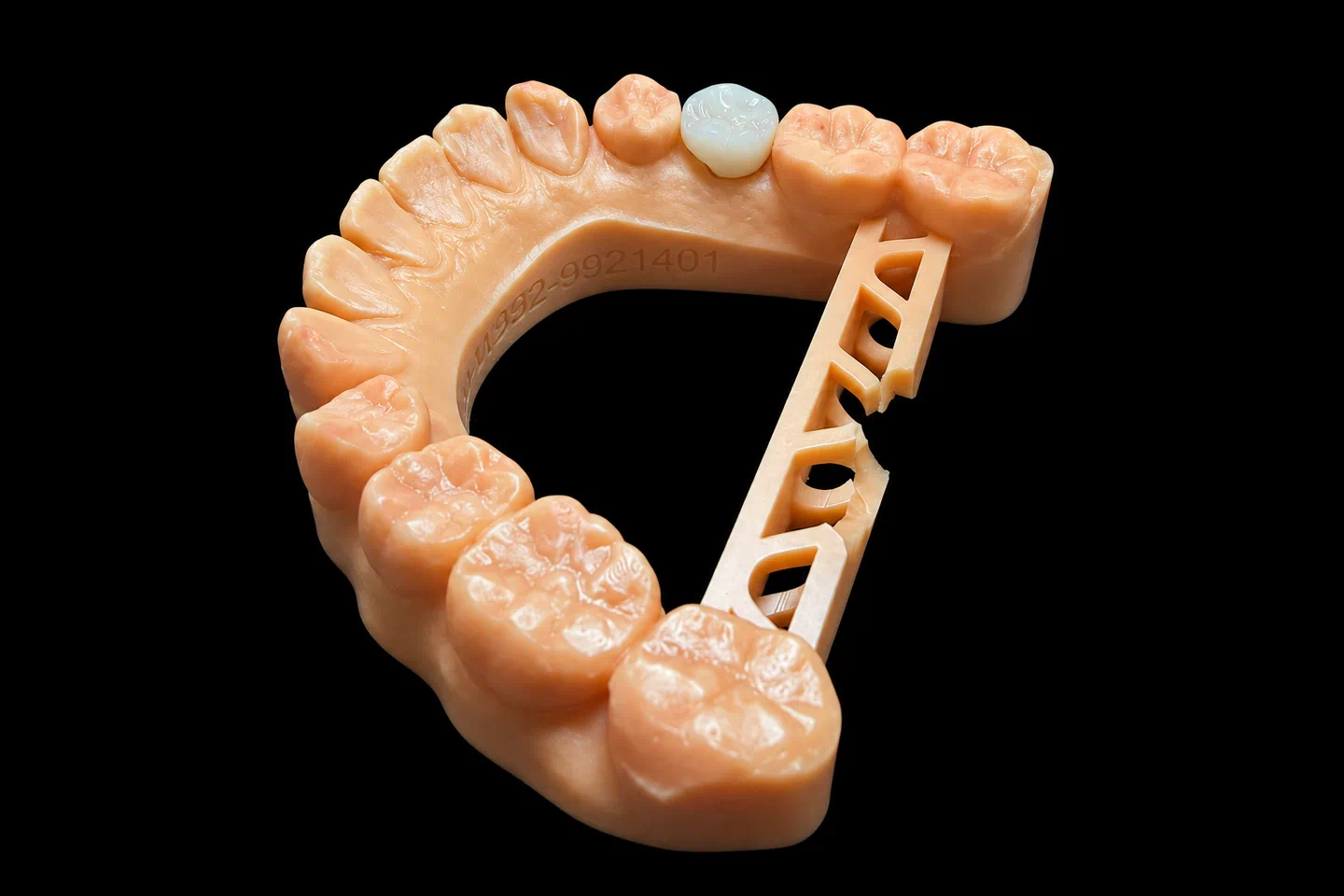
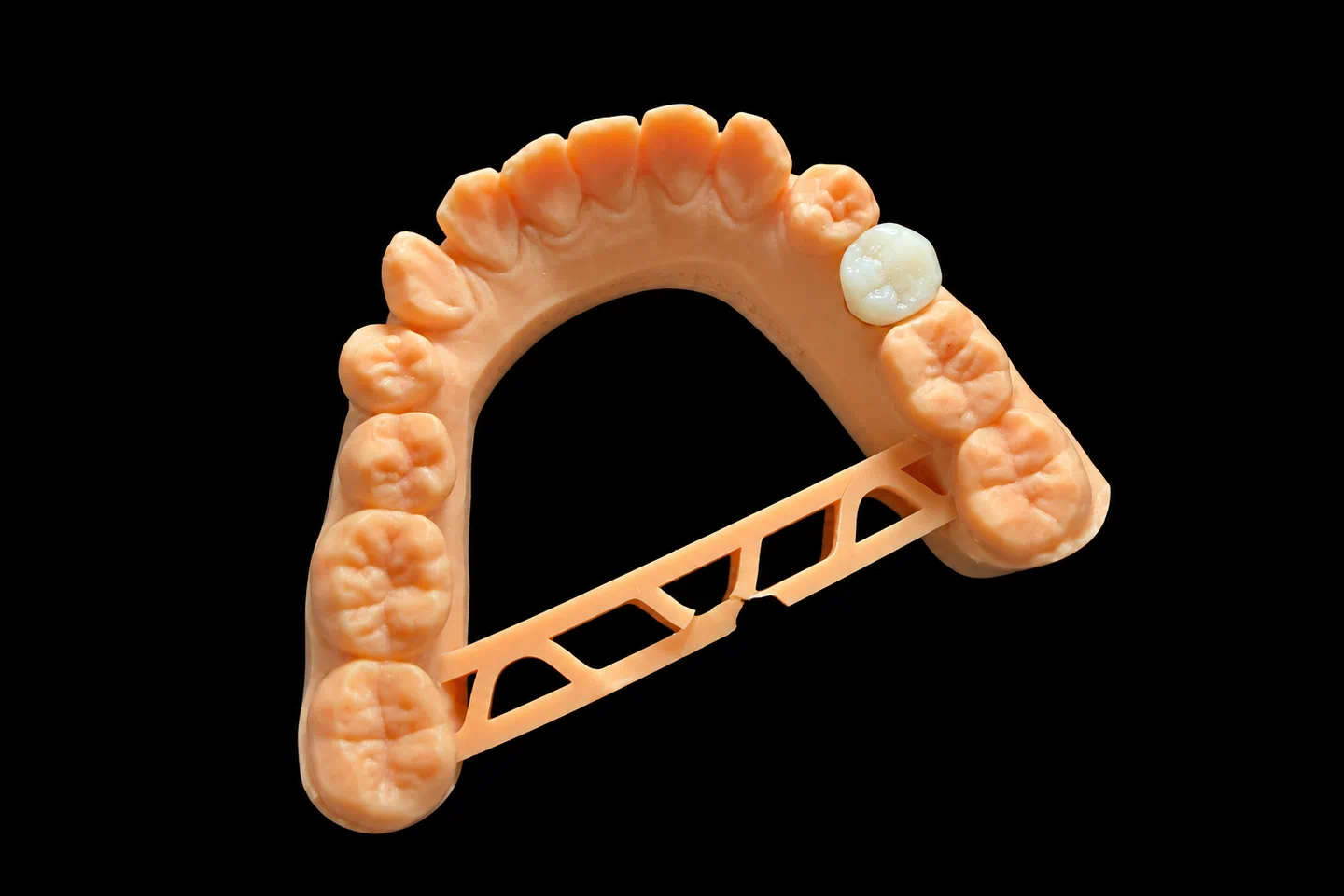
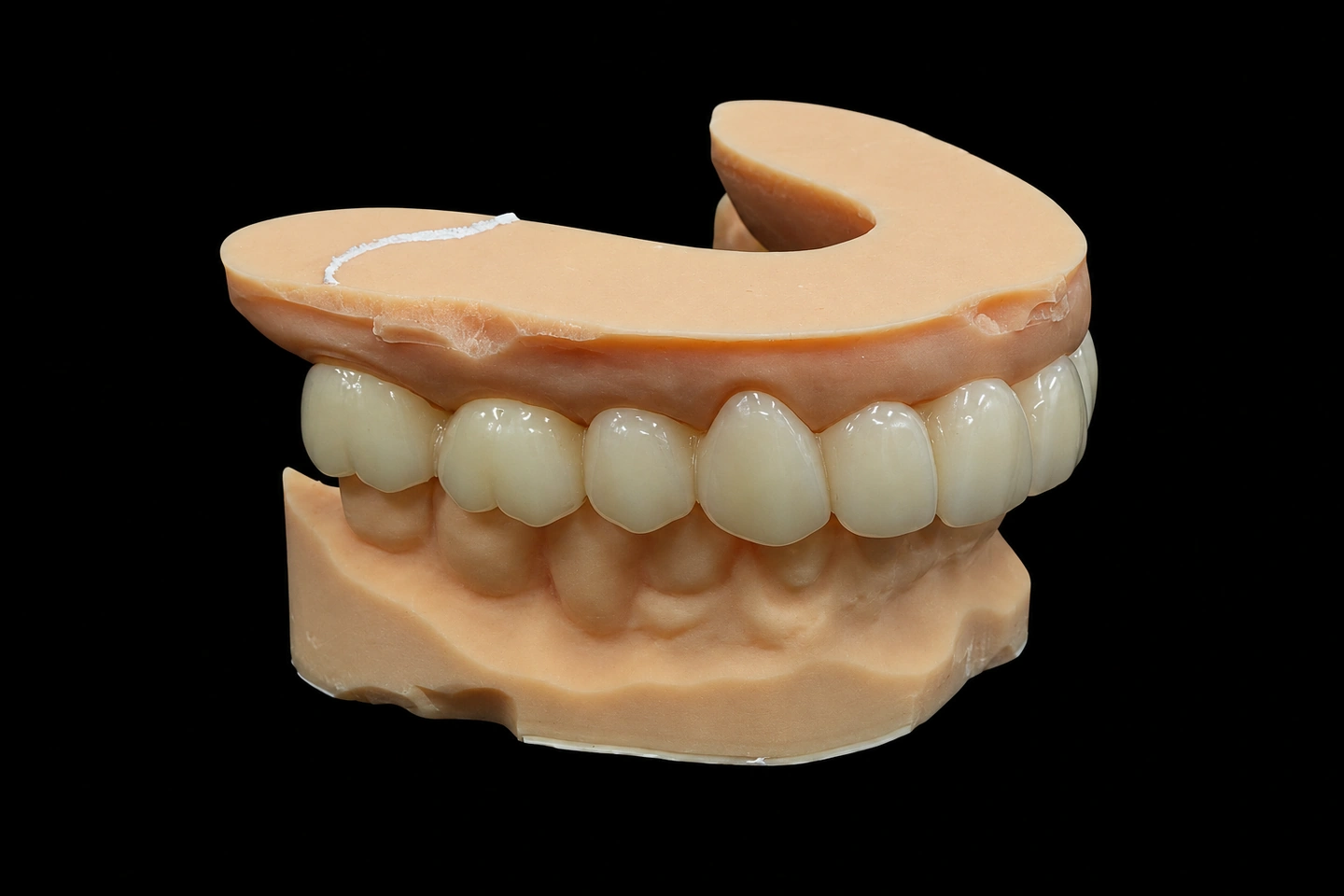
Straumann Ti-base and screw, with batch records on file. Contacts and bite went on the printed model , then got rechecked after glazing.
Rx item 9: bonding to the Ti-base
We followed Straumann’s IFU to bond this single tooth implant crown , with the interface masked off. Excess resin came off while it was still soft, because resin in there can stop the crown from seating.
Making It After Sign-Off
That’s the usual 5–7 working days from receipt, plus the 1–2 days a design sign-off can add.
The Finished Single Tooth Implant Crown
Final inspection on this single tooth implant crown:
| Goal | Check | Result |
|---|---|---|
| Right parts | System, platform, and Ti-base against the Rx and label | All matched |
| Clean interface | Magnified look at the interface, on the analog | No burrs or resin |
| Smooth screw path | Screw seated with the angled driver | No catching |
| Fit | Seated without force on the analog | No rocking or spring-back |
| Channel where approved | Finished crown against version 2 | Matched |
| Contacts | Film on the model at #8 and #10 | Even on both sides |
| Bite | Closing and forward movement | Light closing marks, no heavy forward contact |
| Shade | Crown vs. #8 photo, under lab lighting | Value and incisal band matched; dentist’s photo to confirm |
At delivery, the dentist told us the crown seated on the first try. One forward-movement mark needed a light chairside polish . The access was then sealed chairside, on the dentist’s protocol .
This dental implant for one tooth has no long-term follow-up yet, so we can’t tell you how the tissue or screw will look years from now. Monitoring stays with the clinic: the AAP calls routine implant checks essential.
Sending Your Own Dental Implant for One Tooth
Got a similar axis problem? Send the records before you commit to a retention route. We’ll run the axis in CAD and show you where the channel lands.
For a dental implant for one tooth, we need:
We check uploaded scans within one working day, usually, and tell you right away if something needs a rescan.
Who Made It
The crown on this dental implant for one tooth went through our implant dental laboratory team of about 80 technicians, with a 100-person design group and a separate 25-person QC group. They all work inside Istar Digital Dental Lab’s four labs in Shenzhen and Huizhou, China. We’ve been at this since 2012, we have about 460 people, and nothing gets outsourced. We make about 8,000 zirconia single crowns a month in the slow season and about 15,000 at peak.
Every case passes three QC checks: incoming records, in-process, and final release by an independent inspector. Istar Digital is an FDA-registered establishment (Registration Number 3039441248), which you can verify in the FDA database, and our labs run an ISO 13485 quality system. For EU clinics, custom-made restorations follow the MDR custom-made device procedure.
Single Implant Restoration FAQ
Which implant systems do you work with?
Most systems on the market. Tell us yours before you send the case. If your library version differs from ours, send it and we’ll use yours so the fit lines up.
Can I use compatible parts instead of original ones?
Yes, it’s your decision. Original parts generally give the best fit and long-term stability, and they cost more. Compatible parts cost less, with tolerances, materials, and warranty terms that can differ. We never swap either one without your consent.
Can I order a single tooth implant crown without the Ti-base?
Yes, a crown-only option is available for zirconia implant crowns. Otherwise, we supply the Ti-base or a custom abutment.
What torque should I use on a single implant restoration?
Follow the implant maker’s IFU. We can share a reference value, but the IFU wins.
What's the warranty?
Three years on a single tooth implant crown, same as our other implant restorations. If the problem’s on our side, like an open contact, a high bite, a crown that won’t seat, or a wrong shade, we adjust or remake it free. Implant parts aren’t included in a free remake. A shade or material change you ask for later isn’t covered either, and neither is working from a poor impression after we’ve flagged it. You pay to send a case in, and we pay to ship finished work back, remakes included.
Can you rush a single implant restoration?
Yes, free of charge, if you send us 10 or more cases a month. We guarantee the ship date, but not the arrival date, because customs times vary.
Send Us Your Next Single Tooth Implant Crown
Single trial cases are welcome, and ongoing partnerships suit clinics with a regular case flow. Factory and video visits can be booked too.