Patient Situation
The patient was 17 . At 14 they lost their upper left central incisor, #9 (FDI 21), in a fall, and the tooth couldn’t be saved . Their braces kept the #9 space open for an implant later .
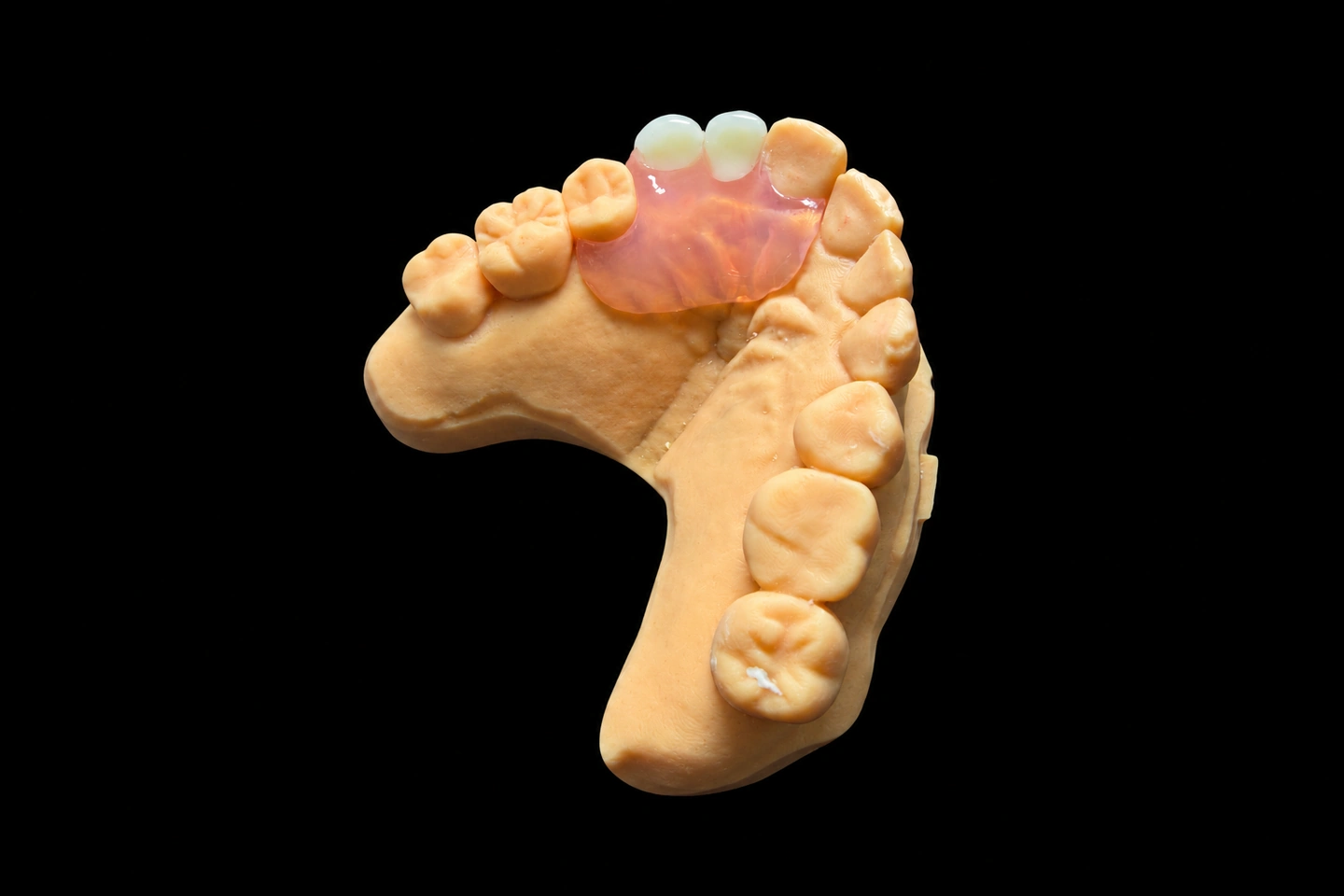
The implant waits until growth is done, which the orthodontist expected in about two years . Until then, a removable upper Hawley retainer with teeth fills the gap.
Case details
- Space at #9: 8.6 mm at the contact level on the scan taken the day the braces came off. #8 measures 8.6 mm too.
- Bite: about 4 mm of overbite. The lower centrals, #24 and #25, close on the palatal side of the upper centrals, with #24 under #9.
- Neighbors: #8 and #10 healthy and unrestored.
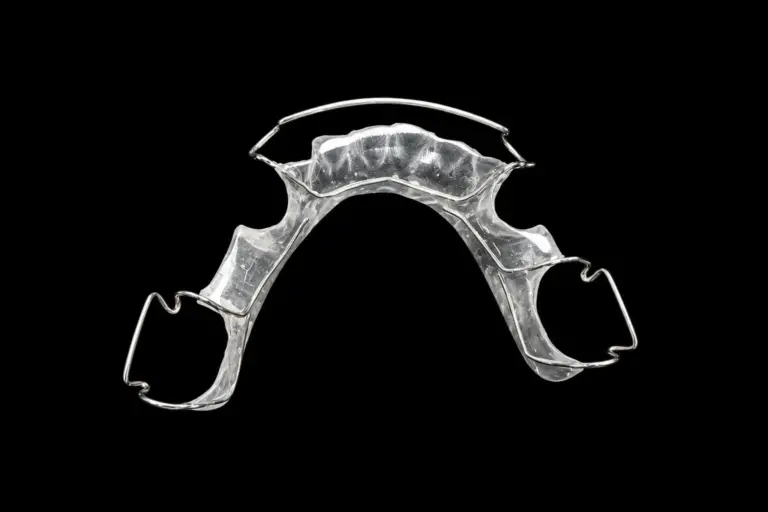
- First retainer: upper Hawley with a #9 denture tooth, labial bow #6–#11, Adams clasps on #3 and #14. Worn all day, out only for meals and brushing. It fit well for two years.
- What happened: the denture tooth came out of the acrylic one morning. The patient wore nothing for 9 days before the visit.
What the Orthodontist Asked For
From the Rx :
The orthodontist sent new scans of both arches and a bite scan, the debond scan from two years earlier, and the old retainer with its loose tooth.
What the Broken Hawley Retainer With Teeth Showed Us
The tooth was only held at its base
The socket left in the acrylic was smooth all the way round . There was no groove or undercut in it, so the tooth had been held by contact at its base and nothing else. A Hawley retainer with fake tooth keeps that tooth only because the acrylic grips it mechanically. When nothing locks it in, every push on the tooth works at the same small joint.
The acrylic behind the tooth was thinnest where the bite lands
On the palatal side, right behind the tooth’s neck, the acrylic measured 1.0 mm at its thinnest . That spot had bur marks on it . Someone had thinned it to clear the lower incisors, which is a normal chairside fix for a tight bite.
We put the new scans on an articulator. In a closed bite, #24 landed exactly on that thinned joint . So on every closure, the lower incisors pushed on the place where the tooth met the acrylic, and the thin wall gave the least support. Two years of that is a likely reason the tooth worked loose.
Nothing held the space once the tooth was gone
The old retainer had no stops beside the space . With the tooth gone, only the bow and the plastic could keep #8 and #10 from moving in, and for 9 days the patient wore nothing.
We laid the new scan over the debond scan. The #9 space now measured 8.2 mm, down from 8.6 mm, and most of that came from #10 tipping toward the gap .
Why a straight copy wouldn't work
Two things ruled out a plain copy. The old 8.6 mm tooth wouldn’t fit an 8.2 mm space. And a copied Hawley retainer with teeth would put the same thin joint back under the same lower incisor.
Three Ways to Build the Hawley Retainer Remake
We stopped before starting the Hawley retainer remake and sent the orthodontist photos of the broken retainer, the scan overlay and the bite contacts, with three options :
| Option | What it means | The trade-off |
|---|---|---|
| A. Copy at today’s width | Same design, tooth narrowed to 8.2 mm | Fastest. The thin joint stays where #24 hits it |
| B. Rebuild at today’s width | Tooth narrowed to 8.2 mm and kept out of #24’s path, a groove lock, thicker acrylic below the bite, stops on both sides of the space | Looks the same from the front. Takes a day longer to design, and the palatal side of the tooth sits slightly hollower than #8’s |
| C. Regain the space first | The orthodontist opens the space back to 8.6 mm, then we build option B at full width | Full width, but more visits and a longer wait in the plain clear retainer |
Whether the patient needs the space reopened is a clinical decision, not ours. The orthodontist asked the implant surgeon, who confirmed 8.2 mm still worked for the planned implant . They went with B.
How We Built the Hawley Retainer With Teeth
Records and models
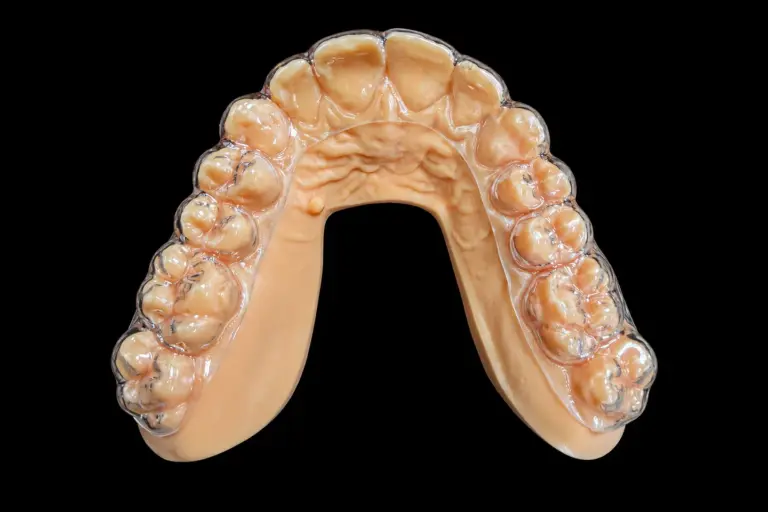
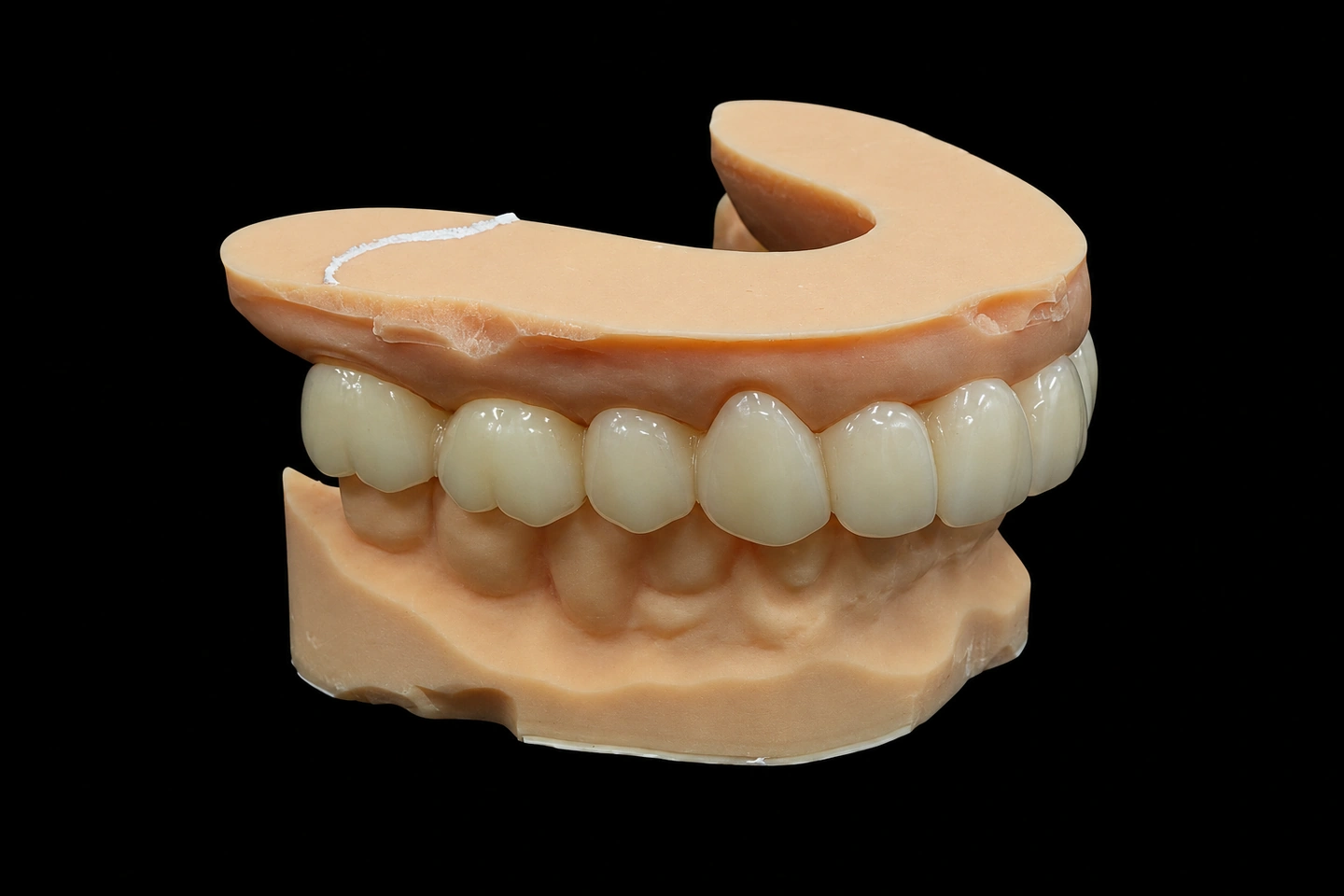
We printed the upper and lower models from the new scans and mounted them on the bite scan . The old retainer stayed on the bench as a reference for the wirework and the outline.
Fitting the tooth into 8.2 mm
We set a new A2 denture tooth with the same facial outline as #8, mirrored . The 0.4 mm came off the distal, with the line angles kept where #8’s are. The midline contact with #8 didn’t move, so from the front the two centrals still read as a pair.
On the tissue side the tooth is convex and just meets the ridge, as the Rx asked .
Keeping the fake tooth out of the bite
The key change was where #24 lands. We hollowed the palatal face of the denture tooth slightly, so in a closed bite #24 stops 0.5 mm short of it . In protrusion, the lower incisors slide forward on #8 and #10, and #24 passes under #9’s edge without catching it .
That moved the bite off the joint. It also freed up room to make the joint stronger.
Locking the tooth in
We cut a groove into the palatal side of the tooth’s neck, so the acrylic flows into it and locks around it . The acrylic now wraps the lower half of the tooth’s palatal face and stops below #24’s path. It’s at least 2.0 mm thick behind the neck, against the old 1.0 mm .
Stops beside the space
We added a short wire stop on each side of the space, one against the distal of #8 and one against the mesial of #10, behind the denture tooth . Stainless steel stops placed mesial and distal to the space keep the gap from closing if the pontic is ever lost. Here that matters twice over: the space has already lost 0.4 mm once.
Wirework
The wirework on the old Hawley retainer with fake tooth had done its job for two years, so we copied it :
Finishing and QC
Timeline
| Working day | What happened |
|---|---|
| 0 | New scans, the debond scan and the old retainer received |
| 1 | Old retainer checked, scans overlaid and mounted |
| 2 | Photos, measurements and three options sent |
| 3 | Orthodontist picked option B after talking to the surgeon |
| 8 | Shipped, tracking number sent the same day |
| 13 | Arrived at the clinic |
Results of the Hawley Retainer Remake
| Check | Result |
|---|---|
| Seating | Went in without adjustment. The orthodontist tightened the Adams clasp on #14 slightly |
| Lower incisors | No marks on the denture tooth with articulating paper in closed bite or protrusion |
| Space at the 3-month check | 8.2 mm on the orthodontist’s calipers, unchanged |
| Denture tooth at 3 months | Firm, no movement when pressed |
| Ridge | No blanching under the tooth at delivery or at 3 months |
| Appearance | #9 reads as a match for #8 in the smile photos. The bow shows, as it did before |
| Comfort | The tongue noticed the thicker acrylic behind #9 for about a week |
Feedback From the Orthodontist and the Patient
Summed up from the orthodontist’s messages after the 3-month check :
they’d planned to just reorder the same Hawley retainer with teeth. Seeing the bur marks lined up with the lower incisors on the photos explained the failure before anything was built, and the option table made the width question a short call with the surgeon.
didn’t notice the tooth was a little narrower. They did notice the extra acrylic at first. They said the best part was no more checking the tooth with their tongue to see if it had started to wiggle.
What this Hawley retainer remake can't do
A Hawley retainer with teeth isn’t an implant, and the fake tooth isn’t for chewing. The patient takes it out to eat, as before. Acrylic and wire can still crack or bend with time.
In the Cochrane review of retention after braces (47 studies, 4,377 people), one trial of 111 patients found Hawley retainers failed less often than clear plastic ones. But that’s plain retainers, the review rates its evidence as low or very low certainty, and no trial there tested retainers carrying a tooth. Wear time and checkups are the orthodontist’s call, which is also how AAO’s retainer guidance puts it.
Sending a Hawley Retainer With Fake Tooth Remake
Everything’s made in our own labs, with no outsourcing: four of them in Shenzhen and Huizhou, China, running since 2012, with about 460 people. Our retainer line covers Hawley retainers with or without denture teeth. Istar is an FDA-registered establishment, Registration Number 3039441248, which you can check in FDA’s establishment database. Every appliance is made to the dentist’s Rx.
Got a Hawley retainer with teeth that’s come apart? Send us the old one with new scans as a trial case. We’ll check why it failed and send you the options before we build anything. Single trial cases are welcome, and regular case flow is where a partnership really pays off. Send your first case, ask for our price list, or book a factory or video visit.
FAQ
What's the warranty on a Hawley retainer with fake tooth?
1 year. Lab-side problems get adjusted or remade free, for example an appliance that won’t seat, lifting edges, badly placed clasps or an inaccurate bite. Changing the shade or material later isn’t free, and neither is a remake after you asked us to go ahead on an unclear impression.
What if it gets damaged in shipping?
Send us an unboxing video showing the shipping label, plus the broken piece, within 24 hours, and keep the original packaging. With that evidence, we remake it free.
Do you take rush cases?
Yes, at no extra charge, for clients who send 10 or more cases a month. We guarantee the ship date. The arrival date depends on customs, so we can’t promise that.
How is a Hawley retainer remake priced?
Quotes are itemized to your Rx, not one bundled price. A Hawley retainer with fake tooth is quoted the same way, new or remade. Ask us for the price list.