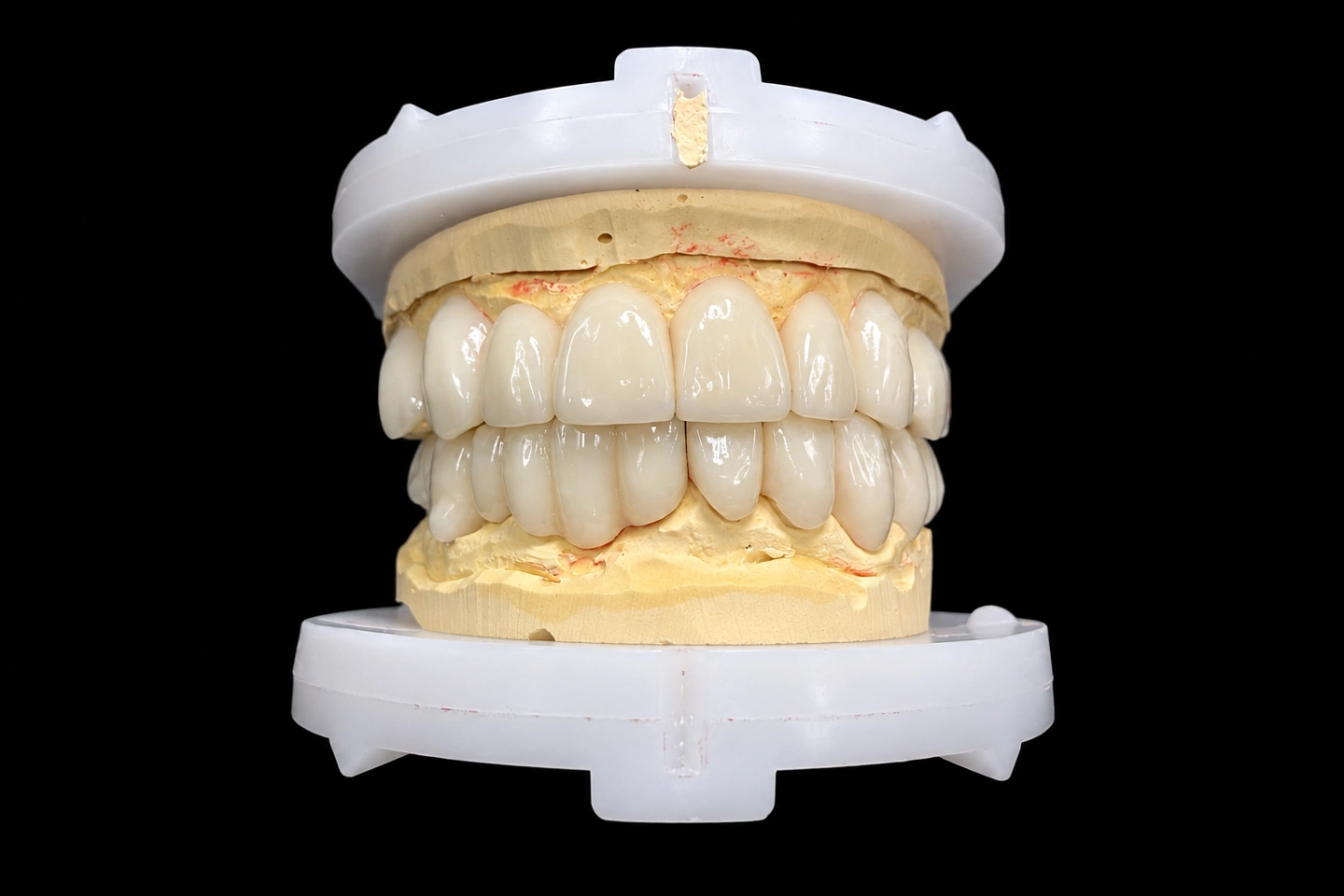
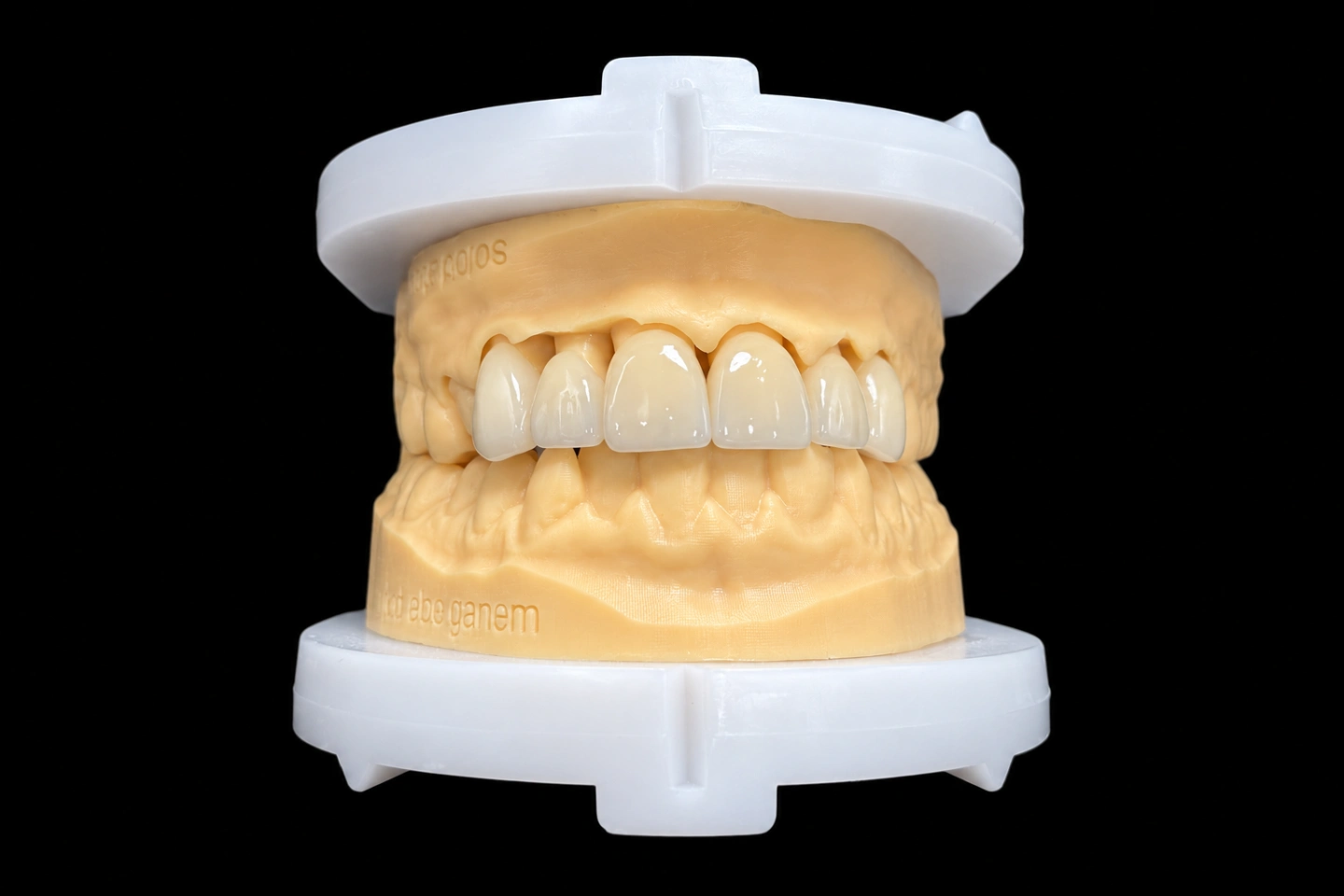
Patient Situation
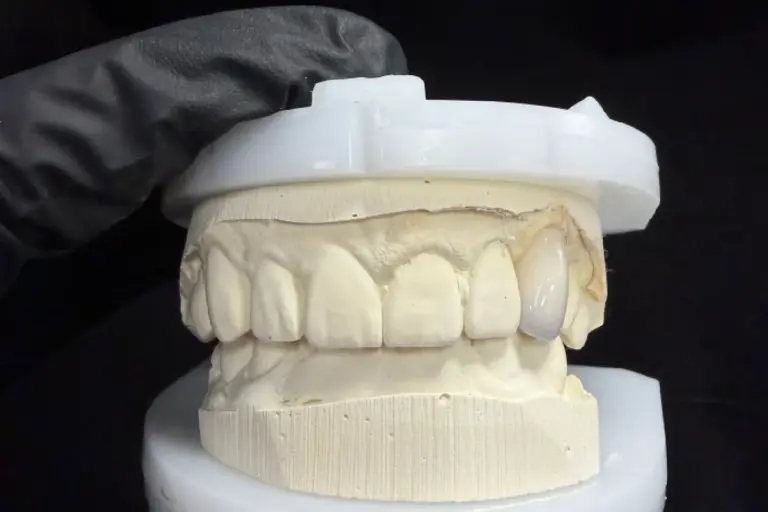
The patient is an adult with healthy gums and unrestored upper front teeth . The centrals look short and a bit square, and there’s a gap between them. Whitening came first. It got the color close, but it couldn’t do anything about shape .
Here’s what mattered for the cosmetic composite veneers:
What the Dentist Asked For
Condensed from the Rx and the WhatsApp notes :
Requests 2 and 3 fight request 6. Request 1 limits how much room we’ve got for request 5. That’s where the work was.
Why Indirect Composite Veneers Here
Choosing cosmetic composite veneers was the dentist’s call. The patient wanted to keep as much enamel as possible and liked knowing the veneers could be adjusted or repaired later . The dentist wanted all six built outside the mouth and checked at a try-in before bonding, so there’d be a chance to change things first .
The dentist also went over the trade-offs with the patient. Ceramic has the stronger long-term record. In a small 10-year split-mouth trial, indirect composite survived at 75% against 100% for ceramic, with 24 veneers per material. If those numbers had changed the patient’s mind, we’d have made pressed e.max veneers instead.
Direct versus indirect isn’t a clean win either way. A 12-month trial saw marginal discoloration in 5 of 30 indirect composite veneers and 23 of 30 direct ones, but it was short, unblinded, and used CAD-CAM veneers rather than hand-layered ones. A systematic review of composite veneers found higher survival for direct, from only seven studies. So nobody here was promised a number. The reason for going indirect was control over this particular design.
The Technical Problems in This Cosmetic Composite Veneers Case
Closing the gap makes the centrals wider
Add 0.6 mm per side to close the gap, and each central goes from 8.2 mm to 8.8 mm. Add the length, and they go from 9.8 mm to 10.8 mm. The ratio actually improves, from about 84% to about 81%. But the teeth are still bigger, and an 8.8 mm tooth with a flat face looks like an 8.8 mm tooth.
You can’t design that width away. You can only change how wide it reads. That comes down to where the facial line angles sit, how the incisal embrasures open, and what the laterals do next door.
A1 next to A2 can go wrong fast
Color is a common complaint with this material. In one satisfaction study on direct anterior composites, it was the most common reason patients were unhappy. With the lower teeth staying at A2, a flat, high-value A1 would have looked pasted on, even with the shade number right.
Thin layers don't leave much room
The dentist kept facial reduction at 0.3 mm or less, and the veneers get thinnest at the gum line . There’s not much room there to build a body layer and an enamel layer. The good news is the underlying teeth were already A2, so we didn’t need any heavy masking. Which meant we could skip opaque layers, and those are usually what flatten a thin veneer.
Longer edges can change the bite
An extra 1.0 mm on the centrals can interfere in protrusive. The dentist had already tested that in the mock-up, so the safest move was copying the mock-up’s edges and palatal contours, not redesigning them.
How We Met Each Requirement
| Dentist’s requirement | What we did | How we checked it |
|---|---|---|
| Follow the mock-up | Built the design on the mock-up scan, then fitted it to the prep scan. | Overlay of the design on the mock-up scan. |
| Close the gap evenly | Split the 1.2 mm evenly, 0.6 mm on each central’s mesial . | Width measured in the design: 8.8 mm on both . |
| Add length | 1.0 mm on #8 and #9, 0.5 mm on #7 and #10 . | Length measured in the design and on the printed model. |
| “Not big” | Moved each facial line angle on the centrals about 0.3 mm toward the center, opened the incisal embrasures, and kept the laterals’ edges 0.5 mm shorter than the centrals . Added light vertical texture so the face reads narrower . | Design screenshots, then the dentist’s try-in photos. |
| A1, but not separate from the lowers | Kept the body in A1, kept the incisal third translucent, and left a little warmth at the cervical . Worked from photos of the lower teeth with a shade tab in frame. | Shade-tab photo under the same light, then try-in photos with the lowers showing. |
| Keep the protrusive path | Copied the mock-up’s incisal edges and palatal contours. | Checked in protrusive and lateral movement on the model. |
| Design approval first | Sent design screenshots on day 2 . Made one revision. Approved on day 3 . | Layering started only after the dentist approved in writing. |
| Lab-made composite veneers | Made in the composite system named on the Rx . | No material change. If we’d seen a reason to switch, we’d have asked first. |
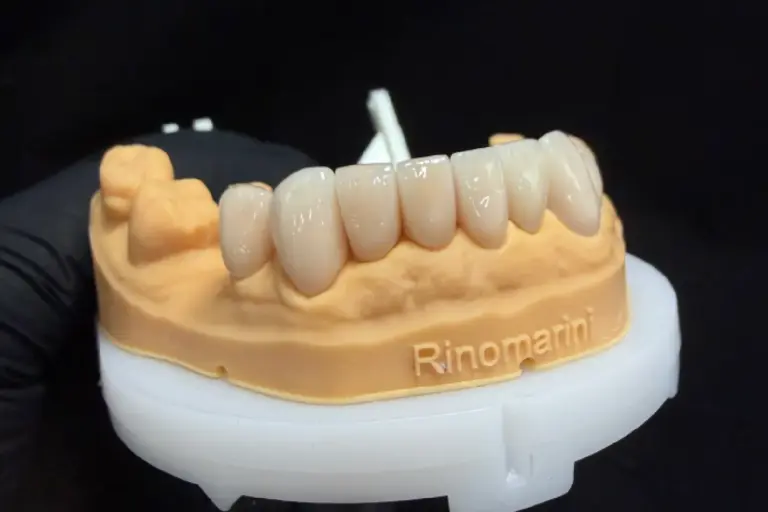
The revision is the part of these lab-made composite veneers worth a closer look. In the first design, the line angles followed the outer contour, and the centrals read wide in the front view. The dentist marked that up on the screenshots. We moved the line angles and opened the embrasures, and the measured width didn’t change at all . It just stopped looking wide.
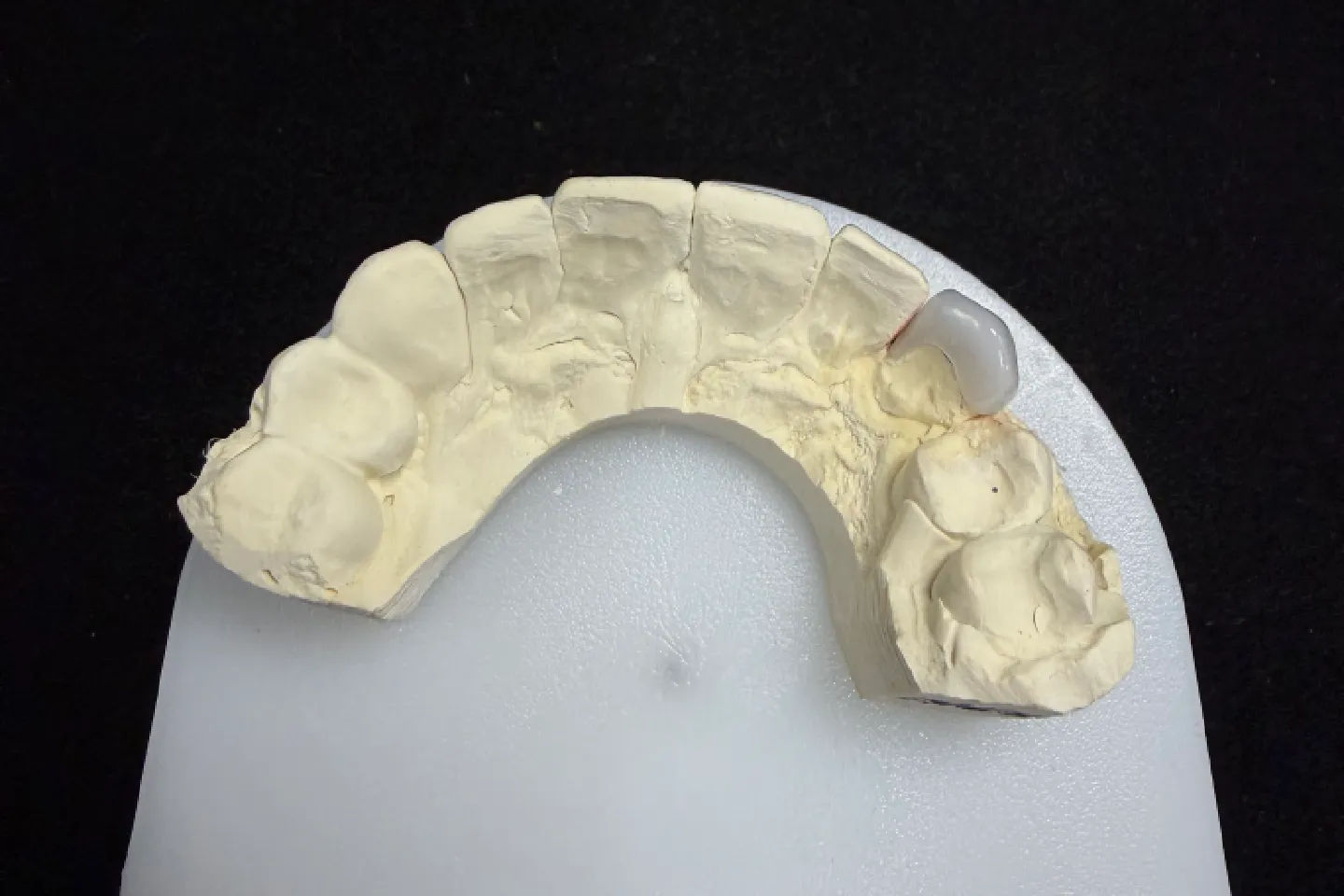
Making the Lab-Made Composite Veneers, Step by Step
Dentist and Patient Feedback After Try-In
The dentist tried in the lab-made composite veneers before bonding and sent photos and notes on WhatsApp . Overall, both the dentist and the patient were happy with the set, and it went ahead to bonding with no changes .
seating, margins, and contacts were fine, and the midline and lengths matched the approved design. The centrals didn’t read as wide as their measurements suggest, and the shade sat comfortably with the lower teeth .
liked that the gap was gone and the front teeth looked longer, without looking big or too white. The set also felt close to the mock-up they’d already worn .
The dentist then bonded all six using the bonding system they normally use with composite .
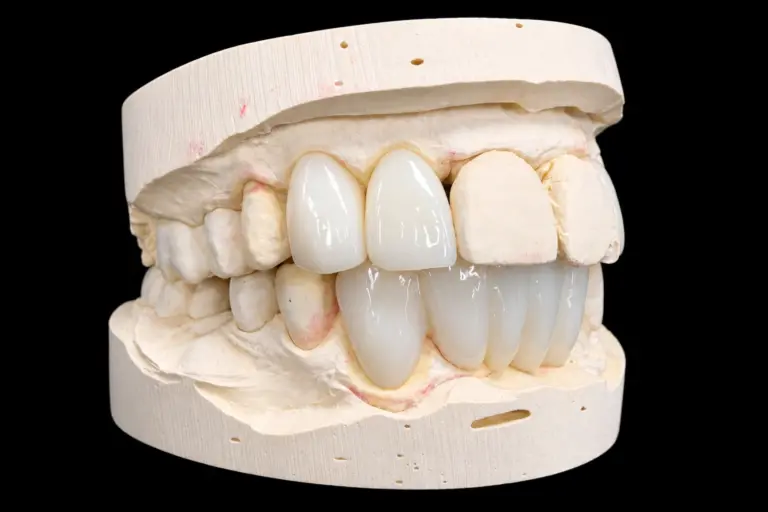
The Finished Cosmetic Composite Veneers
There’s a limit to what a finished photo proves, though. Cosmetic composite veneers age differently from ceramic. A 7-year study of no-prep indirect composite veneers reported 91.3% survival, and color match, surface roughness, and marginal discoloration all got worse over time. It also excluded patients with parafunctional habits, which is why the dentist’s no-grinding note mattered on this Rx. The dentist planned recall polishing and told the patient that repairs may come up down the road .
Sending Us a Case Like This
For your next set of cosmetic composite veneers, here’s what lets us run the same checks. See our veneer options for other materials.
Indirect composite veneers generally take 5–7 working days in our lab. Simple cases can take 2–3, and complex ones 5–7. Front-tooth esthetic veneers go through design approval, which adds 1–2 days.
Who Made It
This set of cosmetic composite veneers went through our CAD design team (about 100 people), our resin area, and a separate QC team of about 25. They work inside Istar Dental Lab’s four labs in Shenzhen and Huizhou, China. We’ve been running since 2012, with about 460 staff, and every step happens in our own labs. No outsourcing.
Istar Dental Lab is an FDA-registered establishment (Registration Number 3039441248), which you can check in the FDA establishment registration database. Our labs run an ISO 13485 quality management system. Want to see it? Visit the factory or book a video tour.
Cosmetic Composite Veneers FAQ
Do you accept physical impressions?
Yes. Send VPS impressions of the prep and the opposing arch, with a VPS bite registration. Wax bites can soften and distort in transit, so please skip them.
What if I don't have a mock-up?
We can make a diagnostic wax-up or mock-up first. You can also send a sketch, an old restoration photo, or a provisional as a reference. If you need provisionals, we offer composite or PMMA, and they can be 3D printed.
Can I choose the brand for lab-made composite veneers?
Tell us on the Rx and we’ll work to your specified brand. We won’t change a material without your consent, written or verbal.
What's free to redo, and what isn't?
Open margins, open contacts, high bite, a veneer that won’t seat, inaccurate color, visible flaws, and poor shape are ours to fix for free. Changing the shade or material after the fact isn’t free, and neither is a case you asked us to try on an impression we’d already flagged as poor.
Can you repair indirect composite veneers later?
Yes. Send photos and tell us what happened. A chip on a veneer that still seats well may work from the old data. Seating, margin, or bite problems usually need a new scan, model, or impression.
What about warranty and shipping?
Composite veneers carry our 1-year warranty. You pay to send a case in, and we pay to ship finished work back, remakes included.
Can you rush indirect composite veneers?
Rush service is free for clients who send us 10 or more cases a month. We guarantee the ship date, but not the arrival date, because customs times vary.
How is pricing handled?
We don’t publish prices on the website. Ask for our price list, and we’ll quote each case item by item to your requirements. Single trial cases are welcome, and ongoing partnerships suit clinics with a regular case flow.
Send Us Your Next Veneer Brief
Got a cosmetic composite veneers case where the patient wants a change but doesn’t want it to look like a change? Send a test case with your scans, photos, and Rx. We’ll measure what you’ve asked for and show you the design before we make anything.