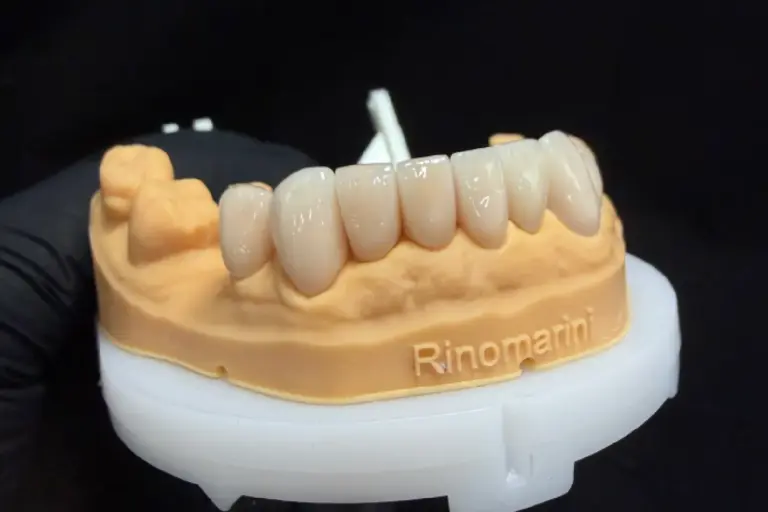
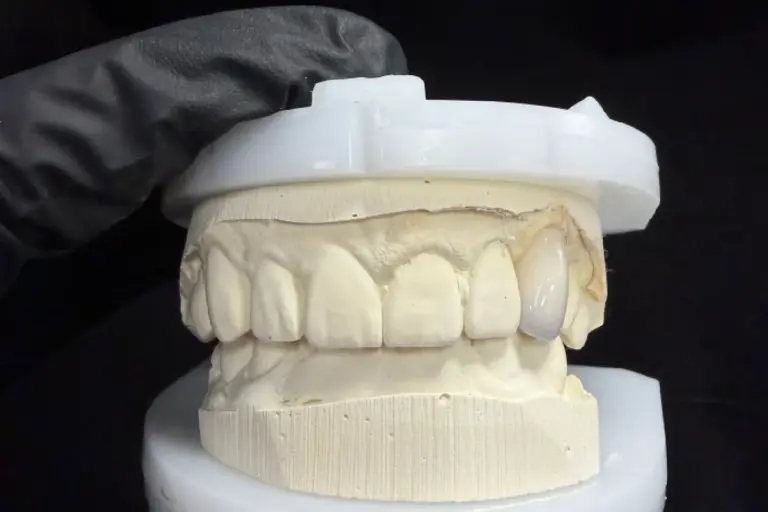
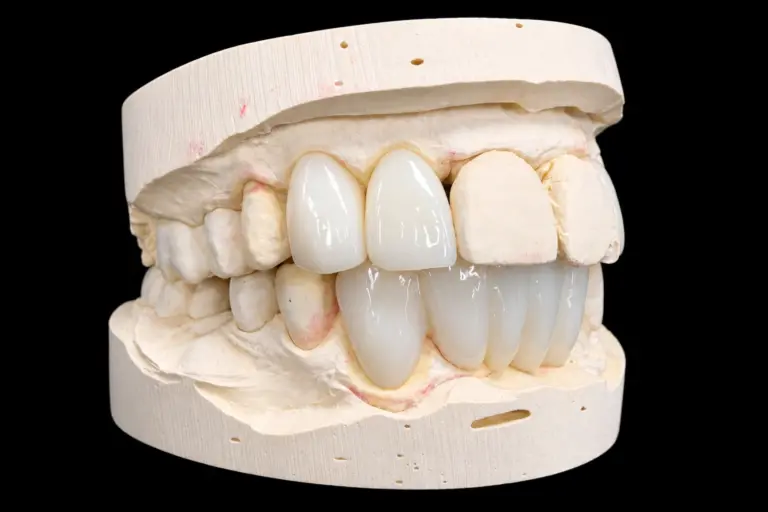
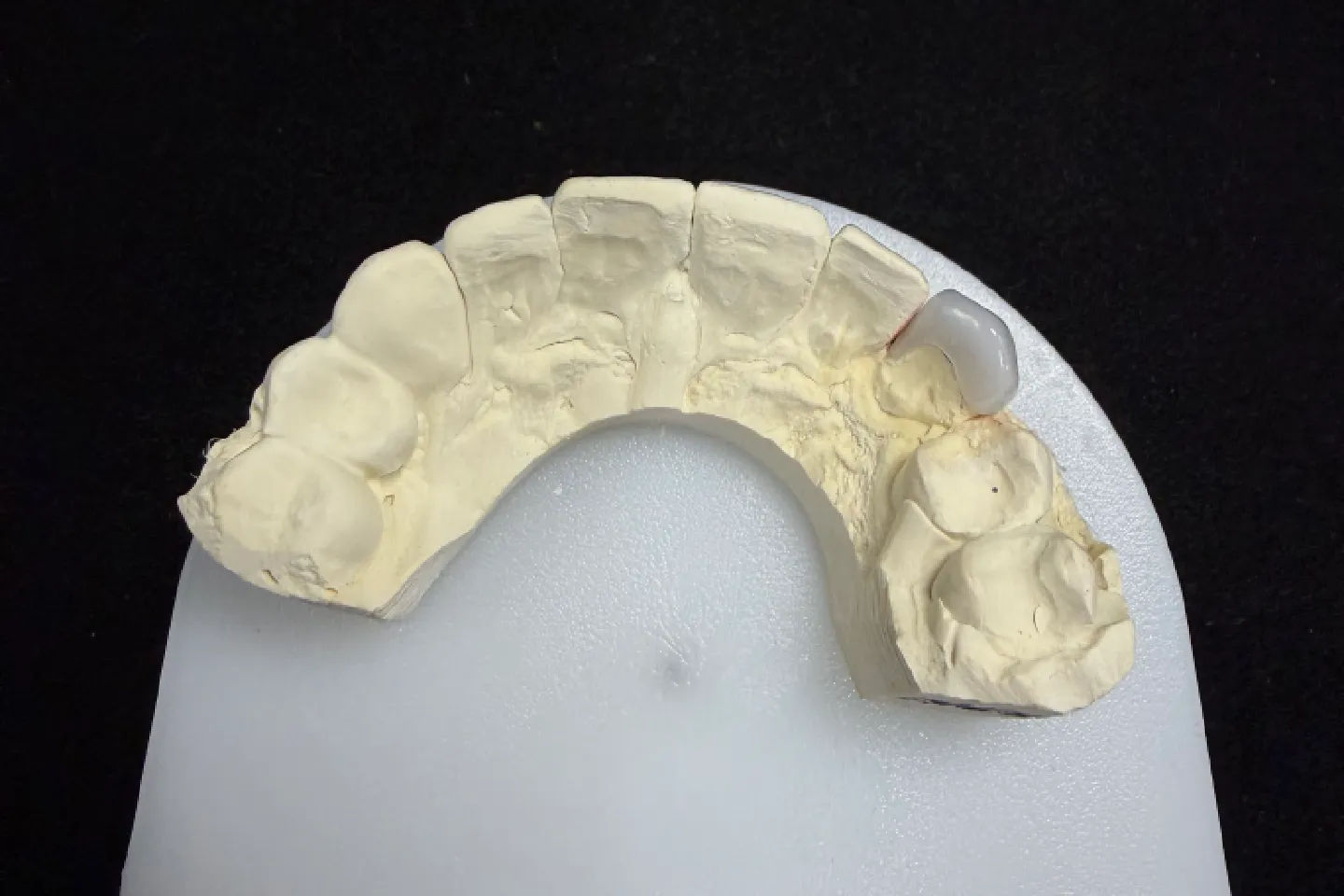
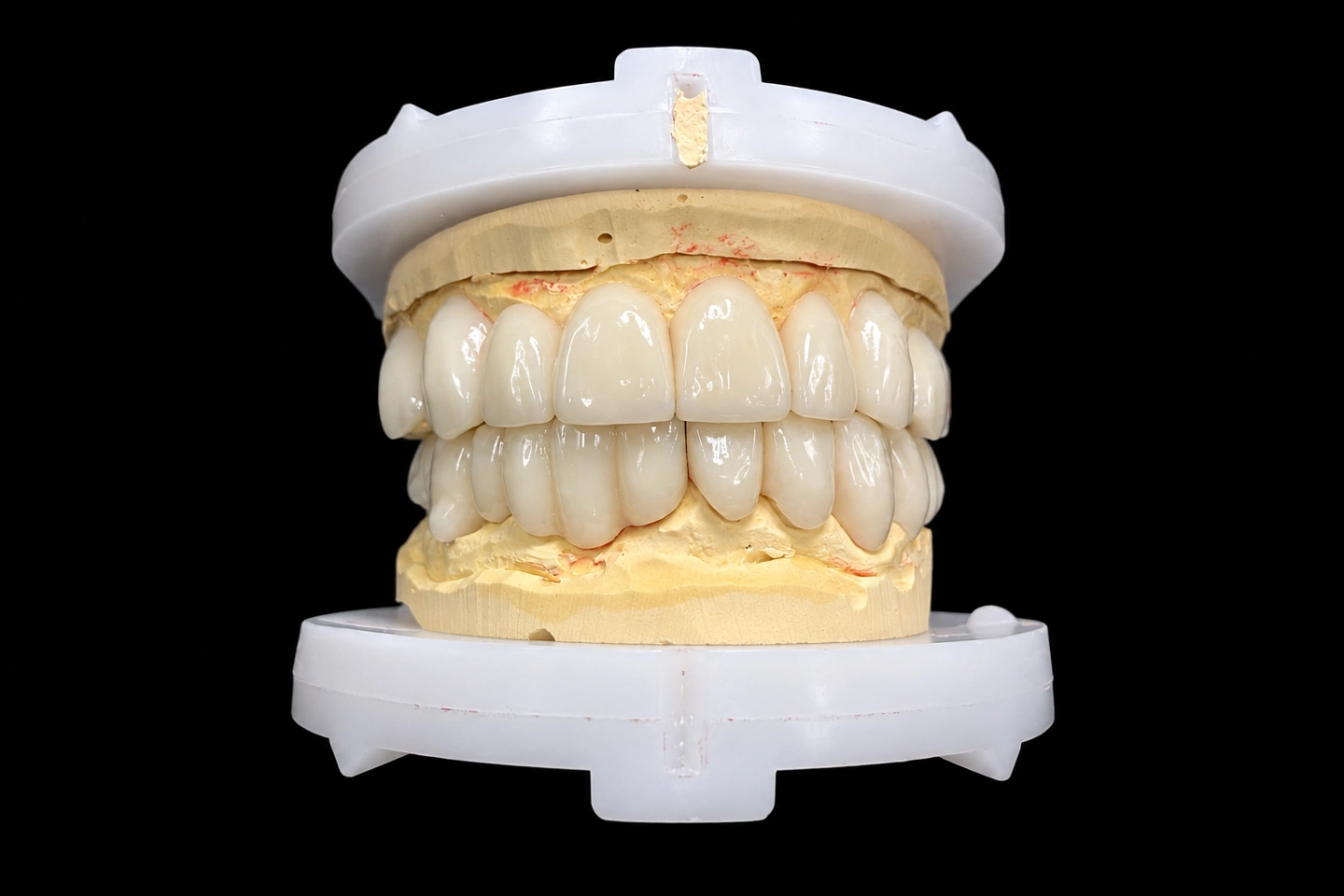
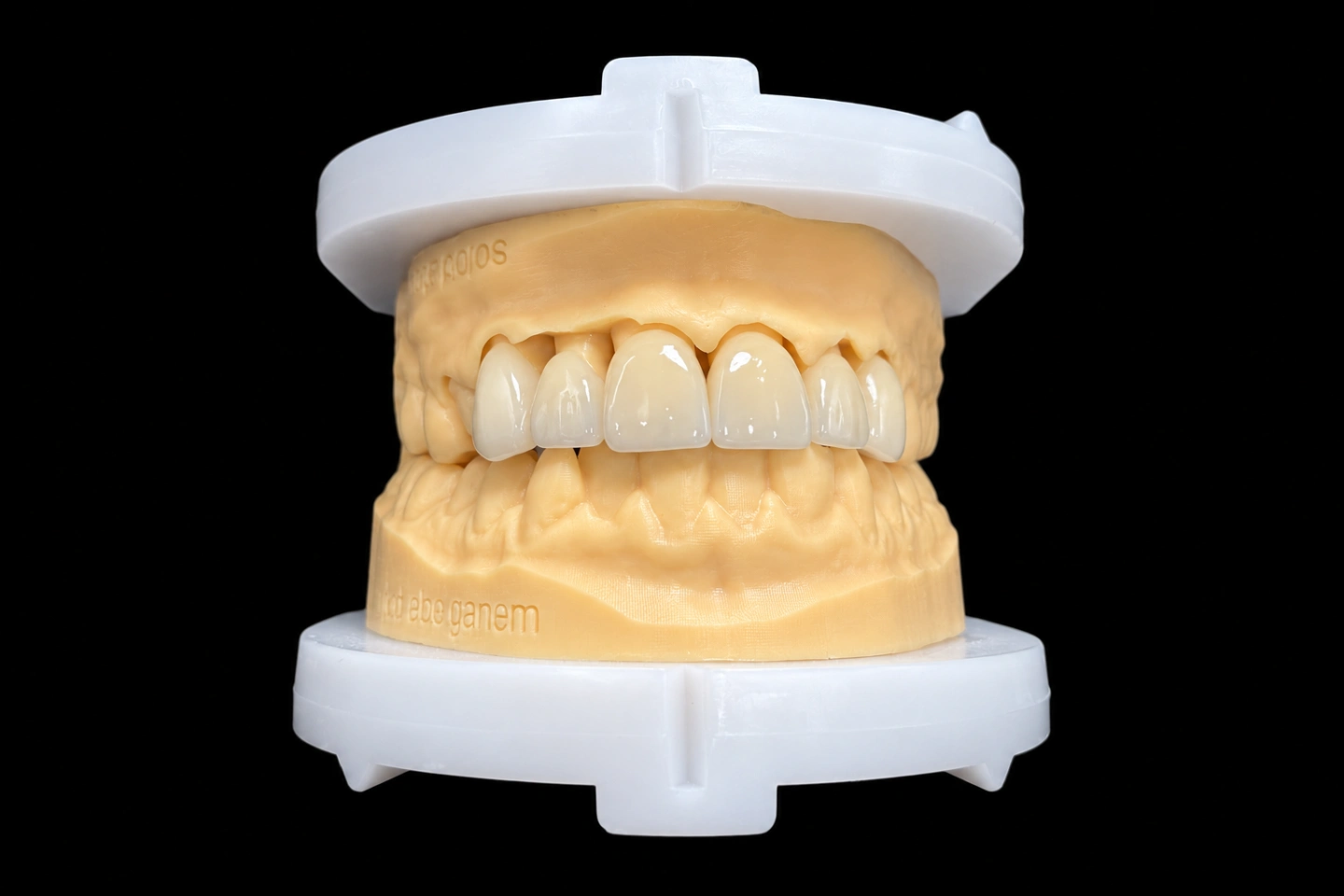
The patient's situation
Adult patient, high smile line that showed the full width of the upper six plus a sliver of the first premolars when they laughed. On rest, the upper lip sat right about the gingival margin of the centrals — so the cervical third of every unit was on display, not hidden. That matters, because any colour mismatch at the cervical reads as a dark line from across a room.
The reasons for sending the case out came in a stack, not one headline. Two central incisors had been bonded years earlier. The original resin had drifted off-shade — now reading warmer and more opaque than the laterals — and had picked up a thin stain line along the mesial-incisal edge of unit 9. One lateral (unit 10) had mild enamel hypoplasia: a chalky, slightly textured patch on the facial surface. It hadn’t got worse in years, but it reflected light differently from the neighbouring enamel and was the first thing the patient saw in photos.
There was mild spacing and length asymmetry across the anterior six. Nothing a layperson would name, but the central incisors were short of each other by about half a millimetre on the incisal edge, and the right lateral sat marginally longer than the left.
Night guard already in use for mild clenching reported by the patient. No wear facets on the posteriors to speak of, no clicking, no sensitivity. The dentist marked bruxism as “not present” on the Rx and flagged the night guard as a design constraint — the arch form had to stay inside what the guard already fit.
Gingival health was clean. No bleeding on probing in the anterior sextant, biotype on the thicker side, papillae full between the centrals and between central-and-lateral. The dentist wanted the margins supragingival wherever the drifted bonding allowed, subgingival only where the old resin extended under the margin.
Function was unremarkable. No endodontic history on the anterior six, no cracks visible on transillumination, bite registration in maximum intercuspation, canine-guided excursion with no interferences on the anteriors.
Patient brief. The quote the dentist wrote on the Rx was short: “look like my teeth from the before-photo”. The before-photo was ten years old and attached to the case. The patient worked in a client-facing role and had stopped smiling in photos — that was the whole reason to open the case.
What’s deliberately not in this write-up: age, gender, nationality, the specific city, the dentist’s name. None of it would change what we did.
What the dentist asked us to deliver
The brief came in on our standard veneer prescription. Here’s what mattered on it:
The things dentists are allowed to change on our side during design review are set out in our workflow: contour, shade, occlusion, contacts, arrangement, material. One design round plus two free revisions are standard. If you want a design preview before milling or casting, mark the correction straight on the image — a circle on the file is enough.
Where this case gets technically awkward
Three things made this case harder than it looks.
1. No stump shade. On any indirect composite veneer, the stump shade decides whether a unit needs a masking layer at all, and how opaque that layer has to be. You can’t guess it from a target shade. Our standard workaround isn’t a workaround at all — it’s what we ask for on every anterior case: a photograph of the prepared stump with the shade tab in the same frame, and a second photograph of the adjacent natural teeth with the same tab in the same light. Same tab, same light, same appointment. Those two frames are the input, not the number written on the Rx.
2. “Natural” across eight units is a design problem, not a shade problem. Dentists usually mean one of two things when they say natural: either “match my patient’s old photo” or “stop making it look like a row of chiclets”. For this case it was both. The fix is to write the build as a gradient per unit and vary the texture per unit, not to pick a different shade number.
3. Length changes affect occlusion more than they look like they will. Eight additive units lengthening the arch by half a millimetre at the incisal is nothing on paper and something in protrusive excursion. The night guard already in use was the constraint we worked back from.
How our dental lab builds the composite bonding veneers
Shade mapping, from frames rather than from a number
We don’t start design until the two frames are in. The stump frame tells us where to mask and how heavy; the adjacent-teeth-with-tab frame tells us the gradient. From those we write a shade map per unit — cervical a step deeper and more saturated, body carried through, incisal built for translucency and a touch of opalescence, surface texture copied from the adjacent natural dentition rather than from a library.
For a single anterior unit, an intraoral shade video is better than a still — a tooth behaves differently at different angles and a video carries that. For a multi-unit case like this one, we still want the still frames, and we’ll ask for a short video on top if the dentist can send one.
One design file, not eight decisions
Here’s the real reason an eight-unit case goes to a lab. At the chair, eight units are eight sequential decisions in one appointment, each one constrained by the one before it. In a lab, eight units are one design file: the shade map fixed per unit before anyone starts building, contour and incisal character approved on the image, revisions versioned so the version you approved is the version that gets produced.
Unit seven on our bench isn’t a fresh interpretation of unit one. It’s the same decision applied again. That’s the structural reason indirect composite veneers come out more consistent across the arch — not because the hands are better, because the decision only happens once.
Design review before anything is cut
Our standard: one design round plus two free revisions. Dentists mark corrections on the image file. On this case we used two rounds. The first design was approved on contour and sent back on incisal character — the units read “too even” across the arch. What changed on round two wasn’t the shade. It was the transition height on the middle three units, lifted so the central-to-lateral read registered properly in a wider-angle smile. The third revision was unused.
Approval adds one to two days to the production clock. Waiting on approval doesn’t eat into our quoted production time — the clock restarts when the case is complete.
Build and finish
Standard anterior veneer finishing: layering, contouring, polishing, surface texture matched unit by unit against the adjacent natural dentition. Nothing exotic.
The checks before anything ships
Every unit goes through the same gate against the approved prescription — not against the last case that looked similar. The gate: seating and marginal adaptation, proximal contacts light-to-normal, excursive and protrusive clearance, form and contour, polish, and a unit-by-unit comparison against the approved design file. A unit that fails the gate is remade. It doesn’t ship with a note attached. For multi-unit anterior work, the packaging is foam-lined so a good unit doesn’t arrive as a cracked one.
Shipping can go out under the dentist’s brand — packaging, Rx, labelling and correspondence carry no Istar name unless you want it on them.
What the finished units had to achieve
Four things, in order:
What we don’t put on this page: a durability number for the finished units. The honest ranges for indirect resin composite come from the published data, not from a page like this one.
A 2023 systematic review and resin composite laminate veneer survival meta-analysis pooled seven studies with 24–97-month follow-up and put composite laminate survival at about 88% overall, with the direct subgroup around 91% and the indirect subgroup around 84%. Porcelain veneers run higher — a porcelain laminate veneer 10-year survival systematic review across roughly 6,500 units reports around 95.5% at ten years.
That’s the trade: composite veneers come in at a lower price point and are easier to repair in place, porcelain lasts longer on the clock. We don’t quote lifespans for our own units because we don’t have the follow-up data to back a number, and we’d rather not make one up.
Try-in feedback from the dentist and the patient
Try-in was done at the chair with the units seated under temporary paste before the final bond. Feedback came back in two short notes, one from the dentist, one from the patient. Here’s the summary.
From the dentist. The arch read as one smile — the central-to-lateral transition didn’t register as “eight teeth” the way the first design round had. Fit was clean on all eight units, no rocking, proximal contacts needed only a light pass with floss, no adjustment to occlusion in centric. On protrusive excursion the night guard reseated without any new interference, which was the design constraint we’d been working back from.
The dentist’s single aesthetic note at try-in: the incisal of unit 9 caught a little more light than unit 8 under operatory light — asked us to confirm the opalescence setting on the design file for that unit, didn’t ask for a remake. Confirmed by return message against the approved file, same build on both.
From the patient. The quote the dentist forwarded was that the teeth “didn’t look painted on” — the one phrase we care about on an anterior composite veneer case. They specifically noticed that the central incisors were brighter than the laterals without being whiter than their own canines, which was the midline-first instruction we’d built the shade map around.
They also noticed the chalky patch on the lateral was gone — not covered up with a bright block of colour, but matched into the gradient of the rest of the arch. They smiled with teeth in the first photo they took afterwards. The dentist flagged that part because it was the whole reason the case was opened.
No shade change requested. No contour change requested. The case moved from try-in to final bond on the same visit.
What happens if something goes wrong after it ships
The line we hold is between clinically adjustable and must be remade.
| Judgement | Criteria | What happens |
|---|---|---|
| Clinically adjustable | deviation can be corrected intraorally without altering the body, the base, the margin or the seat | no return to the lab |
| Must be remade | affects seating, marginal seal, occlusion, retention or biological safety; not correctable in the mouth | return and remake |
Who pays, in our own words. Open margin, open contact, high occlusion, non-seating, inaccurate shade, visible aesthetic defect, unacceptable form — remade free. Not free: you change the shade, you change the material, or you ask us to proceed on an impression we’ve already flagged as inadequate. If the design was yours and the failure is non-seating or occlusal, the loss sits with you. If a unit fractures, it sits with us. If you adjusted the restoration in the mouth and it later fails, we generally still carry the remake.
Every rework starts with an agreed cause filed under one of five headings — clinical, data, design, material, production. Guessing the cause decides who pays the wrong way. A remade unit goes through the full inspection gate again, never a shortened one, and runs on a 3–5 day track.
Our overall rework rate is 2–3%, counted monthly, split by client, product and cause, reviewed case by case. We publish the number because a shop that reports zero has either stopped measuring or stopped telling you.
Why indirect composite veneers belong in a dental lab, not at the chair
Chairside composite bonding is faster and cheaper for small, single-tooth, additive work. We’ll say so to a dentist’s face. The reasons to send an eight-unit anterior case to our dental lab for indirect composite veneers are three, and only three:
The honest limit: indirect means one more bonded interface and a second visit for the patient. On a single additive touch-up, that trade isn’t worth it.
FAQ
Is composite bonding veneers the same as composite veneers?
Not quite. Composite bonding, in CDT language, is additive and partial. Composite veneers are full facial coverage. Patients and search engines use the phrases interchangeably; your coding manual doesn’t. We build the full-coverage indirect version.
Can the lab ship under my own brand?
Yes — packaging, Rx, labelling and correspondence can all go out without our name on them.
What's your rework rate?
2–3% overall. Counted monthly, split by client, product and cause.
If the shade's off, is a remake free?
Yes, provided the case wasn’t built to a shade you later changed. Every rework starts with an agreed cause traced back through photographs, shade records, the design formula and the material batch.
How do I change a design?
Circle it on the image file. Revisions are versioned and the approval record stays with the design system.
How long do you keep my records?
Rx, design and production records: three months as standard, extended on request. Inspection records, photographs and signatures are archived against the work order.
How quickly do you answer a technical question?
Within an hour in working hours. Time difference can add seven to twelve hours outside them. English case conferences are available, including design discussion.
Do you take cases from other labs?
Yes — more than fifty laboratories, over a hundred clinics and four hundred dentists, with full in-house production and no outsourcing.
Send one case. Include the two shade frames. If we think it belongs at the chair, we’ll tell you before we open the file.