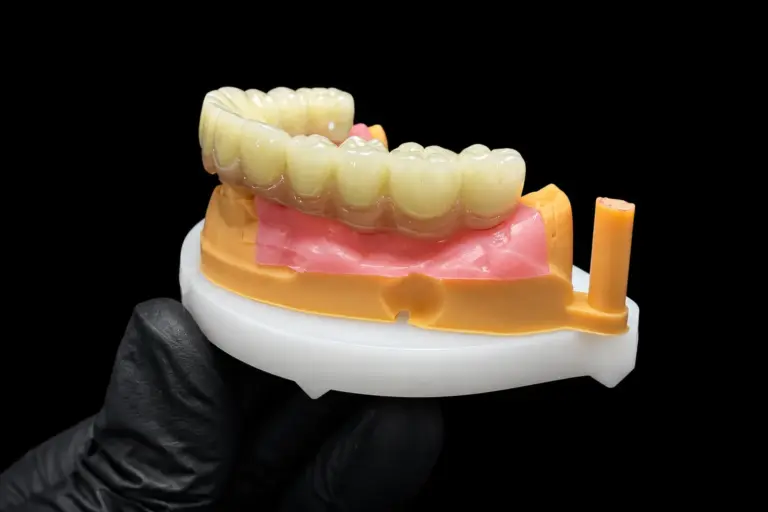
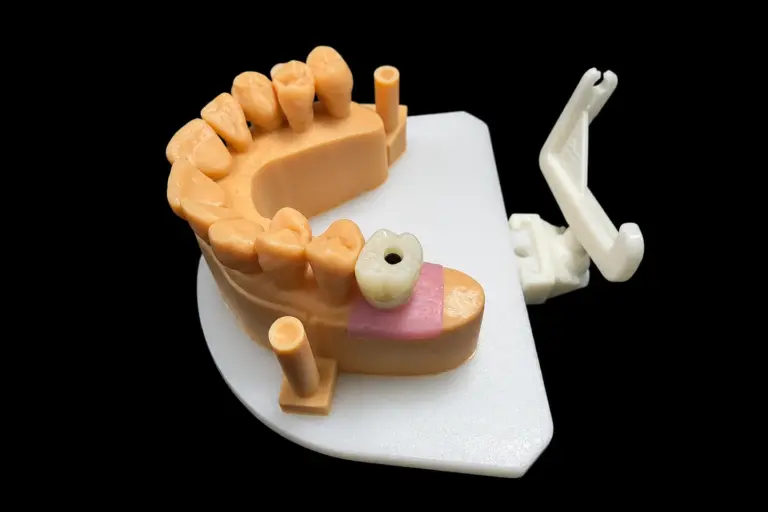
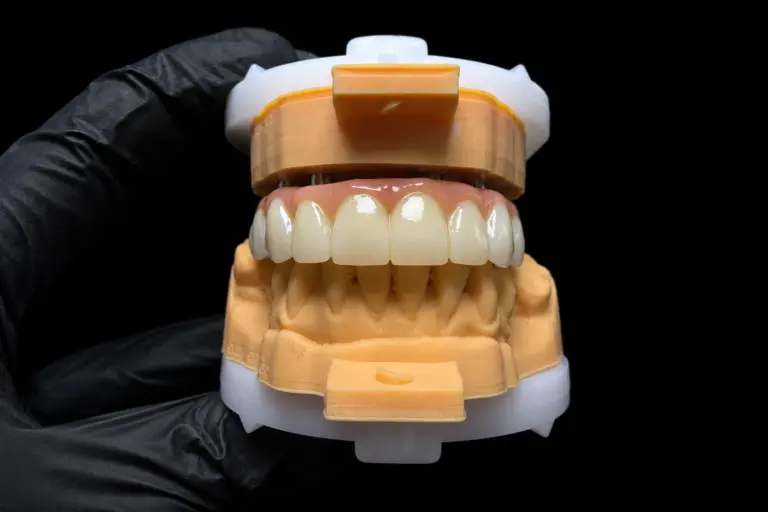
Cement-Retained Implant Crown Fabrication
A full-service dental lab producing cement-retained implant crowns for restorative dentists and clinics in the US and Europe. In-house CAD, milling, ceramic, and quality control since 2012, approximately 460 technicians across Shenzhen and Huizhou, and no outsourcing to third-party labs.
What you receive
A cement-retained implant crown is a custom restoration that seats onto a titanium base or a custom abutment, cemented either in our lab or at chairside in your clinic. We produce it two ways, and the choice is yours per case.
Pre-cemented crown-on-abutment assembly
We cement the crown to the titanium base inside the lab, remove the excess cement in the gel stage before it fully cures, inspect the implant interface under magnification, and ship the finished assembly ready to torque. This is the mode most of our clients use for posterior single units, because it removes the hardest part of the clean-up from the operatory.
Separate crown and abutment for chairside cementation
We mill, finish and inspect both parts, deliver them in matched packaging with the implant library and torque specification on the label, and leave the cementation to you. This is the mode clients choose when the clinical team prefers to control the seating and cementation in the mouth.
Both modes ship with the implant interface clean, the screw channel cleared, the material certificate for the restoration, and the case number laser-marked on the packaging.
Specifications
Every cement-retained implant crown we produce is defined by three choices: the crown material, the abutment, and the fixation to the implant platform. The common combinations we build:
| Options we produce | |
|---|---|
| Crown material | Monolithic zirconia (3Y/4Y/5Y), layered zirconia for anterior esthetics, lithium disilicate (IPS e.max), porcelain-fused-to-metal (PFM) |
| Abutment | Titanium base (Ti-base) with milled zirconia or hybrid superstructure, custom milled titanium abutment, stock abutment, multi-unit abutment (MUA), angled screw channel (ASC) components |
| Case types | Single crown, 2–4 unit cement-retained bridge on multiple implants, hybrid cement-and-screw (screwmentable) retention. For full-arch cases see All-on-X restorations. |
| Shade and layering | Any Vita Classical or 3D-Master shade, custom shade matching from calibrated clinical photographs, cut-back and layered esthetics on request |
On implant system compatibility
We work with most major systems in current clinical use. For every case we match the scan body brand and the CAD library name against the implant brand, platform diameter, and connection on the packaging label or scan body photograph you provide. If a system is unfamiliar we will confirm before milling, not after.
On torque
We follow the implant manufacturer’s torque specification and will note it on the work order on request. We do not substitute our own figure for the manufacturer’s.
When cement-retained is the right choice
Four situations where cement retention produces the better clinical outcome:
- The implant axis places a screw access hole in the facial of an anterior crown, and an angled screw channel component is not available or not acceptable for the esthetic result.
- The restorative space allows a crown plus the cement space but not a sound screw-retained design.
- The clinical team prefers a passive, retrievable-by-chairside-sectioning restoration on a short-span bridge where small axis divergences would stress a screw-retained framework.
- A screwmentable (hybrid) design is planned, where retention is screw-based but a cement seat improves marginal adaptation.
Where we will ask you to reconsider the plan: a screw access hole already clears the occlusal table (screw retention is simpler and avoids cement management), an abutment with less than roughly 4 mm of retention height above the margin (retention form is marginal), or an angulated screw channel component is available in the system you use (it typically solves the same problem without cement). None of these rule the case out. They are the conversations we would rather have before milling.
What we check at each step
Seven checkpoints run from scan intake to packaging. Each one has a name on the work order and a technician accountable for signing it off.
| # | Checkpoint | What we verify |
|---|---|---|
| 1 | Case intake & library match | Scan body brand, platform diameter, connection, and CAD library name are cross-checked against the packaging label or scan body photograph you provide. If anything is ambiguous, we message you before we open the design. |
| 2 | Margin level on the work order | The margin level (equigingival, supragingival, or subgingival with a stated depth and clinical reason) is written on the work order. Six months later, this is the record that resolves any peri-implant soft tissue question. |
| 3 | Cement space geometry | Axial space 20–50 µm starting 0.5–1.0 mm from the margin, occlusal space 50–80 µm, verified on the digital model before milling. These values are tuned to the resin cement families used clinically; the goal is a seat that comes down fully and leaves cement that can be removed. |
| 4 | Ti-base surface preparation | The implant interface is masked. The bonding surface of the titanium base is gently sandblasted with 50 µm aluminum oxide, cleaned by steam or ultrasonic ethanol, dried, and primed with an MDP-containing metal primer immediately before cementation. The interface is never sandblasted. |
| 5 | Extraoral cementation sequence | Resin cement is applied to the inner surface of the superstructure in a controlled bead (never flooded), the superstructure is seated onto the Ti-base, excess is wiped before the cement reaches full cure, and the assembly is inspected for seat completeness before final light cure. |
| 6 | Excess removal in the gel stage | We remove excess cement while it is still in the elastic, gel-like phase, not after it has fully set. Cured cement at the implant interface cannot be removed without touching the interface cone and the screw threads, and any instrument that touches those surfaces will leave a scratch that prevents the next seat. The gel-stage removal is the reason this assembly can be delivered ready to torque. |
| 7 | Interface, cleaning space, and finish | The implant interface is confirmed clean and undamaged under magnification. Hygienic clearance to the mucosa and adjacent surfaces is confirmed at a minimum of 2 mm so your patient can clean around the restoration. No sharp line angles, no step at the margin, polished emergence surface. |
Zirconia shrinkage compensation is set per material batch, kiln parameters are fixed, and a reference test specimen is fired with every batch so dimensional drift is caught before a case leaves. Color and form consistency across a multi-unit case is verified against the client’s confirmed shade reference and photographs on a cross-batch QC bench.
Who makes the restoration
Every cement-retained implant crown is built inside a full-service lab, not routed through a trading company or middleman. Data receiving, CAD design, 3D model printing, CAM milling, zirconia processing, ceramic layering and glazing, polishing, QC, and packaging all run inside our own facilities in Shenzhen and Huizhou.
| Department | Technicians |
|---|---|
| CAD design | ~100 |
| CAM milling | ~70 |
| Implant restoration | ~80 |
| Ceramic and metal (incl. PFM) | ~70 |
| Removable | ~55 |
| Quality control | ~25 |
| Case coordination (English-speaking) | ~40 |
| Sales, admin | ~20 |
| Headcount including trained backup technicians | ~510 |
| Monthly production | Normal season | Peak season |
|---|---|---|
| Zirconia single crowns | ~8,000 units | ~15,000 units |
| Zirconia bridges | ~2,000 cases | ~3,000 cases |
| All-on-X restorations | ~20 arches | ~40 arches |
| Removable dentures | ~4,000 cases | ~6,500 cases |
Current staffing is sized above current order volume, which is how we hold lead times when demand peaks and how we absorb rush cases without reshuffling other work.
Submitting a cement-retained implant case
Digital case
Send the scan files directly from your scanner’s cloud or by email. We accept files from Trios (3Shape), iTero, Medit Link, Shining 3D, Dexis, Primescan (DS Core), Ori, Panda, and WeTransfer links. For every case:
- Full scan set: prepared quadrant or arch with the scan body in place, opposing arch, bite in centric, and a buccal scan of the occlusion.
- Implant identification: scan body brand and model, implant brand (Straumann, Nobel, MIS, and so on), platform diameter (NP/SP/WP or stated mm), connection type (internal cone, external hex, internal tri-channel), implant diameter and length. The clearest way is a photograph of the implant packaging label or the scan body packaging.
- Soft tissue reference: scan of the healing abutment or the provisional in place, or a soft tissue scan after retraction, so emergence profile can be designed to the tissue you actually have.
- Shade and photographs: full-face smile, intraoral in centric, and a calibrated shade photograph with the tab in frame.
- Rx entries: retention choice (cement-retained), cementation mode (extraoral by us, or chairside), restoration material, margin level, contact tightness, any excursive interference to avoid.
Impression case
Pour-ready impression plus bite registration, shade and photographs, implant identification as above, and a prepaid return label if you prefer we arrange the carrier. We send the shipping waybill on request.
Design approval
For cases with aesthetic risk or complex emergence requirements, we send the CAD design and the planned emergence profile for your approval before milling. Approval is handled in a dedicated WhatsApp group with named designer and case coordinator. Design versions are version-controlled on our side, and the file that was approved is the file we mill.
Lead time
Lead time is counted in working days from the day the case data or physical impression arrives at our facility.
| Stage | Working days |
|---|---|
| Diagnostic wax-up or guide | 2–3 |
| PMMA provisional for try-in | 2–4 |
| Custom abutment | 3–4 |
| Final restoration (monolithic zirconia or layered ceramic) | 3–5 |
| Full-arch and All-on-X | 5–7 |
Digital cases save the inbound shipping time that impression cases spend in transit; the production stages themselves are the same length.
Rush cases
All case types can be requested as rush. For client accounts with monthly volume under ten cases, there is no rush surcharge. For every rush case we commit to a specific delivery date before you confirm.
Notifications at three points
Design completion, production completion, and shipment. The shipment notification includes the courier tracking number, and a case coordinator follows the parcel until it arrives.
Chinese national holidays and weekends are not production days and are not counted toward committed lead time. These dates are listed on your account page at the start of each year.
Remakes and responsibility
Most remakes are produced at no charge. The exceptions, written here so there is no surprise:
- A remake requested because the Rx was changed after the case was accepted into production.
- A remake on an impression case where we flagged the impression as unclear, you asked us to proceed anyway, and the clinical fit confirms the original concern.
- A remake caused by a material choice marked on the Rx by the clinician where the material is clinically unsuited to the case.
If repeated remakes still cannot produce a clinically acceptable restoration, we credit the case fully. Shipping of a remake is covered by the party responsible for the cause: us if the cause is ours, the client if the cause is on the Rx or the clinical data.
Cases that arrive damaged in transit are remade at no charge when unboxing video with the shipping label visible is sent within 24 hours and the original packaging is kept for the carrier claim. Carrier and packaging details are on the shipping and packaging page.
Why clients work with us
Since 2012. More than 50 dental laboratories, 100 clinics, and 400 individual dentists have placed cases with us. Our clients are in the United States, the Netherlands, Germany, France, Belgium, Austria, the United Kingdom, Luxembourg, Switzerland, and other European markets.
- In-house manufacturing, not a broker. Every stage of the workflow for a cement-retained implant crown runs inside our own facility. There is no third-party laboratory in the chain and no step we cannot answer for.
- Factory visits and remote audits. Clinics and labs can visit our Shenzhen and Huizhou facilities, tour the production line, or conduct the audit over video. We complete supplier qualification questionnaires and annual audits as submitted by the client.
- English case coordination. English-speaking case coordinators and technical calls for case discussion, technical questions, and compliance document review. English versions of custom-manufacture declarations, material certificates, and product labels on request.
- NDAs, quality agreements, and supplier agreements are signed on request.
Current production capacity sits above current order volume by design. That is how a cement-retained implant crown case placed today keeps its committed lead time next month.
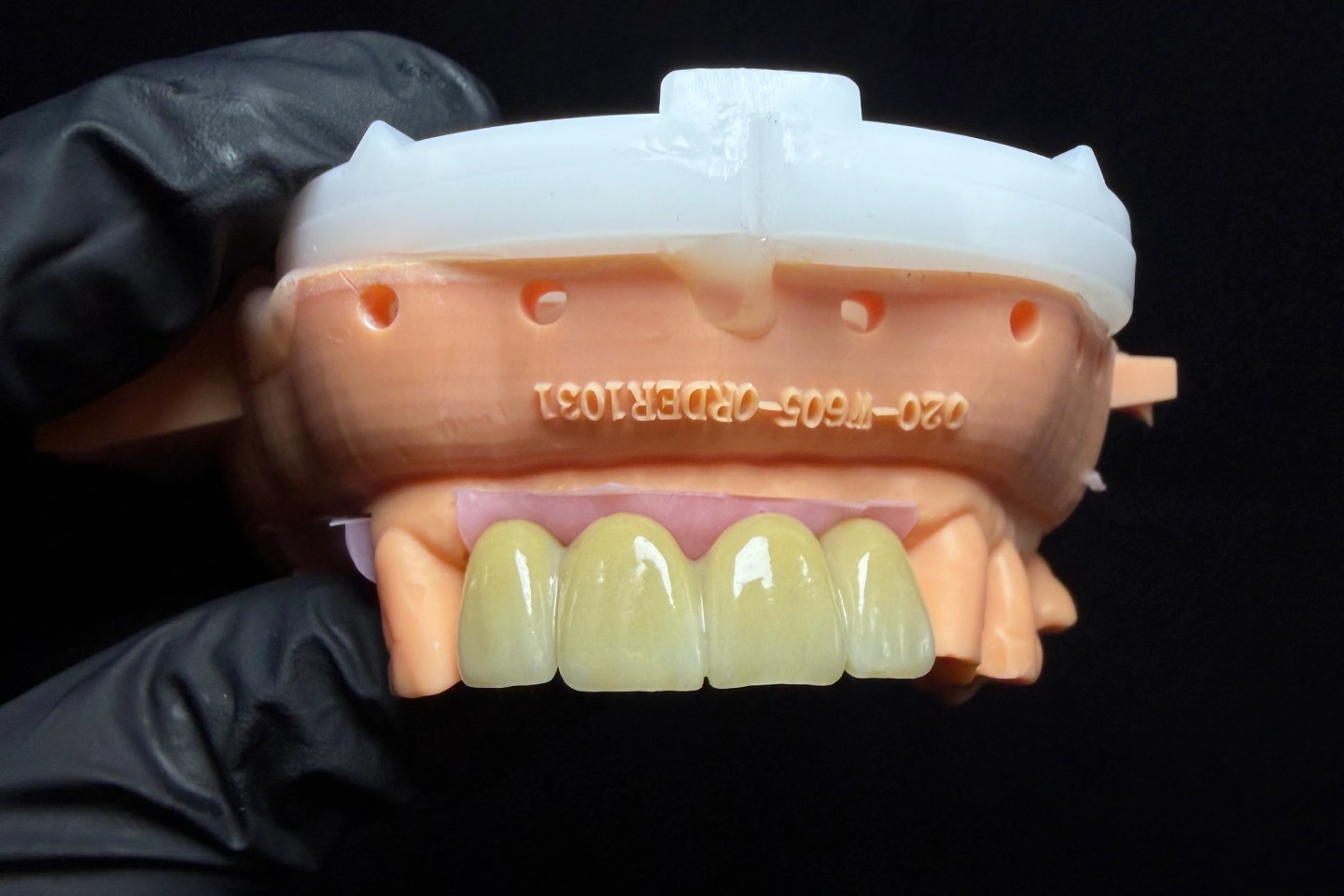
Cases from our lab
FAQ
Can you do a sample case or a trial order first?
Yes. Most new clients start that way. Send one case data to the email below or arrange a prepaid shipping label for an impression case, and we treat it as a trial.
Do you support most implant systems?
Most major systems in current clinical use. For every case we cross-check the scan body brand, platform diameter, and connection against the CAD library name, and confirm with you before milling if anything is unclear.
Can we approve the design before milling?
Yes, by default on cases with aesthetic or emergence complexity, and on request on every case. The approval exchange happens in a named WhatsApp group with the designer and case coordinator.
Can you white-label the restoration and packaging for a lab client?
Yes. Our standard packaging carries no logo. We can also package in your branding on request, and we commit in writing not to approach your end clients.
Do you provide material certificates and lot numbers?
Yes, on any case on request. Brand, country of origin, lot number, and material certificate can be prepared with the shipment.
Start a case
- Request a trial case: send one case data to your account email, or ask us for a prepaid shipping label for an impression case. First-case turnaround is the standard lead time for the restoration type.
- Request a quote: send the case specification (material, abutment, retention mode, implant system, number of units) and we return a line-itemed figure.
- Download the Rx form: fill the fields below, submit, and the case opens in our coordination system in one step.