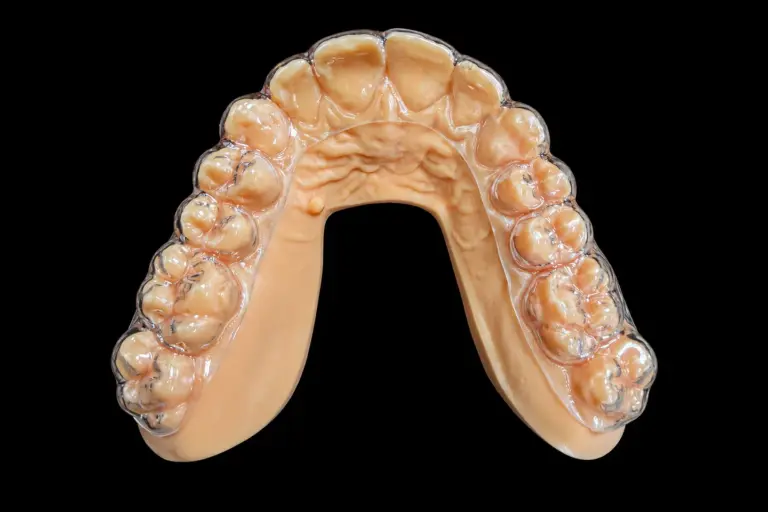
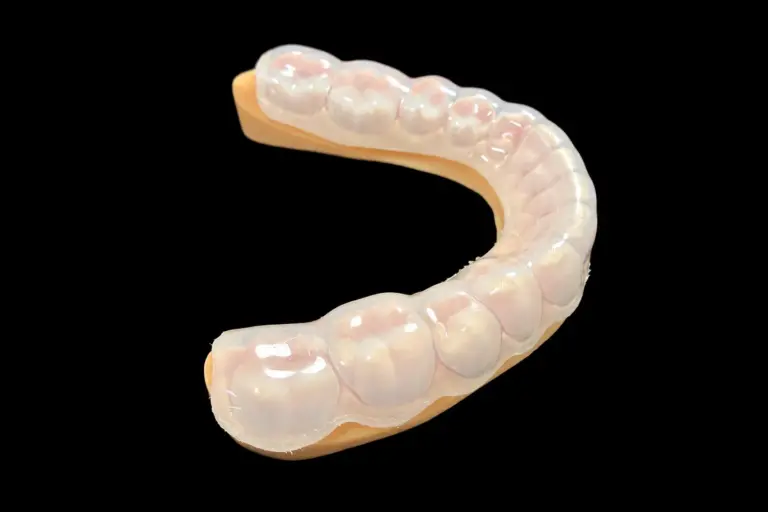
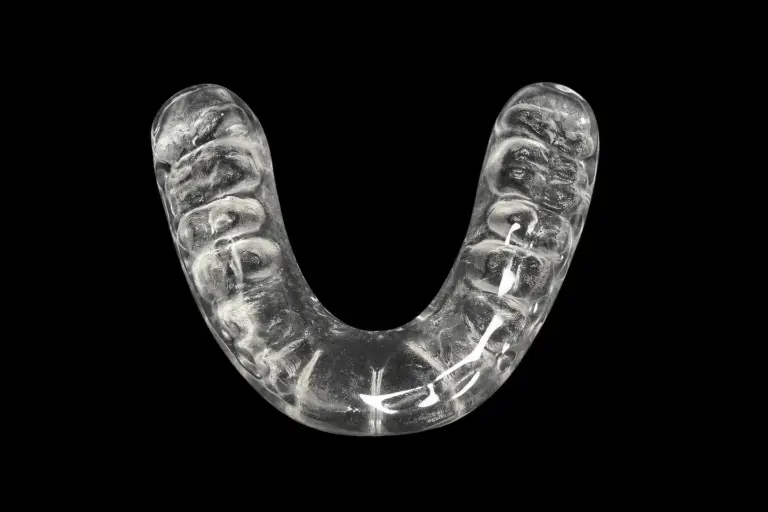
Hawley Orthodontic Retainers, Built the Way You Prescribe Them
The retainer is the last appliance your patient takes home, and the one that protects everything you achieved in treatment. A well-made Hawley orthodontic retainer holds the anterior alignment, lets the posterior teeth settle into a solid bite, and stays adjustable at the chair for as long as the patient wears it.
At Istar Digital Dental Lab, we build every Hawley to your prescription, with the clasps, bow and base you choose, and send it back ready to seat. Your delivery appointment stays short, and your patient leaves with an appliance that feels made for them.
Send us your next retention case and judge the fit yourself.
Why Orthodontists Choose Istar Digital for Hawley Retainers
Upper Hawley orthodontic retainer with Adams clasps on the working model
Your prescription, followed to the letter. The clasps, bow and base you specify are what we build. When an Rx and a model don’t line up, we send you photos and ask before we start, so there are no surprises at delivery.
Easy to work with from anywhere. Send a scan or ship impressions, and we pay to send the finished retainer back, remakes included. Our team answers in English, usually within the hour during working hours (9:30 am to 6:00 pm China time, UTC+8), and stays on until midnight for urgent cases.
Four labs, one standard. Since 2012, every Istar Digital case has been made in our own labs in Shenzhen and Huizhou and never passed to an outside lab. We’re an FDA-registered establishment, Registration Number 3039441248, searchable in the FDA establishment database, we hold ISO 13485, and you’re welcome to tour the lab in person or by video.
Design Your Hawley Orthodontic Retainer
Every Hawley starts with the same three parts: an acrylic base against the palate or lower lingual, a labial bow across the anterior teeth, and clasps on the posterior teeth. How you specify them is what makes the retainer fit the case. Here’s what to put on the Rx:
| Rx choice | Common options | What decides it |
|---|---|---|
| Clasp type | Adams, ball, C (circumferential), arrowhead | The undercuts available, the eruption stage, how much retention you want |
| Clasp teeth | First molars as a rule; premolars or primary molars where needed | Eruption, and which teeth will stay in the arch |
| Labial bow | Standard canine-to-canine with adjustment loops, extended, or wraparound | Occlusal clearance distal to the canines, and how freely the buccal segments should settle |
| Bow wire | Hard stainless steel, customarily 0.7–0.8 mm (.028–.032 in) | Arch, bow length and the stiffness you want |
| Base | Full palatal or lingual coverage, typically about 2–3 mm thick | Strength versus bulk: thicker is sturdier, thinner is easier on speech |
| Active elements | Finger springs or an activated bow | Only when you plan to correct minor relapse, not just hold |
Clasps That Hold Without a Fight
The Adams clasp is still the workhorse of removable orthodontics. It grips the mesiobuccal and distobuccal undercuts of a single tooth, so it holds well even on a partially erupted molar. One detail worth adding to the Rx: if the gingiva has receded or the tooth has over-erupted, say so. We keep the arrowheads out of the deepest undercut, so the retainer goes in and comes out without a struggle.
Ball clasps sit in the undercut between two teeth and are handy in the mixed dentition, as long as both teeth will still be there when the retainer is. C clasps wrap a fully erupted tooth: simple, low-profile and easy to tighten. The Schwarz arrowhead clasp, the Adams clasp’s forerunner, fits between adjacent teeth and is useful when you want retention spread along the buccal segment.
The Labial Bow: Standard or Wraparound
The standard bow runs canine to canine, with U-loops you can tighten at the chair, and crosses the occlusion just distal to the canines. Where that crossing would land on the bite, a wraparound bow carries the wire around the arch behind the last molars instead, so nothing sits between the cusps and the buccal segments settle undisturbed.
Unless you prescribe otherwise, the bow is passive. Each chairside re-bend works the wire, so small, occasional adjustments keep it going longest. To correct minor relapse, write the movement you want on the Rx, and the springs or activated bow are part of the build.
Adams clasp and labial bow loop on a Hawley dental retainer
Hawley Dental Retainer or Clear Retainer: Which to Prescribe
The difference starts with coverage. A Hawley dental retainer leaves the occlusal surfaces uncovered, so the posterior teeth can move vertically and come into fuller contact after treatment. A full-coverage vacuum-formed retainer holds the arches apart by the thickness of the sheet and limits that settling. In a follow-up study of posterior occlusion, contact areas increased substantially during Hawley wear, mostly in the first months.
The trade-off runs the other way for alignment. A randomized trial of 397 patients found vacuum-formed retainers held lower incisor alignment about 0.56 mm better than Hawleys at six months. Across the wider evidence, the 2023 Cochrane review of retention procedures found tooth movement may be similar with either retainer, with clear retainers giving better patient satisfaction but being less likely to last. Its authors rate their confidence in the evidence as low, and no one approach can yet be called best.
So the choice is clinical, case by case. We make Hawley, Essix and bonded lingual retainers, so one case can carry a Hawley for the upper and a clear retainer for the lower if that’s your plan. See our full retainer lab services.
Sending a Dental Hawley Retainer Case
A dental Hawley retainer is only as good as the model under it, and the clasps depend on clean undercuts. Send both arches as scans, PVS or polyether impressions, or poured stone models; a PVS bite registration; and your Rx with the design choices above. Our case submission guide has the forms.
Shipping impressions overseas? Leave the alginate out. It loses water and distorts on the way, can grow mold, and may be held at customs. PVS, polyether or a poured model travels well and gives us the detail the clasps need.
Working digitally? We take files from 3Shape TRIOS, Medit, iTero, CEREC, Shining3D Aoralscan and Planmeca, or orders through 3Shape Communicate and Medit Link. Capture the clasp teeth down to the gingival margin, plus the full palate for an upper or the lingual tissue for a lower. We print the working model from your scan, with finer detail than a milled model, and the retainer is then hand-built on it, just as on stone. More on our digital dental laboratory.

Printed working model for a dental Hawley retainer case
How We Build and Check Every Hawley Orthodontic Retainer
On the model, the technician forms the bow and clasps, fixes them in position, builds the acrylic base around their retentive tags and cures it to the resin maker’s instructions. The base is then trimmed clear of the gingival margins and polished smooth.
Every case passes three checkpoints: a records check on arrival, inspection during production and final release by an independent inspector. At final inspection we measure the base with calipers at several points against your prescribed thickness, check every edge for burrs and lifting, confirm the bow and clasps sit where you asked, and seat and remove the retainer on the model to test retention. Any crack or void sends it back.
Each case carries a unique number that links it to the technician, the equipment, the material batches and every inspection result. Ask, and we’ll send the brand, origin, batch number and certificates for the materials on your case. For orthodontic acrylic, the material standard to look for is ISO 20795-2 for orthodontic base polymers, not the denture-base Part 1. Before shipping, every retainer is cleaned, disinfected and packed on its own, labeled with the patient’s case number.
If a retainer doesn’t seat, the base lifts, a clasp is badly placed, the bite is off or the acrylic color isn’t what you ordered, tell us within 24 hours of receiving it and we’ll adjust or remake it free of charge.
Checking acrylic thickness on a Hawley retainer during final inspection
Cases from our lab

Hawley Orthodontic Retainer FAQ
We're a dental lab. Can you ship retainers straight to our client's practice?
Yes, to any address you name. The sender address on the waybill can’t be changed, so plan your client communication around that.
Is rush service available?
Yes, free for any case type, for clients who send us 10 or more cases a month. We guarantee the ship date; arrival depends on the carrier and customs.
Can each orthodontist in our group keep their own preferences?
Yes. We record each doctor’s standing design requirements, so they don’t need repeating on every Rx. Group practices and DSOs can also get monthly reports on on-time delivery and remakes.
Will you ever change the wire or acrylic I prescribe?
Not without your consent. If a prescribed material is unavailable or unsuitable, we contact you first, and nothing is substituted without your written or verbal approval.
Let Your Next Retention Case Be the Test
Pick an upcoming Hawley case and send it with your Rx. We’ll build it to your design, and you can judge the fit at the chair. Single trial cases are welcome, and ongoing partnerships suit practices and labs with a regular case flow. Your quote is itemized to the prescription and confirmed before we start, so you know the full cost up front.