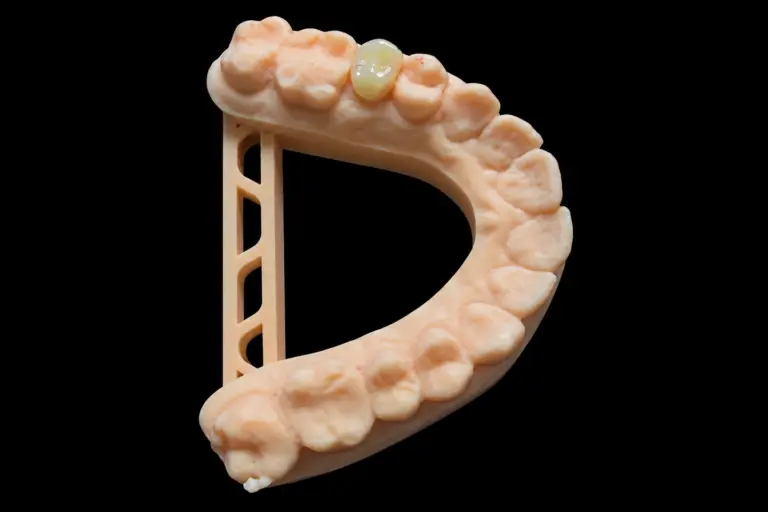
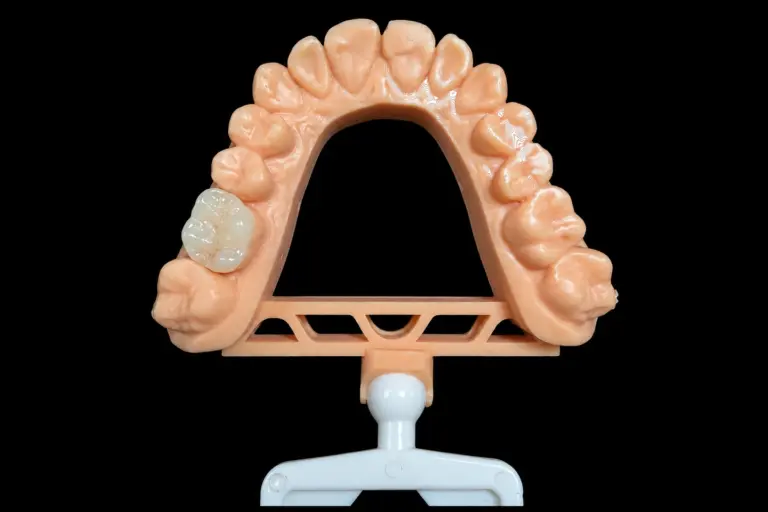
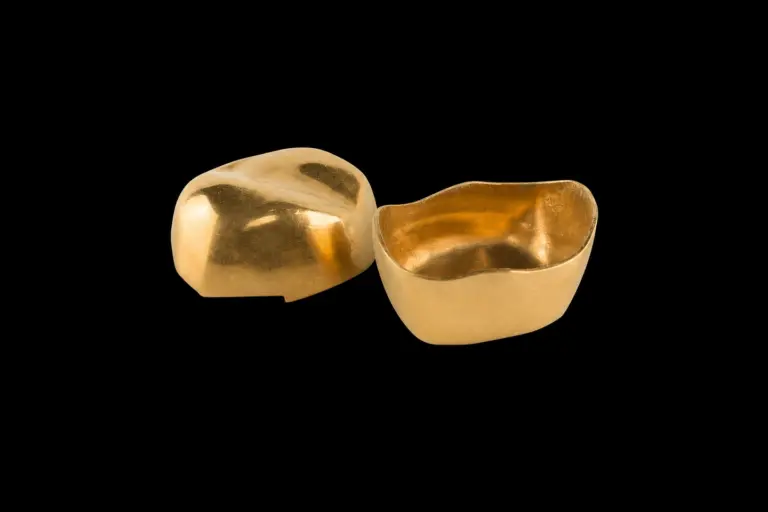
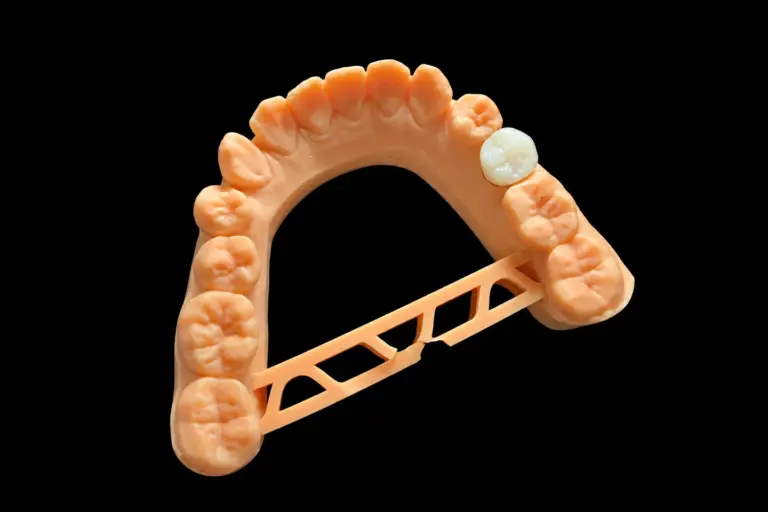
Composite Inlay and Onlay (Lab-Processed) for Dental Professionals
Composite inlay and onlay cases rarely fail because of the material. They fail at case selection, at the preparation margin, or at the bonded interface after the restoration leaves the laboratory. That is why this restoration type is worth discussing case by case rather than in general terms — and why the boundary between “send it out” and “place it directly” is narrower than it first appears.
Composite inlays and onlays are indirect restorations: the material is shaped outside the mouth, either by a dental technician in a laboratory or by a chairside milling unit, and then bonded or cemented into the prepared cavity in a second visit. Once the restoration is made away from the tooth, polymerisation shrinkage occurs against a die rather than against cavity walls, and occlusal anatomy can be built under direct vision. Those are the two real advantages. Longevity is not automatically one of them, and the published evidence on that point is set out below rather than avoided.
Istar Digital Dental Lab is a full-service manufacturing laboratory founded in 2012, with in-house facilities in Shenzhen and Huizhou and a team of around 460 technicians, designers, and quality staff. Our FDA device listing and EU MDR custom-device notification both cover inlays and onlays as a device category.
1. Inlay, onlay, overlay and crown — where the lines fall
The category is decided by how much occlusal anatomy remains, not by which material is chosen. The distinction matters before anything else in the workflow, because it determines the coding, the margin design, and in many plans the reimbursement rate.
| Restoration | What it replaces | Occlusal coverage |
|---|---|---|
| Inlay | Intracoronal defect contained within the cusp tips | Fits between the cusps; no cusp capped |
| Onlay | Intracoronal defect plus one or more missing cusps | Caps one or more cusps |
| Overlay | A larger onlay that caps all cusps but keeps part of the axial wall | Caps every cusp, partial axial |
| Crown | Full-coverage extracoronal restoration | Full occlusal and axial coverage |
This four-tier split, and the rule that a restoration covering every cusp is a crown, follows the standard description of indirect intracoronal restorations (Wikipedia — Inlays and onlays).
A practical consequence at intake: if a prescription reads “inlay” but the preparation shows one cusp already reduced, we raise it with the prescribing dentist before design begins. We do not silently convert an inlay into an onlay, and we do not cut a design that contradicts the written prescription.
2. What "resin-based composite" means in a laboratory context
Resin-based composite is one of five material classes the American Dental Association lists for indirect restorations, alongside gold, porcelain-fused-to-metal, all-ceramics, and base metal alloys (ADA — Materials for indirect restorations).
The material itself is specified by ISO 4049:2019 — Dentistry — Polymer-based restorative materials, published in May 2019 and confirmed at systematic review in December 2024. Its scope covers polymer-based materials intended for direct or indirect restoration, and the polymer-based luting cements used to fix inlays, onlays, veneers, crowns and bridges.
One distinction is worth stating plainly. ISO 4049 is a material-level standard: it describes what the resin must do before it reaches a laboratory. It says nothing about the quality system of the laboratory that shapes it, the traceability of the batch, or the fit of the finished restoration. Those are governed by separate instruments — in our case ISO 13485 for the laboratory’s quality management, FDA establishment registration and device listing for US shipments, and the EU MDR Annex XIII custom-device route for European markets.
The material has also changed generationally. Laboratory-processed composite systems entered use in the early 1980s; the first generation lost ground as its wear behaviour proved inadequate, and the second generation differs in filler loading, matrix chemistry, and the post-cure protocol applied after shaping, with published post-cure regimes running at elevated temperature (BJSTR review of indirect composite systems). The parameter set is specific to each system and is taken from the manufacturer’s instructions for the material in use, not applied as a generic setting across brands.
3. When a composite inlay or onlay is the right choice
3.1 Case selection criteria
Indications for this restoration type are usually described in adjectives — “large cavity”, “repeated failure of direct restorations”, “parafunction”. Those words do not help a clinician decide whether a specific tooth belongs in this workflow. Trial protocols use measurable thresholds instead, and these are the ones we apply when a case arrives — the cusp-coverage rules from the CECOIA protocol (CECOIA trial protocol):
A cusp is covered, and the restoration therefore designed as an onlay rather than an inlay, where any of the following applies:
- The isthmus width exceeds half the intercusp buccolingual distance.
- The residual cusp wall is 2 mm or less before preparation.
- The wall is 1 mm or less after preparation.
- The isthmus approaches half the intercusp distance and one or more cracks are visible.
- The preparation is mesio-occlusal-distal, or is subject to horizontal forces.
The same protocol sets two preconditions worth checking before a case is sent. The tooth must be isolatable with a rubber dam and must retain at least one intact cusp. Active caries, periodontal disease, poor oral hygiene and severe bruxism are exclusions — a point that sits consistently with the eleven-year data below, where unacceptable wear concentrated in severe bruxers.
Where any of these conditions are documented in the case we receive, the design brief defaults to an onlay form unless the dentist directs otherwise in writing.
3.2 Preparation geometry we check before design
Three dimensions determine whether a design can be built at all, and they are worth checking at the chair before the scan is taken:
- Occlusal divergence of the axial walls, typically 15–20°, so the restoration can seat along a single path of insertion.
- Floor thickness of at least 1.5 mm between the cavity floor and the pulp.
- Cusp reduction of 1.5–2.0 mm where a cusp is being covered, to leave room for material of adequate thickness.
These figures are the working values given for indirect composite inlay and onlay preparation in clinical guidance (Oral Health Group). Where a submitted preparation falls outside them, we say so before design rather than after delivery, because the alternatives are a compromised restoration or a remake.
Two further points we raise at intake:
- Minimum section thickness is material-specific. We confirm the limit for the system you have specified before the design is cut.
- Isolation at cementation. Where a photograph shows a subgingival margin with no stated isolation plan, we flag it before design rather than after delivery.
3.3 What the long-term evidence actually shows
Three clinical datasets are worth knowing, and they do not all measure the same thing.
Eleven-year follow-up, direct resin composite inlays versus direct composite restorations. One hundred Class II resin composite inlays and 34 direct composite restorations were placed in 40 patients and reviewed annually for eleven years; 96 inlays and 33 direct restorations were still available for evaluation at the end. At eleven years, 17.7% of the inlay group and 27.3% of the direct group were assessed as unacceptable, and the difference in longevity was not statistically significant. Failure was attributed to fracture (8.3% and 12.1% respectively), occlusal wear in contact areas (4.2% and 6.1%), and secondary caries (4.2% and 9.1%). Molars failed more often than premolars, unacceptable wear concentrated in six restorations in severe bruxers, and marginal adaptation of the inlays was still rated good at the end of the study. Secondary heat treatment produced no apparent improvement in mechanical properties. The authors concluded that the more time-consuming and expensive inlay technique may not be justified given how small the difference was, and recommended the technique for Class II cavities in high caries risk patients with the cervical margin placed in dentin (van Dijken, 2000).
Nine-year prospective study, indirect composite inlays and onlays
Sixty indirect composite inlays and onlays were placed in 32 patients by a single operator, each built to the same clinical procedure. At three years, 88.4% scored Alpha with no failures. At six years the success rate was 100%. At nine years, overall success was 85% and the reported failure rate was 15%, with Alpha at 15%, Bravo at 50%, Charlie at 20% and Delta at 15% (Galiatsatos et al., 2022).
Twelve-month randomised comparison, direct versus indirect
Seventy-four participants received 79 Class II restorations, direct composite (Filtek Ultimate) against indirect composite (Crea.lign); indirect restorations were used where the isthmus width exceeded two-thirds of the intercuspal distance, or where a cusp had been lost. Fifty-eight restorations in 54 participants were reviewed at twelve months, and none of the evaluated criteria showed a statistically significant difference between the two materials (PMC12276707).
Read together, these three studies support a narrower claim than the one usually made for this product category. The eleven-year data found no statistically significant difference in survival between inlay restorations and direct composite restorations, and the authors said in their own conclusion that the more time-consuming and expensive technique may not be justified. The nine-year study has no control group, so it shows that indirect composite performs acceptably over time — not that it outperforms the alternative. The twelve-month trial found the two approaches comparable in the short term. What the indirect route buys is control: of shrinkage, of anatomy, of contact, and of the conditions under which the material is shaped. For a case that a direct restoration cannot reach predictably, that control is the reason to send it out.
On the separate question of composite versus ceramic, the evidence base is genuinely unsettled. The CECOIA investigators, working from the same selection criteria we apply at intake, searched the literature before designing their own trial and found only two randomised comparisons of the two materials. The first, published in 2005, compared 80 CAD/CAM inlays — VITA Mark II ceramic against Paradigm composite — in 43 adults over three years, and found composite better on only two criteria, colour match and restoration fracture. The second, published in 2006, followed 58 inlays in 37 patients for ten years and found survival similar across materials at 75–80% when repairs were not counted as failures; when repairs were counted as failures, CEREC ceramic inlays reached 80% against 51–67% for the other inlays. On that basis the investigators described the evidence on which material to use as controversial and called for a randomised trial. That trial has been designed and its protocol published, but the results are not yet available, so no material preference is settled here.
We hold no long-term follow-up data on our own output, so we do not quote a survival rate for our own cases. What we can document is what happens when a case fails, which is the subject of our rework policy.
4. How a composite inlay or onlay is made
4.1 In-house production, start to finish
Istar Digital runs the full sequence in-house for fixed restorations: data receipt and review, CAD design, model production, fabrication, finishing, inspection, packing, and dispatch. Cases are not routed to third-party laboratories at any stage. The departments that carry this are an in-house CAD design group of around 100 technicians, a milling department of about 70, and a quality-control group of about 25 who inspect independently of the technicians who produce the work.
4.2 Three inspection points and case-level traceability
Every fixed restoration passes three separate checks before it leaves the building:
- Intake check on the submitted scan, impression, or prescription, before any design work starts.
- In-process check between the major production stages, after design and after finishing.
- Final inspection by a quality technician who did not make the restoration and whose only function is to pass or reject the piece against the written prescription. The inspection role is separated from production by design.
Each case carries a unique case number that binds the technician who made it, the equipment used, the material batch, and the result of every inspection. If a question arises months later about why a particular restoration was shaped the way it was, that record is retrievable at case level rather than reconstructed from memory.
We do not publish a single margin-gap tolerance figure. Our inspection criteria are applied against the preparation actually received, and one number detached from the measurement method would misrepresent what was checked. A quality team that needs the criteria in writing can have them with the case.
4.3 What moves off the chair
The argument for laboratory fabrication is not that the material is superior — it is that several variables which are difficult to control at the chair become controllable on a die.
- Shrinkage, once the restoration is shaped outside the mouth, is expressed as a fit problem at the margin rather than as stress distributed through the bonded interface.
- Occlusal anatomy, proximal contact and emergence profile are built against a model, with no cheek, tongue, retraction cord or saliva in the field.
- Complex multi-surface and cusp-covering forms can be built up and assessed before the patient is in the chair, so chair time is spent fitting rather than sculpting.
The boundary of that advantage is worth stating. Cementation still happens in the practice, and the durability of an indirect composite depends heavily on what happens at that appointment — isolation, surface treatment, and moisture control. A well-made restoration can be lost to a compromised bond, and no laboratory can control that step for you.
5. Submitting a composite inlay or onlay case
5.1 What we need
For a routine case:
- An intraoral scan or an analogue impression of the prepared tooth and the adjacent two to three teeth, with the opposing arch captured across the full occlusion, distal to the last molar and forward to the anterior segment.
- A bite registration in maximum intercuspation.
- A written prescription identifying the clinic, the dentist, a patient reference, the tooth number, the surfaces involved, the shade target, and the restoration type — inlay, onlay, or overlay.
- A clinical photograph of the preparation under controlled lighting is optional but useful, particularly for shade work; ring flash or dual-head macro at around 5500 K gives us something we can actually read.
If any of these are missing or mutually inconsistent, the case is paused and the dentist is contacted. Lead time stops while we wait for a reply and resumes when the information arrives; it does not restart from zero.
5.2 File formats and transfer routes
We accept STL, PLY, OBJ and DCM files, 3Shape native scans, and editable exocad or 3Shape design files when you want to supply the design rather than have us create it. Files reach us through 3Shape Communicate, iTero, Medit Link, Shining 3D, Dexis, Primescan, DS Core, Panda, or WeTransfer, and by direct email or shared cloud link.
5.3 Scan quality that matters for this restoration type
Two points specific to inlay and onlay work:
- Opposing arch coverage. The opposing scan needs the full occlusal table to the last molar. A quadrant-limited opposing scan does not let us verify the anatomy an onlay has to occlude against.
- Stitching error on long spans. Keep the sweep continuous, maintain at least 30% overlap between passes, use stable landmarks such as cusp tips as stitching references, and inspect for a stitching step before uploading. Accumulated stitching error is the most common cause of a fit problem that is later misread as a design error.
5.4 Design review and change control
Each case includes one design and up to two free design revisions. The dentist holds final design authority; we propose and you decide. A screenshot or the STL of the proposed design can be sent for approval before fabrication, by email or through your usual messaging channel. Any approved change to design or material is recorded on the work order with a date and time, so there is a written trail if a question comes up later.
5.5 Prescription form and case checklist
A downloadable prescription form and case-submission checklist is available for fixed restorations, and the same checklist applies to composite inlay and onlay cases. Ask the case team for a copy if you want it in your practice manual or in a group’s standard operating procedure.
6. Turnaround, rush cases, and what counts toward lead time
Lead time is quoted as bench time, measured from the point the case is complete. Publishing the clock this way is more useful than a single headline number, because it shows where the pauses are.
| Stage | How it is counted |
|---|---|
| Routine crown and bridge bench time | 2–3 working days from receipt of a complete case |
| Complex implant or full-arch bench time | 5–7 working days from receipt of a complete case |
| Design approval wait | Not counted |
| Missing-information pause | Not counted; the clock resumes when the information arrives |
| Shipping and customs | Counted separately from bench time |
| Chinese statutory holidays | No production or dispatch; lead time is suspended, not compressed afterwards |
A composite inlay or onlay case that follows the routine fixed-restoration pathway runs on the 2–3 working day bench time. Where a case involves a non-standard material, an unresolved cusp-coverage decision, or shade work that needs a photograph round-trip, we give a revised figure before starting rather than after.
Rush cases are accepted, and a specific delivery date can be committed in writing against your target arrival date.
7. Rework policy
7.1 What we rework at our own cost
If a restoration arrives with any of the following and the dentist reports it in writing within 24 hours of receipt, we rework or remake it at our own cost:
- Open or short margin on seating.
- Open or over-tight proximal contact.
- High occlusion that cannot be resolved by routine chairside adjustment.
- A restoration that does not seat on the preparation on first try.
- Shade that does not match the written prescription.
- A visible aesthetic defect — chip, void, surface irregularity, or a form that departs from what was approved.
Rework ships in 3–5 working days from receipt of the returned case. For a fixed restoration the physical piece has to come back; a digital-only case can be reprocessed without a return.
7.2 What we do not rework for free
- A shade or material change initiated by the dentist or patient after the case is approved.
- A new preparation that alters the tooth form after we have shipped. That is a new case, with new lead time and new charges.
- A case where the submitted impression or scan was of poor quality and the dentist asked us to proceed anyway. We will tell you when the data is marginal; if you ask us to work with it, the outcome is a shared risk rather than a laboratory defect.
- Return freight, and any implant components, which are not included in rework.
If a second attempt does not resolve the problem, the case escalates to the production manager for a direct technical conversation with the dentist. Where repeated rework cannot produce an acceptable restoration, we refund the laboratory fee.
7.3 Material selection is a shared decision
If the dentist specifies the material and the case fails for a reason attributable to that choice, responsibility sits on the clinical side. If you are unsure which material suits a given indication, ask before submitting — a short conversation at the start is cheaper for both sides than reprocessing after delivery.
8. Compliance documents and material certificates
On request, for every case:
- The material brand, country of origin, and batch number of the composite system used, with the manufacturer’s certificate of conformity.
- Istar Digital’s regulatory documentation: FDA establishment registration and device listing, which is searchable in the public FDA database and lists inlays and onlays as a device category; EU MDR Annex XIII custom-device notification with the associated declaration; MHRA registration for UK shipments; and ISO 13485 certification for the laboratory’s quality management system.
Supplier questionnaires, quality agreements, and annual audits — on site in Shenzhen or Huizhou, or by live video — are all supported. The factory visit exists for the same reason: a purchasing team that has seen the inspection bench tends to ask better questions afterwards.
9. Frequently asked questions
How do I know the case arrived, and where it is in production?
Every incoming shipment or file transfer is checked in and the count confirmed back to the sender. From there the case is tracked through five stages — receipt, design, production, inspection, dispatch — and notification goes out at each one. Dispatch notification carries the tracking number.
Can you keep each clinician's design preferences on file?
Yes. Contact shapes, occlusal philosophy, contact tightness and shade targets can be recorded per clinician and applied as the default for that doctor’s cases. For group practices and multi-site clients, preferences are held per dentist rather than per clinic, so a case is built to the specifications of the clinician who prepared it.
What happens if production is interrupted?
If equipment, material supply or scheduling puts a case at risk, we assess the effect on the delivery date and contact the client with the cause, the expected delay and the options, in writing, before the original delivery date rather than on it.
Can we sign an NDA before sending patient data?
Yes. Non-disclosure agreements, quality agreements and supplier agreements are all available on request, and patient-identifying information can be reduced to a reference number on our documentation if a client prefers that.
Is there a minimum case volume?
There is no minimum order for a trial, and single cases are accepted. What we do not run is a long-term single-case account, because international freight on one unit makes the economics unworkable at both ends. Most partnerships begin with one or two trial cases and settle into a regular dispatch rhythm after that.
10. Request a composite inlay or onlay case review
Send a scan or a photograph of the preparation, the tooth number and surfaces involved, the composite system you intend to use or a request for a recommendation, and your target delivery date. The reply is a technical assessment of the preparation — minimum thickness, the inlay-or-onlay decision, and whether anything in the case points toward a crown or back toward a direct restoration — before any order is placed.
Use the contact details on our contact page, or ask the case team for the composite inlay and onlay prescription form through the same channel. If a case is borderline and easier to talk through than to type, we can arrange a call in English with the technician who would actually build the restoration.