Emax Dental Crowns and Bridges
Istar Digital Dental Lab makes emax dental crowns and three-unit bridges for dental clinics, DSOs and dental labs. Every restoration is pressed from genuine Ivoclar IPS e.max Press lithium disilicate, then stained, glazed and finished by hand. You send the scan, shade photos and Rx. We design, press, characterize and inspect every unit in our own labs, and ship it back at our cost.
What Goes Into an IPS e.max Crown From Istar Digital
E.max gives you the best translucency of any crown material we make, with moderate strength. That makes it the first choice for anterior single crowns and a good choice for many premolars and molars, provided there’s enough room for the ceramic.
Genuine Ivoclar Material, Traceable to the Lot
All of our e.max work uses Ivoclar IPS e.max Press ingots. “E.max” is often used loosely for any lithium disilicate or all-ceramic crown, and you can’t tell the material from the finished restoration. So on request we send the case’s material documentation: brand, country of origin, lot number and certificate of conformity.
The material on your Rx is the material we use. If a case ever needs a different material, we ask you first and wait for your OK, written or verbal.
Pressed, Not Milled
We make e.max crowns and bridges with the heat-press route: 1. The restoration is designed in CAD and the design is checked before production. 2. The pattern is invested and burned out, and an IPS e.max Press ingot is pressed into the mold. 3. A technician divests, fits and contours the restoration, then stains and glazes it. 4. The finished crown or bridge is inspected on the model before it ships.
Ivoclar makes Press ingots in several translucency levels (HT, MT, LT, MO and HO) plus multi-shade ingots. Ingot choice depends on the stump shade, so the stump shade matters as much as the target shade on your Rx. If you prefer a particular translucency, write it on the Rx.
Is a pressed crown more accurate than a milled IPS e.max CAD crown? A 2024 systematic review and meta-analysis of 18 studies found a slightly better mean marginal fit with pressing. The difference wasn’t statistically significant, and both routes were clinically acceptable. Fit depends on the scan, the design and the technician more than on the route. We press because it gives the technician control over contour and characterization on every unit.
Full-Contour Strength, Hand-Finished Esthetics
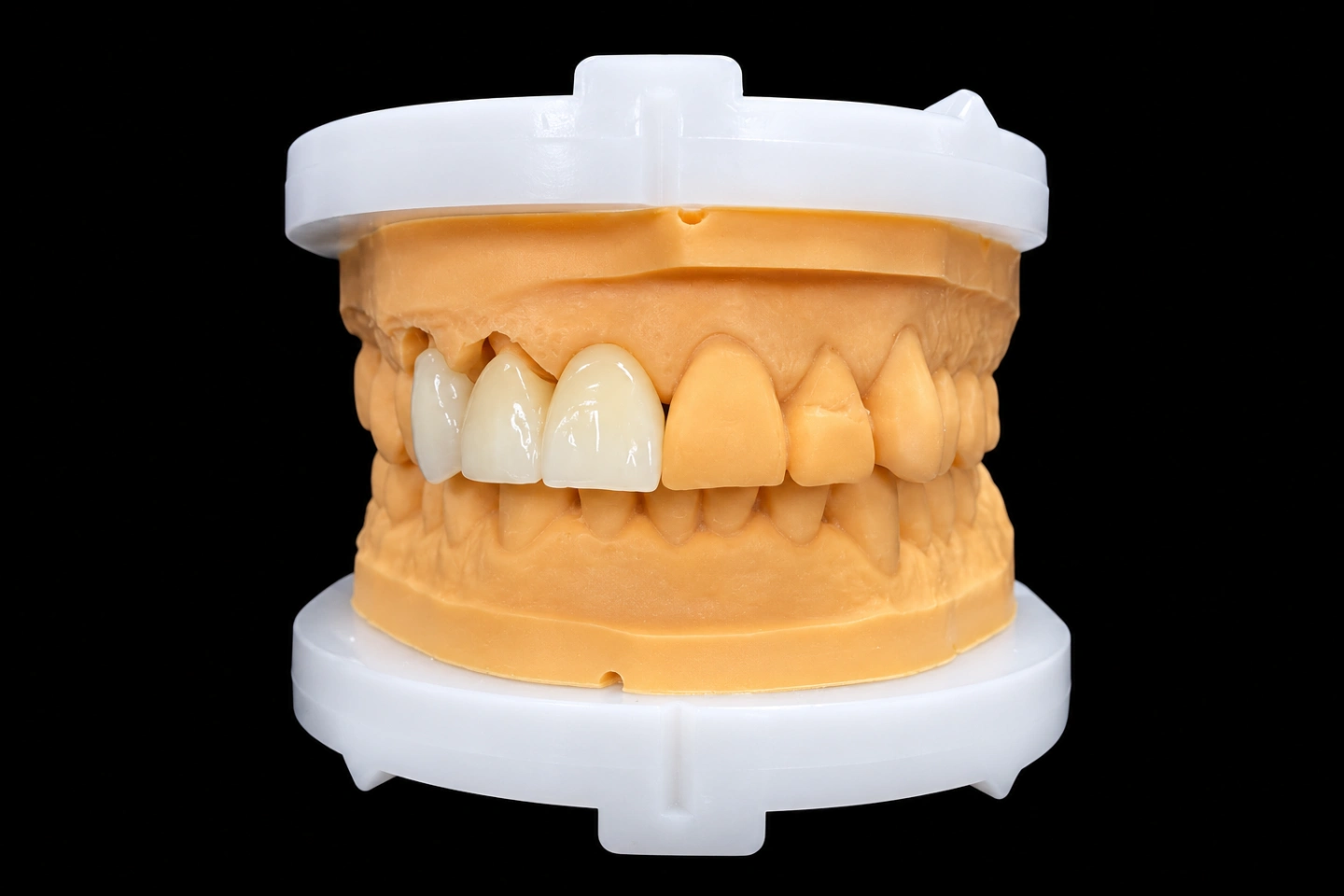
Pressed e.max can be finished full-contour (monolithic): one pressed body of lithium disilicate, characterized with stains instead of a layer of veneering porcelain. Our technicians add custom staining, micro-texture and incisal effects to your description and photos.
Full-contour design is the safer choice clinically. A 2026 systematic review of 64 clinical studies reported 98.5% five-year survival for monolithic lithium disilicate single crowns, against 97.1% for metal-ceramic crowns. The authors noted that monolithic designs cut the risk of fracture and chipping.
When to Prescribe Emax Dental Crowns, and When to Choose Zirconia
The clinical record for pressed e.max crowns is strong. In a private-practice study of 1,960 pressed e.max restorations in 556 patients, estimated 10-year survival was 99.6%, with a failure risk of 0.14% a year. Most failures were on molars. That record depends on case selection, which is why the table above matters as much as the material.
Emax Dental Bridges: Three Units, Up to the Second Premolar
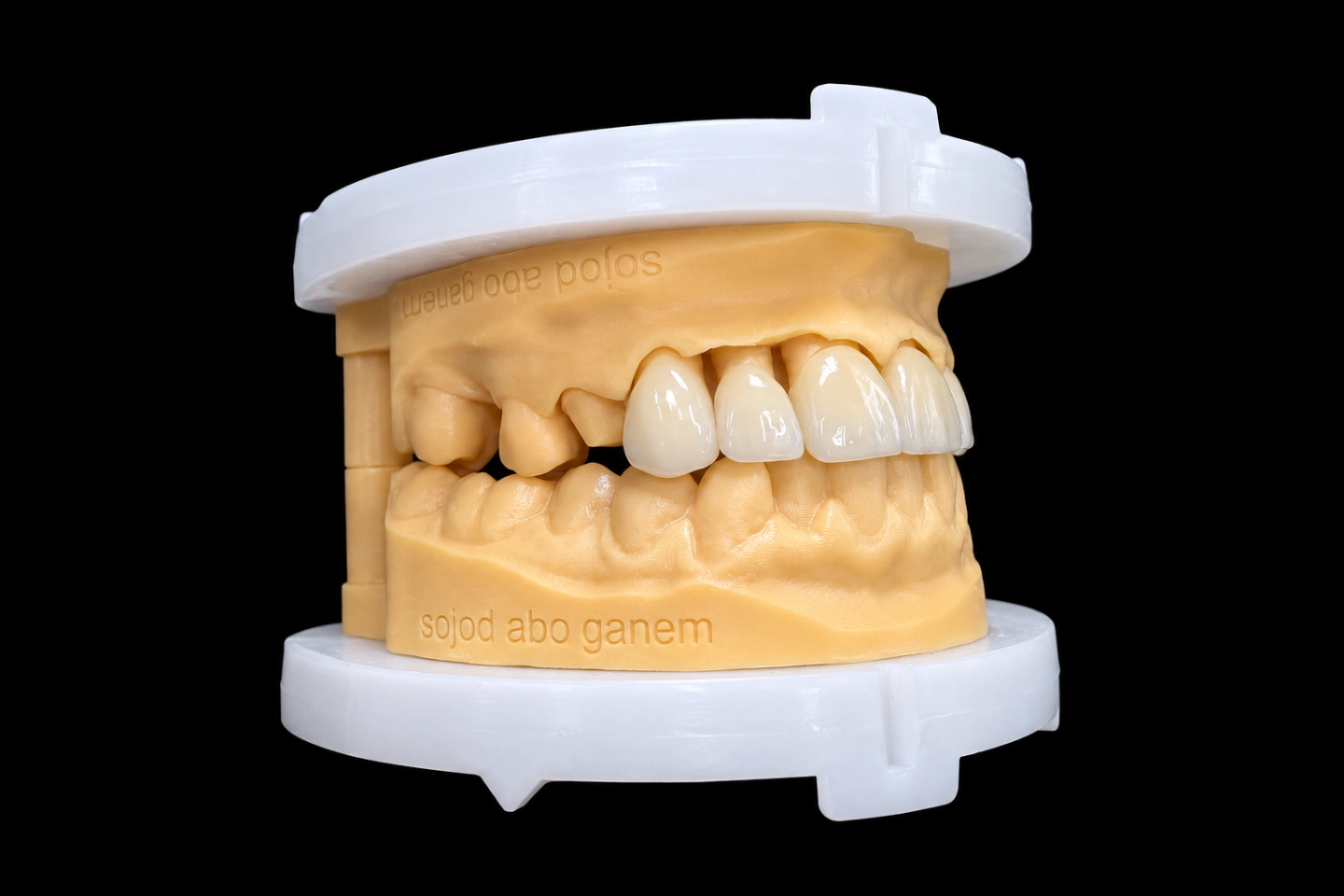
We make emax dental bridges within Ivoclar’s indication for IPS e.max Press: three-unit bridges, with the second premolar as the most distal abutment. That covers a missing incisor, canine or first premolar.
A lithium disilicate bridge’s weak point is the connector, so the connectors get the most attention in design:
Connector Size
The clinical study that followed e.max Press bridges for 15 years used connectors of 4 × 3 mm (height × width) anteriorly and 4 × 4 mm posteriorly. You need enough vertical room between the gingiva and the occlusal contact to fit that height.
Design Preview
The preview shows connector cross-sections and flags thin walls or space problems before anything is pressed.
Pontic Form
Note the pontic type you want (modified ridge lap or hygienic) and how much ridge contact, so the patient can clean under it.
The evidence is the reason for the limits. In that same prospective study, 36 monolithic e.max Press bridges had 100% survival at five years and 87.9% at ten, comparable to metal-ceramic bridges. At 15 years, survival fell to 48.6%; the authors attributed the late failures to fatigue and crack propagation in the ceramic. Short spans and generous connectors give a bridge the best odds.
If the case needs a molar abutment, a second pontic or more strength for a patient who grinds, we’ll suggest zirconia or PFM instead.
Preparation, Cementation and Adjustment
Margins and Reduction
Prepare a shoulder or a chamfer for e.max. A knife-edge or feather-edge margin leaves no room for ceramic at the margin, and the edge is likely to chip. Ivoclar specifies a minimum ceramic thickness of 1.0 mm for anterior and posterior crowns.
Mark the finish line on the Rx (shoulder or chamfer, and how far supra- or subgingival). If you scan, trace the margin yourself instead of relying on automatic detection. When the scan shows less clearance than the crown needs, we contact you before production and mark the spot in the design preview. You can then reduce further, adjust the opposing tooth or switch to zirconia.
Bonding or Cementing
E.max can be adhesively bonded, which helps retention on short or tapered preparations. For adhesive cementation we recommend a resin cement such as Variolink or RelyX Ultimate. On retentive full-coverage preparations, conventional cementation is also an option. In the ten-year bridge study above, the cementation method, glass ionomer or resin composite, didn’t change the outcome.
After Intraoral Adjustment
Adjusting a glazed e.max surface removes the glaze. Polish the area with a lithium disilicate polishing system, such as 3M Sof-Lex, until it’s smooth again. A polished surface is also kind to the opposing teeth. A 2024 network meta-analysis found that lithium disilicate crowns caused about 5 µm more antagonist enamel wear than natural teeth over up to two years, compared with about 40 µm for monolithic zirconia and 83 µm for metal-ceramic.
Sending an E.max Case
Scans and Impressions
We accept scans from 3Shape TRIOS, Medit, iTero, CEREC (Sirona), Shining 3D Aoralscan, Planmeca and any scanner that exports open files, and orders through 3Shape Communicate and Medit Link.
Send PLY with color for anterior and esthetic cases, so we can see tissue color, the gingival margin and surface texture. STL is enough for a simple posterior crown.
The preparation, two or three adjacent teeth, the full opposing arch and the bite.
One ZIP per case (not RAR), every file named with the same case ID, Latin characters only. Keep files under about 150 MB for STL and 300 MB for PLY.
Within one working day we confirm the scan is usable or tell you what needs rescanning, such as a blurred or hidden margin, holes, stitching steps or a missing bite.
For physical impressions, any bubble, drag or tear at the margin, contacts or occlusal area means retaking the impression. Use a VPS bite registration rather than wax: wax softens and distorts in transit, and the crown comes back low.
Shade Records
For anterior cases, the technician needs to see the stump as well as the target. Send:
Hold the shade tab next to the preparation and next to the adjacent natural tooth, and photograph both.
Note incisal translucency or opalescence, the gradient you want, and smooth, moderate or heavy surface texture. Add a reference photo where words fall short.
For a single anterior crown, intraoral photos or a short video of the adjacent teeth help the technician match color and translucency.
Use a ring or twin flash at about 5500 K rather than room or window light. For intraoral shots, ISO 100, 1/125–1/200 s and f/22 work well.
The Rx
A complete e.max order states: 1. Tooth numbers, and for a bridge, the abutments and the pontic type. 2. Margin design and location. 3. Target shade, stump shade and any translucency preference. 4. Incisal effects and surface texture. 5. Contact tightness (light, normal or tight) and any occlusal notes.
Download the Istar Digital Rx form and follow How to Send for packaging and courier details.
Design Approval and Quality Control
Design Preview
We send screenshots or the STL for approval by email or in your case chat. That includes one design and two free revisions, and you have the final say. Approval is required for anterior multi-unit all-ceramic cases, bridges of four or more units, and cases with space or wall-thickness risks.
Who Makes It
Anterior esthetic cases are made by technicians with more than ten years’ experience. Large clients can have a dedicated technician team.
Before Shipping
Every crown and bridge is checked on the model for margin fit, intaglio surface, seating, contacts and occlusion in centric, protrusive and lateral movements. The ceramic is inspected under a dedicated inspection lamp for chips and cracks.
Esthetic Check
Shade, translucency, fluorescence, surface texture and symmetry are compared against your shade information under standardized lighting.
Consistency Across Units and Visits
We record the contour and anatomy of each design. Later units for the same patient are made from the same records, shade references and design files, so a second visit matches the first.
Your Preferences on File
Contact tightness, occlusion, form and shade preferences are saved per doctor and applied to new cases unless your Rx says otherwise.
Lead Time, Warranty and Remakes
Lab Time
Generally 5–7 working days for emax dental crowns and bridges, counted from the day we have complete records. Time spent waiting for missing information or your design approval isn’t counted.
Rush Cases
Free for clients who send 10 or more cases a month. We guarantee the ship date. We can’t guarantee the arrival date, because customs clearance is outside our control.
Shipping
You pay to send physical impressions or models to us. We pay to ship finished work back, remakes included.
Warranty
E.max crowns and bridges carry a 3-year warranty.
Free Adjustments and Remakes
Open margins, open contacts, high occlusion, a restoration that won’t seat, an inaccurate shade, visible flaws or poor form.
Not Covered
Shade or material changes you request, and cases we made on an unclear impression at your request after flagging the problem.
What to Send Back
If a crown seated well but the ceramic cracked, we can remake it from the original data. For fit, margin or bite problems, send a new scan or impression.
Damage in Transit
Within 24 hours, send an unboxing video showing the shipping label, keep the damaged piece and the original packaging, and we’ll remake the case free of charge.
Why Clinics and Labs Send E.max Work to Istar Digital
Istar Digital was founded in 2012 and runs four dental labs in Shenzhen and Huizhou, China, with about 460 employees. Milling, 3D printing, porcelain and resin work each run in separate areas to keep materials apart, esthetic cases have their own specialist group, and every case is made in-house. We don’t outsource to other labs.
Measured Quality
95% of cases pass final inspection at Istar Digital. That’s a separate number from our overall remake rate of 2–3%, which counts cases clients send back.
Regulatory
Istar Digital is an FDA-registered establishment, Registration Number 3039441248. You can verify it in the FDA establishment registration database. For the EU, our restorations follow the MDR custom-made device procedure, and our labs work under an ISO 13485 quality management system.
For DSOs and Group Practices
Each doctor’s preferences are recorded separately, so one account can serve many chairs.
See It Before You Commit
Book a visit to Shenzhen or Huizhou, or a live video tour of the labs.
More on our workflow: digital dental laboratory · about Istar Digital · all e.max restorations
Cases from our lab
Frequently Asked Questions
Do you accept a single trial case?
Yes. A single trial case is the best way to check our fit and shade against your current lab. Ongoing partnerships work best with a regular case flow, because that keeps international shipping cost-effective.
How are e.max crowns and bridges priced?
Quotes are itemized to your requirements, not one bundled price. Ask your account manager for the current e.max price list, and we’ll confirm the full cost of a case before production starts.
Can you press an e.max restoration from my lab's design?
Yes. We accept editable exocad and 3Shape design files and can return design and inspection records in your lab’s own format. If we see an obvious problem in the design, we tell you before pressing.
Can you use a specific Ivoclar ingot or lot?
Yes. Tell us the ingot, and the lot if it matters to you, and we’ll produce with that material.
Do you make e.max veneers, inlays and onlays?
Yes. See e.max veneers and ceramic inlays and onlays. For root-canal-treated molars with enough sound structure, an e.max onlay often preserves more tooth than a full crown.
Start With One E.max Case
Send us your next anterior e.max crown with a PLY scan, stump and target shade photos and a completed Rx. Review the design preview, then judge our margins, contacts and shade on your own patient before you send more.