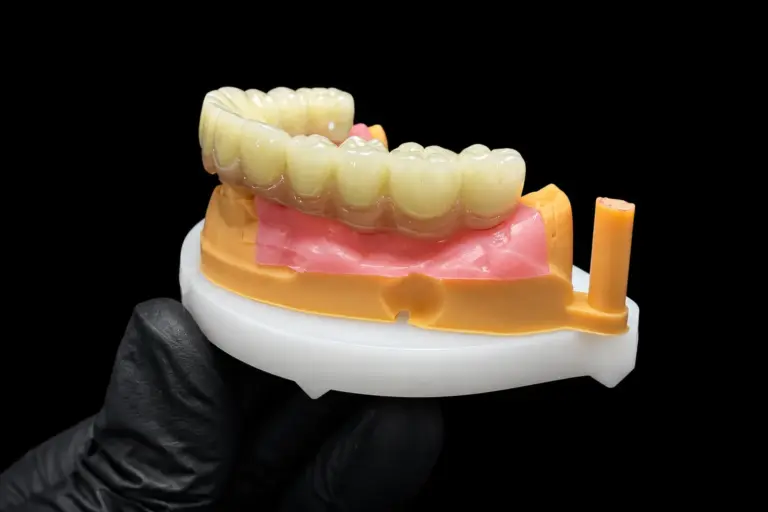
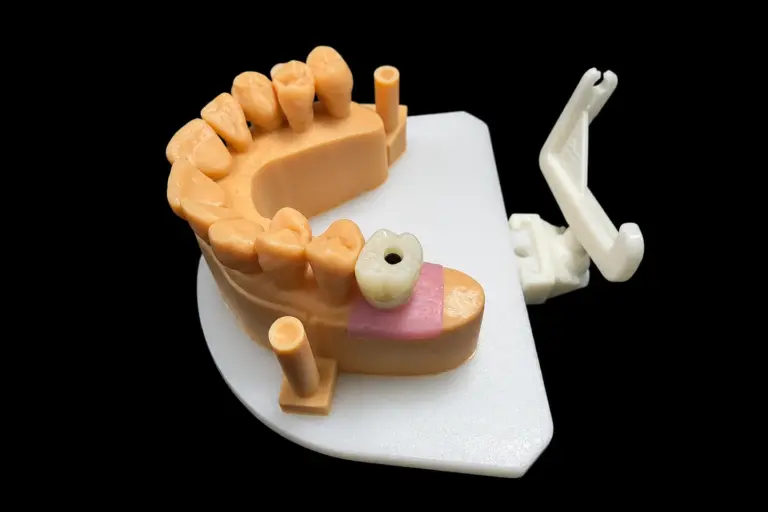
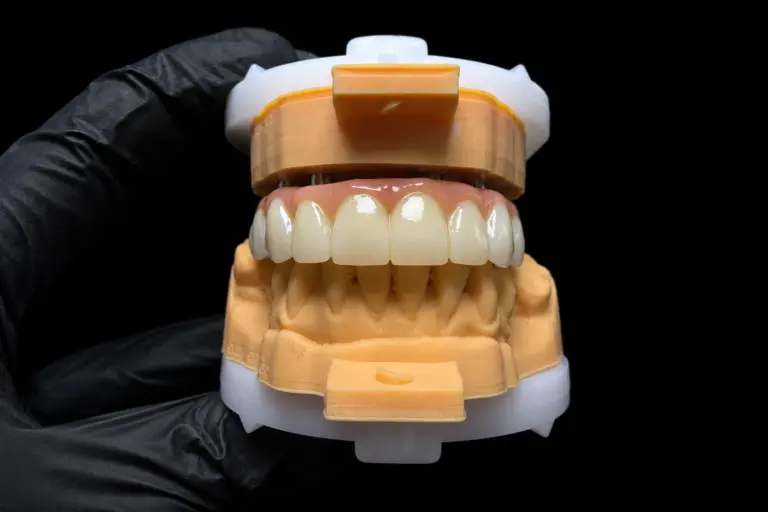
Implant e.max Crown
A single-unit implant e.max crown, built for dentists and clinics in the US and Europe. We mill it from IPS e.max CAD, crystallize it to final strength, and bond it onto your specified Ti-base in our lab, so you receive one screw-retained hybrid-abutment restoration ready to torque in. Istar Digital has been fabricating implant work from our Shenzhen and Huizhou facilities since 2012; today we ship these cases to roughly 400 dentists and 100+ clinics across the United States, Germany, the Netherlands, France, the UK, Belgium, Austria, Luxembourg, and Switzerland.
Ready now? Open an inquiry with your scan file and implant reference. You’ll have a configured quote back the next working day.
The product: what you're actually buying
Every Istar Digital e.max implant crown is a hybrid abutment crown. The crown is milled from IPS e.max CAD, crystallized in our furnace, and resin-bonded to the Ti-base on our bench, not in your chair. That matters because the bond lives in a crevice-free, saliva-free environment during fabrication, which is exactly what resin cements need to work.
Standard delivery includes:
| Spec | What we ship on a default Istar Digital e.max implant case |
|---|---|
| Ceramic | IPS e.max CAD, crystallized, monolithic (no veneering on single units) |
| Translucency | HT or LT, chosen to match the neighbor; let us pick if you prefer |
| Shade system | Vita Classical and Vita 3D-Master; stump-shade capture requested on esthetic-zone cases |
| Abutment base | Your specified original-system Ti-base, resin-bonded in-lab |
| Retention | Screw-retained through the Ti-base channel (default) |
| Surface | Glazed on the clinical crown surface; polished (not glazed) on the emergence segment below the gingival line |
| QC | Margin check, screw-channel verification, and chip/crack inspection under dedicated inspection lighting |
| Packaging | Clinical case with the implant screw torque reminder printed on the Rx response |
Configurable, by request on the Rx:
| Option | When to pick it |
|---|---|
| Custom titanium abutment + crystallized e.max crown | Emergence profile needs more control than a stock Ti-base allows, or screw access would exit through an esthetic surface |
| Custom zirconia hybrid abutment | Peri-implant tissue is thin and you want to avoid gray show-through |
| Cement-retained | Screw access would land on an incisal edge or central fossa; move the critical bond chairside, with your awareness |
| Screwmentable (do-not-cement variant) | You want to keep retrievability without a direct screw channel through the esthetic surface |
| Material brand / batch specification | You or your DSO protocol requires a specific LS2 batch on file |
If you don’t specify, we default to original-system Ti-base + monolithic HT or LT e.max CAD, screw-retained. We don’t substitute parts without telling you.
Who this emax implant crown is for
An e.max implant crown is the right call for an implant single-unit when the esthetic bar is high and the clinical context supports it. Istar Digital accepts and ships these cases every week for:
- Maxillary anterior single implants where the patient’s natural tooth shows obvious translucency and the neighbors are not already crowned.
- Premolar single implants where translucency and chroma matter more than the extra flexural strength of monolithic zirconia.
- Replacement crowns on an already-restored implant where you want to match a lithium disilicate neighbor made elsewhere.
An e.max implant crown is not our recommendation when:
- The implant is a second molar and the patient has active parafunction with no planned night guard.
- Peri-implant tissue is thin (< 2 mm) and the gingival show-through risk outweighs the esthetic gain from lithium disilicate.
- Vertical restorative space is < 2.5 mm from the implant platform to the opposing occlusion.
For those cases we quote monolithic zirconia on the same implant platform at the same submission, so you don’t have to split the order into two Rx’s.
The 5-point preflight we run before we start CAD
Most e.max implant remakes we see started with a case the lab should have questioned at Rx stage. We built the preflight to catch those cases before design opens. If any one of these conditions fails on your Rx, we flag it in writing and give you two options: revise the plan, or switch to monolithic zirconia. We don’t quietly guess.
| # | Preflight condition | Why we check | Where it maps on your Rx |
|---|---|---|---|
| 1 | Occlusal thickness ≥ 1.5 mm at the deepest central groove | Thin lithium disilicate under implant loading is where fractures start (ITI clinical insights) | Scan + opposing arch |
| 2 | Vertical restorative space ≥ 2.5 mm, platform to opposing | Needed to stack Ti-base + crystallized ceramic + bonding gap | Scan with scan body |
| 3 | Peri-implant tissue ≥ 2 mm at the emergence | Below 2 mm, titanium reads gray through monolithic LS2 | Soft-tissue scan or intraoral photo |
| 4 | No active parafunction, or a planned night guard | Implant restorations lack a periodontal ligament, so load isn’t buffered the way a natural tooth is | Rx notes |
| 5 | Original-system Ti-base on the Rx | Non-original Ti-bases show elevated torque loss in the published literature | Rx line 1 |
This single check is the biggest reason our e.max implant cases don’t come back. If you want to see the primary clinical source for conditions 1–5, the two load-bearing papers are the Ti-base systematic review at PMC10329526 and the ITI clinical-insights write-up on hybrid abutment-crown restorations.
The strength number on your quote: 530 MPa, not 400 MPa
Two production routes exist for IPS e.max. 400 MPa on one lab’s page and 530 MPa on another’s for the “same” material are both real: one is the pressed version, one is the milled-and-crystallized version. We ship the second.
| Route | Flexural strength | What Istar Digital does with it |
|---|---|---|
| IPS e.max Press (hot-pressed ingots) | 370–460 MPa | Available on request for multi-unit anterior cases where the clinical plan calls for pressed ceramics |
| IPS e.max CAD, crystallized | ~530 MPa per Ivoclar | Our default on single-unit implant crowns |
| IPS e.max CAD, pre-crystallized (blue state) | ~130 MPa | We never ship in this state. A milled e.max block out of the mill is a stressed blank, not a restoration |
Your quote reflects the 530 MPa figure, because that’s what a finished Istar Digital e.max implant crown measures to after crystallization.
How your case moves through our floor
| Stage | Who owns it | What happens | Normal day on an e.max implant case |
|---|---|---|---|
| 1 | Case Coordination (~40 people) | Rx review, 5-point preflight, platform and part-number check | Day 0, same day as scan arrival |
| 2 | CAD Design (~100 designers) | Hybrid design on the specified Ti-base, margin and emergence profile | Day 1 |
| 3 | Milling (~70 operators) | IPS e.max CAD block, HT or LT per Rx | Day 1 |
| 4 | Crystallization | Furnace firing to final 530 MPa strength | Day 1–2 |
| 5 | Bond to Ti-base | HF etch, 50 µm alumina air abrasion, silane + MDP primer, resin cement | Day 2 |
| 6 | Stain, glaze, polish | Emergence segment polished (not glazed) to avoid sulcus biofilm trapping | Day 2 |
| 7 | QC (dedicated 25-person team) | Dedicated inspection lighting; margin, screw channel, chip/crack | Day 3 |
| 8 | Pack and ship | Case tracking, torque reminder printed on the response | Day 3 |
Nine steps, all under one roof. No stage of this restoration is outsourced to a third-party lab. Everything from receiving your scan to packaging the shipment happens inside our Shenzhen and Huizhou facilities, which is why we can promise what shows up in the box.
Pricing is case-by-case, because configuration decides what the piece costs to produce. We quote on review of the Rx and return a line-itemized quote the next working day. No portal signup, no price held back after you submit a form.
Three remake drivers we close out before they happen
These are the three failure modes we see when an implant e.max crown comes back to any lab. All three are preventable at Rx stage, and they’re specifically why we insist on the preflight.
- Short Ti-base. A short Ti-base raises the crown-to-abutment lever arm and is a published cause of debond. If your vertical allows, we go one or two heights taller. If it doesn’t, we tell you before we mill.
- Non-original Ti-base. Elevated torque loss is in the literature. We only build on original-system Ti-bases. If your Rx names a non-original part, you’ll hear from us before CAD opens.
- Weak lab-side bond. Our bonding protocol is explicit: 5% hydrofluoric acid etch of the intaglio for 20 seconds, 50 µm aluminum oxide air abrasion of the Ti-base at 2.5 bar and 45°, silane with MDP primer, resin cement. RMGI cements are not acceptable on this bond; the chemistry doesn’t match lithium disilicate (PMC10329526).
The fourth driver, bad shade match, we close with intraoral photography. On every e.max implant crown in the esthetic zone we ask for a shade photo or short video alongside the mounted scan, and we match chroma, translucency, and stump shade against the adjacent teeth before glaze. On multi-unit cases we archive the design file and the anatomy map so unit 2 and unit 3 stay consistent with unit 1.
Send us the case
A complete e.max implant crown Rx on our form includes:
- Implant system and part number (or an implant reference model if the part isn’t in your records)
- Platform diameter (NP / RP / WP) and the scan body model you used
- Preferred Ti-base height, or a request for us to recommend based on your scan
- Retention mode: screw-retained (default), cement-retained, or screwmentable
- Translucency: HT, LT, or let us pick
- Shade on Vita Classical or 3D-Master, plus stump shade if the implant is in the esthetic zone (this one gets forgotten most)
- Intraoral photos or a short shade video. One well-lit photo is enough for most anterior cases
Open-STL scan files from iTero, Trios, Primescan, Medit, and CEREC Omnicam are all fine. If you work with your own forwarding lab, send through them and the case still comes to our implant department directly.
→ Submit your e.max implant case or ask about compatibility with a specific implant system before you send: email our case coordination team or use the inquiry form at the bottom of this page. We confirm compatibility and reply with a configured quote the next working day.
What you get on an Istar Digital case
- A monolithic IPS e.max CAD crown, crystallized to final strength (~530 MPa), bonded to your specified Ti-base before shipping, so the critical ceramic-to-titanium bond is formed under lab conditions, not chairside.
- A 5-point case preflight on your Rx before CAD opens. If something is going to make this restoration fail, we tell you in writing, not six weeks later as a remake.
- Direct access to a human case coordinator per order. The Rx is read, questioned if needed, and signed off by a technician before design starts.
Why Istar Digital on an e.max implant crown specifically
Not every claim about a lab is verifiable from a product page. These are:
- Manufacturer, not a trading company. The nine-step workflow above runs inside our own Shenzhen and Huizhou facilities. Nothing on this restoration is subcontracted to a third-party lab.
- A dedicated implant team. About 80 technicians work exclusively on implant restorations here, backed by a ceramic-and-metal department of roughly 70 and a 25-person QC team. Your case opens on a workstation that only does implant work.
- Factory visits and live video audits. This is the single hardest thing to fake, which is why we lead with it. If you want to watch an e.max implant crown come off our bench, book a video walkthrough; most of our international clients do this before the first case.
- An existing US and European book. Roughly 400 dentists and 100+ clinics across the US, Germany, the Netherlands, France, the UK, Belgium, Austria, Luxembourg, and Switzerland work with us today. We’ll put you in touch with a current client in your region on request.
What this page does not claim: no star ratings on this restoration, no success-rate statistics invented for marketing, no third-party certifications listed without a document on file. If you need a specific attestation for a procurement review, ask and we’ll tell you exactly what we can and can’t provide.
Common questions from dentists
Is an emax implant crown better than a zirconia implant crown?
On an anterior single-unit with ≥ 2 mm of peri-implant tissue, lithium disilicate reads more naturally. In the second molar, in confirmed bruxers without a night guard, or in cases with thin tissue and a dark implant shadow risk, monolithic zirconia is usually the better call. We fabricate both and we’ll say which fits your case when we quote it.
Can an emax implant crown be screw-retained?
Yes, that is our default. The crown bonds to the Ti-base in our lab, and the whole hybrid unit torques onto the implant in your chair. Cement-retained is a request, not a default.
Why do I see 400 MPa and 530 MPa on different pages?
Different production routes. IPS e.max Press reports 370–460 MPa. IPS e.max CAD, after crystallization, reports approximately 530 MPa per Ivoclar’s product documentation. We ship the milled-and-crystallized version by default, so our quote reflects the 530 MPa number.
Which implant systems do you support?
We work with the major original Ti-base ecosystems. If your system isn’t on our order form, name the manufacturer and part number on your first Rx and we’ll confirm compatibility before any CAD time is spent. For unfamiliar systems, send a reference model and we match from there.
I use an intraoral scanner, not an impression. Is that OK?
Yes. Open-STL files from iTero, Trios, Primescan, Medit, and CEREC Omnicam go directly into our implant CAD workflow. For analog impressions on implant cases, send a mounted model with the scan body in place.
How does shade matching work on an anterior single?
We ask for one well-lit intraoral photo of the stump against the adjacent teeth, taken with the shade tab in frame. On an upper central or lateral we also match the stump shade against neighboring translucency before glaze. If the neighbor is a lithium disilicate crown from another lab, say so on the Rx and we’ll bias the HT/LT choice toward that match.
What's your warranty on a remake?
The remake policy is tied to the configuration and lands on the quote and the shipping documentation. If your clinic has a required warranty window, flag it at Rx submission and we’ll either match it or tell you clearly where we fall short.
What's a realistic in-lab turnaround?
Three working days on our implant line is normal for the standard spec in the workflow table, counted from the point your scan clears the preflight. Rush is possible on single-unit cases; ask at Rx submission.
Ready to send a case?
Open an inquiry with your scan file, implant reference, and one intraoral photo. We confirm compatibility and reply with a configured quote the next working day. First case through our implant line is the best way to see whether we’re the right lab for your implant work.