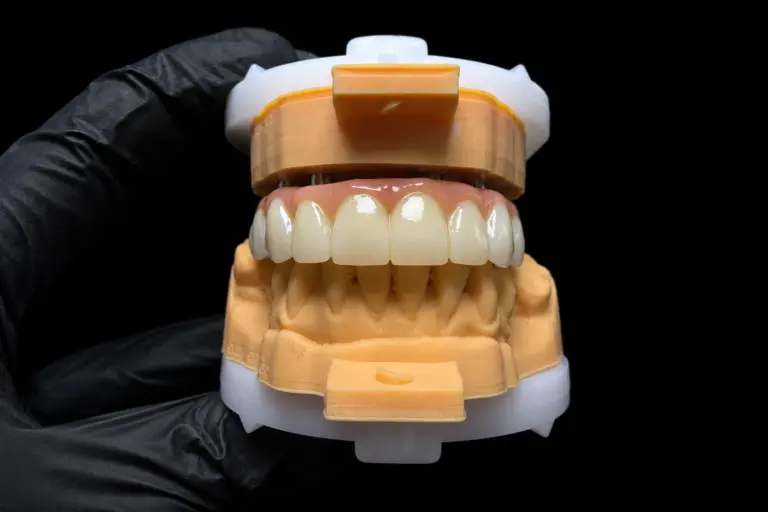
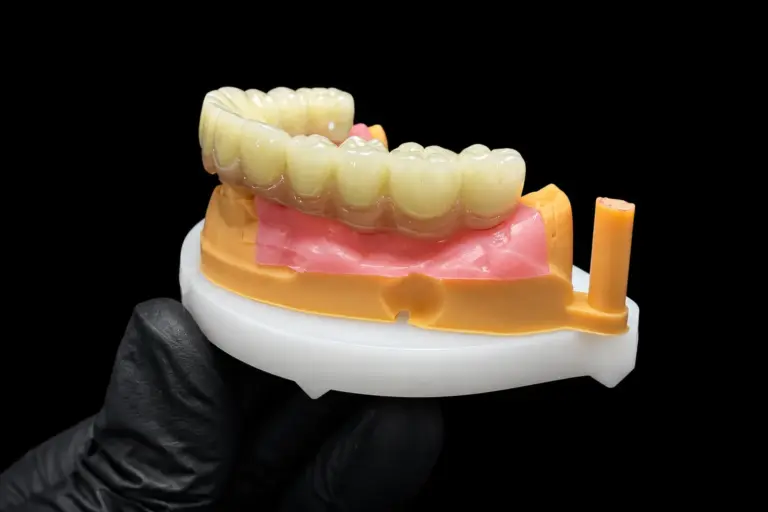
Implant Layered Zirconia Crowns, Designed Around the Implant
An implant layered zirconia crown has to do two jobs at once: match the natural teeth beside it and fit an implant connection exactly. Those jobs meet at the screw access hole, the emergence profile and the porcelain design, so they’re best decided together rather than one at a time.
Istar Digital Dental Lab makes layered zirconia implant crowns in-house for dentists, clinics, DSOs and dental labs. We verify the implant data before design, send the design for your approval and check the interface again before the crown ships.
Have a case in mind? Send us the implant system, tooth position and shade information, and we’ll talk through the retention and porcelain options with you.
What Is a Layered Zirconia Crown on an Implant?
A layered zirconia crown, also called a PFZ crown (porcelain-fused-to-zirconia) or veneered zirconia crown, is a milled zirconia coping with porcelain built up over it by hand. CAD/CAM produces the coping. A technician builds the porcelain, stains it, glazes it and finishes it.
That hand-built layer is why dentists choose it. It gives the ceramist room to control shade, translucency and surface texture, and it’s generally the option we suggest for high-esthetic anterior cases with stable occlusion. If you want strength and value alongside good esthetics, full-contour multilayer zirconia is the alternative we’d compare it with. We also accept posterior implant layered crowns; if load or limited space is the main concern, we’ll go through full zirconia with you as well.
Three Porcelain Designs
“Layered” can describe different restorations, so state the design you want on the prescription.
| Design | Where the porcelain goes | Why you might choose it |
|---|---|---|
| Full-coverage layering | The whole crown, including the occlusal surface | The most freedom to build shade and character across the crown |
| Facial cut-back | Facial or buccal surface over a reduced zirconia area | Layered esthetics where they show, with zirconia elsewhere |
| Micro-layering | A thin porcelain layer over the zirconia | A balance of zirconia strength and natural appearance |
The framework shape matters whichever you pick, because porcelain needs even support. In an in vitro study on premolar crowns, a 0.8 mm cut-back framework reached a higher failure load under static loading than a 0.5 mm even-thickness framework (about 1,450 N vs 1,170 N). It’s one small laboratory study on non-implant crowns, but it shows why coping design is worth reviewing rather than leaving to a default.
Screw-Retained or Cement-Retained?
We prefer screw retention where the implant position allows it. We consider cement retention when the implant angle would bring the access hole out on the facial surface, or when there’s enough occlusal space and the esthetic demand is very high.
The evidence doesn’t make this choice for you. A five-year randomized trial of zirconia-based single-implant restorations found largely the same clinical, technical and radiographic outcomes for the two approaches, with technical complications frequent in both groups. It didn’t study layered crowns specifically, so implant position and esthetics still drive the decision.
On a layered crown, retention and porcelain design also affect each other. With full-coverage layering, a screw access hole passes through the porcelain. With a cut-back design, the opening can often sit in zirconia. That’s why we’d rather settle both at the same time.
When the Screw Access Isn't Ideal
If the implant axis gives a poor access position, these are the options we work through with you:
| Option | When it helps | What to keep in mind |
|---|---|---|
| Angled screw channel with a custom abutment | The axis would bring the hole out in an esthetic area | Must stay within the component maker’s maximum angle, with clinician approval |
| Multi-unit abutment | The angle needs correcting at the abutment level | Adds a component to plan and order |
| Reshaped restoration | A small shift can move the hole to the lingual or a non-esthetic area | Needs a design review of contour and channel |
| Cement retention | None of the above solves the problem | Needs enough space and controlled cement removal |
An angled channel solves an esthetic problem, but it isn’t free of trade-offs. In one in vitro study of zirconia crowns on titanium bases, retention was significantly lower with angled channels than with straight ones (about 1,032 N vs 1,732 N, seven specimens per group). We use one when it’s the right answer for the case, not as a default.
In CAD, we plan the channel along the implant’s long axis and try to keep the opening in the occlusal fossa on posterior teeth, or away from esthetic surfaces, and clear of occlusal and proximal contacts. We check the path and wall thickness in the software and review them again on the finished crown. If the position is poor, we contact you before going further.
Abutment and Ti-Base Zirconia Crown Options
Istar Digital can provide Ti-bases, angled screw channel solutions and multi-unit abutments. A stock abutment suits a well-positioned implant where function comes first. A custom abutment is usually the better fit in the esthetic zone, where soft tissue demands are high or the implant position is complex.
OEM or Compatible Components
We recommend OEM components first for fit and long-term stability. Validated compatible parts can suit a limited budget or a discontinued part, though tolerances, materials and warranty may differ from OEM. The clinician decides, and we don’t substitute a component without your written or verbal consent.
The choice also shows on the invoice: OEM parts are charged at purchase cost plus a handling fee, while compatible parts generally cost less.
How We Bond a Ti-Base Zirconia Crown
Bond quality depends on surface control and cement control, so this step follows a set protocol in our lab:
- Protect the implant interface and air-abrade only the bonding surface with 50 µm alumina.
- Clean with steam or an ethanol ultrasonic bath, then dry completely.
- Apply an MDP primer and bond promptly.
- Keep the cement gap at 20–50 µm with a suitable resin cement.
- Seat under even pressure and remove excess at the gel stage, keeping cement out of the interface.
- Cure to the manufacturer’s parameters, try the seating and check the margin and interface under magnification.
Screws and small parts ship in a separate labeled bag marked non-sterile, with the packing double-checked. For final tightening, follow the implant manufacturer’s torque instructions. We can give a reference value, but the manufacturer’s figure is the one that counts.
Emergence Profile and Soft Tissue
Porcelain can’t hide a poor transition from the platform, so we design the emergence profile from your soft tissue records rather than from the crown down.
Send a scan of the healing abutment or provisional, or tissue cuff data, along with soft tissue thickness. We design a smooth narrow-to-wide transition from the implant platform, then send you the design images or a 3D-printed model. Milling starts after you confirm it.
Tell us about any tissue problems you want addressed:
- Black triangles: extend the contact point toward the gingiva, add proximal convexity or use pink porcelain.
- Gingival recession: extend the margin subgingivally, or use pink porcelain and contour the emergence profile.
- Uneven gingival margins: take the opposite side as the reference and coordinate with the smile line, with pink porcelain if needed.
Materials and How We Control the Coping
Our porcelain comes from Ivoclar, Shofu and Noritake. Zirconia options include Aidite, Wieland, Cercon and 3M Lava. You can specify a brand or batch on the prescription and request composition information, instructions for use and batch documents. If a specified material is out of stock, we check the effect on your case and agree a substitute or a delay with you. We never change it without your consent.
The layer you see depends on the coping beneath it, so the coping gets its own controls:
- Sintering: Programs lock in temperature, ramp rate and hold time, and each furnace curve is logged.
- Shrinkage: Compensation follows the material manufacturer’s parameters and is checked with standard test pieces for each batch. New batches are trial-run before production.
- Coping check: Technicians check the sintered coping for distortion before it moves on. A distorted coping is milled again.
Implant and esthetic cases have dedicated work groups, and milling, porcelain and resin work are kept in separate areas. Each case stays in-house from file review to packing, across our four labs in Shenzhen and Huizhou. No case goes to a third-party lab. Our team of about 460 includes about 80 people in the implant department, 100 in CAD design and 70 in ceramics and metal.
Quality Checks for an Implant Layered Zirconia Crown
Every case passes three stages of inspection: incoming files and materials, in-process checks and final inspection. Final release belongs to dedicated inspectors who don’t make restorations. Complex implant and esthetic cases get an extra review.
For an implant layered crown, final inspection covers:
| Check | What must be true |
|---|---|
| Interface | Sits accurately on the analog, with no burrs |
| Screw channel | Angle and inner diameter match the design; the screw turns in smoothly |
| Passive fit | Seats without force, rocking or rebound |
| Components | All models match, with no shift after tightening |
| Margin and contacts | Margin fit, proximal contacts and occlusion match the approved design |
| Esthetics | Shade, translucency, texture and symmetry match the shade records, under a standard light source |
| Surface | No cracks, pores or chips |
Acceptance is judged against the confirmed prescription and design, and you can ask for inspection photos before shipment.
Two lab-wide numbers help you judge us. First-pass inspection is about 95%: cases that pass final inspection the first time, divided by all cases inspected in the period, with reworked cases not counted as passes. Cases that fail are remade. The remake rate, meaning cases clients send back, is 2–3%. Neither figure is specific to implant layered crowns.
What to Send for an Implant Layered Zirconia Crown
A complete first submission is the fastest way to protect your schedule, because waiting for missing details doesn’t count toward lead time.
| Item | What we need |
|---|---|
| Implant data | Brand, platform, connection, implant diameter and length, with a photo of the label or product code |
| Scan body | Brand, model and the matching CAD library name |
| Scans | Scan body position, opposing arch and an accurate bite record |
| Soft tissue | Emergence information and soft tissue thickness |
| Photos | Smile, intraoral occlusion and shade photos |
| Shade | Base shade (and any metal beneath), target shade, incisal translucency or opalescence, surface texture |
| Prescription | Tooth position, porcelain design, retention type, abutment or Ti-base choice, OEM or compatible parts |
We check the scan body against the digital library and review the interface alignment in CAD before design. We prefer manufacturer-sourced libraries and keep each case on one library version. If your library differs from ours, we use yours.
Files. We accept open files from 3Shape TRIOS, Medit, iTero, CEREC/Sirona, Shining3D Aoralscan and Planmeca systems. Export iTero and CEREC cases as STL or PLY. For layered cases, send PLY, since color and soft tissue information help with shade and gingival design. Put each case in its own ZIP folder, keep PLY files under 300 MB per arch and use a case number in place of the patient’s name if you prefer.
Shade. One shade tab isn’t enough for a single anterior crown. Show us the neck, body and incisal character, the base shade and the adjacent teeth. If you can’t describe a feature in words, send a picture and the technician will work from it.
We normally confirm within one working day whether a scan is usable.
Ready to try it? Download the Rx and case checklist, then send one case.
Lead Times, Warranty and Remake Terms
| Term | What applies |
|---|---|
| Custom abutment stage | 3–4 working days |
| Final layered restoration stage | 3–5 working days |
| Complex implant cases | 5–7 working days |
| What isn’t counted | Waiting for design approval, missing information or client replies |
| Shipping time | Carrier transit only; customs clearance and remote-area delivery are extra |
| Rush cases | Free for clients sending 10 or more cases a month; we guarantee the ship date, not the arrival date |
| Warranty | 3 years on crowns, including implant restorations |
| Shipping costs | We pay to ship finished work and remakes to you; you pay to send physical items to us, plus import duties and clearance fees |
| Free remakes or adjustments | Open margin or contact, high occlusion, a crown that doesn’t seat, inaccurate shade, a visible defect or poor form |
| Not free | Client-requested shade or material changes, and work attempted on a poor impression at your request |
| Implant components | Not included in a free remake |
Please report any problem within 24 hours of receiving the case, with the case details and photos. We confirm the cause with you before remaking, so the same problem doesn’t come back.
Start With a Test Case
The most useful test of a lab is one real implant case held to your own standards, and new clients often begin that way. We welcome single trial cases; ongoing partnerships work best with a regular case flow. Quotes are itemized by units, material, components and design complexity, and you can confirm the full cost before production. Ask your sales manager for the current B2B price list.
For dental labs. We take on design, milling, porcelain layering, glazing or complete cases. We accept editable 3Shape and exocad files and can work with your implant library. White-label packaging and NDAs are available. We can ship to the address you name, although the sender address on the waybill can’t be changed.
For audits and compliance. Book a factory visit or video inspection of our Shenzhen and Huizhou labs. Istar Digital is an FDA-registered establishment, Registration Number 3039441248, which you can look up in the FDA Establishment Registration & Device Listing database. In the EU, custom-made restorations follow the MDR custom-made device procedure. The lab holds ISO 13485. Registrations, listings and notifications are not approvals or certifications.
Frequently Asked Questions
Is a layered zirconia crown the same as a PFZ crown?
Yes. Layered zirconia, PFZ and veneered zirconia all describe a zirconia coping with porcelain over it. They differ from multilayer zirconia, which is one piece of zirconia with a built-in gradient and no porcelain layer.
Can you make layered crowns for posterior implants?
Yes, we accept them. Tell us the porcelain design and the available space. Layered zirconia is mainly chosen for high-esthetic anterior cases with stable occlusion, so for a posterior case we’ll also discuss whether full zirconia better fits the load and space. The treating dentist makes the decision.
Which implant systems do you support?
Most systems on the market. Send the brand, platform, connection and scan body details so we can confirm your specific system and library before you commit to a case.
Who decides between OEM and compatible components?
The clinician. Compatible parts can lower cost, but tolerances, materials and warranty may differ, so we confirm your choice and never substitute without consent.
Does a free remake cover implant components?
No. A free remake covers the restoration; component costs are separate. We also pay return shipping on the remade work, while you pay to send the original restoration or a new impression to us.
Do you make layered zirconia crowns on natural teeth too?
Yes. For natural teeth, we suggest a shoulder margin for layered zirconia. Include the margin design and base shade on your prescription.
Send Your Implant Layered Zirconia Crown Case
If you have an esthetic implant case coming up, send the implant details and scan, tell us your preferred porcelain design and retention, and we’ll check the files and flag any concerns. You’ll see an itemized quote before production and a design to approve before milling.
Next step: Submit a test case · Request the price list · Book a factory or video visit
Our team works in English and usually replies within an hour during working hours (9:30 am to 6:00 pm China time, UTC+8). Support extends until midnight for urgent cases.