Metal Dentures: Cast Partial Frameworks and Metal-Base Dentures Made to Your Rx
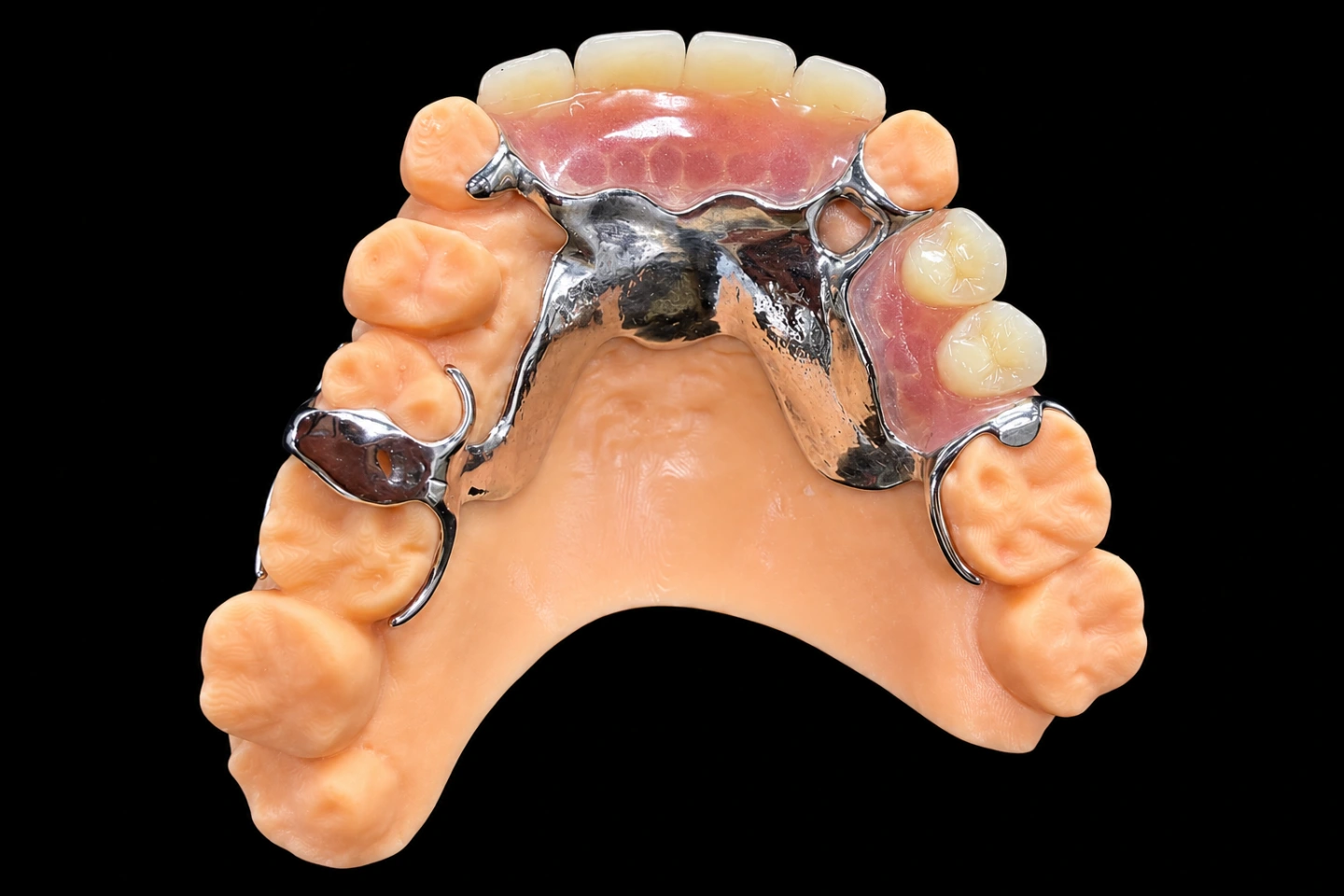
Metal dentures from Istar Digital Dental Lab are removable prostheses built on a metal framework or base, made to your Rx for clinics and dental labs across the US and Europe. Most of the cases we receive are partials: a cast partial denture and a metal partial denture are the same prosthesis, a one-piece framework of rests, clasps, and connectors that carries acrylic bases and denture teeth. “Cast” describes how the framework is made, not a separate product.
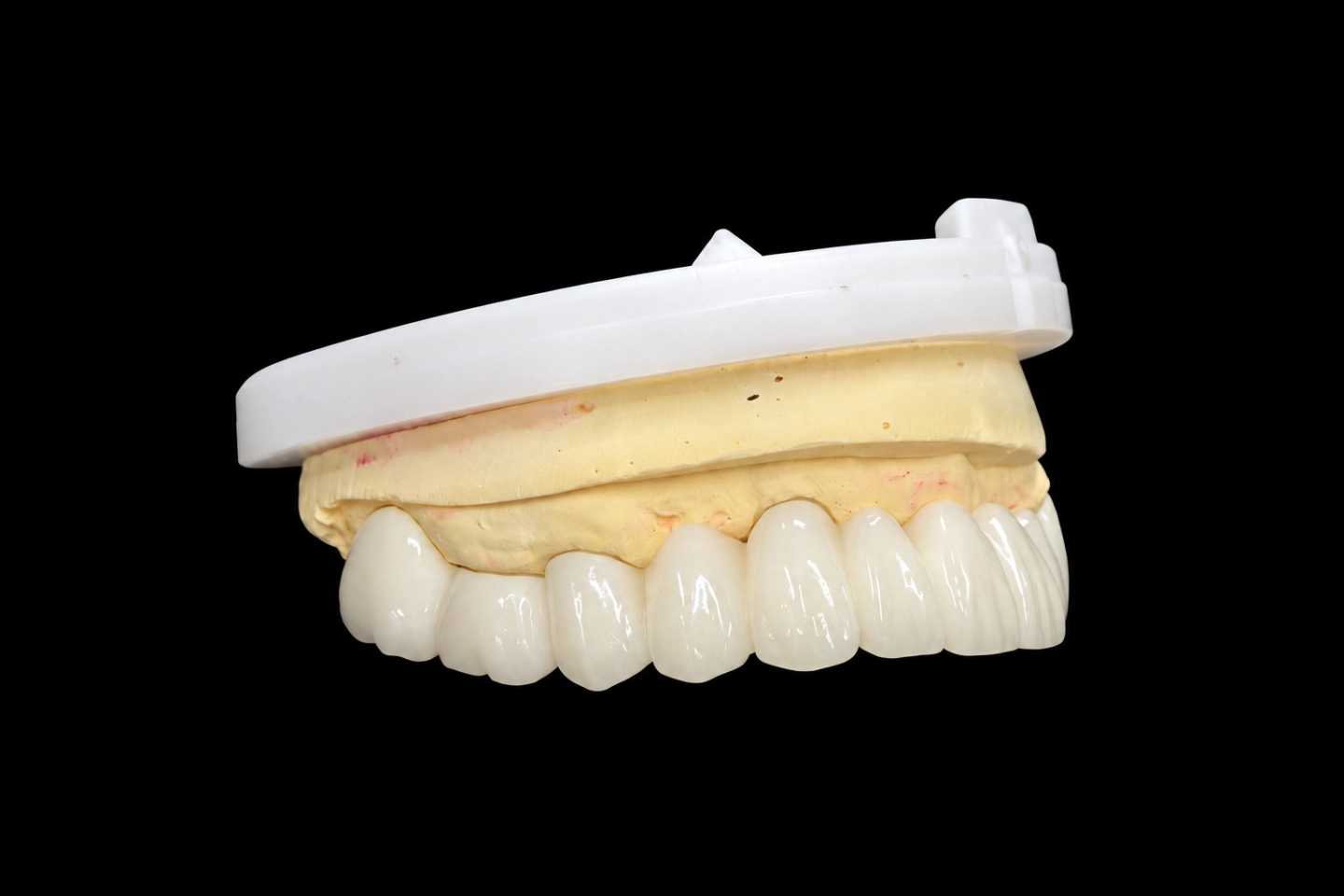
We also make complete dentures on a metal base.
What You Can Order
Three Ways to Take Delivery
A try-in is the easiest point to catch a framework that rocks or binds. Once teeth are processed onto it, the same problem is much harder to correct. For acrylic-only, flexible, and implant-retained options, see our removable denture lab.
Partials With Precision Attachments
Write the attachment system, type, and size on the Rx. We order the attachment parts to that specification, so the components match what’s in your office.
Complete Dentures With a Metal Base
A metal base is a specialized option, not the default for complete dentures. A case series on base metal denture bases describes where it earns its place: a base that keeps fracturing, cases where acrylic adapts poorly to the ridge, and patients troubled by changes in an acrylic base over time. A metal base stays rigid in thin section, and it conducts heat far better than acrylic.
The trade-off is maintenance. As the ridge resorbs, a metal base can’t be relined as freely as acrylic, so it suits a stable ridge better than one that’s still changing.
For a cobalt-chromium base, send final impressions, a wax-rim jaw relation record, a facebow transfer, the old denture if there is one, and shade and smile photos. We provide a wax try-in before the denture is processed. For a titanium palatal plate instead, see titanium dentures.
Choosing the Framework Material for a Metal Partial Denture
Cobalt-chromium is the conventional choice for a long-term metal partial denture. The other options exist for specific patients, and the right one depends on the arch, the abutments, and the patient’s history.
When metal isn’t the right answer, we also make PEEK frameworks and flexible partial dentures. Flexible partials hide clasps and suit single or multiple missing teeth. They’re a poor fit for heavy occlusal loads, large base coverage, or very deep undercuts, because they deform more and are harder to reline and repair.
Because we make all of these in our own labs, changing the material doesn’t mean changing labs. We never substitute one material for another without your consent, written or verbal.
Cast Partial Denture Design: Who Decides What
A cast partial denture fits only as well as the design decisions behind it, so we settle them before fabrication. You choose how much of the design you hand us:
Mark clasp types and positions, rests, the major connector, and the extent of the retention mesh on the Rx or the model.
Labs and clinics that design in-house can send an editable exocad or 3Shape file, and we fabricate and finish from it.
Our technicians survey the master model, set the path of insertion, measure undercuts, and propose a framework design for your approval.
Whichever route you choose, the design can only use the mouth preparation that’s actually there. Rest seats and guide planes have to be cut clinically. Tell us on the Rx which teeth you prepared, and we won’t assume preparations that weren’t made.
Design Approval Before Fabrication
Before the framework is made, we send the design as a screenshot or file by email or in your case group chat. It marks clasp types (such as I-bars and circumferential clasps), rest positions, connector dimensions, and mesh coverage. Complex framework partials always go through this step, and so do attachment cases, because the attachment position and the path of insertion have to agree before any metal is made. Any other case can on request. Approval adds 1–2 working days.
Clasp Placement Is Our Responsibility
Visible clasps are a frequent patient concern with metal partials. Where we design the framework, clasp placement is our call, and we treat it that way: a poorly placed clasp, or one that spoils the patient’s esthetics, is a lab-caused problem we remake or adjust free of charge.
Records and Files for a Metal Partial Denture Case
- Master impression or scan of the arch, with clear rest seats and abutment contours, plus the opposing arch.
- Bite record. Use a wax rim where too few teeth remain to hold a stable occlusion.
- Shade and tooth mold for finished partials, plus photos when anterior teeth are involved.
- Preliminary impression if you want us to make a custom tray for the final impression.
For digital cases, we accept scans from 3Shape TRIOS, Medit, iTero, CEREC, Shining3D, and Planmeca in open formats, and our digital dental laboratory page explains file preparation. A digital case usually comes back 1–2 days sooner, because no impression has to travel, and the scan stays on file for a remake or a future partial.
Speed and reusable data are the real gains. A digital route doesn’t by itself guarantee a better-fitting framework: a review of RPD framework fabrication methods found studies pointing in different directions on fit, and showed that finishing and polishing affect fit whichever method is used.
Inspection Before Your Metal Dentures Ship
Every framework is checked on the master model:
- Seating: smooth along the planned path, with no rocking
- Clasps: form and flexibility against the planned undercut
- Rests: fully seated on their rest seats
- Connectors: cross-sections and transitions as designed
- Defects: visual and magnified inspection for porosity, cracks, and distortion
- Occlusion: no interference with the opposing arch
Each alloy has its own tools, sandblasting, and polishing equipment, so cobalt-chromium and titanium never pick up each other’s particles. Our metal processing and heat-treatment equipment goes through installation, operational, and performance qualification, with periodic requalification. The acrylic is held by retention mesh, beads, or grooves on a sandblasted, degreased surface. Primers support that bond but don’t replace it.
Finished partials pass four checkpoints: the model, the wax setup, the tooth arrangement, and the processed denture. The final check covers centric and excursive contacts, base extension and thickness, clasp retention, and a polish that leaves the tissue surface and borders unaltered. Bubbles, porous areas, poor adaptation, or an inaccurate bite mean a remake before the case leaves us. Across all products and all four labs, our remake rate (cases clients send back) is 2–3%.
Turnaround, Quotes, and Warranty
In-lab time counts from the day we receive complete records. Each stage of a staged case is scheduled separately, and waiting for records or replies, including design approval, isn’t counted. Weekends and Chinese public holidays aren’t production days, and international shipping and customs clearance come on top. We’ll tell you which category your case falls into when we review it.
Rush service is free for clients who send 10 or more cases a month; we guarantee the ship date on rush cases, not the arrival date, because customs is outside our control.
Quotes are itemized to what you order, whether that’s a framework only, a staged case, or a finished partial, and you can confirm the full cost before production starts. Request our removable price list for current fees. You pay to send impressions or models to us. We pay to ship finished work back, remakes included.
Metal partial dentures carry a one-year warranty that covers the whole prosthesis, framework included. Besides clasp problems, lab-caused issues we fix free of charge include a partial that doesn’t seat, lifted borders, an inaccurate bite, and unsatisfactory acrylic color. Shade or material changes you request, and cases we flagged as having unclear records but made at your request, are charged.
Registrations and Material Documentation
Istar Digital Dental Lab is an FDA-registered establishment, Registration Number 3039441248, which you can verify in the FDA establishment registration database. Our device listings cover partial and complete dentures. For clinics in the EU, custom-made dentures follow the MDR custom-made device procedure, with a statement for each case. Our labs operate under an ISO 13485 quality management system.
On request, we include the brand, origin, batch number, and composition documentation for the alloy used in your case.
Why Clinics and Labs Send Us Their Metal Dentures
Istar Digital Dental Lab has made dental restorations since 2012, with four labs in Shenzhen and Huizhou, China, and about 460 staff. Removable work has its own department of about 55 people, and a separate quality control department of about 25 checks work across all four labs. The removable line handles about 4,000 cases a month in a normal season and about 6,500 at peak.
Nothing is outsourced. Design, framework fabrication, finishing, setup, and processing all happen in our own labs. You’re welcome to see the line on an on-site visit or a video tour of the factory.
Metal Denture FAQs
What should I send if a framework doesn't seat at try-in?
Send a new impression, scan, or model along with the framework. A seating problem has to be traced to its source, and a remake from the original records would only repeat it.
Can you copy the patient's existing partial?
Yes. Send an impression or scan that captures the existing partial and the neighboring teeth, plus a wax bite for the occlusion and vertical dimension. We keep what the patient has adapted to, such as tooth size and lip support, and correct bite or arrangement faults in the old prosthesis. If the Rx, photos, and old partial disagree, we’ll check with you before going ahead.
Can you repair a metal partial or add a tooth to it?
Yes, for the acrylic base and teeth. Send upper and lower models, the existing partial, and a wax bite. We repair with resin of the same type as the original, roughen and clean the old acrylic so the new resin bonds, keep processing temperatures low enough not to damage the denture, and strength-test each repair before it ships.
Titanium frameworks can also be laser-welded to add a clasp. For a broken cobalt-chromium framework, send photos first and we’ll tell you whether a repair or a new framework is the better option.
Can you ship finished cases directly to my client's office?
Yes. We ship to any address you give us, so a dental lab can have finished partials sent straight to the prescribing clinic. The sender address on the waybill can’t be changed.
What are your office hours, and how fast do you reply?
Customer service works 9:30 a.m. to 6:00 p.m. China time (UTC+8) and stays available until midnight for special or urgent cases. During working hours, technical questions usually get an answer within an hour. Outside them, the time difference can stretch that to 7–8 hours, but never more than 12.
Send Your First Metal Denture Case
The quickest way to judge a framework lab is one case on your own patient. Single trial cases are welcome, and ongoing partnerships work best with a regular flow of cases.
- Digital case: send your scan files with a completed Rx form.
- Impression case: follow the how-to-send guide. We can send you a prepared shipping waybill, or you can ship to our address and send us the tracking number.
- Not sure which framework fits the case? Send the records or photos and ask our technicians for a material and design recommendation before you commit.
Questions before your first case? Contact our removable team.